Waterlogged Soil, Root Hypoxia, and Bacterial Leaf Scorch on Red Oak Trees in Arlington, Texas. In Arlington, I was called out to inspect a mature Red Oak tree (Quercus shumardii) showing severe canopy wilt, premature leaf decline, and advanced root stress directly associated with chronic waterlogging and improper drainage conditions.
This property represents a textbook example of how poor drainage and oversaturated soils can create cascading physiological failure in hardwood trees across North Texas.
The homestead sits at the bottom of a slope within the neighborhood, causing stormwater runoff from multiple surrounding properties to collect directly in the front yard. During the inspection, I observed that a neighboring property had installed a retaining wall drainage system discharging directly toward the client’s landscape.
As I walked the property, the sod and soil profile throughout the front yard remained heavily saturated and soggy. The environmental conditions around the root zone were extremely concerning and showed clear evidence of long-term root hypoxia, basal decline, and secondary bacterial infection.
The Red Oak under inspection is now showing substantial canopy stress, severe foliage wilt, root decay, and bacterial leaf scorch symptoms that are directly associated with prolonged oversaturation of the root system.
This situation highlights the importance of proper drainage design, soil oxygenation, and early arboricultural intervention before irreversible decline occurs.
The Relationship Between Drainage and Tree Health
One of the most misunderstood aspects of tree health is the relationship between water and oxygen.
Many homeowners assume that more water always benefits trees. Scientifically, that is incorrect.
Tree roots require both:
- Water
- Oxygen
Roots respirate through oxygen exchange occurring within soil pore spaces.
According to ISA arboricultural research and Texas A&M AgriLife Extension, healthy soils contain a balance of:
- Mineral particles
- Organic matter
- Water
- Air-filled pore spaces
When soil becomes chronically oversaturated:
- Oxygen is displaced
- Carbon dioxide accumulates
- Root respiration declines
- Cellular metabolism slows
- Root tissue begins dying
This condition is called root-zone hypoxia.
What Is Root Hypoxia?
Root hypoxia occurs when oxygen availability in the soil becomes insufficient to support normal root respiration.
Roots are living tissue.
Just like humans require oxygen for cellular respiration, tree roots require oxygen to produce the energy necessary for:
- Nutrient uptake
- Water absorption
- Carbohydrate transport
- Root development
- Defense responses
When soils remain waterlogged for extended periods, oxygen diffusion decreases dramatically.
ISA literature explains that root respiration is essential for maintaining healthy root metabolism and vascular function. Without oxygen, roots cannot properly absorb nutrients or support canopy development.
Over time, chronic hypoxia leads to:
- Feeder root mortality
- Root decay
- Reduced carbohydrate movement
- Foliage wilt
- Canopy thinning
- Increased pathogen susceptibility
- Structural decline
This Red Oak in Arlington is displaying nearly all of these symptoms.
Field Observations During Inspection
During my inspection, several key indicators immediately pointed toward chronic oversaturation and root stress.
Moss Growth Around the Root Flare
One of the first things I observed was extensive moss colonization around the lower trunk and root flare.
The moss growth covered approximately 75% of the exposed root flare area.
Moss typically develops in environments with:
- Excessive moisture retention
- Limited sunlight penetration
- Poor airflow
- Chronically damp surfaces
This is important diagnostically because moss colonization often indicates a persistently wet microenvironment around the trunk base.
The excessive moisture around the bark and root collar creates ideal conditions for fungal and bacterial colonization.
The root flare should remain visible, dry, and breathable.
Instead, the base of this Red Oak remained chronically wet.
Basal Root Rot at the Main Stem
Closer inspection revealed basal decay approximately three inches above grade level on the primary stem tissue.
This type of basal trunk deterioration is commonly associated with:
- Chronic moisture exposure
- Bark saturation
- Root collar stress
- Oxygen deprivation
- Fungal colonization
Once bark tissue remains saturated for prolonged periods, the tree’s natural defense barriers begin breaking down.
Over time:
- Cambial tissue weakens
- Phloem transport declines
- Opportunistic decay organisms invade
- Structural integrity decreases
This is one of the dangerous long-term effects of improper drainage around hardwood trees.
Decaying Surface Roots and Waterlogging Indicators
I also observed protruding structural roots showing visible decay and deterioration.
Exposed roots often become vulnerable when:
- Soil erosion occurs
- Root tissue remains oversaturated
- Oxygen levels collapse
- Root bark begins deteriorating
This was another strong indicator that the root zone has remained waterlogged for an extended period of time.
According to Texas A&M Forest Service guidance, prolonged oversaturation can kill feeder roots within days or weeks depending on soil composition and oxygen availability.
Clay-heavy North Texas soils are especially problematic because they retain water and drain slowly.
Why Red Oaks Struggle in Oversaturated Soils
Red Oaks, including Shumard Red Oaks (Quercus shumardii), are highly vulnerable to chronic waterlogging conditions.
Although mature oaks can tolerate short periods of wet conditions, they are not adapted for prolonged root saturation.
When roots remain submerged or oxygen-starved:
- Aerobic respiration declines
- Root pathogens increase
- Nutrient uptake decreases
- Photosynthesis becomes impaired
- Carbohydrate reserves deplete
Eventually, the canopy begins showing visible symptoms of decline.
This tree has now progressed into secondary bacterial complications.
Bacterial Leaf Scorch – A Secondary Environmental Outcome
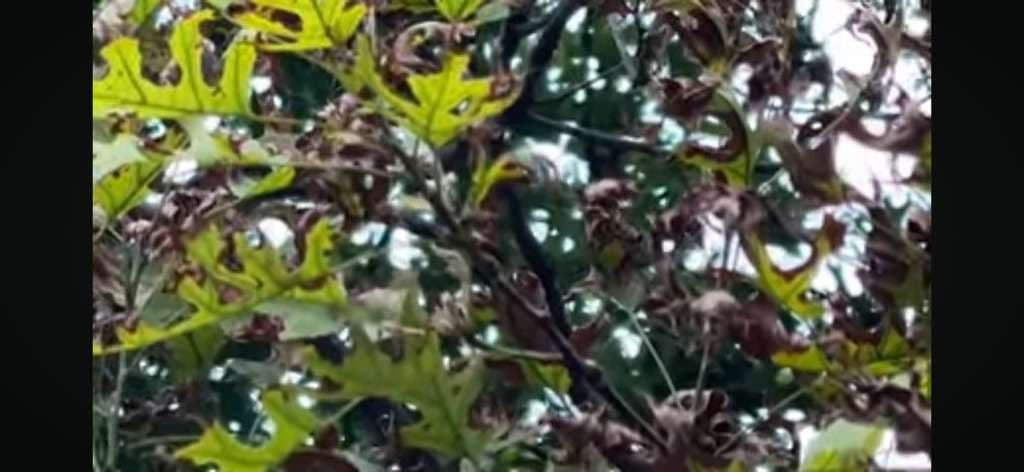
Approximately 75% of the canopy is now showing symptoms consistent with bacterial leaf scorch.
Bacterial leaf scorch is commonly associated with:
- Marginal leaf necrosis
- Foliage wilt
- Premature browning
- Leaf scorch patterns
- Early leaf drop
Texas A&M research notes that bacterial leaf scorch often becomes more severe when trees are already under environmental stress.
This is critically important.
The bacterial infection itself is not necessarily the original cause of decline.
The environmental stress came first.
The waterlogged root system created severe physiological dysfunction, weakening the tree’s ability to defend itself against secondary pathogens.
Premature Leaf Drop and Carbohydrate Depletion
One of the most concerning aspects of this case is the timing.
We are still in early May.
The tree is already showing:
- Severe wilt
- Necrotic foliage
- Premature leaf cast
- Extensive canopy stress
This creates a major physiological problem for the tree.
Leaves are responsible for photosynthesis.
Photosynthesis produces carbohydrates, which serve as the tree’s energy reserves.
When leaves are lost prematurely:
- Carbohydrate production declines
- Energy reserves become depleted
- Defense systems weaken
- Root regeneration slows
- Stress tolerance collapses
ISA research consistently emphasizes the importance of stored carbohydrates in tree survival and recovery.
If this Red Oak continues losing foliage before summer even begins, it may not have sufficient reserves to survive prolonged heat stress later in the season.
The Cascade of Decline
This property demonstrates a classic cascading environmental failure sequence.
Sequence of Failure
- Improper neighborhood drainage
- Water redirected into front landscape
- Chronic oversaturation develops
- Soil oxygen declines
- Root hypoxia occurs
- Root decay begins
- Nutrient uptake decreases
- Carbohydrate production declines
- Bacterial pathogens take hold
- Foliage wilts and becomes necrotic
- Premature leaf drop accelerates stress
- Potential mortality risk increases
This entire process originated from environmental conditions.
Importance of Correcting Drainage First
One of the biggest mistakes homeowners make is attempting to treat foliage symptoms without correcting the underlying environmental issue.
If drainage is not corrected:
- Root hypoxia will continue
- Root decay will worsen
- Oxygen deprivation will persist
- Disease pressure will increase
- Plant healthcare treatments become less effective
That is why the first recommendation in this report was correcting drainage and redirecting water flow away from the front yard.
Without environmental correction, the tree remains trapped in a chronic stress cycle.
Recommended Plant Healthcare Program
Because this tree is under severe stress, immediate plant healthcare intervention is recommended.
The primary objectives are:
- Reduce stress
- Improve root function
- Restore nutrient availability
- Support carbohydrate recovery
- Suppress bacterial pressure
- Improve canopy retention
Treatment Protocol
To restore vitality, encourage healthy foliage, and protect the landscape from stressors, the following materials will be used:
- Monopotassium Phosphate – boosts energy production and root metabolism
- Dried Molasses – carbon-rich microbial stimulant to enhance soil life
- Microbe Booster – restores biological balance in soil, supports root health
- Seaweed Carbon Extract – improves stress response, growth, and mineral uptake
- Propiconazole – systemic, broad-spectrum fungicide (preventative care)
- Bifenthrin – surface-contact insecticide for broad pest coverage
- Imidacloprid – systemic insecticide for long-term control of sap-feeding insects
- Micronutrient Complex – tailored blend of trace minerals to improve foliage quality and strengthen plant immunity
Additional recommendations include:
- Carbohydrate supplementation
- Root-zone oxygen improvement
- Drainage correction
- Water diversion strategies
- Long-term canopy monitoring
Why Soil Biology Matters
Healthy trees depend heavily on healthy microbial ecosystems.
Oversaturated soils often experience:
- Reduced microbial diversity
- Anaerobic conditions
- Reduced nutrient cycling
- Poor root-microbe interactions
TCIA plant healthcare principles emphasize restoring biological balance within the soil ecosystem to improve long-term tree vitality.
When microbial activity collapses:
- Nutrient availability decreases
- Root function declines
- Stress tolerance weakens
Restoring soil biology becomes essential during recovery.
Why Early Intervention Matters
This Red Oak may still have preservation potential if environmental corrections occur quickly.
However, delayed intervention greatly increases the likelihood of:
- Progressive canopy loss
- Root collapse
- Structural instability
- Secondary pathogen expansion
- Complete mortality
Early diagnosis is critical.
Final Thoughts
This Arlington property demonstrates how improper drainage can slowly destroy even large mature hardwood trees.
The Red Oak under inspection is not failing because it is weak by nature.
It is failing because the environment surrounding the root system has become chronically oversaturated and oxygen deprived.
The combination of:
- Root hypoxia
- Basal decay
- Waterlogging
- Root deterioration
- Bacterial leaf scorch
- Premature leaf loss
has created a severe physiological crisis within the tree.
The good news is that proper drainage correction combined with aggressive plant healthcare intervention may still provide an opportunity for recovery.
At Arborist USA, our goal is not simply to treat symptoms.
Our goal is to identify the environmental trigger, correct the stress condition, restore root function, and help preserve valuable mature canopy whenever possible using ISA, TCIA, and Texas A&M science-based arboriculture practices.
For general tree-care best practices, homeowners can also reference guidance from the Texas A&M Forest Service, https://tfsweb.tamu.edu/trees/, a trusted authority on Texas tree health.
Schedule a professional inspection. Early detection and scientific intervention are the difference between preservation and loss. If you’d like to speak to an arborist, please call us at 817-880-6130 or visit https://www.arboristusa.com/
Today we’re in Arlington discussing one of the most destructive environmental problems affecting hardwood trees across North Texas: chronic waterlogging and improper drainage around the root system.