Free for nonsubscribers
By Karl Sinclair
July 29, 2026, © Leeham News: Airbus reported on July 29 a reinforced commitment to hit targets of 870 aircraft deliveries, adjusted EBIT (earnings before interest and taxes) of €7.5 billion and free cash flow of around €4.5 billion for the full year of 2026.
After a disappointing first quarter, Airbus picked up the pace and hit 351 aircraft delivered for the first six months of the year (compared with 306 in the first half of 2025), including 44 A220s, 271 A320neo family aircraft, 10 A330s and 26 A350s.
“I’m pleased with the progress made by team Airbus and by the entire ecosystem. We are actually where we want it to be and that confirms our trajectory,” said Guillaume Faury, Airbus’ chief executive.
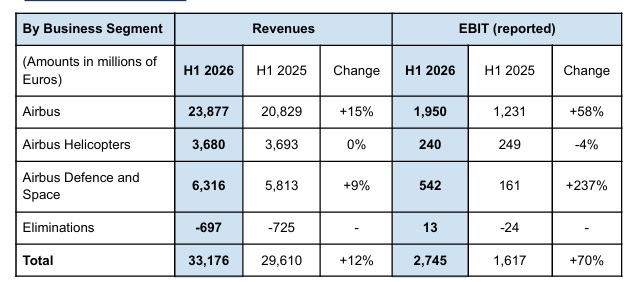
Company revenues were €33.2 billion with an adjusted EBIT of €2.7 billion in the April-June period. Free cash flow before financing was negative €1.2 billion, but is expected to improve throughout the year, and to hit full-year guidance.

Source: Airbus
With the exception of Airbus Helicopters, which posted relatively flat revenue and dipped slighting in adjusted EBIT (down 4%, year-over-year), Airbus commercial and Defense & Space showed marked improvements over the same period last year.
EBIT reported and adjusted were almost identical year over year, at €2.7 billion. (Adjusted EBIT is a measure which generally excludes material charges or profits not related to normalized production.)
Commercial catch up
Airbus delivered 237 aircraft during the second quarter, a record for the period, according to Faury.
He also reiterated that 870 deliveries (plus or minus 20 aircraft) would be considered a successful year. The previous high-water mark was 863 deliveries in 2019, so the company’s full year delivery totals have reached similar heights before.
Results on the order front were equally strong, doubling the backlog generated in the second quarter of 2025. The book-to-bill ratio was 2.3X.

Source: Airbus
From quarter-to-quarter, Airbus generated €15.4 billion in revenue, compared with revenue of €8.44 billion in the first quarter 2026, and adjusted EBIT of €1.9 billion (versus a paltry €81 million). It truly was a turnaround period for Airbus’ commercial division.
As of June 30, the total backlog stood at more than 9,200 aircraft, stretching production far into the next decade. 7,467 of those unfilled orders are for A320neo family aircraft, with approximately 75% of those consisting of the A321neo variant.
The A350 Freighter is on schedule to have its first flight later this year. Flight testing, certification and entry-into-service is all expected to occur in 2027, with a production ramp-up in 2028.
More broadly across commercial programs, panel issues (interiors), administrative delays (with China) and engine snarls (with Pratt & Whitney) have all largely be resolved.
“We have no gliders in the sense of aircraft not being delivered solely because of engines. So we are in a normalized situation,” Faury said in response to an analyst question about engine delays. “We’ll continue to get from Pratt & Whitney for 2026, 2027 and beyond, the number of engines that have been finally agreed and which are the current basis for the 2026 delivery guidance and consistent with the midterm targets.”
This is welcome news for the A220 program (sole supplier) and A320neo (dual supplier, along with the CFM LEAP), which rely on P&W’s geared turbofan (GTF) engines.
Production ramp up
After a dismal first quarter which was hampered by supplier snags—most notably the P&W GTF powered-metal coating saga, Airbus confirmed its targeted production timeline:
- A220 delivering 13 per month in 2028
- A320neo family delivering 70-75 per month by the end of 2027
- A330 delivering five aircraft per month in 2029
- A350 delivering 12 aircraft per month in 2028
The A320neo rate is expected to stabilize at 75 per month thereafter, before any changes.
For those keeping score, by 2028 Airbus projects to deliver 100 jets per month and a whopping 1,200 per year. The most any commercial OEM has ever handed over was just over 860 airframes.
By hitting those rates, one could see the logic behind the lofty projections of €12-€13 of adjusted EBIT for the full year of 2029, with over 80% of that coming from commercial. Such is the need for Airbus aircraft.
“We continue to target rate 12 [on the A350] in 2028,” Faury said. “Our target ramp-up rates for our widebodies have not changed, [with a] strong market demand that could support even more.”
Faury declined to comment on plans to open another final assembly line, which would be needed to move beyond 12 A350s per month.
The final piece of the puzzle were details regarding the integration of the Airbus portion of Spirit Aerosystems for the A220 and A350 programs.
Accordingly, nothing out of the ordinary has occurred and the process is progressing as expected, with €123 million spent that relates to the integration of former Spirit AeroSystems work packages.
Airbus Helicopters
The company’s rotorcraft division was fairly quiet during the quarter, with a slight uptick in deliveries, flat revenue and a small drop in EBIT.

Source: Airbus
Providing modest margins of 6.5% on revenue of €3.7 billion, there were some positive signs for the division.
“Margins are increasing in the second half of the year relative to the first,” said chief financial officer Thomas Toepfer.
Contributing only 11% of total company revenue, it is important that the division does not venture into red-ink territory and remains profitable.
Defense and Space Growth
Given the current geopolitical climate, the division is on an upward trajectory and projects to remain so for the foreseeable future.
Second-quarter order intake almost doubled over the same period of last year. Revenue grew 9% and EBIT jumped 237% year over year.
With two large conflicts and a bump in NATO (and European) defense spending, the division stands to
increase its share of the Airbus revenue pie—which stands at 19% of €33.2 billion.
However, Toepfer was guarded in his comments about the rest of the year. “We are planning to
increase R&D, but that has not fully materialized yet,” he said. “Same is true for headcount.”
Surely, these investments are made with future contracts and revenues in mind, which is good news for the division moving forward.
Round up
When compared to the first quarter, Airbus is certainly pleased with the results of the second quarter and resulting first half of the year.
Concerning liquidity matters, the company has ample resources and will not be strapped for cash anytime soon, holding €23.4 billion in total gross cash.

Source: Airbus
As previously reported by LNA, the company recently announced a €5 billion share buyback plan over the next three years. As long as Airbus does not go overboard with the program, it should be able to weather the reduction in cash.
The April-June period represented a much-needed rebound quarter overall for Airbus, with increased delivery tempos set to arrive in the third and fourth quarters.
LNA‘s second-quarter earnings coverage continues on July 30 with MTU and Rolls-Royce.
Related