Free for nonsubscribers
By Howard Hardee
August 7, 2026 © Leeham News: The commercial aerospace sector could be roughly a decade away from achieving high-rate production of major composite aerostructures.
Airbus and Boeing are exploring how to produce larger composite structures without curing them in autoclaves. Current infrastructure is time-intensive and expensive to operate, limiting today’s aircraft production rates and presenting complex challenges for the future of airliner manufacturing.
The airframer duopoly is interested in out-of-autoclave production processes because the next generation of single-aisle jets could be produced at rates of more than 100 aircraft per month. If the wings or fuselages of those aircraft are made mostly with composite materials, the companies would need massive autoclave capacity to support adequate production rates. Both companies are researching how to work around that constraint.
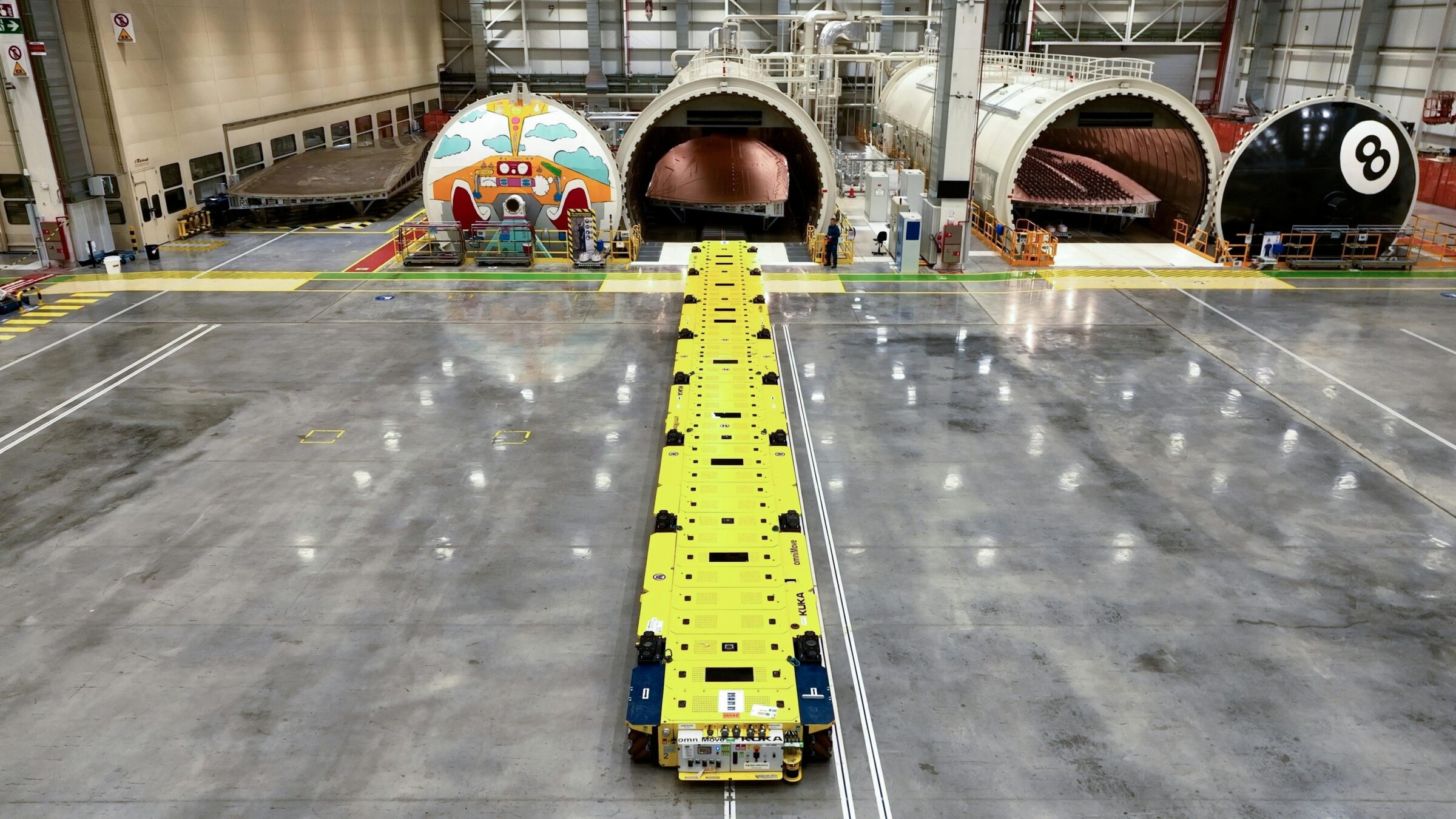
Taking the time to cure the fuselage barrels and wings of the Airbus A350 and Boeing 787 in giant autoclaves—chambers that apply intense pressure and heat to cure composite structures, such as wing top covers—makes sense because those programs deliver jets at much lower rates than the single-aisle A320neo and 737 Max families. (However, supporting greater widebody aircraft production rates is another compelling reason to develop out-of-autoclave processes.)
LNA aerospace analyst Bjorn Fehrm explains in Part 3 of his series on Airbus’ next clean-sheet aircraft that, in A350 production, a full cycle of curing wing top covers takes 24 hours, and only two covers fit inside the chamber at a time. Operating two production sites equipped with autoclaves—in Stade, Germany and Illescas, Spain—Airbus produces about 10 A350 airframes per month. It is attempting to increase that rate to a dozen A350s monthly.

Wing top covers curing in autoclaves at Airbus’ facility in Illescas, Spain. Photo credit: Airbus
Turning to Airbus’ eventual A320neo replacement, Ferhm’s analysis indicates the company would need as many as 20 autoclaves running continuously to support all-composite narrowbody production rates of around 100 aircraft per month. That is a capital-intensive proposition that the company would likely prefer to avoid.
Decade or decades?
After learning from the first-generation all-composite A350 and 787 Dreamliner programs, both of which have had production pains as well as engineering triumphs, Airbus and Boeing are looking at how to apply advanced material technology to their next narrowbody lineups. How to produce composite wing structures at scale is a central question for Airbus’ Wing of Tomorrow research program.
Experts with both companies believe that out-of-autoclave manufacturing of large aerostructures is feasible, though that could be up a decade or more away—depending on who you ask.
LNA recently posed the question to Sue Partridge, head of Airbus’ Wing of Tomorrow program, as well as Lisa Orme, vice president of Boeing, leads a team of 650 engineers and scientists working on advanced material design and production. Their responses shed light on how the companies are approaching the problem.
Going bigger
Orme notes that Boeing’s out-of-autoclave processes are currently limited to producing smaller parts and fuselage components, such as door surrounds. Resin transfer molding, for example, promises faster cycles, but the tooling is expensive and has thus far proven best suited to smaller parts and medium production rates.
Boeing would surely like to find a way to go bigger. Notably, the still-not-certified 777X, the long-awaited twin-aisle twinjet, features a mostly composite wing with signature folding wingtips. Wing structures for the 777-9 are produced in an autoclave.

The 777-9’s wing is a big part of what makes the forthcoming widebody more efficient than the 777 Classic. Photo credit: Boeing
“I think there’s a future. I really do,” Orme said. “We continue to innovate. We’re not done with figuring out where we are without an autoclave, and we do think there’s an art of the possible there. We’re researching that. In terms of timing, that’s really hard to say, but it is in the future.”
Asked by LNA whether she believes that future is decades away, Orme said the timelines is like “it is probably singular,” or around a decade. Boeing has lately taken the stance that its next narrowbody will enter service late in the 2030s, or even as late as 2040.
Both Airbus and Boeing are researching very long and thin wing designs with higher aspect ratios for future aircraft platforms. While more efficient, such wings would be difficult to manufacture and would require advanced material designs.
Wing of Tomorrow
Airbus has been exploring how to leverage next-generation wing technologies to improve the fuel efficiency and reduce the operating costs of its next clean-sheet jets for more than a decade, Partridge said. That has included building three full-scale wing demonstrators and the recent launch of a flight-test program that will extend the wings of an Airbus A321neo.
“The first objective is about the performance of the wing; the wing will bring as much efficiency improvement to the next-generation single-aisle as the engine,” she told LNA at Farnborough International Airshow. “It’s a really important lever for efficiency, and the way you improve efficiency is through the wingspan.
“By increasing the span of the wing, you reduce drag, reduce fuel burn, reduce CO2….So that’s the first objective of the technologies we’re developing: longer, lighter, slender wings.”
Another objective of the Wing of Tomorrow program is establishing how to produce new wing designs at high rates. Specifically, the major structural components of Airbus’ next narrowbody wing will be made from composites, while the leading and trailing edges will be aluminum. Many other smaller components on and inside the wing will be metallic, as well.
High rate, high quality
Partridge is “very optimistic” that Airbus will solve how to produce wing structures with composite materials at high rates, without sacrificing safety and quality.
“We made the decision to invest in a really good technology program, developing these technologies at scale in as close-to-as-possible to a real industrial environment,” she said. “We need them to be mature. We need to have demonstrated that we can repeatedly make components, and we need to demonstrate the reliability of our industrial system. That’s what Wing of Tomorrow is doing.”

The successor to the A320neo family will likely feature much longer wings, with folding wingtips to allow for access to airport gates. Photo credit: David McIntosh/AIN
To those ends, Airbus is exploring out-of-autoclave pathways, such as “dry fiber” technologies. Those processes place non-resin-impregnated fiber in a mold, then infuse the material with resin after layup. That is different from “prepreg” systems in which fibers are impregnated with resin before placement into a mold.
Airbus is also exploring how to increase production rates of its current prepreg systems—fiber pre-impregnated with resin—which it has honed over years of A350 production.
“The key there would be taking all the knowledge we have and then making sure that we can replicate it again at a high rate,” Patridge said. “We’ve been exploring different out-of-autoclave options, different dry fiber options. Those decisions are to come in the future.”
Partridge maintains that solving the puzzle will take less than 10 years, with the company targeting the launch of its A320neo family successor in 2030 and service entry later next decade.
In and out of autoclave
Boeing is also researching how to produce lower-cost and higher-rate composite structures using autoclaves, as well. Lane Ballard, Boeing’s chief technology officer, said the airframer is “placing bets in both camps.”
“There is a lot of work to be done even in-autoclave with tooling…and material systems,” he said. “We’re working on both ends, just like the wind turbine and car industry is working on it, too. How do you come up with a way to produce first-pass quality at a very rapid rate without having these huge amounts of infrastructure that composites currently drive today?
“So, we’re doing a lot of research on both sides, but, definitely, out-of-autoclave is one of those areas we’re interested in solving.”
Boeing has already demonstrated the concept on a smaller scale, including in developing the MQ-28A Ghost Bat, a stealthy autonomous aircraft designed by Boeing Australia for the Royal Australian Air Force. That aircraft’s assembly includes the largest resin-fused panel ever built by Boeing, in a process completed outside of an autoclave.
Scaling those techniques and developing repeatable production systems is an immense challenge facing the aerospace industry, from smaller air taxi start-ups to the global airframer duopoly.
“We develop new materials from a systems point of view,” Orme said. “The materials that we develop, we need to ensure that they can be subsequently coated and tested and machined and assembled and produced at rate.”
Related