Have you ever passed by an interesting residential building in New York City and wanted to know more about its history? In this series, Brick Underground teams up with Tom Miller, creator of Daytonian in Manhattan, a blog about Manhattan buildings and other historic architecture. Each week, we run an excerpt from the Daytonian’s archives with a link to the full article.
In 1881, developer John W. Stevens acquired a 50-foot-wide parcel on West 87th Street between Ninth and Tenth avenues. (The avenues would be renamed Columbus and Amsterdam in 1890.) Rather than erect two commodious townhouses, Stevens directed his architect, William Howe, to squeeze three onto the plot. Each would be just over 16-feet-wide and would cost $8,000.
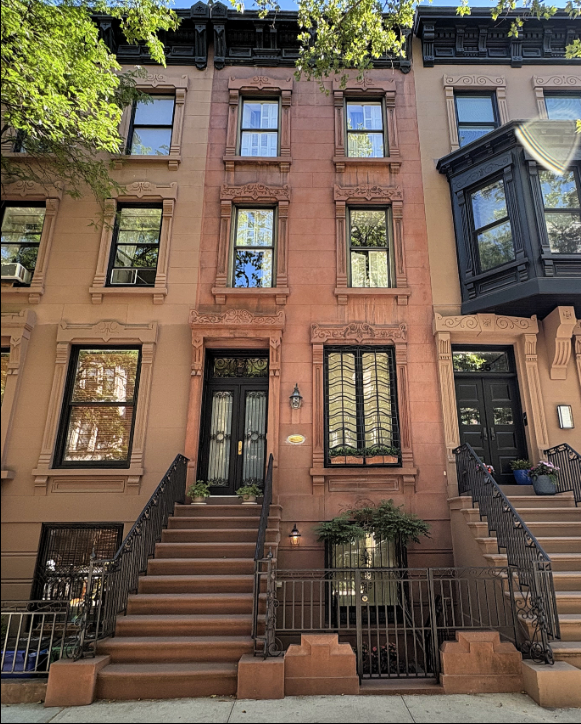
Like its identical siblings, 127 West 87th St. was faced in brownstone and designed in the neo-Grec style. Howe compensated for the home’s lack of width with exuberant decoration. The windows were flanked by paneled piers upon bracketed sills. Mimicking the doorway, the lintels were decorated with foliate designs. A complex pressed metal cornice of corbels, brackets and a paneled fascia completed the design.
The house was initially owned by Albert M. Crouter and his family. They sold it at auction on September 29, 1891. Norman and Sarah E. Macdonald placed the winning bid of $16,900.
Norman Macdonald was one of hundreds of New Yorkers who were frustrated with the city’s lack of street signs. Some residents or businessmen erected their own signs, and stone blocks on the second floor of some corner buildings were carved with the avenue and street names. In January 1901, Macdonald signed a petition that urging the city to address the issue.
Later that year, the Guggenheim Ordinance was enacted, instituting a system of standardized street signs.
The Macdonalds sold 127 West 87th St. in April 1905 and the property changed hands several times in quick succession purchased in March 1909 by Dr. Herman B. Sheffield, a pediatrician and prolific author. His expertise was often sought by attorneys as an expert witness, such as the lunacy hearing of 22-year-old Walter Lathrop Hanson.
Hanson’s mother, Mrs. Aimes Hanson, had multiple homes and was the niece of Leland Stanford, the founder of Leland Stanford University. Hanson’s father died in January 1912, and Walter was receiving payments from a $50,000 trust, administered by his mother. The New York Times reported that on November 5th, 1912, Walter married Henriette Keutti “without his mother’s consent.” She cut him off from his “allowance” and sought to have him committed as a lunatic.
In the courtroom on March 5th, 1913, Dr. Herman B. Sheffield “pronounced him mentally competent,” reported The New York Times. The article added, “On the side of young Hanson sat his young bride, who returned stare for stare of her mother-in-law.”
No. 127 West 87th Street is remarkably intact after more than 140 years. Even the interior shutters survive on the upper floors.
For more on the property and the people that lived here, check out the full article.