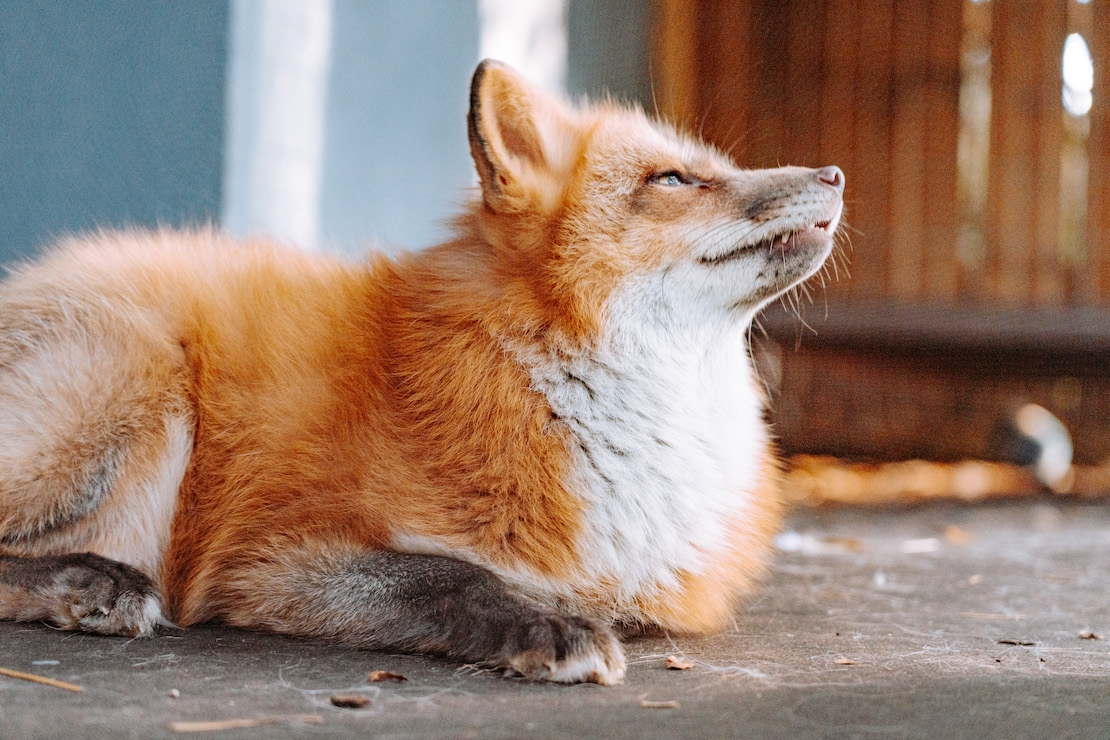
Nicole Navarro is describing a recent rambunctious moment between two of her rescue foxes, Coral and Reef. Upon being offered a gifted box of treats, the latter pushed the former out of the way and sprinted off with the box, screaming with glee while spilling the treats. “He lost his mind over the box. Everything new has to be his,” Navarro says, laughing. “[Foxes] are curious. They’re so smart. I have lots of toys, dog puzzles for them. I have snuffle mats [that encourage foraging] because they get bored very quickly.” On fur farms, the stress and boredom of confinement typically results in self-destructive behaviors. That’s why, Navarro explains, foxes saved from farms can sometimes have no teeth. “They’ve ground them down trying to chew their way out of the wire.”
Coral and Jasper, along with Reef, Louie, Libby and Penny, are the residents of Pawsitive Beginnings, the fox rescue that Navarro started two years ago in Key Largo, Florida. They all come from generations of captive-bred foxes, born into the fur trade. It’s a trade that in 2016 was seeing a record number of sales. But much has changed since then.
Once a hallmark of opulence, fur is being cast out of luxury fashion. Today, all but seven of the twenty five biggest houses have bans on wild animal fur. Armani and HUGO BOSS led the way in 2016. Gucci went fur-free the following year (declaring fur “passé”) as did the world’s biggest luxury online retailer Net-a-Porter. In the years that followed, one by one, storied brands and retailers would cut ties with the fur industry. In 2018, Burberry and Versace dropped fur. Givenchy debuted its switch to faux with its Fall 2018 collection, and Prada has not used animals’ fur since 2020.
By early 2021, department store Bloomingdales (once home to a fur salon) was faux. Nordstrom is in the final stages of phasing out real fur. Luxury retailers Neiman Marcus and Bergdorf Goodman pledged to end fur sales by early 2023. French conglomerate Kering, home to labels like Saint Lauren and Balenciaga, announced that by Fall 2022 its entire fleet would be fur-free. And in January, within two weeks of each other, Moncler and Dolce & Gabbana finally announced they were leaving fur behind. Media is jumping on board too — as of February, Elle no longer features fur.
These victories and the groundswell of public support for the anti-fur movement haven’t come easy. It has taken many years of concerted pressure from grassroots activists and animal protection organizations to get closer to the goal of abolishing the fur trade and ending animal suffering.
But who are the fur-bearing animals at the center of the movement, and how much do we know about them?

Reef

Coral
The fur trade’s long shadow
Globally, foxes are the second most farmed animal after mink, with approximately 4 million killed each year. Yet, there is the illusion that fox farming doesn’t exist in the U.S., partly because the USDA doesn’t publish statistics on fox farms. According to animal rights site finalnail.com, however, there are around 50 fox fur farms in the U.S. “A lot of these places fly under the radar,” says Navarro. Located in rural isolated areas primarily in the Midwest, they operate in obscurity. This leads to an inadequate understanding of captive-bred foxes, even among activists.
“[Liberation] can be a sensitive topic, especially in the animal rights community,” Navarro says. Over the years, a typical action meant activists releasing foxes into nearby forests. But release, in reality, very rarely leads to survival. Farmed foxes lack hunting skills, having relied on being fed by humans. They make easy prey, because of their insufficient camouflage. “Four out of the six of my foxes aren’t even natural colors. Their colors don’t occur in the wild,” Navarro explains. While they yearn for freedom, captive foxes are maladapted to fend for themselves. In this short video of a fur farm in Finland, the world’s biggest producer of fox pelts, a worker mocks a fox that escaped from their cage but didn’t flee the property.
With their chances of making it in the wild next to zero, ensuring freedom for farmed foxes is a complex task that requires preparation and diplomacy (the foxes at Pawsitive Beginnings were given sanctuary by Navarro in close collaboration with intermediary rescuer Mikayla Raines). If protocol isn’t followed and a USDA license is not obtained, a fox faces seizure by authorities and euthanization.
Had they not been rescued, Navarro’s six foxes would have been killed for being ‘undesirable.’ Jasper’s “defect” was his inability to continue breeding. At 6, he is the oldest fox at the sanctuary and had spent the longest on a fur farm. He has severe arthritis from his four years of standing on wire. Because fur-bearing animals like foxes are excluded from the Animal Welfare Act, the Humane Methods of Slaughter Act, and the Dog and Cat Fur Protection Act, they survive on the absolute bare minimum long enough for pelting season each December. A typical wire cage is about 5 sq feet.
The environment, too, pays a price. While the fur industry’s last line of defense has long been that “real fur” is more sustainable than faux, raising animals for slaughter requires intensive use of water, land, energy and feed — as with all forms of animal agriculture. According to a study conducted by European research firm CE Deft, “The climate change impact of 1 kg fur is at least 5 times higher than the highest scoring textile (wool) – due to the production of animal feed and manure emissions.” The effect of fur’s lifespan on the environment, from tanning to lengthy cold storage, is three to 10 times higher than that of fake fur, the report concluded. And despite misleading claims that “fur is biodegradable,” a report commissioned by the fur industry itself found that as little as 6.6 % of a fur garment is biodegradable. And this lowest percentage is attributed to died fox fur.

A fur farm cage, now used as an educational tool at Walking Wild Rescue, run by Molly Schulz who is a close friend of Navarro’s

Navarro holds up a poster of her rescued foxes at a protest last fall in front of Dolce & Gabbana’s store in NYC
All of the foxes came to Navarro in bad shape with “awful bloodwork.” Jasper has broken teeth from chewing on wire, as well as neurological issues. “Sometimes, his brain and his mouth don’t communicate. So if he has trouble eating, I’ll have to hand feed him,” Navarro explains of her “special needs boy.” But he has improved a great deal since arriving at Pawsitive Beginnings in 2020. “He gets all the care I can give here. We have a vet that comes once a month to give him laser acupuncture and massages.”
Like Jasper, Penny became useless once she stopped breeding. And Libby was set to die because she was born without a tail — congenital deformities are common in captive-bred animals. Louie had imperfect fur and disfigured ears. He suffered from untreated hematoma on the farm. “His ears exploded with infection,” explains Navarro. “Obviously, [there is no] vet care on a fur farm. [So] once they healed on their own, the cartilage [became] deformed.” Because he’s prone to ear infections due to lack of airflow, he now receives regular deep ear cleaning under sedation as part of his treatment.
“They like routine. They’re very, very sensitive creatures.”
The youngest, Reef and Coral, were saved last spring because their mothers rejected them. Reef was pulled off the fur farm at just 10 days old. His mother had started to eat him, which is a known occurrence in the dysfunctional conditions of a fur farm. “As soon as I had him, he crawled into my hoodie and slept right there on the ride back,” recalls Navarro, who drove for 30 hours from Mikayla Raines’ rescue in Minnesota back home to Key Largo. Coral, who was three months old when she arrived at the sanctuary, is “a true survivor. Her mother ate everyone except her and her sister.”
As the foxes inquisitively wander in and out of frame during our Zoom call, it quickly becomes apparent that they are not only loved but understood. “They like routine,” says Navarro. “They’re very, very sensitive creatures. If I rearrange a part of their enclosure, and they don’t like it, it’s all sorts of drama.” She explains that sometimes facilities that take in foxes will adopt them out within a short period. “I decided when I started this that any foxes I ever got would be with me permanently. I know how sensitive they are after seeing it first hand. So, yeah, these guys aren’t going anywhere.”
Making rescue a reality
Navarro’s love for animals is lifelong. She grew up on a Western Pennsylvania farm surrounded by horses, with a naturalist and wildlife rehabilitator as a next-door neighbor. “At a very early age I learned to respect wildlife, [respect] the boundaries that come with rehabilitating wildlife, and then honor [wildlife] where they belong, in the wild.”
She was 36 and working at The Hemingway Home in Key West when Hurricane Irma hit in 2017. Navarro was among a small group of employees that decided to stay behind to care for the property’s 60 cats. “I literally went through a category 4 hurricane, not having power and living very rugged for 14 days,” she recalls. “You just find the strength to get through it.” After the storm, she was once again called to be of service by volunteering at the Monroe County Sheriff’s Animal Farm, a local refuge for abused and confiscated animals. It was there that she had her first encounter with foxes, when two rescues from a fur farm ended up in her care. “I became obsessed with these two foxes,” she says of Lana and Rocky. “I just fell in love with the species.”
Foxes are naturally wary of human contact, so “when a fox decides that you’re alright, it’s like winning the lottery.” Navarro spent several months earning Lana and Rocky’s trust, which became a pivotal experience for the would-be activist. “Once they decided that I was gonna be their person, I guess it just really lit a fire [in me].”
“I had obviously known about fur being used in fashion,” she continues. “But once you see the animal that’s been exploited, something just happens.” While interactions with cows and pigs are common for many activists, having one with a fur-bearing animal is unlikely. Colombian artist Praxis, whose anti-fur street art can often be seen around New York City, had been an animal rights activist for close to a decade before he met his first fox at Pawsitive Beginnings last fall. “It was important to get closer to whom I am fighting for,” he explains. “[The visit] inspired me and reassured me that we need to keep fighting to dismantle the fur industry and all animal exploitation. Meeting these survivors [was] proof that a second chance at life is possible for beings like them, and us.”
Navarro’s opportunity to provide that second chance came as the world went into Covid lockdown in the spring of 2020. On the night that she lost her job, she received a call: “‘There’s 20 foxes that can be saved. Are you ready to take two?’ I was like,‘Yep!’ Don’t know how we’re gonna do it, but we’re gonna do it.” By then, she had built up a loyal Facebook following, and was able to fund the rescue with their donations. One early April morning Navarro drove to Ohio on nearly-empty highways, and a few days later she was back in Key Largo with Libby and Louie, her first rescues.

Jasper (foreground) and Reef
Speaking up
Fox sanctuaries in the United States are a rarity. And the U.S. is at a greater disadvantage than Europe in passing a country-wide fur ban because of its state legislature. 16 European nations have now outlawed fur farming. Germany has had a de facto ban since 2017 when production ceased because of strict new animal welfare regulations. In February, Belgium’s last fur farm shut its doors. Norway’s fur ban goes into effect in 2025, and Italy is fully dismantling its fur farming by this summer. UK’s last fur farm shut down in 2003, and now an effort to ban on fur sales and imports is underway.
And while the U.S. is lagging behind, there are significant developments nonetheless. In February, a bill that included an amendment to ban mink farming in the US (known as the America COMPETES Act, the successor to Bill H.R. 4310) passed the House of Representatives and is next headed to the Senate. In 2019, California became the first state in the nation to ban the sale and manufacturing of fur, which goes into full effect in 2023. (Exceptions to this bill include cowhide, sheepskin and goatskin. It should be noted that the aforementioned fur-free luxury designers still produce shearling products.) The precursors to the state-wide California ban were bans in San Francisco, Berkley and Los Angeles.
New York City, home to the world’s biggest Fashion Week, might very well be next. In March, 2019, a bill to ban fur sales was proposed by then City Council speaker Corey Johnson. Although it stalled with the previous administration, today there is renewed hope because half of the city council is now composed of new members. Allie Feldman, the founder of political advocacy organization Voters For Animal Rights, encourages activists to continue putting pressure on designers who still use fur. She explains that each new ban shows the city council “that this is the direction the garment industry is moving in.” She also wants to see activists reach out to their city council members. “Let them know that banning the sale of fur is something that’s really important to [you]. So that way, when legislation is introduced, [council members] will have a sense of where their constituents are.”
Not long after she founded her sanctuary, Navarro met New York area activists and quickly became involved in the anti-fur movement. “We know activism works, ‘cause so many [designers] dropped [fur],” she says. “I’m so grateful to be connected to [the activist] community. It’s like I have two sides. I’m the calm fox mom in Key Largo, making their dinner every night, tucking them into bed. And then when I get to come to New York [to protest], I put all of this feeling out there for the world.”
At protests and in everyday life, Navarro is compelled to educate others about “these six amazing animals that I have the honor to care for.” She makes it clear, however, that while she considers herself the rescued foxes’ representative in public spaces, she is not their “voice.”
“I speak for the victims that can’t be heard because they’re trapped,” she explains of foxes that are on still fur farms. “These guys,” she says of her rescues, “have their own big, loud, screechy, screamy voice. I don’t have to say anything. I could just post a picture. They’re their own best advocates.” Speaking of voices, although foxes belong to the same Canidae family as dogs, how they sound is drastically different. “[Foxes] have a couple dozen different vocalizations. Especially when they find their voice, once they’ve been rescued,” Navarro explains. “When they’re playing with each other, they’ll scream and laugh. If there’s something out in the yard I can’t see, Libby ‘sassy pants’ does warning barks which literally sound like a woman screaming. It’s very funny.”

Nicole Navarro with foxes Jasper and Penny. The Florida Wildlife Commission requires wiring on all sides of animal enclosures, and is a condition of Navarro’s Class III. Pawsitive Beginnings has 700 sq feet of space, equipped with multiple levels for play and rest.
“Not one of them is like the other.”
In many ways, Pawsitive Beginnings offers a glimpse into what a fur-free future could look like for all survivors. Navarro’s goal is two-fold: to help bring about the end of fur farming through advocacy; and to ensure that the animals in her care are living their fullest lives. Foxes, whether wild or captive-bred, have complex physical and emotional needs. And when those needs are met, like they are at the Navarro’s sanctuary, self-expression emerges.
“Not one of them is like the other, they [each] have their own individual tonalities,” she says Navarro of her foxes. The youngsters, Coral and Reef, are at ease around people, having only spent a short time on a fur farm. “[They] got to actually have a childhood [at the sanctuary]. They don’t know anything besides love.” Coral is the sweetheart and the attention-seeker. “She knows [when] I’m talking about her and to her. When friends [visit], she is always front and center, way up high on her platform in the corner. So people can just walk up and pet her and worship her.”
Reef, who’s been with Navarro since he was five weeks old, is “definitely a mama’s boy. He seeks me out if he needs a quick cuddle just to know that I’m here, and then he runs off.” Lately, he’s been going through a “bad boy teenage phase,” which doesn’t always bode well with the other foxes. “He just walks around and annoys everybody.” He’s also a local celebrity of sorts, with his own column “Reef’s Report” in Keys Weekly.
The adults, on the other hand, are more distant “because of the trauma [of the fur trade].” Libby and Louie are the “sassy” ones — not interested in human interaction, but fond of each other. “When no one’s looking, these two will play. They will go at it. They’ll be running back and forth. They toss toys around,” says Navarro. “[Libby’s] favorite thing in the entire world are squeaky balls. But she’ll go through two squeaky balls a day, so I have to have an endless supply. And there’s only a certain kind that she likes.”
Penny is “doesn’t like chaos” and Jasper “just chills out and wants to enjoy life.” When Navarro made the inside of her house accessible to him and Penny, “it [was] like Jasper had been waiting for that moment his whole life. He [climbed] onto my bed, plopped down and slept there the whole [night].” Not long after, Penny made herself at home too. “It’s so funny—in the middle of the night I’ll wake up, and she’s sitting right next to me, just staring at me. She wants to be really near me, but she doesn’t want me to touch her.” In her role as caregiver, Navarro is keenly aware of respecting her foxes’ boundaries.
“[Nicole] is truly, honestly invested in giving these foxes a new life,” tells me New York-based animal rights activist Rachel Ejsmont, at whose invitation Nicole gave a speech at the annual Anti-Fur March in New York City in 2021. “Who else [is] in a better position to talk about these foxes? She left us in tears. But like she said [during her speech], you can’t ‘sanctuary away’ this problem. You have to shut down the fur farms. That’s the bottom line and that’s the goal.”
Shutting down the fur industry
One of the pathways to ending fur farming is getting designers and retailers to go fur-free. Ejsmont is a veteran of the anti-fur movement, and has organized countless actions across the city. She recalls disrupting a Michael Kors event at the Metropolitan Museum of Art in 2017. “We took over the stage. And three months later, he dropped fur. And that was huge because he was always quintessential [in using] fur.” Originally from Montreal, Canada (once a fur trade hub), Ejsmont formed an aversion to fur as a child while helping out at her parents’ dinner parties. “I would be at the door greeting the guests, and they would plop their fur coats in my arms,” she says. “It felt like the fur was alive. I would ask my mom, ‘What is this? This looks like my cat.’ I was disgusted and mortified.”
Three decades into being an activist, Ejsmont is certain that unity is integral to abolishing the fur trade. One example, she explains, would be weeks of simultaneous protests or disruptions in different cities, resulting in pressure on brands and retailers so immense that it would be “impossible for them not to cave in at some point.”
Ejsmont has seen the efficacy of pressure campaigns first-hand. When she and fellow activists started targeting Saks Fifth Avenue in 2016 for selling fur, “we were relentless. We were doing banner drops with messages on them on the second floor, taking over the whole store.” After years of activists being “constantly on [Saks’] backs,” the retailer declared in 2021 that within the next two years their stores would be cleared of fur. “I think that sent a message to the fashion world [that] fur has been done to death. It’s over. It’s time to move on.”
“Grassroots activism, PETA [doing] a lot of work behind the scenes—every component is important,” she stresses. “Every piece and every action that everyone puts in when they work cohesively, gets victories.” And the victories have been hard-fought. When long-time outlier Dolce & Gabbana announced in January that they were going fur free, “I had tears of joy,” says Ejsmont. “We had been targeting them for quite some time. I couldn’t contain myself thinking about all the animals that will be spared the suffering [on fur farms].”

Coral (left) and Penny
The road ahead
Pawsitive Beginnings is a stark contrast to the misery of fur farms. “I’ve definitely found myself overwhelmed thinking about the ones who aren’t saved. And that’s just foxes,” says Navarro, who’s been vegan since the beginning of 2021. She has occasionally caught flack on social media for feeding her foxes a carnivorous diet. “Foxes cannot be vegan. No way around it,” she explains. It’s a reminder that fighting for animals’ well-being includes respecting their innate nature.
And the fight continues. Next up is LVMH, the world’s largest luxury group. Its top-earning brands Louis Vuitton, Fendi and Dior rely heavily on fur, citing consumer demand and tradition. (Fendi began as a furrier in 1925 and calls fur a “precious material”). CEO Bernard Arnault, the world’s third richest man, has vowed to continue using fur even as the fashion industry moves away from it. “I don’t know how much more money [Arnault] could possibly make off the suffering of these animals,” says Ejsemont.
“There’s so much to be done but we’re chipping away at the block.”
She understands that LVMH will be “a very tough, tough target.” But tenacity is nothing new to the anti-fur movement. “We’re going to use everything we have in our arsenal. Disruptions, protests, going after bankers, investors,” Ejsemont says of the LVMH campaign, which she expects to be long-term. “We’re going to hit secondary targets. [We’ll] get everyone on board and just keep adding the pressure non-stop—phone blasts, emails, petitions. There’s so much to be done but we’re chipping away at the block.”
There’s hope on the horizon. LVMH is in the beginning stages of developing a lab-grown fur made with keratin, with proof of concept expected in two years. One of its houses, Stella McCartney, is working with Koba—a new material being heralded as the most sustainable fur alternative to date. Neiman Marcus has already halved its fur inventory and is on track to substantially increase its revenue from ethical products by 2025.
In Finland, the fur industry has taken a definitive hit as a result of various bans worldwide and unfavorable public opinion. “Production and the amount of farms are decreasing. There has been a big shift,” says Mai Kivelä, a long-time animal rights activist and vegan who was elected to Finnish Parliament in 2019. Her journey is documented in the new film Just Animals. “The most promising action line is that the [fur] ban could come through the European Union,” she explains. “There is very active campaigning from non-profits, as well as in political spheres. Two years ago, our biggest party (the Social Democratic Party) took the stance that they are also against fur farming.”
Back at Pawsitive Beginnings, Nicole Navarro dreams of having more acreage for her six foxes and those she’s yet to provide permanent sanctuary for. “I have a vision of what the property would look like—all of [the foxes’] individual enclosures leading into one huge play yard that I could let them out into in turn,” she says. “I always wonder what they would do if they just had a chance to run, like really, really run. I would cry if I saw them run.”