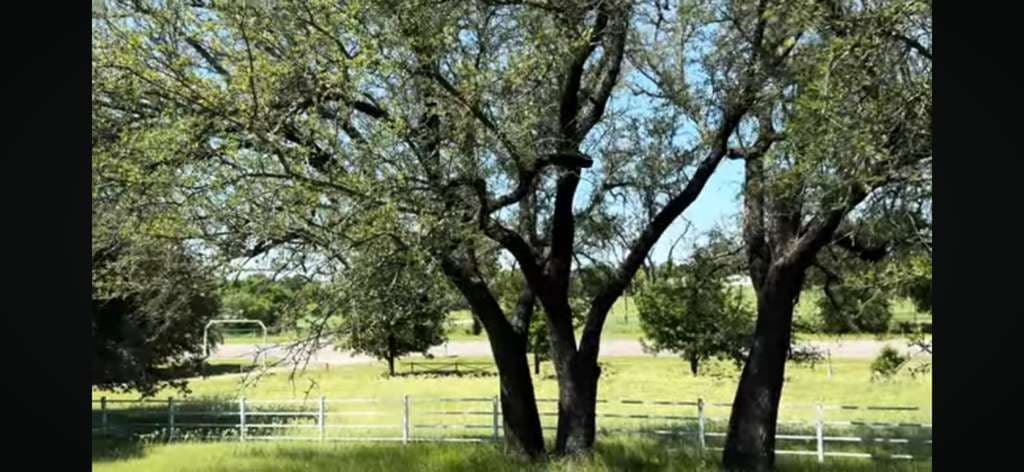
Oak wilt continues to be one of the most destructive tree diseases affecting Texas landscapes, and in Stephenville, Texas, we are currently seeing severe outbreaks across large properties containing mature and historic live oaks.
At Arborist USA, we recently diagnosed at least seven separate oak specimens exhibiting symptoms consistent with oak wilt. The most important concern on this property is not only the trees already infected, but the large population of historic Southern Live Oaks (Quercus virginiana) that are currently asymptomatic and still salvageable.
These trees are irreplaceable.
Many of the oaks on this property are mature legacy trees that have likely stood for generations. Once oak wilt spreads through a grove of live oaks, the loss can become catastrophic if intervention is delayed.
Our focus on this property is aggressive prevention and containment using:
- Low-volume macro infusions with Alamo propiconazole
- Integrated Pest Management (IPM)
- Monitoring of root-graft transmission zones
- Protection of healthy trees before symptoms appear
This is exactly where proper diagnosis and early intervention matter most.
⸻
What Is Oak Wilt?
Oak wilt is a vascular fungal disease caused by:
Bretziella fagacearum
This pathogen attacks the vascular system of oak trees, specifically the xylem tissue responsible for transporting water throughout the canopy.
Once the fungus enters the vascular system:
- water transport becomes restricted
- leaves wilt and scorch
- carbohydrate movement declines
- canopy collapse begins
Texas A&M Forest Service identifies oak wilt as one of the most serious tree diseases in Texas because of how aggressively it spreads through connected root systems and insect vectors.
⸻
Why Stephenville, Texas Is a Major Oak Wilt Hotspot
Stephenville and the surrounding Erath County area have become major oak wilt zones because of:
- dense live oak populations
- connected root systems
- rolling slopes
- drainage patterns
- environmental stress
- historic oak groves
On this specific property, the hardest-hit area appears to be located along the front slope.
The evidence strongly suggests that trees located higher on the slope became infected first, and over time the disease spread downhill through:
- interconnected feeder roots
- shared root grafts
- moisture movement through saturated soil
This is one of the most dangerous aspects of oak wilt in live oak systems.
⸻
How Oak Wilt Spreads Through Feeder Root Grafts
Southern Live Oaks naturally form interconnected root systems underground.
These root grafts allow trees to:
- share moisture
- share nutrients
- stabilize groups of trees together
Unfortunately, they also allow:
👉 oak wilt to move directly from tree to tree underground.
According to Texas A&M AgriLife and the Texas A&M Forest Service, underground root-graft transmission is the dominant spread mechanism in live oak populations.
The fungus moves through:
- feeder roots
- interconnected vascular tissue
- shared moisture pathways
Once the pathogen enters a connected grove, the disease can spread approximately:
75–100 feet per year
This is exactly why multiple trees on this property are now affected.
⸻
Why the Slope Made the Problem Worse
The topography of this Stephenville property plays a major role in disease movement.
The trees located at the top of the slope likely became infected first.
As rainfall and irrigation water moved downhill:
- soil moisture carried fungal pressure
- root zones remained saturated
- root graft activity increased
- stress conditions worsened
The lower trees then became vulnerable through:
- shared feeder roots
- environmental stress
- increased moisture retention
This is why the lower section of the property is now the hardest-hit area.
⸻
Why Historic Live Oaks Must Be Protected Immediately
The most important trees on this property are the large historic Southern Live Oaks that currently do not show visible symptoms.
These trees are:
- mature
- irreplaceable
- historically valuable
- structurally significant
The goal is no longer simply treating symptomatic trees.
The goal is:
Preventative Protection
Once a live oak begins showing severe symptoms:
- vascular plugging has already occurred
- root transmission may already be active
- decline accelerates quickly
That is why asymptomatic trees must be protected before infection becomes established.
⸻
Low-Volume Macro Infusions With Alamo Propiconazole
The primary treatment on this property is:
Low-Volume Macro Infusion
This treatment uses:
Alamo Propiconazole
Alamo is the standard fungicide recommended by:
- Texas A&M
- ISA
- TCIA
- Texas Forest Service
The process involves:
- drilling small ports around the root flare
- installing infusion tees
- allowing the tree to absorb the fungicide directly into the vascular system
The fungicide then moves systemically through the xylem.
This treatment helps:
- suppress fungal colonization
- slow vascular plugging
- protect healthy tissue
- reduce infection potential
⸻
Why Low-Volume Infusion Is Superior
Traditional large-volume injections can:
- increase wound size
- create unnecessary stress
- prolong uptake time
Low-volume macro infusions:
- reduce wounding
- improve uptake efficiency
- minimize stress
- deliver cleaner vascular support
This is currently one of the best technologies available for oak wilt prevention.
⸻
Why IPM Is Critical for Oak Wilt Prevention
One of the biggest mistakes homeowners make is focusing only on the fungus.
But according to Texas A&M:
Sap-Feeding Beetles Are Major Vectors
These beetles:
- feed on fungal mats
- carry spores
- move between fresh wounds
When they land on:
- storm wounds
- pruning cuts
- damaged bark
they can introduce oak wilt into healthy trees.
This is why our treatment plan includes:
Integrated Pest Management (IPM)
The goal of IPM is to:
- reduce beetle pressure
- suppress insect activity
- minimize vector transmission
Without proper pest management:
👉 reinfection risk remains high
⸻
Why Environmental Stress Makes Oak Wilt Worse
Environmental stress dramatically increases oak wilt susceptibility.
Trees under stress from:
- drought
- oversaturation
- compaction
- construction
- nutrient imbalance
become weaker internally.
Once carbohydrate reserves decline:
- immunity drops
- vascular response weakens
- fungal progression accelerates
This is why preserving vigor is critical.
⸻
Supporting Tree Vigor During Treatment
Along with Alamo infusions and IPM, healthy trees should also receive:
- micronutrients
- carbohydrate support
- soil management
- root-zone care
The purpose is to:
- improve photosynthesis
- rebuild carbohydrate reserves
- support canopy density
- maintain root vigor
Healthy trees are far more capable of resisting disease pressure.
⸻
Why Early Diagnosis Matters
One of the biggest problems with oak wilt is delayed response.
Many homeowners wait until:
- leaves are falling
- branches are dead
- canopy collapse is visible
At that stage:
👉 the disease has often already spread underground.
This is why annual evaluations by ISA Certified Arborists are critical in high-risk areas like Stephenville.
⸻
Texas A&M, ISA, and TCIA Recommendations
The current recommendations supported by:
- Texas A&M Forest Service
- ISA
- TCIA
focus heavily on:
- preventative macro infusions
- proper pruning timing
- vector control
- root-graft awareness
- rapid intervention
Fungicides alone are not enough.
The entire environment surrounding the tree population must be managed correctly.
⸻
Final Thoughts
This Stephenville property is a perfect example of how devastating oak wilt can become once it establishes itself inside a live oak grove.
The disease appears to have spread:
- from upper slope trees
- downhill through feeder root grafts
- into multiple connected live oaks
At least seven trees are already showing symptoms.
Now the focus shifts to:
- preserving healthy historic trees
- protecting asymptomatic live oaks
- reducing vector pressure
- slowing underground spread
Through:
- low-volume macro infusions
- Alamo propiconazole
- IPM programs
- long-term monitoring
these historic live oaks have the best opportunity for survival.
At Arborist USA, our focus is not just treating symptoms.
Our focus is preserving legacy trees before it is too late.
For general tree-care best practices, homeowners can also reference guidance from the Texas A&M Forest Service, https://tfsweb.tamu.edu/trees/, a trusted authority on Texas tree health.
Schedule a professional inspection. Early detection and scientific intervention are the difference between preservation and loss. If you’d like to speak to an arborist, please call us at 817-880-6130 or visit https://www.arboristusa.com/
Today in Stephenville, Texas, we’re addressing oak wilt, a highly destructive tree disease affecting Southern Live Oaks (Quercus virginiana). We’ve identified at least seven units showing symptoms. Our priority is to protect healthy trees before the disease spreads, as oak wilt can spread aggressively through interconnected root systems once established.