Not all innovations are created equal in the rapidly evolving technological landscape.
Some technologies cause ripples, while others trigger tsunamis of change across economic and social structures.
Understanding the hierarchy of technology adoption isn’t merely an academic exercise; it’s a crucial lens through which we can anticipate how technologies will reshape industries, markets, and society itself.
The Technology Adoption Hierarchy framework illuminates why technologies born in different contexts, with different shapes and characteristics, exert dramatically different economic impacts.
From fleeting product iterations to generational transformations, this hierarchy helps explain why some technologies fade quickly while others fundamentally alter human civilization.
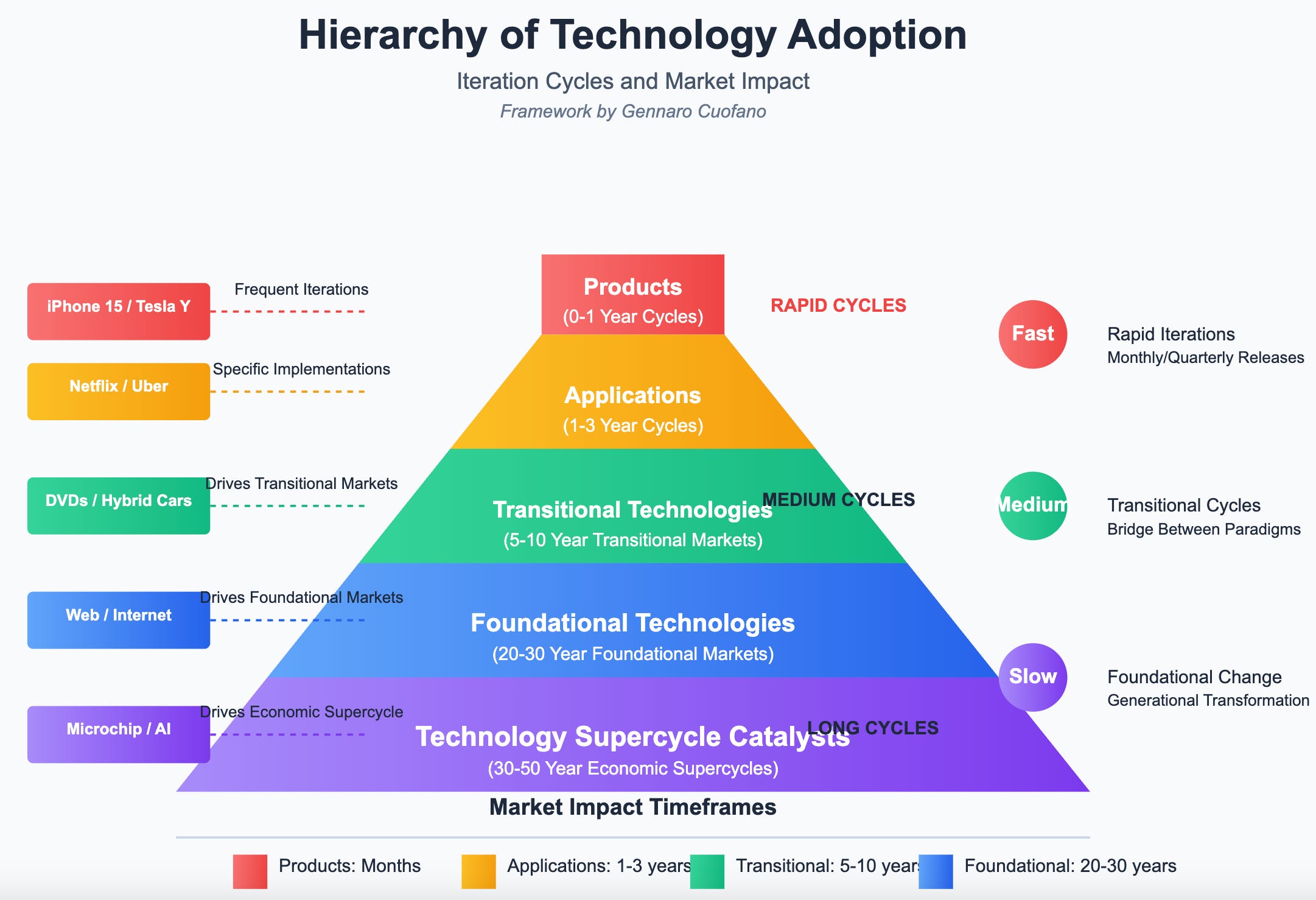
Products are the most visible but least structurally significant technological manifestations at the peak of our hierarchy pyramid.
These include specific implementations like the iPhone 15 or Tesla Model Y that iterate rapidly through monthly or quarterly release cycles.
Products represent the tactical deployment of technology, characterized by:
-
Frequent iterations and updates
-
Direct consumer visibility and brand recognition
-
Short market lifecycles (typically measured in months)
-
Incremental improvements rather than paradigm shifts
While products capture headlines and consumer attention, their economic impact remains relatively contained. They represent the deployment of deeper technological capabilities rather than fundamentally new approaches.
Applications represent specific implementations of technology paradigms.
These include platforms like Netflix and Uber that apply underlying technological capabilities to specific use cases and market needs.
Applications feature:
-
Medium-term development cycles (1-3 years)
-
Specific implementations of broader technological approaches
-
Business model innovations that leverage underlying technology
-
Market-specific adaptations of more universal capabilities
Applications demonstrate how technological capabilities can be deployed to create specific market value.
While more durable than individual products, they remain dependent on the underlying technological frameworks they leverage.
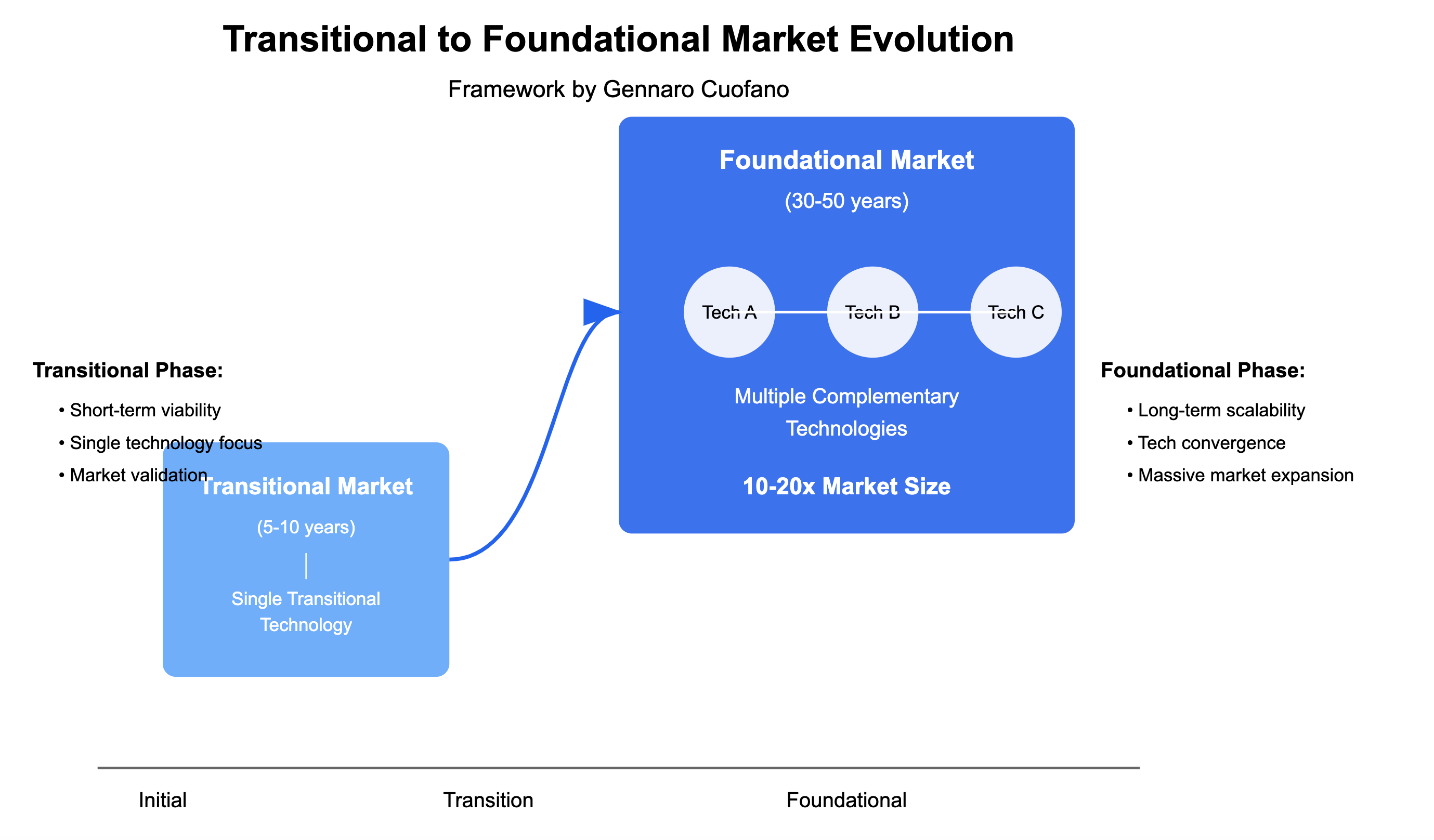
Transitional technologies serve as crucial bridges between technological paradigms.
Examples like DVDs and hybrid vehicles create temporary but essential markets that help society migrate from one technological foundation to another.
These technologies are characterized by:
-
Medium-length market cycles (5-10 years)
-
Bridging function between technological paradigms
-
Leveraging aspects of both legacy and emerging approaches
-
Creating necessary stepping stones for consumer adoption
Technology theorists often undervalue transitional technologies but serve a critical economic function.
They create viable commercial paths that allow businesses to maintain revenue streams while society adjusts to more fundamental shifts.
Netflix’s initial DVD-by-mail service exemplifies this bridge function, maintaining the familiar physical media paradigm while introducing digital discovery, setting the stage for eventual streaming dominance.

Foundational technologies establish long-term platforms upon which entire ecosystems of innovation can flourish.
The Web/Internet represents a perfect example, a foundational technology that created stable, multi-decade markets and enabled countless downstream innovations.
Key characteristics include:
-
Long development and adoption cycles (20-30 years)
-
Creation of durable market infrastructures
-
Enabling of numerous dependent technologies and applications
-
Significant shifts in how value is created and distributed
Foundational technologies drive generational transformations in business models and market structures.
They create stable, long-term foundations upon which entrepreneurs can confidently build, knowing the underlying technological base will remain relevant for decades.
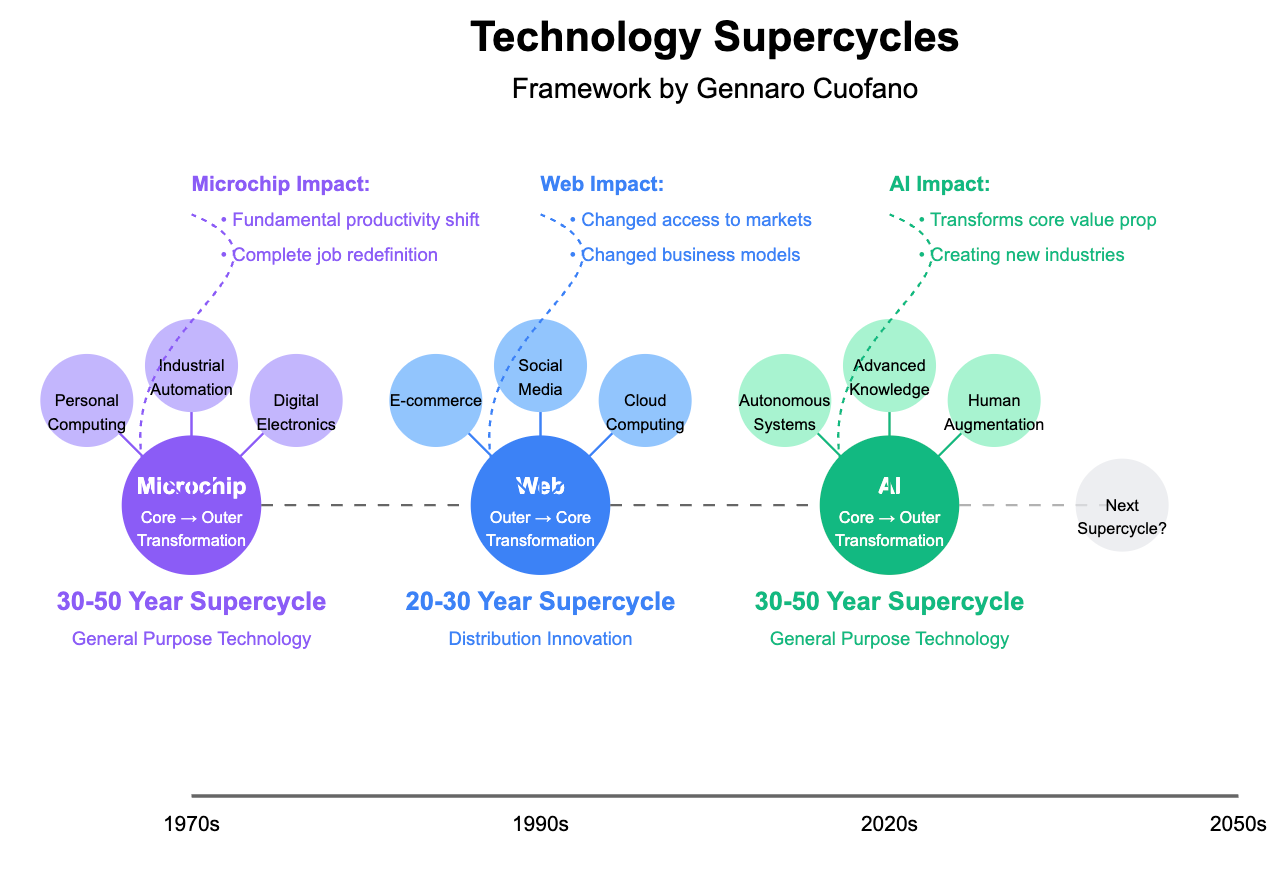
Technology Supercycle Catalysts lie at the base of our hierarchy, the most profound but least immediately visible level.
These rare technological revolutions, like the microchip and artificial intelligence, don’t merely create new markets—they fundamentally reshape the entire economic landscape.
Technology Supercycle Catalysts feature:
-
Multi-generational impact timeframes (30-50 years)
-
Ability to trigger economic supercycles with broad societal implications
-
Transformation of productivity across virtually all sectors
-
Redefinition of work, value creation, and economic organization
Unlike other technology levels, Supercycle Catalysts can initiate economic supercycles, extended periods of structural transformation that reshape how entire economies function.
The microchip didn’t just create new products or even new industries; it transformed productivity and possibility across virtually every sector of the economy for multiple generations.
The stratification of technologies into this hierarchy reveals crucial insights about how technological change interacts with economic systems:
Each level operates at a fundamentally different velocity. Products iterate rapidly, while foundational technologies evolve slowly but with far greater magnitude.
This creates a multi-speed technology ecosystem where different layers evolve according to different timelines.
This multi-speed reality explains why technological forecasting often fails.
Observers confuse movement at one level (like rapid product iterations) with momentum at deeper levels, leading to overhyped predictions of immediate transformation and underappreciation of truly fundamental shifts.
The deeper a technology sits in the hierarchy, the more profound its economic impact.
While an individual product might generate billions in revenue, a Supercycle Catalyst can generate trillions in economic value across decades and multiple industries.
The economic multiplier of technologies increases exponentially as we move down the pyramid.
The internet (a foundational technology) enabled many trillions in market value creation, while the microchip (a supercycle catalyst) enabled hundreds of economic values across generations.
Different hierarchy levels demand fundamentally different investment approaches:
-
Products require rapid iteration and market timing sensitivity
-
Applications need medium-term user experience optimization
-
Transitional technologies benefit from understanding migration pathways
-
Foundational technologies require patient capital with decade-long horizons
-
Supercycle catalysts demand generational investment perspectives
Misaligned investment horizons lead to market failures.
Value destruction occurs when quarterly-focused capital attempts to fuel foundational technology development or when patient capital overinvests in ephemeral products.
The most consequential aspect of this hierarchy is the distinction between Technology Supercycle Catalysts, the rare innovations with the unique ability to trigger economic supercycles.
An economic supercycle represents a 30-50 year period where:
-
Productivity fundamentally increases across most sectors
-
New industries emerge while others become obsolete
-
Labor markets undergo structural reorganization
-
Wealth creation patterns shift dramatically
-
Societal institutions evolve to accommodate new economic realities
Only technology supercycle catalysts can initiate these profound economic transformations. In modern history, we’ve experienced three major technology-driven economic supercycles:
-
The Industrial Revolution (steam engine as catalyst)
-
The Electrical Revolution (electrical grid as catalyst)
-
The Digital Revolution (microchip as catalyst)
We appear to be entering a fourth, the Intelligence Revolution, with AI as the catalyst.
Each of these catalysts shares key characteristics:
-
Universal applicability across virtually all economic sectors
-
Ability to transform both production and consumption patterns
-
Creation of numerous complementary innovations
-
Fundamental productivity improvements that compound over decades
Understanding the technology hierarchy enables better strategic planning:
-
Differentiated investment timeframes: Match capital deployment to the appropriate hierarchy level
-
Portfolio construction: Build balanced technology portfolios across multiple hierarchy levels
-
Transitional opportunity identification: Recognize lucrative bridging opportunities between paradigms
-
Supercycle positioning: Align long-term strategy with emerging supercycle catalysts
The hierarchy provides a framework for technology investment:
-
Appropriate return timelines: Set realistic expectations for returns based on hierarchy position
-
Category-specific metrics: Apply different evaluation metrics to different hierarchy levels
-
Valuation methodologies: Recognize that technologies at different levels require different valuation approaches
-
Supercycle exposure: Ensure portfolios maintain appropriate exposure to emerging supercycle catalysts
Policy frameworks should recognize the different needs of technologies at different hierarchy levels:
-
Tiered regulatory approaches: Apply different regulatory frameworks to different hierarchy levels
-
Infrastructure support: Focus public investment on foundational technologies and supercycle catalysts
-
Education alignment: Develop skills pipelines aligned with emerging supercycle needs
-
Transition management: Develop policies to manage economic dislocations during supercycle transitions
The hierarchy of technology adoption illuminates why technologies born in different contexts, with various shapes, exert dramatically different economic impacts.
A technology’s position within this hierarchy largely determines its economic influence, from the ephemeral but visible product iterations at the top to the profound but often initially underestimated supercycle catalysts at the base.
While product innovations capture headlines and consumer imagination, the deeper layers, particularly the rare supercycle catalysts, truly reshape economic landscapes.
Understanding this hierarchy allows us to anticipate better how emerging technologies will reshape markets, industries, and society.
As we navigate the emerging AI revolution, potentially the fourth major technology supercycle of modern history, this framework provides crucial context for business leaders, investors, policymakers, and citizens.
By recognizing where technologies sit within this hierarchy, we can better prepare for the multispeed technological future unfolding before us, with its dramatically different impact profiles and timeframes at each level.
The shape of technology within this hierarchy isn’t merely an academic classification; it’s the primary determinant of its ultimate economic and societal impact.
Not all technologies are created equal, and understanding these fundamental differences is essential for navigating our increasingly technology-driven future.
Not all innovations are equal; technologies vary dramatically in how deeply they reshape the economy and society. The Technology Adoption Hierarchy helps explain these differences across five levels, from fast-moving products to civilization-shifting supercycle catalysts.
-
Level 1 – Products (0–1 Year Cycles)
-
Short lifecycle, highly visible (e.g., iPhone 15, Tesla Model Y)
-
Rapid iterations, minimal structural impact
-
-
Level 2 – Applications (1–3 Year Cycles)
-
Leverage existing tech for specific market use (e.g., Uber, Netflix)
-
More durable than products, still dependent on deeper layers
-
-
Level 3 – Transitional Technologies (5–10 Year Cycles)
-
Bridge legacy and emerging technologies (e.g., DVDs, hybrid vehicles)
-
Enable smoother societal and business adaptation
-
-
Level 4 – Foundational Technologies (20–30 Year Cycles)
-
Provide long-term infrastructure (e.g., the Internet)
-
Enable vast ecosystems of innovation and new business models
-
-
Level 5 – Technology Supercycle Catalysts (30–50 Year Cycles)
-
Trigger major economic transformations (e.g., microchip, AI)
-
Reshape productivity, labor, and institutions across generations
-
-
Different Velocity Zones:
Each level evolves at a different speed. Fast product cycles can mask slow-moving but deeper changes, leading to misjudged forecasts. -
Economic Impact Correlates with Depth:
The lower in the hierarchy, the larger and more enduring the economic impact. Products may earn billions, but supercycle catalysts enable trillions. -
Investment Time Horizons Must Align:
Investment strategies must match each level’s cycle. Short-term capital mismatched to long-term technologies leads to failure. -
Supercycle Catalysts Drive Structural Change:
These rare innovations launch economic supercycles. Historical examples include:-
Steam engine (Industrial Revolution)
-
Electricity (Electrical Revolution)
-
Microchip (Digital Revolution)
-
Artificial Intelligence (Emerging Intelligence Revolution)
-
-
Business Leaders:
Align strategy and capital deployment with the appropriate hierarchy level. Identify bridging (transitional) opportunities and position for supercycle catalysts. -
Investors:
Use the hierarchy to set return timelines, apply tailored metrics, and diversify exposure to deeper, more impactful technologies. -
Policymakers:
Create tiered regulatory frameworks, fund foundational technologies, align education with emerging needs, and manage transition shocks.
A technology’s position in the hierarchy determines its economic and societal impact. Recognizing this is essential for navigating the future, especially as we enter the potential fourth major supercycle, the Intelligence Revolution driven by AI.
With massive ♥️ Gennaro Cuofano, The Business Engineer
This is part of an Enterprise AI series to tackle many of the day-to-day challenges you might face as a professional, executive, founder, or investor in the current AI landscape.