December 2025 will mark the 24th anniversary since the last ever flight operated by the one-time great American icon of commercial aviation, TWA, or Trans World Airlines, to give the carrier its full name. Having held a dominant position on routes across the Atlantic for decades, the airline became synonymous with transatlantic glamour and the epitome of long-haul travel by air.
However, despite its enviable position as the leading carrier between the US, the UK, and Europe, no accolade, award, or title could render the company immune from a series of internal disputes, financial issues, and worst of all, a fatal accident involving one of its Boeing 747s which killed all 230 passengers and crew onboard. The fallout from these events would eventually combine, leading to the bankruptcy of one of the airline industry’s most prominent and iconic players, which would ultimately lead to its demise and the selling of its remaining assets to a fellow US airline.
In this article, AeroTime examines the tumultuous and troubled history of TWA – from its humble beginnings flying mail flights on behalf of the US Postal Service to its dramatic fall from grace and eventual closure in 2001. Truly a rollercoaster of a story that still is referred to nowadays as a case study of how not to run an airline.
TWA – some context
TWA did not originally stand for Trans World Airlines. The letters TWA were originally an acronym for Transcontinental & Western Air, an early airline that flew passengers and air mail across the continental US, becoming one of the first carriers to do so.
During its seven decades of flying, TWA became one of the largest carriers operating in the US, operating a sizable fleet of jet aircraft to a host of domestic and international destinations across North America, Europe, the Caribbean, and the Middle East.
At its height between 1967 and 1970, the carrier would become the world’s largest airline in terms of passengers carried annually, behind Aeroflot and fellow US carrier United. The airline operated a huge number of aircraft types during its existence, including almost 400 individual jet aircraft. The company became an early pioneer of the jet age, utilizing Boeing 707s, 747s, and Convair 880s on many of its international routes.
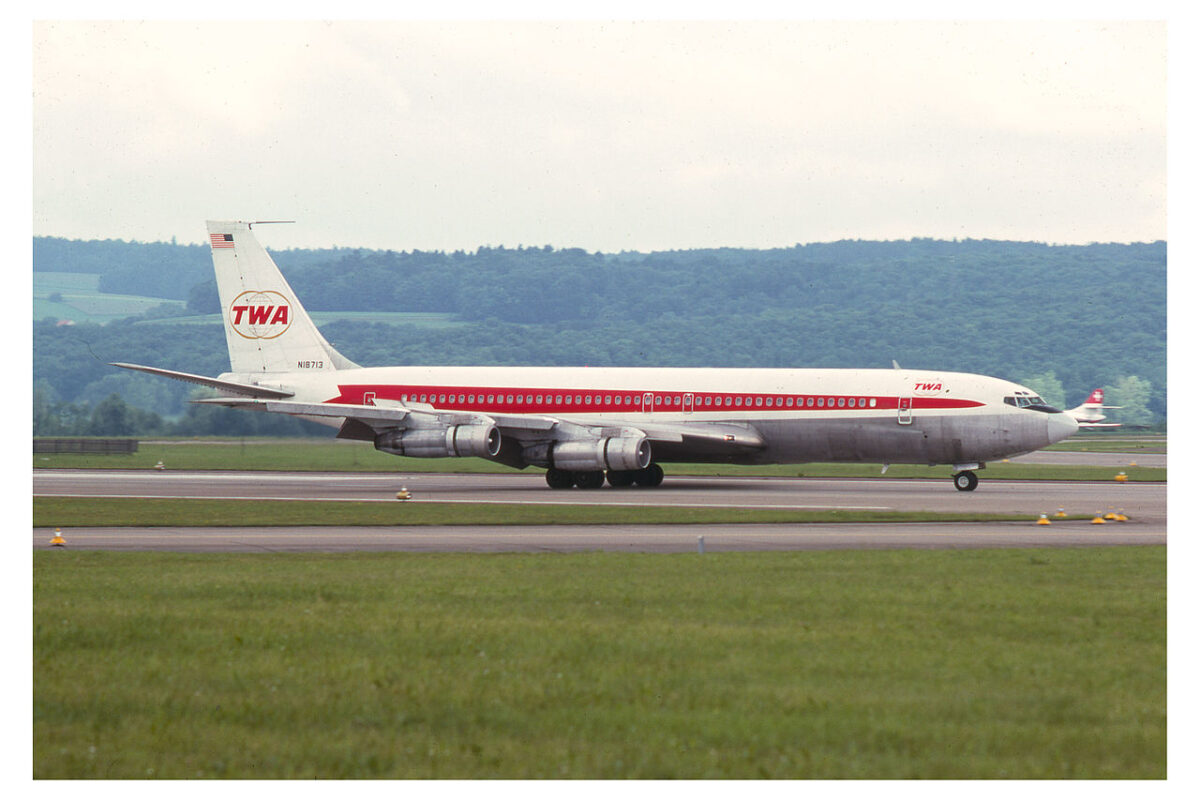
In its later years, many of the older aircraft would be sold off or grounded to be replaced by newer Boeing twinjets and McDonnell Douglas products. TWA is sometimes best remembered as one of the original operators of the Boeing 747SP, the US manufacturer’s short-fuselage, longer-range version of its venerable jumbo jet.
According to the US Department of Transportation, between 1990 and 2001, TWA carried 280 million passengers, just under three times the number carried by Delta Air Lines in 2024 alone. Yet, the airline was considered to be one of the biggest and best airlines in its heyday, before things turned sour and the airline ultimately failed.
The early years of development
TWA was first established on July 16, 1930, as Transcontinental & Western Air, flying air mail routes on behalf of the US Postal Service as well as carrying passengers on these flights. The company flew one of the first transcontinental services in the US, from New York to Los Angeles with intermediary stops at cities along the way, including St Louis and Kansas City. The route took around 36 hours to complete in each direction.
The company resulted from the merger of two fledgling mail carrier airlines in 1928: Western Air Express, founded in 1925, and Transcontinental Air Transport, founded in 1928. Since 1926. Western Air Express had been flying mail and passengers in its first year of service between Los Angeles and Salt Lake City. Meanwhile, Transcontinental Air Transport had been developing its own transcontinental network so that it could bid for even more lucrative postal contracts from the US government.
The two carriers merged following a suggestion of the US Postmaster General, who believed that having two airlines under expensive government contracts to deliver airmail across the US was unviable and uneconomic. The airlines operated almost identical routes and were both being paid by the US Postal Service for largely the same task.
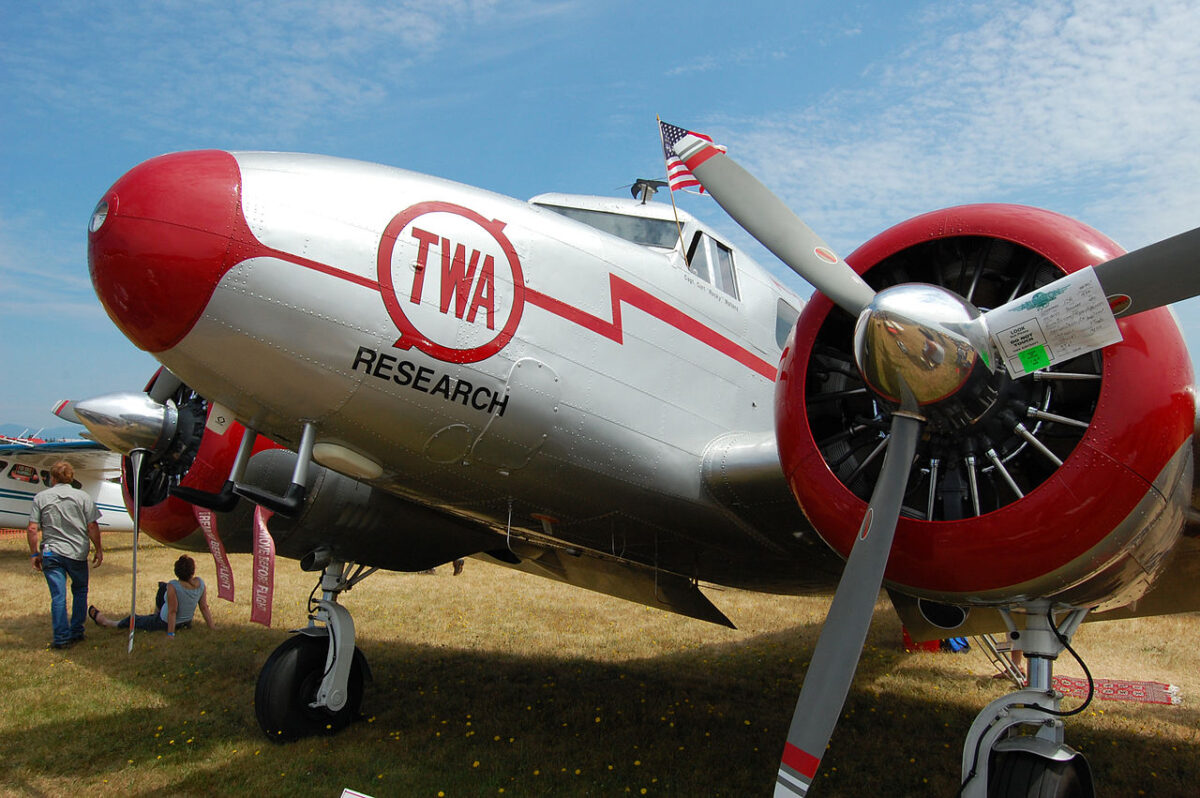
Upon its incorporation post-merger, TWA established a new headquarters in Kansas City in the state of Missouri. Already a staging post and overnight stop of the airline’s transcontinental route from east to west coasts, Kansas City was suggested by acclaimed aviation pioneer Charles Lindbergh, who had originally been involved with Transcontinental Air Transport. TWA constructed its first headquarters buildings at the Kansas City Municipal Airport (KCI), with additional offices scattered throughout the city. Joining other rapidly developing airlines such as American, United, and Eastern Airlines, TWA would quickly become one of the country’s “Big Four” domestic airlines.
In 1934, Western Air Express was spun back out of TWA, becoming an independent operator once again and later assuming the name of Western Air Lines. Also in 1931, 30-year-old William John Frye became the president of TWA. Frye’s previous career was as a stunt pilot working in Hollywood before taking up the position with TWA.
In 1938, in a bold move that would propel TWA ahead of its competitors in terms of range and comfort levels, Frye placed an order with the Boeing Airplane Company for its long-range Boeing 307 Stratoliner. To fund the purchase of the ultra-luxurious propliners, Frye convinced the famed aviation pioneer and business magnate Howard Hughes to finance the purchase and also to invest in TWA itself. Over time, Hughes built up his shareholding in the airline, eventually assuming control of the carrier in 1939.
Wartime and post-war TWA
Shortly afterwards, World War Two began, and TWA’s aircraft were used to support the US military throughout the Allied campaign. However, in 1945, and with the war over, the airline decided to expand rapidly and to aggressively fight for greater market share against airlines like American Airlines and United. In time, TWA would establish itself as the second-largest carrier in the US, behind Pan Am.
In 1946, TWA introduced the first of its new Lockheed Constellations on its transcontinental New York to Los Angeles route, an aircraft renowned for its speed and comfort. Indeed, TWA Constellation services were seen as offering a far superior experience to that of United Airlines, which continued to use the slower and noisier Douglas DC-4s. That same year, TWA began transatlantic operations for the first time, operating between New York City and Paris, France.

However, the rapid growth and continued success of TWA were not without their setbacks. Later in 1947, Frye (the president) and Hughes (the airline’s major shareholder) became embroiled in a bitter dispute, largely over how much money the company was losing. At the time, TWA was losing $20 million a year and was getting increasingly in debt to the US major oil companies, which began to threaten to withhold supplying TWA aircraft with aviation fuel as a result of unpaid bills.
Exacerbating the dispute was a strike called by the TWA pilots’ union, grounding airplanes and causing a loss of reputation amongst the travelling public. To try to steady the ship, Hughes provided an additional $10 million of financing, later converted to 1,039,000 additional shares in the company. Through this deal, Frye was removed from the airline entirely, and Hughes brought in 11 new members to the TWA board, while assuming full control in the process.
The birth of Trans World Airlines
Until 1950, the carrier had retained its full name of Transcontinental & Western Air. However, with the event of Hughes taking full control and something of a fresh start for the airline, the carrier changed its legal name to Trans World Airlines, cleverly retaining the acronym TWA for which the airline had become known.
In September 1952, TWA introduced the first of its larger Lockheed L1049 Super Constellations to its fleet. Once again, these aircraft offered a far superior service to that offered by the competition, with the new aircraft seen as the epitome of speed and luxury on both transcontinental and transatlantic routes.

Subsequently, on October 19, 1953, TWA became the first US airline to begin operating scheduled, nonstop transcontinental services between New York and Los Angeles. The addition of the longer-range Super Constellations allowed the airline to expand its international routes across Europe, as well as to the Middle East, Africa, and Asia throughout the 1950s, spreading the TWA name and brand even further across the globe.
In 1956, the company decided to consolidate all of its operations into one facility. A new headquarters building was constructed in downtown Kansas City at the site of a former brewery and costing $1.5 million to convert. At the time, the corporate headquarters building was the first major commercial structure built in the city in decades. The exterior was covered in red and white metal paneling, in keeping with the TWA adopted corporate colors. The three-story L-shaped commercial facility was completed in October 1956.
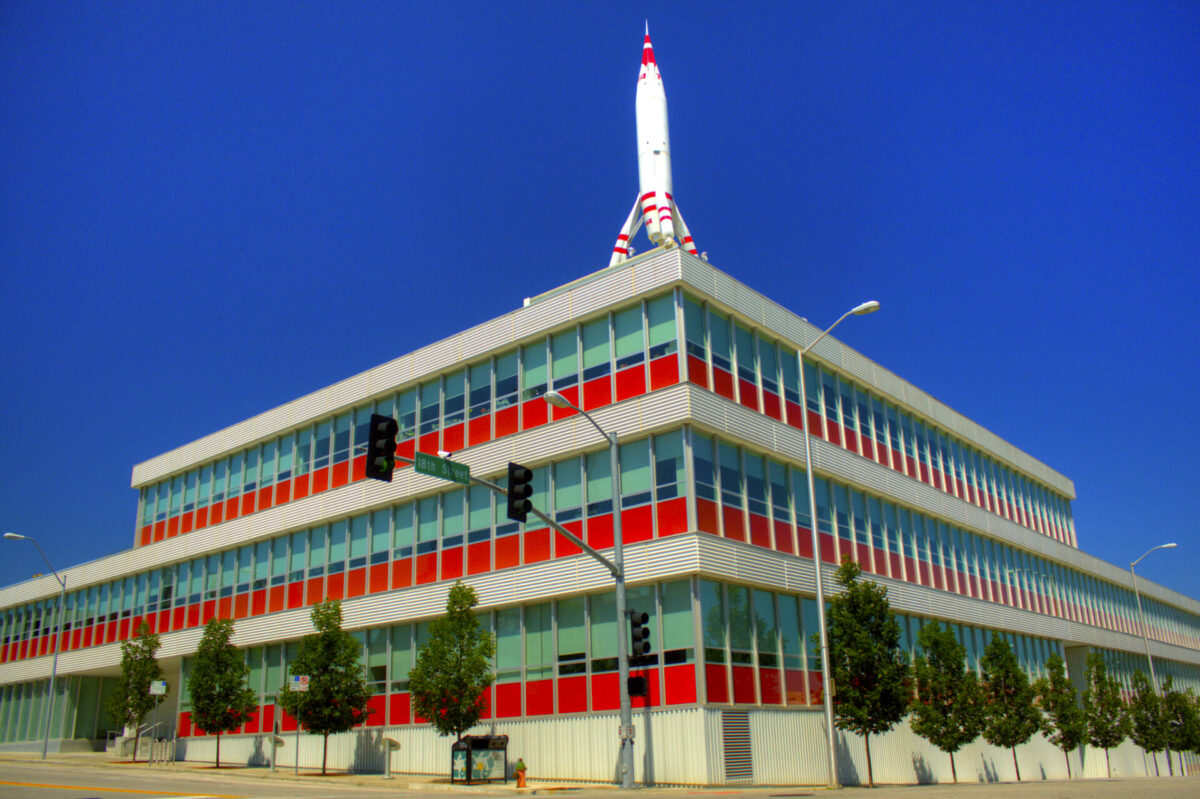
A giant 6.7m (22ft) model rocket named ‘Moonliner II’ was mounted on the roof of the new headquarters building. It was a 1/3 scale replica of another rocket, the ‘Moonliner I’, that was exhibited in Tomorrowland at Disneyland in Anaheim, California. The Moonliner at Disneyland was sponsored by TWA from 1955 to 1962 and featured the company’s logo. After the partnership ended, the Moonliner II rocket was removed from the top of the building headquarters. It eventually ended up as an exhibit at Kansas City’s National Airline History Museum, where it remains.
TWA enters the jet age
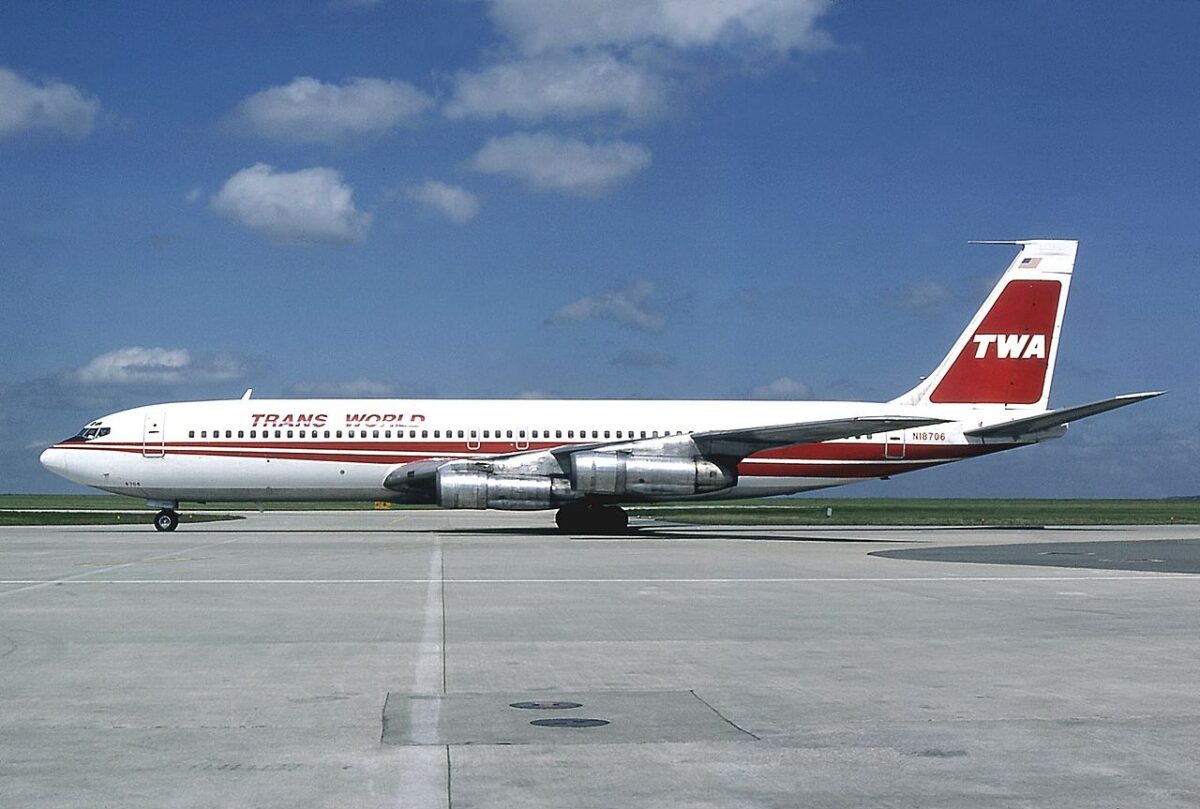
With the start of the 1960s came the dawn of a new era in commercial aviation in the form of the jet age. TWA was one of the early adopters of the new technology, ordering Boeing 707s and 720B long-range quad jets which it would use as a springboard to expand its international operations even further.
Then, in 1961, things turned sour at TWA. Howard Hughes, who remained TWA’s principal shareholder, lost control of the airline to a group of Wall Street banks and financial institutions that had financed the purchase of the new jet aircraft entering the airline. An antitrust lawsuit combined with a complex network of civil litigation cases followed. However, despite being called to appear at court on multiple occasions, Hughes, known as something of a reclusive character, refused to attend the hearings. Eventually, in 1966, Hughes sold his TWA shares for over $500 million and left the airline industry to pursue other business ventures.

By this time, and with the arrival of its new fleet of long-range Boeing aircraft, TWA had become a major player across the Atlantic. This culminated with the opening of the iconic TWA Flight Center at New York-JFK Airport (JFK), a dedicated air terminal for TWA transatlantic and transcontinental flights. The building quickly established itself as an architectural icon, adopting an Art Deco feel and appearance, and quickly became synonymous with TWA’s high-quality long-haul services from New York (see Remaining legacies of TWA below).
By 1964, TWA had become a major international player in aviation and was world-renowned for offering an elevated passenger experience. The rapid growth of its operations resulted in the airline transferring its headquarters to New York City. However, the iconic Kansas City headquarters building was retained to house TWA’s accounting department, ticket office, credit department, cargo department, and flight attendant training until 1969. Additionally, around this time, the airline began developing a further significant US hub at St Louis-Lambert International Airport (STL).

Throughout the 1960s and 1970s, TWA retained its position as a leading player in international and national markets, a reputation it had worked hard and spent vast amounts of money to achieve. In 1961, the airline became the first airline to introduce in-flight movies on long-haul flights, while in 1967, the airline acquired the entire chain of Hilton Hotels as well as the Century 21 Real Estate chain in an attempt to diversify the company’s business interests away from aviation.
TWA #1 across the Atlantic
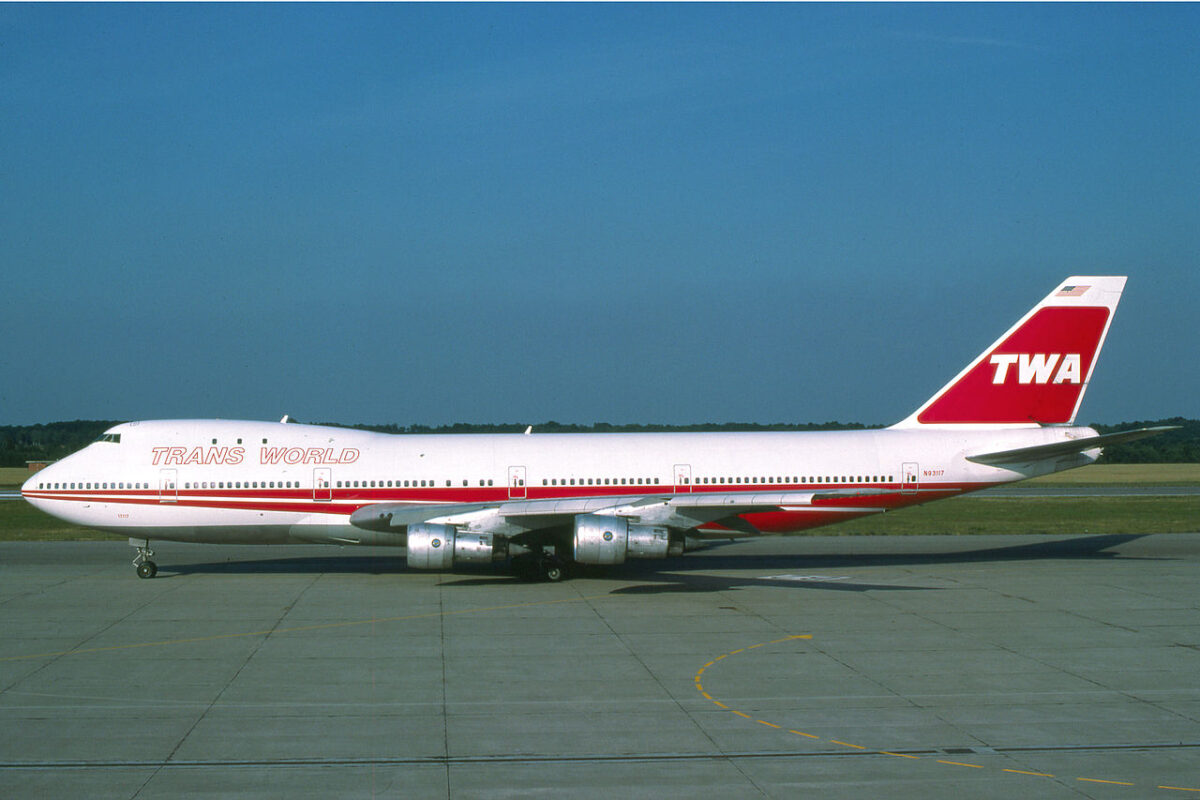
In July 1969, the airline officially replaced New York archrival Pan Am as the world’s number-one transatlantic airline. Not resting on its laurels, the carrier would give a further boost to its transatlantic operations the following year with the arrival of the carrier’s first Boeing 747jumbo jets, resplendent in the airline’s red and white livery and offering first class passengers the benefit of a stand-up lounge bar in the upstairs ‘bubble’ of the iconic jets. While TWA initially began flying the Boeing 747 on its well-established New York to Los Angeles transcontinental service, it would soon appear on flights from JFK to London-Heathrow, Paris-Charles De Gaulle, and Frankfurt.

From 1969 to 1975, TWA also operated trans-Pacific services to key cities in Asia and became a round-the-world carrier, offering connecting services heading both eastward and westward from JFK that would enable a circumnavigational travel itinerary to be constructed. However, in 1975, it suspended these services in a route exchange with Pan American World Airways, taking on more transatlantic routes while Pan Am focused on trans-Pacific operations and the round-the-world service.
1978 marked a seismic shift in the US airline industry landscape. In that year, the Airline Deregulation Act was passed, deregulating the US airline industry and removing all federal control over various activities, including fare fixing, route development, and the removal of barriers to entry for new carriers, although the Federal Aviation Administration (FAA) retained full regulatory powers over all aspects of aviation safety in the industry.
The Deregulation Act led to a wave of airline failures, start-ups, and takeovers as the carriers engaged in intense competition with each other while also struggling against rising fuel costs due to an increase in oil prices on the world stage. The focus on its international network had left TWA seriously exposed in the US domestic market, with numerous other airlines starting to encroach on its market share across the US.
The start of financial woes
To better cope with a fast-changing market following deregulation, in 1979, TWA was reorganized under the ownership of a holding company called Transworld Corporation. Then, in 1984, Transworld floated TWA in a public offering on the New York Stock Exchange to bolster its finances. The airline had left itself in a vulnerable position and was experiencing significant financial issues with rising debts amid increasing competition. The airline had even become the target of a hostile takeover in a plot that eventually failed.
In late 1985, renowned American investor Carl Icahn acquired the majority of the shares in TWA. In 1986, TWA bought Ozark Air Lines, a carrier with an established route network in the south-central United States, giving its domestic network a much-needed boost. However, it would prove to be an insufficient move to reverse TWA’s fortunes, and with Icahn at the helm, TWA began to sell off some of its most profitable assets to competitors to generate enough cash to pay off its debts.

In 1988, Icahn assumed full control of TWA and returned the airline to full private ownership once again, receiving $469 million for securing the deal. The agreement also resulted in TWA taking on $540 million in debt. In 1991, with TWA still facing financial strain, Icahn sold TWA’s historically important and prized routes serving London-Heathrow Airport to American Airlines for $445 million. However, many saw this move as akin to “selling the family silver” and one which would hasten the ultimate demise of TWA.
Although TWA continued to operate as usual, these measures did little to stem its losses. In January 1992, with creditors circling and debts continuing to rise, TWA filed for US Chapter 11 bankruptcy protection to allow it time to reorganise its finances and its operation without the threat of liquidation hanging over it while it did so.
Within a year, in 1993, TWA exited Chapter 11 protection thanks to a deal that saw 55% of the company now under creditor ownership. Carl Icahn was himself a creditor being owed $190 million by the airline by this stage. The whole process through Chapter 11 saw the relationship between TWA and Icahn deteriorate, and a deal was reached with Icahn where he would sever ties with the airline in exchange for reduced tickets on TWA services. Jeffrey H. Erickson took over from Icahn as president in 1994 and moved the airline’s headquarters for the third time in its history to St. Louis.

The airline attempted to fight its way back from a loss-making position, taking on more modern aircraft (such as the Boeing 757 and 767 and ordering the new Boeing 717 twinjet) while retiring its remaining Lockheed Tristars and Boeing 727s. Yet, with its transatlantic network largely gone and with hugely increased competition in the US domestic market, the writing was on the wall for TWA by this point.
Bankruptcy again, followed by Flight 800
Despite a raft of cost-cutting measures, TWA continued to operate at a loss throughout the 1990s and was forced to declare bankruptcy for a second time in 1995. While things looked grim for the airline at this point, the situation would soon become a whole lot worse for the airline.

On July 17, 1996, shortly after departure from JFK Airport in New York and heading to Paris, one of TWA’s remaining Boeing 747-200s (which was 25 years old at the time) suffered a mid-air explosion, killing all 230 people on board while heading out over the Atlantic Ocean close to Long Island.
The National Transportation Safety Board (NTSB) later concluded that the most likely cause of the disaster was a center fuel tank explosion, which had been caused by arcing of exposed electrical wiring in the area surrounding the fuel tank. Coverage of the disaster focused on the age of the carrier’s old and tired fleet, which was among the oldest in international service, and speculated as to whether cost-cutting by the airline had led to engineering shortcuts putting safety at risk.

Amid bankruptcy and with an internationally reported fatal crash to add to its woes, the late 1990s also saw TWA hamstrung by its mechanics unions, which were fighting the airline against a proposal by TWA to close numerous maintenance bases across its network. In Europe, stringent labor laws meant TWA had to retain engineering staff, despite having no work for them to perform. The airline did eventually emerge from bankruptcy for a second time, but only briefly.
TWA closes as American Airlines swoops
In January 2001, having limped on for years and with no real prospects of launching a recovery to become a profitable business once again, it was announced that TWA was filing for bankruptcy for the third time and would be shut down. The company’s remaining assets, route structure, and aircraft would be picked up by American Airlines, which had taken TWA’s prized transatlantic routes some years previously.
Having once been a pioneer for US domestic and transatlantic travel, and having forged a reputation for itself for fast, reliable and comfortable air travel, TWA’s fall from grace in its 70 years of history was little short of spectacular. With its failure, the airline joined other iconic US carriers such as Eastern Airlines and Pan Am that had once been the pride of the US airline industry but had failed to sustain their longevity amid rising costs and increased competition.

Similar to Pan Am and the fatal loss of Flight 103 over Lockerbie, Scotland in 1988, the destruction of one of TWA’s flagship Boeing 747s was the final straw for the airline, as well as a metaphor for the fall from grace for both airlines that at one stage had been the forerunners in the burgeoning US airline industry. Having been in operation for over 70 years, TWA joined Pan Am as an icon of America’s golden age of aviation and a pioneer of commercial passenger travel on the scrapheap.
Remaining legacies of TWA
Although the name of TWA will remain deeply embedded within the history books of aviation, there remains little in terms of tangible evidence that the once mighty airline existed. However, there are two pieces of evidence that keep the TWA flame alight, long after the airline itself disappeared from the skies.

As part of its heritage fleet program, American Airlines retains several Boeing 737-800s in its current fleet, sporting the colors of airlines that have been merged into the carrier over the years. One of these is the 737 registered as N915NN, which carries the 1980s and 1990s era TWA livery with the twin-dart fuselage cheatlines in red, accompanied by the iconic red tail with TWA lettering. The aircraft was first rolled out in this livery in 2015 and flies alongside others that display the colors of other former US carriers now part of American Airlines, including AirCal, Republic, US Airways, and Piedmont.

Secondly, at New York-JFK Airport stands the TWA Hotel. Constructed within the former TWA Flight Center, the iconic Art Deco terminal opened by the airline in 1962, the hotel still serves the public today and alongside luxurious accommodation, houses an extraordinary collection of TWA memorabilia, artifacts, and uniforms dating back to the ‘Golden Age of Travel.’ Topping off the visitor experience is the existence of a fully restored Super Constellation in the hotel forecourt, resplendent in its 1960s TWA livery, which visitors can step aboard and see for themselves how TWA passengers travelled in the airline’s heyday.
Conclusion
Having begun life from the humblest of beginnings, TWA grew to become a formidable force both within the US domestic market as well as across the North Atlantic. However, offering a premium experience on new aircraft would come at a cost, which would start a spiral of debt from which the company never recovered.

Like many airline failures, TWA’s ultimate demise was a combination of several factors, which included but were not limited to, lack of cost control, internal squabbles, mounting debts, an ageing fleet, deregulation and increased competition, loss of consumer confidence as bankruptcy lingered, and finally, the tragic loss of Flight 800.
While any one of these may have been manageable, the combination of them all was simply too much for TWA to withstand, confining one of the most iconic airline brands in history to the aviation archives.