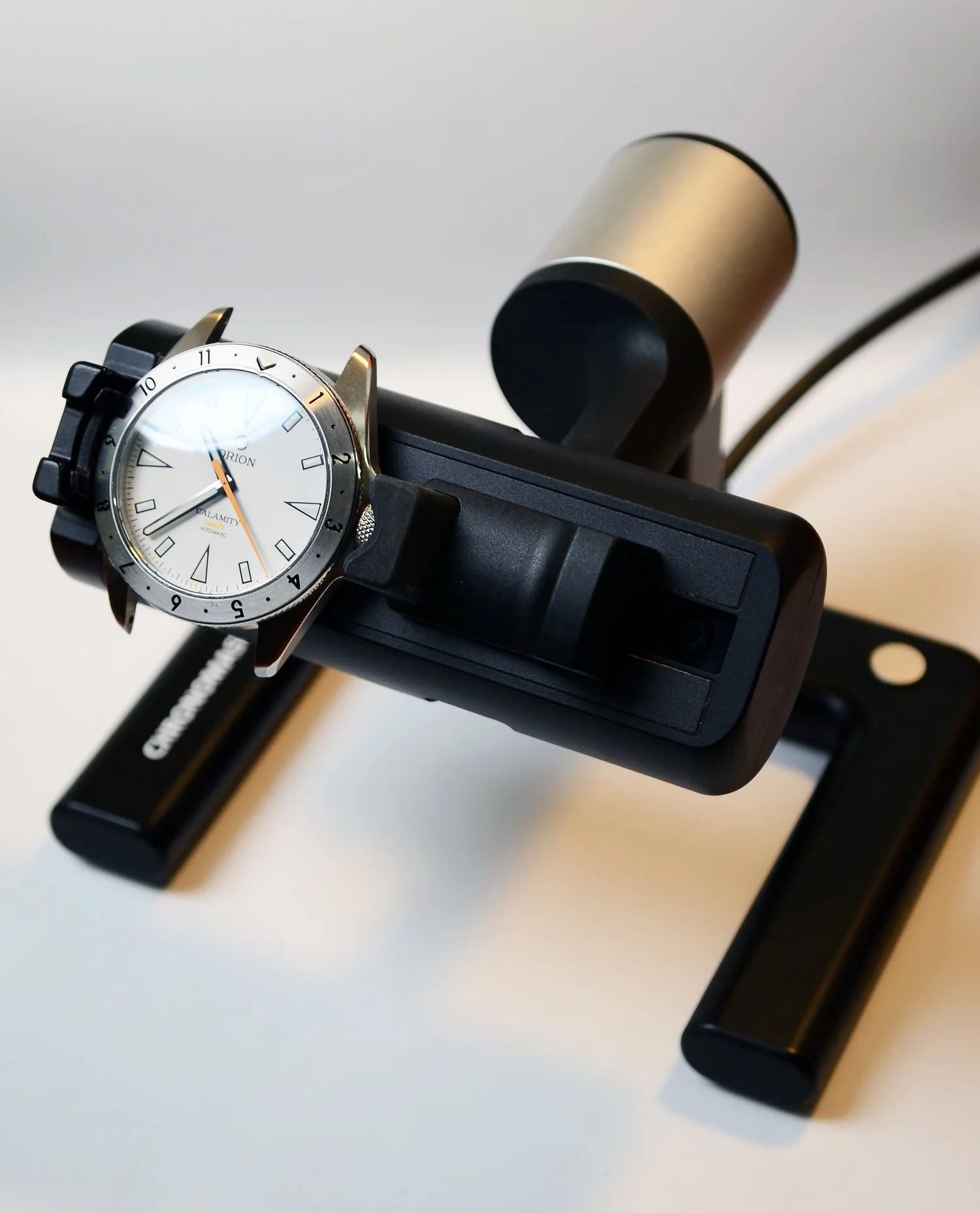
And I’m not saying everyone has to regulate or submit all their watches to a timing test, that’s what the factory should be doing. You should presumably have 1) the movement factory providing its checks then 2) the assembly house or watch factory providing its checks and finally 3) the brands final QC and checks which should include simple timing, which as I hope you can see now, timing a watch is different than regulating it or having a full timing test. If somehow, you, as a brand, are ending up with movements and watches that after multiple presumed steps of QC and adjustment are still failing or performing so poorly you need to intervene, it may be time to start asking about the provenance of your movements. Sometimes its an active cost cutting decision, sometimes someone in the chain tricks you and you have no idea.
Regulating as a marketing phrase and value added proposition in the microbrand space, for me, raises more questions than it answers. I may be a purist but I like when trained and competent people work on my watches and, much like human medicine, we shouldn’t really be intervening needlessly – there should be a sufficiently good reason. I purposely became a certified watchmaker to understand these things at a foundational level, I see many brands that have offsite watchmaker support or no watchmaker support making these claims and I hope that I can arm you, the reader, with some critical knowledge as to what regulation is, why it would be needed, and how to ask appropriate questions that may support the veracity of the claims of a presumed timing test carried out on your watch.
To very finely regulate a watch (i.e. poise, escapement and hairspring adjustment) takes considerable time and skill, to the degree you need sufficient training. To generally regulate a watch takes quite a bit less work, this is where I think most of the claims would fall. So I invite you to inquire on the details of regulation. Why is it necessary? What’s the delta? How many positions? Was power reserve checked? What about timing it at half wind? Even the equipment used can have a bearing on it. Any company that is honestly flaunting regulation as a testament to their skill should be happy to share the information with an honestly engaged and curious customer, while I suspect a less than honest company may provide murky and vague answers. So is that brand regulating your watch? Maybe. And maybe it’s for a good reason and maybe it’s for a bad reason.
In summary and using reductive logic we can imagine a few scenarios:
1) A company buys movements directly from the factory. The factory regulates them, provides timing sheets as proof for each movement which is then verified by the purchasing company upon receipt. Any movement outside agreed upon tolerances is returned and replaced under warranty. The customer buying the movements in this case does not need to regulate them, unless they wanted to save money by buying a lower grade timing spec and spend more time personally adjusting them. At which point proof should be readily deliverable of said adjustments.
2) A brand owner buys movements through their watch factory, who then sources them through a broker or the movement factory. This scenario is like the first one with extra steps. There are 3 parties now, the party selling the movements, the watch factory building and assembling the watch with said movements, and the brand owner who will eventually receive the watches. In this case, party 1 can either be the factory or a broker. In which case, the factory will provide timing sheets as proof of performance to their customer, which is, in this case, the watch factory. The brand owner will not see the timing sheets, but they existed and regulation was performed. Now, the factory has to QC and ensure proper functionality after the watches are assembled and before they are sent to their client, the brand owner. This will include timing tests. At this point, the watches have been regulated at least once and checked at least twice. When the owner receives them, they should perform a final QC which would include assessment of the rate. Now repeat this scenario but instead of the watch factory purchasing from a movement factory, they purchased from a broker. The broker might include timing sheets, but they are not obligated to and many times they will not. Quality and performance may not be guaranteed. In the scenario from the broker, there exists the possibility of the movements being in disrepair, in need of service or regulation. At which point, the watch factory should catch that in their QC and there is still the final QC of the brand owner. As movements stray further from service intervals, it is common for their timing to become less stable. This is a scenario in which a final regulation may be warranted and even beneficial, though, it could end up being a band aid on a larger problem.
3) A company buys directly from a broker. Like scenario 1, a company buys movements directly. Brokers, however, are not obligated to provide the same warranties and tolerance adherence as a factory is. There is a very likely chance these could be old stock or otherwise used or refurbished movements. The owner now has movements that do not carry a guarantee of rate and likely did not come with timing sheets to verify the performance of the movement. This has had virtually 0 eyes on it in regards to regulation or QC at this point and all of that will need to be either carried out by the owner or, the assembly house/watch factory if the purchaser of the movements decides to forward them. In this scenario, you can imagine the necessity for a regulation, let alone a full service is probably necessitated (Sometimes brokers deliver great product! Sometimes they don’t, it’s a gamble and with gambles there are no guarantees). A scenario like this is more likely to see or require additional regulation further downstream in the process.
Then, there are the market pressures, where brands see other brands offering something of perceived value so they want to offer it as well. If, however, whatever they’re offering is not only disprovable but in their interest to make said claim, you can see where you may have an issue of runaway claims. Honesty and deception mixing in a market. If the consumer has no way to readily ask for evidence of said claim, how are they able to discern an honest claim from a deceptive one? The intent of this article is to arm you, the reader, with some knowledge to provoke questions that would reveal an honest claim and a deceptive claim. Since stating things like “we regulate our movements” is a vague term that is unregulated, there is little downside to lie about it if your assertions will never be tested – and the liars extoll an additional cost on those who are honest – those who put in the extra time (and time is money) to either correct issues or demonstrate their competency at regulating a movement now are competing with those who do not expend that additional cost yet make the claim they do. A failure to hold claims accountable, will eventually lead us to a market of wondrous and fabulous statements of regulation and intervention and all sorts of rarified horological adjustments that don’t actually mean anything. Which, is why accountability is important, to ensure that we get what we pay for and to ensure that the words that are being used accurately convey the service and product being provided. There are many ways this claim can go, from honest infusion of competent watchmaking, to a lie simply to keep up with those doing the actual work – there is value in people taking time to create a better product but I know, personally, there are many people who have no issue bending words or finding loopholes to make it sound like they’re doing work they never did.