Marketing is about creating, communicating, and delivering value to your customers, and AI in marketing is not only revolutionizing the ways you can do this but also automating the process and enhancing the value delivery. Consumer expectations are constantly changing, and it is tedious to keep up, but now marketers no longer have to rely just on the traditional methods of targeting, personalization, and engagement; they can use AI in marketing and advertising to do so.
Artificial intelligence in marketing is no longer a futuristic concept reserved for tech giants. It’s the core of how brands deliver value, streamline operations, and build deeper customer relationships.
According to industry forecasts, the global market for AI in marketing and advertising is projected to surpass $107 billion by 2028, driven by the explosion of data, the rise of omnichannel platforms, and the increasing availability of intelligent automation tools.
Businesses once required large teams and long cycles to execute marketing research and plans, but today, you just need custom AI solutions for marketing that learn, adapt, and optimize continuously.
The benefits of the use of AI agents in marketing are immense, including greater efficiency, sharper targeting, higher ROI, and more meaningful customer engagement. However, not everyone is aware of how to use it for their business’s benefit.
Therefore, in this blog, we’ll explore 26 real-world use cases—grouped across strategic marketing functions—where AI in marketing and advertising drives tangible results.
Let’s dive in.
Audience Intelligence & Personalization
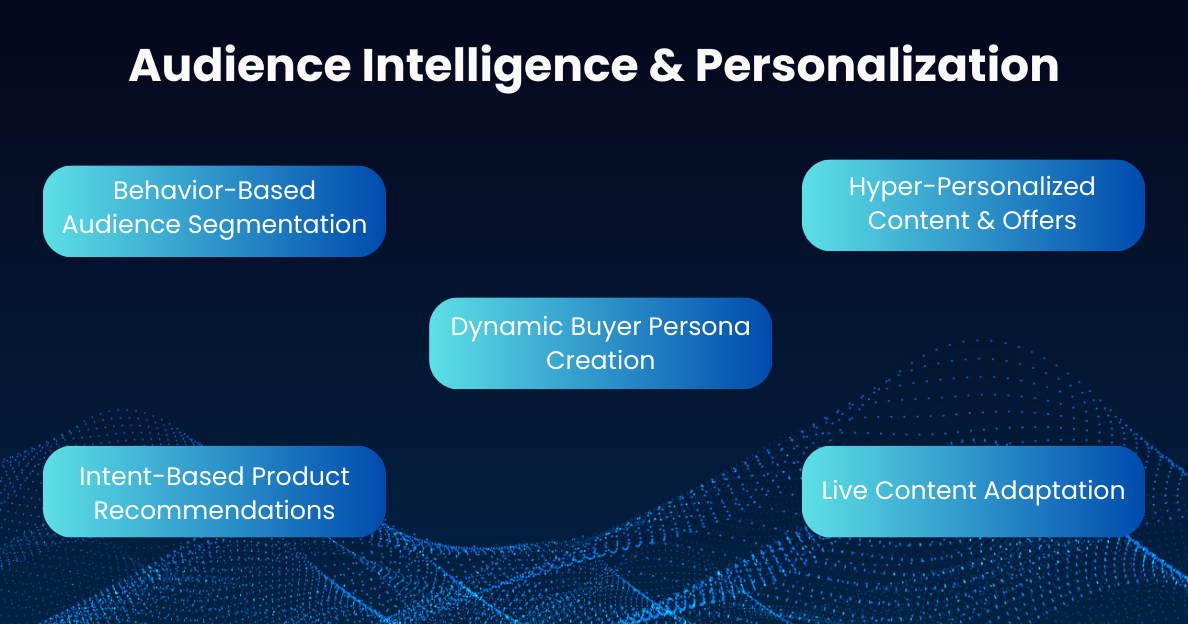
1. Behavior-Based Audience Segmentation
Scenario:
Traditional segmentation relies on broad demographic filters like age or location, which often lead to generic messaging and low engagement. Brands struggle to connect meaningfully when customer interests change frequently.
AI in Marketing Solution:
AI in marketing and advertising enables real-time micro-segmentation using behavioral data such as product views, clicks, and engagement patterns. Machine learning models group users into dynamic segments that evolve based on actual behavior, not assumptions. This level of personalization ensures relevant content, better targeting, and increased conversion rates. Artificial intelligence in marketing makes segmentation smarter, faster, and far more accurate than manual efforts.
2. Dynamic Buyer Persona Creation
Scenario:
Creating buyer personas is often a manual, time-consuming process that becomes outdated quickly. Marketing teams lack visibility into behavioral shifts and psychographic insights across customer groups.
AI in Marketing Solution:
AI solutions for marketing use behavioral signals, CRM data, and social insights to auto-generate live personas that update in real-time. These intelligent personas go beyond static templates—they reflect actual buying intent, emotional drivers, and content preferences. As ai agents in marketing evolve, they continuously refine these profiles, making audience targeting more precise and scalable.
3. Hyper-Personalized Content & Offers
Scenario:
Sending the same offer or message to everyone reduces impact and increases customer fatigue. Manual personalization is not scalable across thousands of users.
AI in Marketing Solution:
AI in marketing enables true one-to-one personalization at scale. By analyzing behavioral history, device type, session frequency, and even dwell time, artificial intelligence in marketing delivers tailored messages, emails, push notifications, and offers in real time. Whether it’s an exclusive coupon or a personalized product suggestion, AI ensures each touchpoint is relevant, timely, and conversion-optimized.
4. Intent-Based Product Recommendations
Scenario:
Generic recommendations like “most popular products” don’t reflect a user’s real-time intent, resulting in lower click-through rates and lost sales.
AI in Marketing Solution:
Using AI in marketing automation, platforms can predict what a user is most likely to buy next—based on browsing behavior, abandoned carts, or search patterns. Generative AI in marketing can even customize product descriptions or reorder layouts to match user preferences. These personalized journeys drive higher average order values and improve retention rates.
5. Live Content Adaptation
Scenario:
Static websites fail to reflect user intent dynamically, leading to high bounce rates and missed engagement opportunities.
AI in Marketing Solution:
AI adapts website elements—like headlines, images, or call-to-actions—in real time. Based on user behavior, AI delivers different homepage versions to a new visitor, a returning customer, or a high-value lead. Marketing automation artificial intelligence ensures the content experience changes as users progress through the funnel, leading to improved time-on-site and engagement metrics.
Campaign Management & Ad Optimization
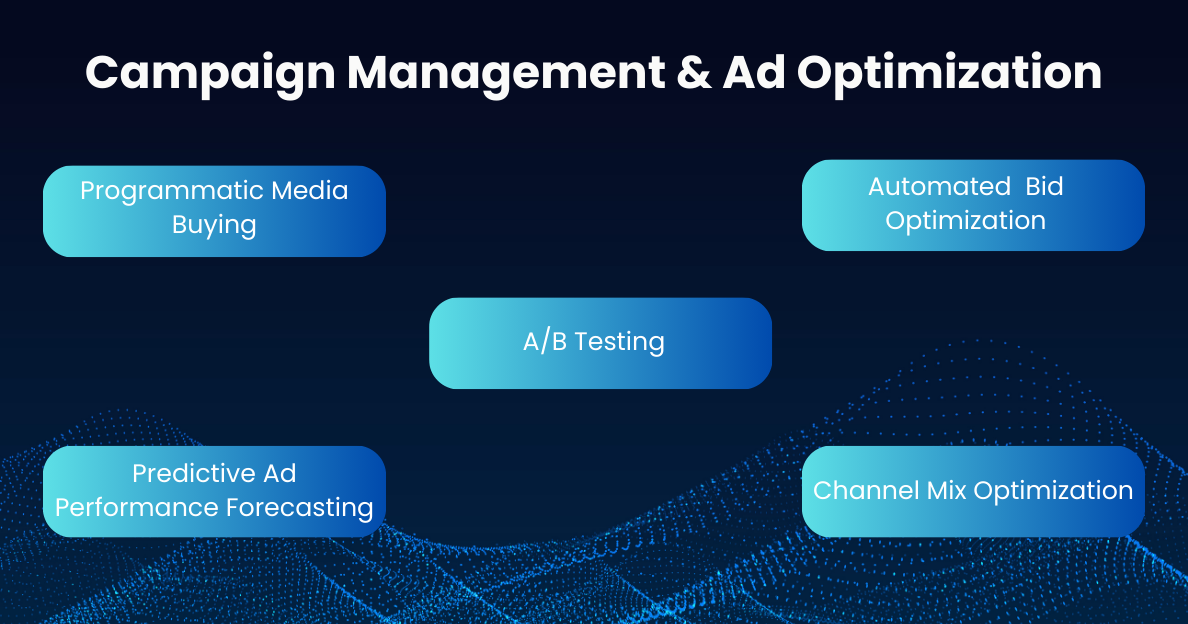
6. Programmatic Media Buying
Scenario:
Media buyers can’t keep up with the sheer scale of ad impressions across platforms. Manual bidding and placement decisions lead to inefficiencies and missed opportunities.
AI in Marketing Solution:
AI in advertising makes real-time bidding smarter and fully automated. Platforms powered by artificial intelligence in advertising evaluate each impression, user profile, and context to place the most relevant ad at the best price. With ai in digital advertising, brands see increased ROI, reduced acquisition costs, and more accurate targeting across channels.
7. Automated Budget Allocation & Bid Optimization
Scenario:
Managing ad spend across platforms like Google, Meta, and programmatic networks is time-intensive and often reactive. Marketers miss out on performance gains when budgets aren’t optimized in real time.
AI in Marketing Solution:
AI solutions for marketing continuously monitor ad performance and dynamically reallocate budgets to the best-performing campaigns. Bid amounts are adjusted based on conversion probability, audience quality, and channel efficiency. AI in marketing ensures every dollar is spent where it drives the most value, maximizing return without manual intervention.
8. Creative Asset Optimization & A/B Testing
Scenario:
Designing and testing creative variations takes time and resources. Traditional A/B testing methods are limited in scale and slow to generate insights.
AI in Marketing Solution:
With generative AI in marketing, brands can create multiple ad variants—changing headlines, CTAs, colors, and layouts. AI then runs multivariate tests to determine which combinations work best for each audience segment. Artificial intelligence in marketing delivers data-driven creative insights, reduces guesswork, and accelerates performance improvements.
9. Predictive Ad Performance Forecasting
Scenario:
Before launching large-scale campaigns, marketers struggle to estimate potential results and justify ad budgets to stakeholders.
AI in Marketing Solution:
AI in marketing and advertising uses historical performance data, audience behavior, and seasonal trends to predict campaign KPIs such as impressions, conversions, and revenue. These forecasts help marketers plan smarter, make budget decisions with confidence, and avoid costly missteps. Future of AI in marketing lies in proactive, insight-driven campaign planning—this is already happening today.
10. Channel Mix Optimization
Scenario:
Choosing the right channel mix for different audience segments is complex and often based on intuition rather than hard data.
AI in Marketing Solution:
AI in marketing automation models analyzes engagement, conversion rates, and cost across email, social, display, and search channels. AI identifies the most efficient channel combination for each campaign goal, optimizing the customer journey from discovery to purchase. This is one of the most impactful AI solutions for marketing because it reduces waste and amplifies reach with precision.
Lead, Funnel, and Journey Optimization
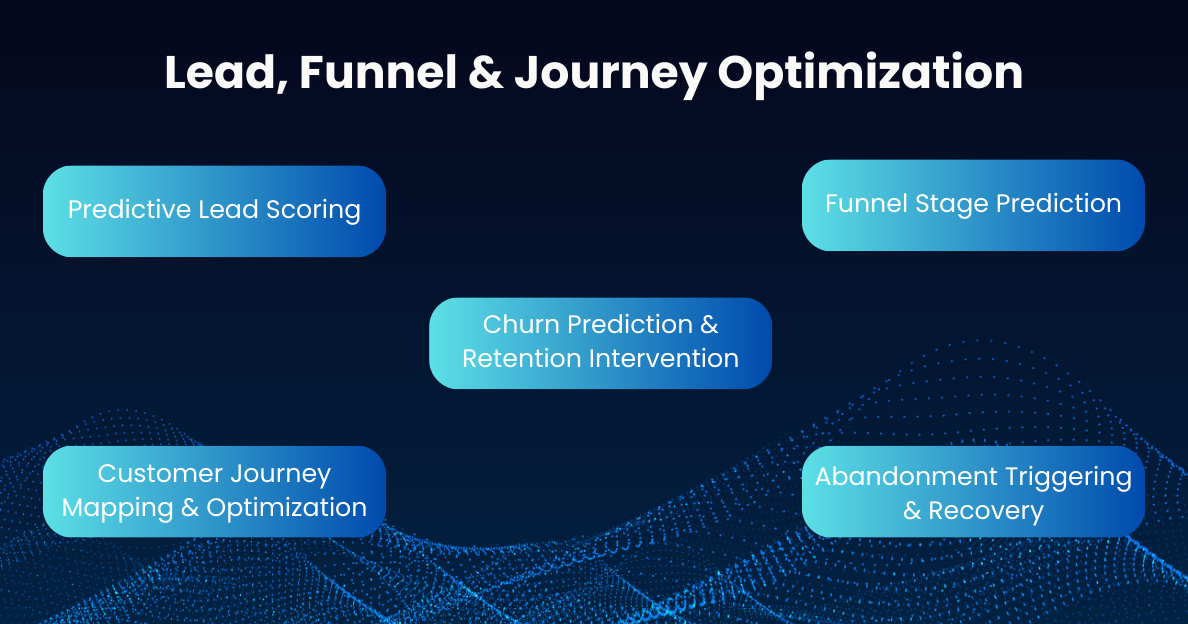
11. Predictive Lead Scoring
Scenario:
Sales teams often receive thousands of leads but don’t know which ones to prioritize. Without an intelligent scoring model, high-value prospects get lost in the noise.
AI in Marketing Solution:
Artificial intelligence in marketing can analyze past deal data, email engagement, and behavioral signals to predict which leads are most likely to convert. By assigning scores in real time, AI agents in marketing empower sales teams to focus on qualified prospects, shorten sales cycles, and improve conversion rates. This use case represents a core AI solution for marketing and sales alignment.
12. Funnel Stage Prediction
Scenario:
Understanding where a lead sits in the marketing funnel is difficult, especially across multiple touchpoints and channels.
AI in Marketing Solution:
AI in marketing automation uses behavioral patterns, engagement frequency, and content interactions to predict funnel stages. It distinguishes between cold leads, nurtured prospects, and sales-ready contacts. Marketers can then deliver the right messaging, offers, or triggers at exactly the right time, making campaigns more efficient and personalized.
13. Customer Journey Mapping & Optimization
Scenario:
Most marketers know where drop-offs occur but can’t see the full picture of why or how customers disengage.
AI in Marketing Solution:
Using machine learning, AI in marketing maps the entire customer journey—tracking cross-channel behaviors, identifying friction points, and revealing micro-conversions. These insights help teams adjust content flow, CTAs, or touchpoint timing. Artificial intelligence in advertising makes journey optimization data-driven, continuous, and scalable.
14. Abandonment Triggering & Recovery
Scenario:
High-value prospects often drop off after cart additions or key product interactions—and most of these moments are never followed up.
AI in Marketing Solution:
AI in advertising can identify real-time abandonment behavior and trigger automated recovery workflows—such as personalized emails, SMS nudges, or retargeting ads. Combined with ai in content marketing, these reminders can be tailored with dynamic product images, discounts, or urgency-based messages to win customers back efficiently.
15. Churn Prediction & Retention Intervention
Scenario:
By the time a customer cancels or stops engaging, it’s too late—and winning them back is far more expensive than retaining them proactively.
AI in Marketing Solution:
AI in marketing and advertising identifies churn signals like reduced activity, negative sentiment, or drop in product usage. Once flagged, the system can deploy targeted offers, loyalty incentives, or support outreach. Future of AI in marketing lies in this kind of predictive, real-time retention strategy—saving revenue while deepening customer trust.
Content & SEO Optimization
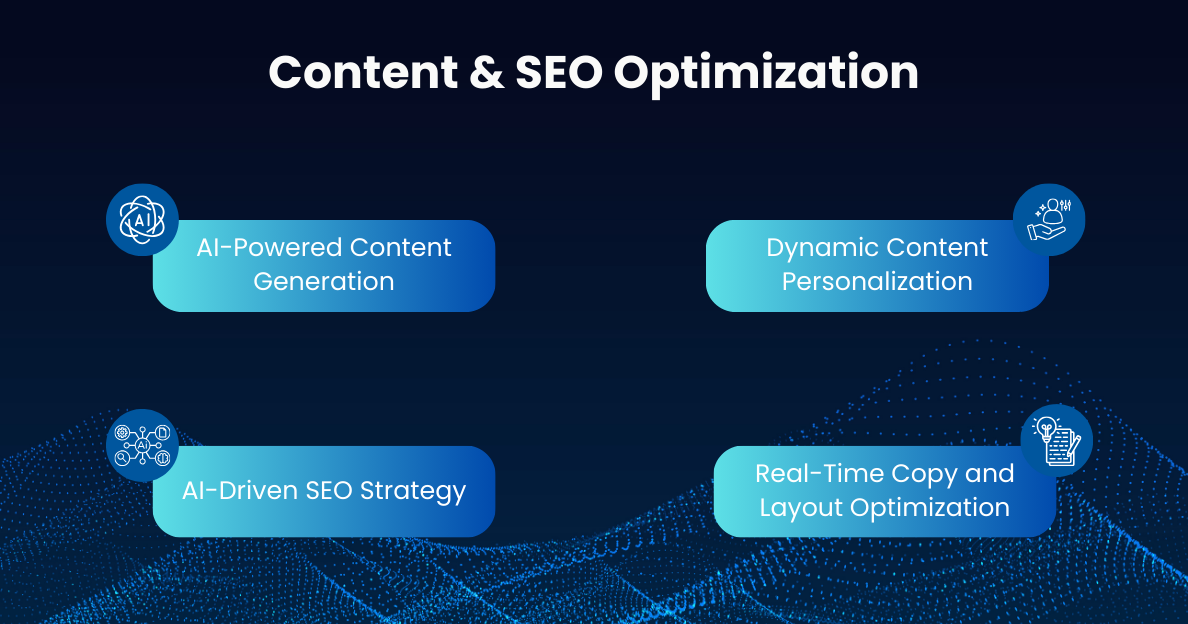
16. AI-Powered Content Generation
Scenario:
Content creation is time-consuming and often inconsistent across campaigns, platforms, or languages. Creative teams are stretched thin and struggle to maintain output quality at scale.
AI in Marketing Solution:
Generative AI in marketing enables teams to automate content writing for blogs, ad copy, product descriptions, and emails. These AI models—trained on brand tone and performance history—generate drafts, headlines, and even campaign themes that can be edited and deployed faster. Artificial intelligence in marketing ensures that content is consistent, scalable, and optimized for conversion across every stage of the funnel.
17. Dynamic Content Personalization
Scenario:
Most content is generic and static, even though user needs and behavior vary dramatically across segments and touchpoints.
AI in Marketing Solution:
With ai in content marketing, platforms can deliver personalized blog posts, landing pages, and resource suggestions in real time. Based on past behavior, demographics, and device type, AI in marketing automation adapts headlines, visual assets, or CTAs for individual users—boosting dwell time, engagement, and lead quality.
18. AI-Driven SEO Strategy
Scenario:
Marketers managing large websites or product catalogs often fall behind on keyword mapping, content gap analysis, and technical audits.
AI in Marketing Solution:
Artificial intelligence in marketing can evaluate SERPs, analyze competitors, and identify high-intent keywords to improve organic rankings. AI-powered tools also highlight underperforming content and suggest updates, internal linking strategies, or metadata changes. This level of SEO optimization is essential for performance marketing, and it’s increasingly powered by ai solutions for marketing teams aiming to scale traffic intelligently.
19. Real-Time Copy and Layout Optimization
Scenario:
Static web pages miss opportunities to test variations or adapt based on user response patterns.
AI in Marketing Solution:
Using marketing automation and artificial intelligence, web pages can auto-adjust copy, CTA placement, and layout based on real-time user interactions. These micro-optimizations drive conversion rate improvements without needing A/B tests for every variation. It’s like continuous optimization—powered by machine learning and rooted in behavior data.
Social, Competitive, and Brand Intelligence
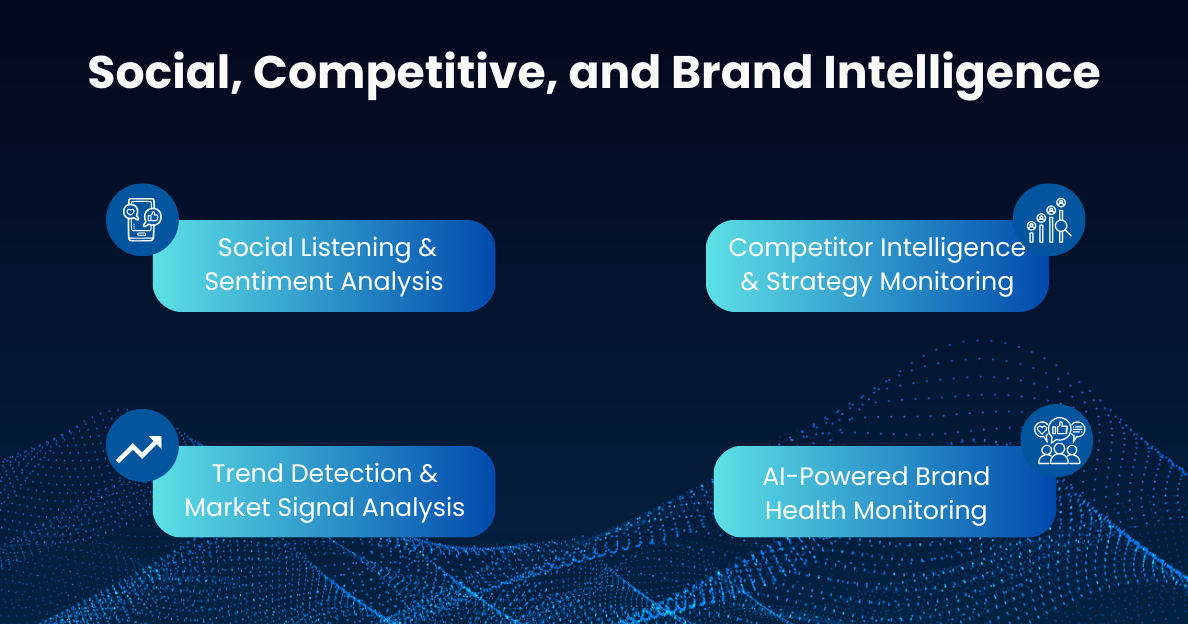
20. Social Listening & Sentiment Analysis
Scenario:
Thousands of brand mentions happen daily across platforms like X (formerly Twitter), Reddit, and TikTok—but many go unnoticed until it’s too late to respond meaningfully or avoid PR risks.
AI in Marketing Solution:
Artificial intelligence in marketing uses natural language processing (NLP) to scan, interpret, and categorize brand mentions by topic and sentiment. Whether identifying early signs of customer dissatisfaction or picking up on viral momentum, AI agents in marketing can trigger alerts and recommend responses. It’s a must-have for modern reputation management in both marketing and advertising.
21. Competitor Intelligence & Strategy Monitoring
Scenario:
Marketers often overlook competitor activity changes in ad messaging, SEO strategy, or pricing shifts—reacting late or missing opportunities altogether.
AI in Marketing Solution:
AI in advertising tools can scrape data from competitor websites, ads, social campaigns, and search rankings. By analyzing patterns in ad creative, content cadence, and messaging pivots, ai solutions for marketing generate real-time dashboards with actionable intelligence. Teams can use this insight to launch counter-campaigns, exploit content gaps, or refine positioning before competitors gain the upper hand.
22. Trend Detection & Market Signal Analysis
Scenario:
Spotting emerging trends manually across industries and platforms is slow, fragmented, and often biased by internal assumptions.
AI in Marketing Solution:
Artificial intelligence in advertising scans news feeds, social platforms, influencer content, and search behavior to detect rising terms, shifting sentiment, and unmet needs. These market signals help brands stay ahead of the curve, ideate fresh campaigns, and launch products that align with cultural and consumer momentum. This use case illustrates the future of ai in marketing—proactive, data-rich, and trend-responsive.
23. AI-Powered Brand Health Monitoring
Scenario:
Understanding how your brand is perceived at any given moment is difficult without deep insights into tone, emotion, and brand mentions across platforms.
AI in Marketing Solution:
AI continuously tracks brand sentiment, share of voice, influencer traction, and association keywords. It also identifies which campaigns are strengthening or weakening brand perception. With AI in marketing and advertising, marketers gain a holistic, real-time view of brand health—across owned, earned, and paid media.
Workflow Automation & Decision Support
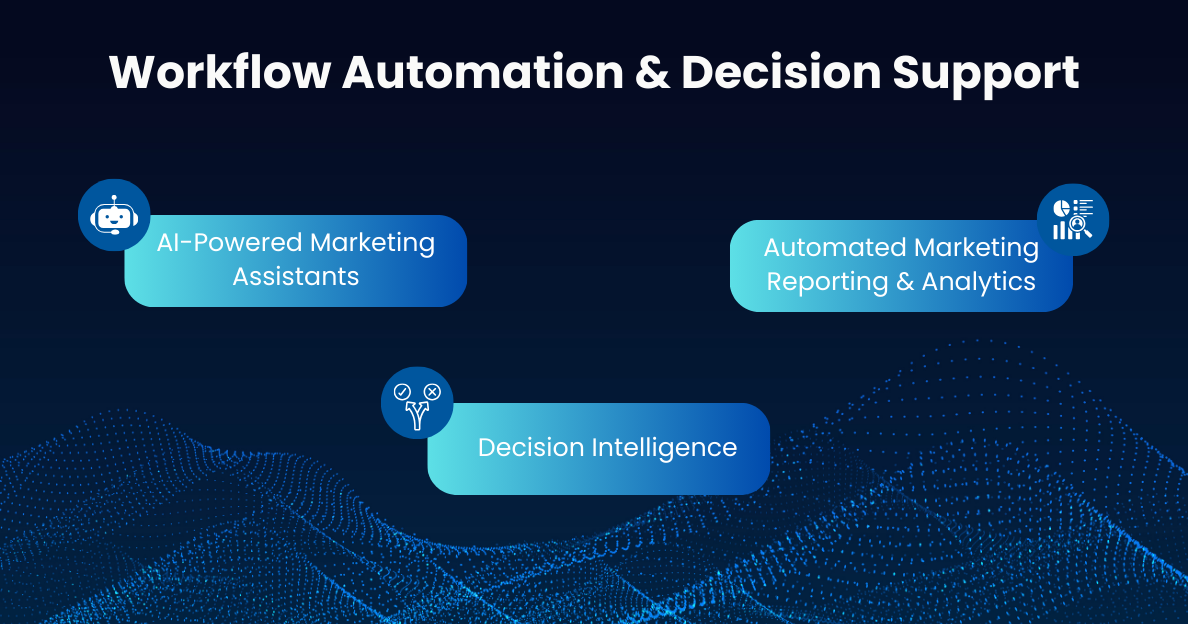
24. AI-Powered Marketing Assistants
Scenario:
Marketers often spend hours writing briefs, pulling reports, and navigating analytics platforms, leaving less time for strategic thinking and execution.
AI in Marketing Solution:
AI agents in marketing can now function as intelligent co-pilots—drafting email sequences, summarizing campaign results, recommending next-best actions, or generating creative briefs. These assistants, powered by large language models, help marketers move faster and smarter. Whether integrated into Slack, a CRM, or an analytics dashboard, artificial intelligence in marketing dramatically improves efficiency and confidence in decision-making.
25. Automated Marketing Reporting & Analytics
Scenario:
Compiling campaign metrics, performance summaries, and channel reports across tools is a repetitive, error-prone task that slows down feedback loops.
AI in Marketing Solution:
AI in marketing automation connects disparate data sources, analyzes KPIs across campaigns, and auto-generates visual reports with actionable commentary. Whether tracking conversions, CPL, or engagement trends, marketers get instant clarity on what’s working and what needs adjusting. These AI solutions for marketing free up teams from number crunching and accelerate real-time optimization.
26. Decision Intelligence & Strategic Recommendations
Scenario:
CMOs and marketing leads often rely on dashboards filled with raw data, but lack predictive insights or clear recommendations for next steps.
AI in Marketing Solution:
This is where the future of AI in marketing shines. AI models analyze historical performance, market signals, user behavior, and budget data to suggest actionable next moves—like increasing spend on a winning campaign, shifting budget to a higher-performing channel, or pausing ineffective creatives. This decision intelligence, integrated into existing workflows, makes artificial intelligence in marketing and advertising a proactive force rather than a passive tool.
AI is Revolutionizing Marketing
Marketing has always been part art and part science—but with the rise of AI in marketing, that equation is tilting dramatically toward precision, speed, and scale. Whether it’s anticipating customer behavior, optimizing media spend, or generating high-converting content, today’s AI technologies are reshaping how marketers think, work, and deliver results.
At the heart of this transformation are three powerful pillars of artificial intelligence in marketing: machine learning, natural language processing (NLP), and generative AI. Together, they form the engine of a new marketing era—one where decisions are data-driven, campaigns are hyper-targeted, and creativity is intelligently augmented.
Machine Learning (ML): Pattern Recognition at Scale
Machine learning enables systems to learn from past data and improve over time without explicit programming. In marketing, this means:
- Scoring leads based on conversion likelihood
- Segmenting audiences by real-time behavior
- Predicting campaign outcomes before launch
AI in marketing automation wouldn’t be possible without ML models that adapt continuously—powering smarter decisions, better personalization, and more responsive campaign strategies.
Natural Language Processing (NLP): Understanding Human Communication
From chatbots to sentiment analysis, NLP allows machines to interpret and respond to human language in meaningful ways. In the context of ai in advertising, NLP enables:
- Scanning millions of social mentions to detect trends
- Categorizing sentiment in product reviews
- Auto-generating campaign summaries or performance insights
Marketers no longer need to guess how their audience feels—artificial intelligence in marketing surfaces emotional tone and feedback at scale, turning passive data into proactive action.
Generative AI: Redefining Creativity
Perhaps the most buzzworthy development in the future of ai in marketing is the emergence of generative AI. These models don’t just analyze—they create. They write emails, design product descriptions, suggest CTAs, and even develop multiple ad variants in seconds.
This evolution is not about replacing creative teams—it’s about supercharging them. With generative AI in marketing, brands can experiment faster, scale content production, and tailor messaging to each audience segment without burning out internal resources.
Why Marketing is Ripe for AI
Few functions generate more data than marketing—clicks, impressions, sentiment, conversions, scroll depth, bounce rate, and more. This massive data stream makes marketing a prime candidate for intelligent automation.
Unlike operations or finance, marketing lives at the intersection of fast-changing consumer behavior and rapid experimentation. That’s why the adoption of AI in marketing and advertising is happening faster than in most other departments; it offers both agility and insight.
As we move deeper into an AI-augmented future, the most successful marketing teams will be those that embrace this shift, not as a replacement for human creativity, but as a catalyst for smarter, faster, more effective campaigns.
How to Start Using AI in Your Marketing Stack
Getting started with AI in marketing and advertising doesn’t require a massive overhaul. With the right focus, even small steps can yield big results.
Start with high-impact pilot projects like email automation, content personalization, or ad budget optimization. These use cases deliver fast wins and help teams get comfortable with how to use AI in marketing.
Next, prioritize clean, structured data. No AI model—no matter how advanced—can perform well without quality input. A solid data foundation ensures your AI solutions for marketing are accurate, reliable, and ethical.
Finally, partner with experts. Resourcifi helps businesses implement custom AI in marketing automation strategies, predictive lead scoring models, and GPT-powered content tools. With the right support, scaling AI becomes not just possible—but profitable.
Conclusion
The marketing landscape is changing fast, and AI in marketing and advertising is leading the charge. What was once experimental is now essential. From dynamic content to predictive insights, from smarter targeting to real-time optimization, artificial intelligence in marketing is no longer a nice-to-have—it’s a strategic advantage.
Marketers who embrace AI early are already seeing the benefits: better performance, faster execution, and deeper customer connections. As AI solutions for marketing continue to evolve, the competitive gap between AI adopters and laggards will only grow wider.
At Resourcifi, we believe that the future of AI in marketing is not just about automation—it’s about intelligence. We help teams integrate AI where it matters most—turning data into decisions, content into conversions, and strategy into impact.
Also Read: AI Use Cases in Banking & Finance