A couple of issues back we commented on the somewhat premature appearance of hiyaoroshi/akiagari autumn releases amidst a still very hot and dragging summer. It seems this could actually be an issue moving forward.
Although a long hot summer was possibly expected by some, it seemed it caught sake suppliers and breweries off-guard a little. Basically they sold out of summer sake at a time when many bars, restaurants and consumers weren’t quite done with the refreshing styles for the year. Distributors began pushing autumn releases onto retailers who quite simply didn’t want them just yet.
Upon speaking with some brewers at a recent tasting event a number of them commented that they may re-think their strategy for next year and dedicate a little more of their resources into summer releases to correct course to meet consumer demands next year.
Could climate change make natsuzake a bigger player in the seasonal scheme of things? Let’s see what happens next year.
And now for the news…

Tokyo- The winners from the National Kanzake Awards, held in July, have been revealed. The competition, designed to highlight the merits of warmed sake, is now in its 17th year.
This year saw 939 sake from 230 breweries submitted for blind tasting by professionals from the sake industry. In each division the top 30% of sake tasted are awarded a gold medal. The top 5% of those Gold medal winners are then awarded the Saikō (Supreme) Gold medal.
Awards flew thick and fast with 50 entries receiving the Supreme Gold Medal and 237 receiving Gold medals.
The categories are divided by price and serving temperature:
-Budget Warm Sake Division– sake valued under JPY1250 for 720ml or under JPY2500 for 1.8L. Tasted at 45°C.
-Budget Hot Sake Division– sake valued under JPY1250 for 720ml or under JPY2500 for 1.8L. Tasted at 55°C.
-Premium Warm Sake Division– sake valued at over JPY1251 for 720ml or over JPY2501 for 1.8L. Tasted at 45°C.
-Premium Hot Sake Division– sake valued at over JPY1251 for 720ml or over JPY2501 for 1.8L. Tasted at 55°C.
-Warm Sake Special Division– sake that falls into the following categories: Aged sake (over 3 years), Taruzake (barrel), sweet sake (with a SMV/ Nihonshudo of minus 10 or lower). Tasted at 45°C.
Full results are available here in Japanese.
Meanwhile the results for the fourth Oriental Sake Awards (OSA) were also announced on September 5.
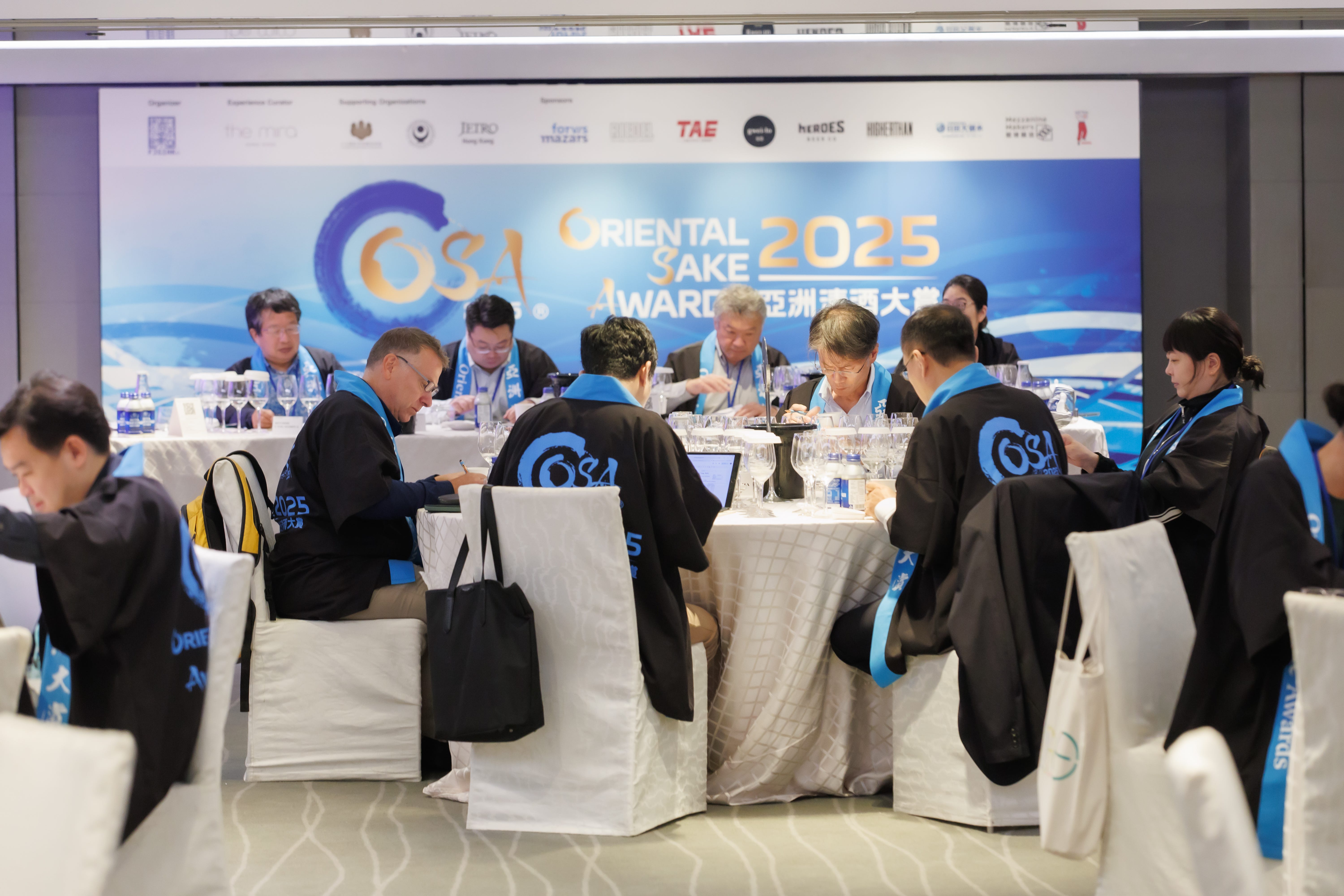
The competition is growing to become one of the largest on the international sake calendar with this year’s event having 531 entries and 227 medals (in total) awarded.
OSA brought together 39 judges from Hong Kong, Japan, China, Taiwan, Macau, Korea, Singapore, and Australia.
Winners from the eleven categories include:
Ginjō (Light & Clean): MIYASAKA Yamada Nishiki, Nagano (Miyasaka Jozo)
Ginjō (Light & Aromatic): Sanran Junmai Daiginjō, Yumesasara Tonoike Shuzōten Tochigi
Ginjō (Rich & Aromatic): Yoakemae Junmai Daiginjō Ono Shuzōten, Nagano
Junmai (Light & Clean): Kinoene Junmai Yawaraka Chinomegumi, Iinuma Honke, Chiba
Junmai (Rich & Umami): Bou Kimoto Junmai Akita Sake Komachi, Tonoike Shuzōten, Tochigi
Honjōzō: Atagonomatsu Senretsu Karakuchi, Niizawa Jozoten, Miyagi
Sparkling: Urakasumi12 Sparkling Silver Label Urakasumi, Miyagi
Namazake: Kid Shibata’s Junmai Daiginjō be fresh!, Heiwa Shuzō, Wakayama
Aged Sake (Elegant type): SAKE HUNDRED RAIHI, Clear Inc, Tokyo
Aged Sake (Rich type): Yumenokanbai Ko-shu 2000 Tsurumi Shuzō, Aichi
Special Type: Maboroshinotaki Funky Mabotaki, Mikunihare Shuzō, Toyama
Full list of winners is available here in English.
JG: Warm sake and hot sake are still a bit under the radar overseas, although enjoying sake in that way is kind of returning to its erstwhile former semi-glory in Japan. I think that there are a couple/few reasons for that. One, overseas sake promoters are still trying to get people to approach sake, and simplifying it with “one temp suits all” is surely infinitely easier. Also, there is no real history to pairing food with warm beverages, at least in the west. And lastly, the toys, the tools, the accoutrements for warming sake and serving o-kan (warmed sake) call for space, care and training. So I get it. But I am still hopeful that warm sake will become increasingly popular the world ‘round.
Kochi- The brewing season has begun in Kochi Prefecture, using fresh “early-harvest” rice.
As we all know, sake brewing is generally carried out over the winter months, however some breweries in the prefecture begin early each year using rice harvested over the summer.