How much do you need to retire on $7,000 per month?
In previous posts on my site, I highlighted how much you need to save to retire on $5,000 per month AND $6,000 per month.
I’ll link to those detailed case studies at the end!
But what about if you wanted to spend more, especially with inflation being higher??
What about spending $7,000 per month = a tidy $84,000 after-tax per year rising in spending every single year?
Well, inspired some reader questions who like free case studies on my site this post will tell you what you need to have invested to spend $7,000 per month starting in your early 50s for decades on end.
How much do you need to retire? It’s all about what you intend to spend
I believe retirement planning is a multi-step process that evolves over time.
The process is simple but not always easy:
- You need to know what you intend to spend / what are your spending goals.
- You need to know your income sources to meet those needs, and beyond that,
- You need to include some wiggle-room and some buffer built-in.
I’ve already determined these things for us. I wouldn’t be retiring in 2026 myself if I didn’t have those answers!
I’ll share how I can help you out with your answers at the end of this post as well…
Aligned to #3 above, I believe you also need to strongly consider how you might be forced to navigate any sequence of returns risk.
Why is mitigating sequence of returns risk important?
Because timing in life – matters.
As you know, a retirement portfolio generally isn’t just a lump of cash. Any well-constructed retirement portfolio is very likely to hold a mix of cash/cash equivalents, some fixed income and some equities that when combined meet spending needs and deliver income and growth to thwart inflationary risks.
Inflationary risks that are happening in real-time today for all of us.
Ideally, the growth will replenish at least a portion of what you withdraw over time, making your withdrawals more sustainable over the period of time you’ve planned for…
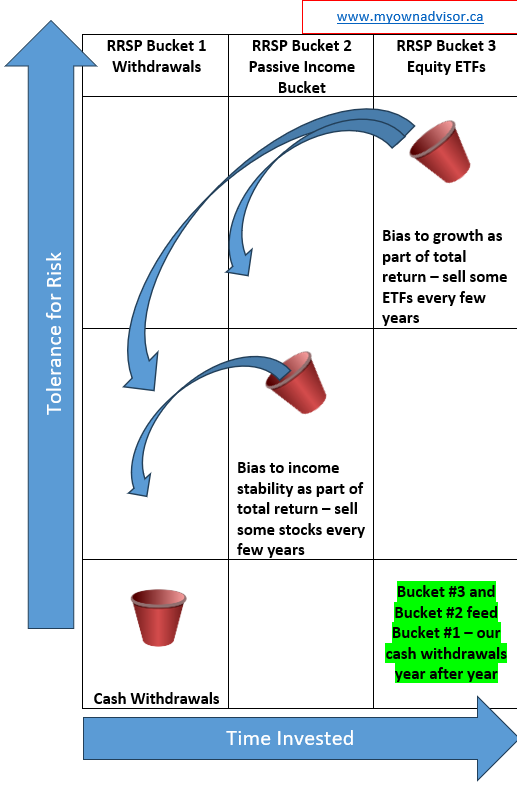
Here is my visual of our RRSP Bucket Approach:

A major market drop or a poor sequence of market returns typically in the first five (5) years or so of retirement can really cripple any income needs and wants.
If you must tap equities in your portfolio to cover your expenses, and that portfolio is losing value as well, that’s a double-hit of problems.
This creates two major problems if you need to do that:
- Not only do you need to drain your equity portfolio faster during a poor series of market returns,
- It leaves your portfolio lower in value that can generate future growth and future returns if/when the market recovers.
Check out this visual aid from BlackRock to clarify this risk:

Source: https://www.blackrock.com/us/individual/literature/investor-education/sequence-of-returns-one-pager-va-us.pdf
How much do you need to retire on $7,000 per month? Ask yourself questions…
As you explore your retirement income plan here are some questions to consider:
- Can you pay off your mortgage (and all other debts) before you retire?
- How much travel or discretionary expenses do you have planned beyond base expenses?
- What health issues might derail your plan?
- Do you have any ambitions to change your location, if only temporary, or to downsize your home?
Stephanie and Zack want to spend $7,000 per month in retirement – how much is enough?
In our case study today, Stephanie and Zack want to retire younger than most. Kudos!
Like other free case study examples on my site, this couple has already answered some of the questions I flagged above:
- No, they will not have any debt when they retire.
- Yes, they will have some travel expenses in retirement.
- Yes, they have considered spending buffer.
- No, they will not relocate nor downsize anytime soon.
My couple profiled today has worked hard to maximize contributions to their Tax Free Savings Accounts (TFSAs) and Registered Retirement Savings Plans (RRSPs). They needed to. Without any workplace pensions to rely on and the desire to retire early, funding retirement is on them.
Can they retire at age 51 with what they have?
How much do they need to retire on $7,000 per month, increasing their spending year-after-year?
Here are Stephanie and Zack’s assumptions…
Retirement Assets/Liabilities and Assumptions:
- My fictional couple wants to retire next year in 2026 at age 51.
- They have zero debt.
- Like many people these days, they remain worried about inflation, so we’ve assumed they want to spend 3% higher year-after-year until age 95. (May not happen of course in reality but they want assurance from their portfolio they can make their money last.)
- Stephanie and Zack keep cash but they also hold some GICs as extra cash-related insurance. They keep their portfolio in a 90/10 stock/fixed income mix. While they own a few individual stocks they are mostly index investors. We’ll assume with their long-term 90/10 asset allocation they can earn at least 5.5% annualized returns going forward throughout retirement via a total return approach. (Note: total return is the sum of dividends and capital gains and interest earned.)
- Because they fired their wealth manager years ago they pay next to nothing in ongoing money management fees. 🙂
Other Assumptions:
- Stephanie and Zack will keep some cash on hand, but not very much, about $15k in total. They intend to rely on these assets if they need some cash in a pinch. I have not included this amount in their drawdown plan.
- They will both take CPP at age 70 = 50% of max contributions (because they are early retirees and had only a dozen or so maximum contribution years towards this government benefit).
- They will both take OAS at age 65 to take pressure off RRSP/RRIF withdrawals.
- Stephanie and Zack own their home in Nova Scotia. They have no plans to sell their house near-term nor downsize. Like some Canadians, they see their house at age 80+ as part of their “nuclear” plan to fund any older-age retirement income needs.
- We’ll assume their Nova Scotia home is worth about $650,000 these days. They anticipate the real estate should appreciate by 2% at mininum over the coming decades. Maybe it’s more, who knows?!
- A reminder they have no workplace pensions at all.
- CPP and OAS are both indexed to inflation.
- Finally, Stephanie and Zack have amassed a lofty ~$1.7 million in portfolio assets at the time of this post. The majority of their assets are inside their RRSPs, the rest remains inside their TFSAs ($250,000 combined to date) and non-registered assets owned between them.
- They will also work because they want to and likely need to meet their retirement spending needs rising with inflation every year.
- Stephanie is going to continue to teach yoga to earn about $24,000 per year before taxes. Zack has decided he wants to drive for Uber every few weeks. He also believes he can earn up to $24,000 per year in his 50s and 60s. I’ve assumed they will stop this hobby income by age 65 when their OAS kicks in.
How much do you need to retire on $7,000 per month results
After running some math, I can conclude Stephanie and Zack can retire at age 51.
If they are both working part-time jobs thoughout their 50s, earning some hobby income, they have plenty of assets to spend $7,000 per month and more with time based on $1.7 million invested.
You can see from the financial assets chart below that Stephanie and Zack essentially “die-broke” at age 95 with only the real estate asset left to manage for the estate – as the real estate itself appreciates quite a bit over time worth millions in 40+ years.

When it comes to cashflow, be warned with 3% sustained inflation, spending needs and wants go WAY up over time which may or may not be realistic. Spending tends to taper off as you age and move into your “slow-go” years.
That said, there are long-term healthcare funding risks for every individual or couple to consider.
- Spending $84,000 early next year in 2026 is a good start to their retirement, but with 3% higher inflation,
- That’s going to be like spending about $130,000 per year at age 65, and with 3% sustained inflation,
- That’s going to be like spending $260,000 per year at age 88.
Is that realistic? That may or may not happen at all.
Inflation as Larry Bates highlights here is one of three wealth-killers to watch out for.

What happens if Stephanie or Zack don’t work until age 65? Can they still retire on $7,000 per month?
Not really, there are risks.
Stephanie and Zack will run into a modest cashflow shortfall if their side-income assumptions don’t work out in their 50s and 60s like they think.
Yet it’s not all doom-and-gloom.
Even if only one of them works in their 50s, earning $24,000 per year for a few years, our couple can still spend $78,000 per year (on average) starting at age 51 earning 5.5% but they might incur a spending shortfall in their late-80s.
They will need to sell the house if that happens potentially worth millions.

How much do you need to retire on $7,000 per month without working at all at age 51?
In playing with some numbers I can conclude the following:
- Anyone in their early 50s with a portfolio close to $1.7 million has done a. very well and b. is likely going to fulfill their retirement spending needs and wants approaching $84,000 per year after-taxes for decades on end and should not worry about outliving their money or their house.
- If folks want to spend more than this, they will need to save more than this.
- Better still, if people can be flexible with their spending / discretionary travel expenses, consider spending more in “good market years” like 2025 has been but also taper spending as needed in bearish markets when they occur – Stephanie and Zack or any other couple should be just fine.
Spending in retirement doesn’t seem to be a straight-line for any individual or couple, Stephanie and Zack are no exception.
This makes the process of planning and re-planning your retirement income needs essential for long-term success since many Canadians won’t have this much to retire on…
How much do you need to retire on $7,000 per month results – drawdown ideas
Most individuals or couples, who have been smart and focused on maxing out contributions to their TFSAs and RRSPs for decades on end (like Stephanie and Zack have), even if they have no workplace pension whatsoever, should be just fine in retirement with such a nest egg.
The keys beyond saving and investing inside your TFSAs and RRSPs with mostly equities of course is keeping your money management fees away from greedy financial piranhas, being very selectful of your retirement drawdown order, and ensuring you’re smart with CPP and OAS benefits decisions.
Any retiree retiree should build-in the flexibility to ratchet-down their spending wants in retirement, for potentialy a few years if needed, just in case market returns like 2024 and 2025 year to date are not as favourable.
Thanks for your readership and more case studies to come in 2026.
I look forward to your comments, as always, on my content.
Mark
Disclosure: this case study and all images are for illustration and education purposes only, which is not direct advice but may be helpful to model your retirement income plan after.
Related Reading:
How much do you need to retire on $5,000 per month?
How much do you need to retire on $6,000 per month at age 50?
Here is my Financial Independence Budget.
Need any help or support with your retirement projections? If you need some help forecasting your retirement decumulation puzzle (including how to efficiently withdraw from your retirement accounts), or figuring out if you have enough saved from any portfolio you’ve constructed consider reaching out – I can support you with my partner with our low-cost services at Cashflows & Portfolios.
Mark
Mark

My name is Mark Seed – the founder, editor and owner of My Own Advisor. As my own DIY financial advisor, I’ve reached financial independence. Now, I share my lessons learned for free on this site. Join the newsletter read by thousands every week.