To move beyond conclusions drawn from the world one knows, researchers must look at human-animal relationships more broadly. At Oxford, the Palaeogenomics and Bio-Archaeology Research Network (PalaeoBARN), led by Greger Larson, investigates how animals have moved, bred, and lived alongside humans. One branch of this work, led by researcher AB Siegenthaler, reexamines animal burials that fall outside familiar categories of pets and livestock, considering dogs, snakes, birds, pumas, and cases like the Hopewell bobcat. These burials suggest relationships that resist explanations of utility, ritual, or ownership.
DOGS IN IRON AGE BALTICS
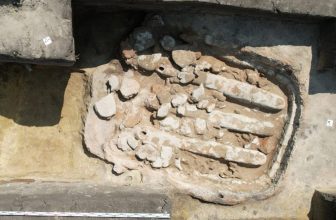
My work with Oxford’s PalaeoBARN, in collaboration with researcher Eduards Plankājs at the University of Latvia, turns a similarly careful eye to roughly 1,000-year-old Iron Age cemeteries where humans and dogs were buried together. In grave after grave of different Iron Age tribes in modern-day Estonia and Latvia, canine skeletons were placed beside human ones, sometimes fully intact, sometimes curled close, sometimes resting at a person’s feet.
To understand the lives behind these burials, our team draws on multiple lines of evidence. We analyze ancient DNA to determine whether the dogs belonged to local lineages or came from elsewhere, tracing patterns of ancestry and migration. We measure chemical isotopes preserved in their bones to answer questions of diet and mobility: Did these animals eat like the people they were buried beside? Did they travel together? And we study their skeletal wear and healing to see how their bodies responded to labor, injury, and age.
Each method offers a window into the experiences of a past creature. Together, these data build a more complete understanding of not just why these dogs were buried with humans, but also how these dogs lived with humans.
Nevertheless, even with all these biological and biomolecular data, there remain many possible narratives produced—or also limited—by archaeologists’ own worldviews or drawn from ethnographic examples. The dogs may have been symbols of status, their bodies placed in the graves of elites with the same intention as a finely worked blade or imported vase. Perhaps the canines were revered as spiritual guardians, buried to protect and guide a community.
Or I might imagine a man and a dog with more closely entangled lives. They shared food and played. The dog slept at the foot of the man’s bed. They grew old together. Upon their deaths, someone made the decision to bury the man and dog as they had lived, side by side.
THE STORIES WE TELL
Whether we imagine status symbols, spiritual guardians, or lifelong companions, each interpretation rests on the same fragments of evidence. Scientific techniques provide archaeologists with increasingly powerful tools for illuminating the past, but there is an often-unrecognized malleability in our interpretations.