
The ITV Whistleblower Didn’t Shock SEND Families. It Confirmed What Many Have Been Saying for Years

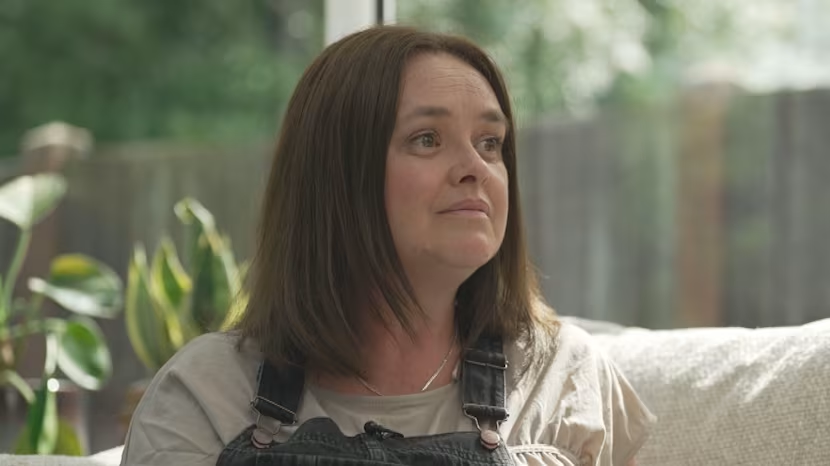
Last week, millions of people watched an ITV News investigation in which an anonymous EHCP caseworker described a culture that should alarm anyone who believes disabled children deserve a fair education.
The whistleblower alleged that managers encouraged staff to delay support, avoid creating paper trails, withhold information and keep families at arm’s length because delay saved money.
For much of the public, it was a shocking story.
For SEND families, it wasn’t.
It was confirmation of what we knew was happening all along.
Across social media, parents from every corner of England responded in remarkably similar ways.
“That happened to us.”
“This could have been our council.”
“Nothing in that report surprised me.”
When thousands of people who have never met one another, dealing with different local authorities, immediately recognise the same behaviours, something much bigger than one whistleblower is unfolding.
A Broken System—or Something More?
Government frequently tells us that the SEND system is “broken.”
That may be true.
But “broken” is an incomplete explanation.
A broken system suggests accidental failure.
The experiences described by thousands of families suggest something different.
Parents are not simply describing delays.
They describe information being withheld.
Emails going unanswered.
Professional evidence apparently being ignored.
Complaints becoming the only way to obtain answers.
Tribunals becoming the route through which lawful decisions are finally made.
That isn’t simply a shortage of resources.
It raises questions about governance.
And that distinction really matters.
If a child waits because there genuinely isn’t an available specialist placement, families may be frustrated, but they understand the challenge.
If a child waits because processes are not followed, information isn’t shared or decisions appear inconsistent with the available professional evidence, that is an entirely different issue.
One is about capacity.
The other is about accountability.

Measure What Matters has already told us this story
The ITV investigation did not emerge in isolation.
Campaign group Measure What Matters has collected more than 1,200 testimonies from families across 134 local authorities.
Their findings paint a remarkably consistent picture.
Parents describe obstruction rather than collaboration.
Conflict rather than partnership.
A system that too often feels designed to wear families down instead of helping children.
Those testimonies come from different parts of England.
Different councils.
Different schools.
Different professionals.
Yet the themes are strikingly similar.
At what point do repeated individual stories become evidence of a wider pattern?
My Family’s Experience
When I watched the ITV report, I couldn’t help feeling that the whistleblower could just as easily have been describing our own experience with Nottinghamshire County Council.
My daughter could no longer access mainstream education.
Two independent Educational Psychologists had separately concluded she should not return to mainstream school.
Both recommended specialist provision.
The evidence was clear.
Yet mainstream remained the placement named in her Education, Health and Care Plan.
Throughout the process, we repeatedly asked Nottinghamshire County Council to provide consultation responses from schools we asked them to contact.
Some mainstream school consultation responses appeared on the EHCP portal.
Others, from Independant specialist schools did not appear on the EHCP portal.
Those documents would almost certainly have been relevant had we proceeded to Tribunal.
Despite repeated requests—both personally and through our solicitor—the responses were not provided.
It was only after I submitted a formal complaint that Nottinghamshire County Council acknowledged it had failed to respond appropriately.
During that complaints process, the Council disclosed that LA maintained specialist schools had already been consulted.
We had not requested that any LA maintained specialist schools be consulted about offering a school place to my daughter, because there are none suitable to meet her needs accessible from where we live.
That admission changed everything.
If Nottinghamshire County Council were consulting LA maintained specialist schools, and two Educational Psychologists had already concluded specialist provision was necessary, why was mainstream school still being named on her EHCP when it was finalised?
The LA maintained school could not offer our daughter a place because it was full.
The most suitable school with a space was an independent specialist school, and they confirmed they could meet need.
Why were complaints necessary?
Why was legal representation necessary?
Why did it take formal challenge before the decision changed?
Following the complaint, Indie’s EHCP was amended to name the independant specialist school we had identified.
The outcome was ultimately the right one.
Many families have no choice but to wait for a date for tribunal to challenge these decisions, which could mean their child is out of school for another 18 months.
LAs often concede just a few days before the hearing, because tehy know the evidence is not in their favour.
These delays should never have happened, and should not be happening.
Parents should not need to become lawyers
One of the most striking things about the SEND system is how quickly parents become experts in education law.
Not because they want to.
Because they have little choice.
Parents learn legislation.
Read case law.
Study the SEND Code of Practice.
Pay for independent reports.
Seek legal advice.
Submit complaints.
Prepare for Tribunal.
All while trying to support children whose education, mental health and confidence are often deteriorating.
That should never be considered normal.
Yet it has become so commonplace that many families now expect conflict before they expect support.
Trust cannot be demanded
The Government’s proposed SEND reforms ask families to place greater trust in local authorities and schools.
But trust cannot be rebuilt simply by asking people to trust.
Trust is earned.
It requires transparency.
It requires accountability.
It requires acknowledging when systems have failed—not only that they have failed.
Many parents feel that Government has been willing to acknowledge increasing demand and financial pressures, while being far less willing to acknowledge the experiences families describe when navigating the system itself.
That distinction matters enormously.
Because the issue is no longer simply whether the system works.
It is whether families believe it is operating fairly.
The question Parliament must answer
The ITV investigation leaves us with one unavoidable question.
If families across England have been reporting remarkably similar experiences for years, why has no independent national investigation taken place?
Were these warnings missed?
Were they dismissed?
Or were they simply accepted as an unfortunate consequence of an overstretched system?
Whatever the answer, disabled children deserve better.
Reform must begin with honesty
I believe education in England needs reform.
Schools need better funding.
Teachers need more support.
Class sizes need to reduce.
Specialist provision needs investment.
Children should receive help much earlier, before an EHCP becomes necessary.
None of that is controversial.
But meaningful reform cannot begin by reducing legal protections while leaving unanswered questions about how existing legal duties have been implemented.
The Children and Families Act already provides a strong legal framework.
The challenge has too often been ensuring it is consistently followed.
That should be the starting point.
Not weakening the rights of children whose families already struggle to secure support.
This is why trust has broken down
SEND families are often accused of being resistant to change.
I don’t believe that is true.
Most parents desperately want change.
What they do not want is to be asked to surrender legal protections before Government has acknowledged why those protections became necessary in the first place.
The ITV whistleblower did more than expose alleged failings inside one local authority.
The report held up a mirror to a system that thousands of families recognised immediately.
That should concern every politician involved in SEND reform.
Because until Government is prepared to confront how the system has failed—not simply say that it has—trust will remain broken.
And no reform, however well intentioned, will succeed without it.
Editor’s Note
Following publication of this article, I have written to my Member of Parliament, Nottinghamshire County Councillors and senior council leaders asking them to support:
- An independent national investigation into local authority SEND practice.
- A review of late Tribunal concessions and decision-making.
- Stronger protections for SEND whistleblowers.
- Greater transparency around EHCP consultations and decision-making.
- A commitment that legal protections for disabled children will not be weakened until these issues have been independently investigated.
If you are a parent, professional or whistleblower who recognises the issues described here, I encourage you to contact your own MP and ask the same questions.
Discover more from Zena’s Suitcase
Subscribe to get the latest posts sent to your email.


