

“In these terrible happenings you cannot be neutral now,” Meridel Le Sueur wrote of Minneapolis in 1934. “No one can be neutral in the face of bullets.”
Le Sueur, a Communist writer whose work roamed through fiction, journalism, history, and poetry, was describing what would become known as Bloody Friday, a day of police terror unleashed on strikers fighting for union recognition in the Minneapolis trucking industries. In a pivotal moment in the third and final strike of the year, police fired on strikers in the Market District (now the Warehouse District), killing two strikers and wounding over sixty. Henry Ness, a striker on the picket lines, was shot at point-blank range. As he fled, the cops continued to fire. Doctors later removed thirty-eight slugs of buckshot from his body. He died on July 21, a day after Bloody Friday. John Belor, another striker shot by police, died in early August.
Ness and Belor were shot four miles from where Immigration and Customs Enforcement (ICE) agent Johnathan Ross murdered Renée Nicole Good on January 7, 2026, two and a half miles from where Border Patrol agents murdered Alex Pretti seventeen days later, and a little over four miles from where Minneapolis police murdered George Floyd in 2020. Each of these state killings fueled mass movements. Ness became known as a “martyr of labor’s struggle,” and as many as fifty thousand people took to the streets of Minneapolis during his funeral. The murder of George Floyd became the catalyst for one of the largest uprisings in U.S. history, a long hot summer of revolt that burned down the Third Precinct in Minneapolis and briefly sent Trump into a bunker as protestors amassed outside the gates of the White House lawn.
In this sequel to Trump’s first term, ICE’s so-called “Operation Metro Surge” in the Twin Cities looks like vengeance for the George Floyd uprisings and its militant reckoning with the legacies of racism and police brutality. While the clarion call of 2020 to defund and abolish the police failed, its impulse now survives in the calls to defund and abolish another law enforcement agency: ICE. Following the killing of Renée Nicole Good, labor, community, and immigrant justice organizers called for a “general strike” to protest ICE terror in Minneapolis, “a day of no work, no shopping, no school.” On January 23, at least fifty thousand people took to the subzero streets while as many as a thousand businesses closed for the day and a hundred clergy members were arrested for disruptions at the airport (a key logistical node of the deportation regime).
While the sacred words of “general strike” were invoked, the reality was somewhat different. Minnesota’s “Day of Truth and Freedom” was a remarkable show of solidarity against ICE’s siege, but not a work stoppage shutting down multiple industries and forcing employers and the state to come to the bargaining table. Indeed, major corporate employers in the Twin Cities like UnitedHealth Group, Target, Best Buy, and US Bancorp made it through the one-day strike unscathed. As Aru Shiney-Ajay, a Minneapolis organizer with the Sunrise Movement, put it in an interview, “Real general strikes that can shut down an economy don’t happen in a week— it’s going to take a lot more work. But what we did was incredible.” The killing of Alex Pretti one day after the “Day of Truth and Freedom” only further galvanized efforts to turn the call for a general strike into reality.
The Minneapolis mass strikes of 1934 may look like a distant event from a bygone era of labor insurgency, only connected to the present through a shared history of geography. But the mass strikes also resonate through police violence against workers, community organizing tactics and the power of solidarity. Emerging out of the depths of the Great Depression, the mass strikes revealed a profound reality: organized working people can win, even against the combined forces of employers, police terror, capitalist vigilante groups, conservative union leadership, mainstream media, and fickle liberal politicians. Indeed, the mass strikes broke the citadel of the “open shop”—upheld by the powerful Citizens’ Alliance—and turned Minneapolis into a union town.
What began as a limited labor struggle in the trucking industry expanded to encompass an entire city. Solidarity became the fuel to spread the fire: boycotts, sympathy strikes, mutual aid, other workers lending their skills to the strike effort, whether that meant factory workers running strike kitchens, volunteer doctors and nurses providing care to strikers wounded by the police, or farmers donating food to feed striking families. The mass strike, then, was not just a movement against a world of exploitation and injustice but also an enactment—however briefly—of a new kind of world rooted in what Le Sueur called “communal sensibility.”
“Make Minneapolis A Union Town”
The Minneapolis mass strikes emerged in a moment of widespread discontent; from coast to coast, in the city and the countryside, uprisings erupted out of the desperate conditions of the Depression. The yearbook of revolt included a general strike led by longshoremen in San Francisco, mass strikes in the auto supply industry in Toledo, and the largest textile workers strike in U.S. history in the eastern half of the country. These were anything but peaceful affairs, with over fifty workers dying in labor struggles by the end of the year.
Coming into office a year before the strikes, the Roosevelt administration was just beginning its experiments in statecraft with the New Deal. The passage of the National Industrial Recovery Act in 1933 and its famed Section 7a gave workers “the right to organize and collectively bargain through representatives of their own choosing,” and free from the “interference restraint” and “coercion of employers.” But, as the strikes in Minneapolis would soon illustrate, it was anything but clear how the state might interfere in labor struggles and guarantee these rights.
Led by the General Drivers’ Union Local 574, the mass strikes of 1934 grew out of the Minneapolis coal yards. At the beginning of the year, the General Drivers’ Union was a small local affiliated with the International Brotherhood of the Teamsters. The Teamsters still clung to a conservative notion of craft unionism and imposed a set of bureaucratic hurdles to limit any strike action (none of the three strikes in 1934 received the official blessing of Teamsters leadership).

But Local 574 also counted among its members a small cadre of revolutionary communists connected to the Trotskyist Communist League of America. The Trotskyist Teamsters, while holding no formal leadership positions within the union at the time, played a decisive role in organizing and leading the strikes. The Trotskyists possessed organizing skills and experience, a keen sense of what was possible in Minneapolis, and an ability to learn from the rank-and-file and widen the circumference of struggle. In Revolutionary Teamsters: The Minneapolis Truckers’ Strikes of 1934, Bryan D. Palmer describes this as a “dialectic of leaders and led.” “Leaders relied on and learned from the rank-and-file,” Palmer writes, and “the rank-and-file relied on and learned from the leaders.”
The Minneapolis strikes unfolded in a unique terrain of social struggle: not just Trotskyist communists organizing within a conservative union but also a state government administered by a third-party and a local labor movement long suppressed by a powerful employers’ association. The Farmer-Labor Party, supported by a coalition of labor unions, populist farmers, socialists, and middle-class progressives, entered the governor’s office in 1931 with the election of Floyd Olson. A son of Scandinavian immigrants and a former member of the Industrial Workers of the World, Olson was prone to rhetorical flourishes that flirted with radicalism and anti-capitalist sentiments—but the militancy of the strikes would expose the contradictions of these nominal commitments.
If the Farmer-Labor Party and the New Deal administration seemed to offer new possibilities for the local labor movement, any strike in Minneapolis still had to contend with the powerful Citizens’ Alliance. Formed in 1903, the Citizens’ Alliance was an employers’ association committed to keeping Minneapolis a citadel of the “open shop.” Far from an isolated phenomenon, the Citizens’ Alliance was one example of what historian Chad Pearson has described as “capital’s terrorists”: employer-led groups keeping labor down through scabs, surveillance, and spies, and often operating in conjunction with the police. Le Sueur described the Citizens’ Alliance as the “fascist-minded middle class backed by the two biggest banking interests in the Northwest [Midwest], a vigilante organization in embryo.” Nellie Stone Johnson, a Black civil rights and labor organizer in Minneapolis, later referred to the “anti-Teamster feeling” among the “power structure” of the city as “rampant and wicked.” As Johnson put it, “they were as antihuman as you could be then.”
The first strike in February shut down most of the coal yards in Minneapolis and revealed a militant union willing to contend with the “power structure” of the city. Strikers locked their trucks in the coal yards and formed “flying squadrons” to stop deliveries by scab trucks. These flying squadrons even seized coal trucks and dumped their loads in working-class neighborhoods to be freely gathered by residents. The February strike was a success, forcing employers to recognize the union and agree to a slight increase in wages.
From the first strike in February to the final strike in August, the General Drivers Union built what Palmer describes as an “edifice of solidarity.” The organizing efforts extended beyond the Teamsters union to incorporate the unemployed, a Women’s Auxiliary movement, farmers, and other workers in the labor movement. In a prelude to the industrial unionism that would propel the organizing campaigns of the Congress of Industrial Organizations (CIO), the union broke away from the old strategies of craft unionism and worked to organize all workers in the trucking industry (including the “inside workers” at warehouses). A spring organizing drive following the February strike brought membership up to 3,000; by the summer, membership more than doubled and reached 7,000, a remarkable increase for a union that only counted seventy-five members in the spring of 1933.
The “edifice of solidarity” also included an old garage on Chicago Avenue that the local turned into strike headquarters. Installing stoves, sinks, and counters for a kitchen and commissary, along with beds for strikers to rest in between picketing and even an area devoted to emergency first aid, the old garage became what one observer described as “a perpetual picnic.” The family of Nellie Stone Johnson, prosperous Black farmers in Pine County, Minnesota, donated potatoes and rutabagas to the strike kitchens. The Women’s Auxiliary movement, both reflecting and transgressing traditional gender norms, was key to keeping the strike headquarters running. While the main roles of the Women’s Auxiliary were relegated to critical if gendered notions of “women’s work”— cooking and serving food, fundraising, and nursing—women also fought on the front lines of the picket and led protests outside of city hall.
The strike was not just a refusal of labor but a reorganization of everyday life. The success of the strike depended on the work of reproducing social existence through cooking, health care, media, transportation, and self-defense. Le Sueur, who volunteered in the Women’s Auxiliary movement, noted how the work in the strike kitchens was no “church supper.” Feeding thousands of people a day, with volunteers working twelve-hour shifts, Le Sueur described the kitchens as “organized like a factory.” The harsh discipline of the factory was put to new ends, feeding striking workers and sustaining a prolonged social struggle.
Collective self-defense became another notable tactic of the strikers. The second strike in May found the union skirmishing in the streets with police and the “special deputies” enlisted by the Citizens’ Alliance. The “special deputies” included Greek frat boys, professionals, patriots, golfers, and playboys. But this “law and order” brigade failed to break the strike. May 22 would become known as the “Battle of Deputies Run,” so named because the “special deputies” who had eagerly signed up to bust the heads of workers fled as the strikers fought back. When the street battles appeared in newsreels in movie houses, audiences broke out in cheers at the plot reversal.
The May strike also found the union building off the tactics from the February strike to disrupt transportation in the city. With the support of farmers, already familiar with road blockades from the Midwestern milk strikes of 1932-33, around fifty entry points to the city were blocked off. With the “flying squadrons” continuing to seize scab trucks and drive them back to strike headquarters, strikers also parked delivery trucks at gas stations, locking the doors and walking away to disrupt the flow of gasoline needed to keep the city running.
Governor Olson, while aiming for “neutrality” between the unions and employers, still put the National Guard on call as potential strikebreakers. Even with a third-party in power with labor in its name, there were clearly limits to reform from above. As the leaders of Local 574 realized from the beginning, Olson and the Farmer-Labor Party were no friends of the struggle. The Trotskyist organizers knew they had to strategically maneuver among Olson and the Farmer-Labor Party, taking advantage of rhetorical support for the workers while also navigating their “law and order” devotions.
For the Citizens’ Alliance and their supporters in the local press, however, there was no distinction between Olson and the Farmer-Labor Party, the union and their leaders, and the local Communist Party (who played no active role in organizing the strikes and criticized the Trotskyist dissidents from the sidelines). For the Citizens’ Alliance, the strike was understood in apocalyptic terms, a prelude to a communist takeover of Minneapolis. As the Trotskyist James Cannon pointed out, the rabid anti-communist barking was a rhetorical ploy, a means to frame up “every worker who fights for his rights.” This form of magical thinking, a means to beat back modest demands for union recognition, increased wages, and an end to “police terror against workers,” did not die with the Depression. “Red” carried the same kind of amorphous encapsulation that the “radical Left” holds for MAGA stalwarts today. But the Trotskyist organizers knew the terrain of struggle was far more complex; the union had to contend with the leaders of the Farmer-Labor Party, union officialdom, federal mediators, police and National Guardsmen, the local Communist Party, and the Citizens’ Alliance.
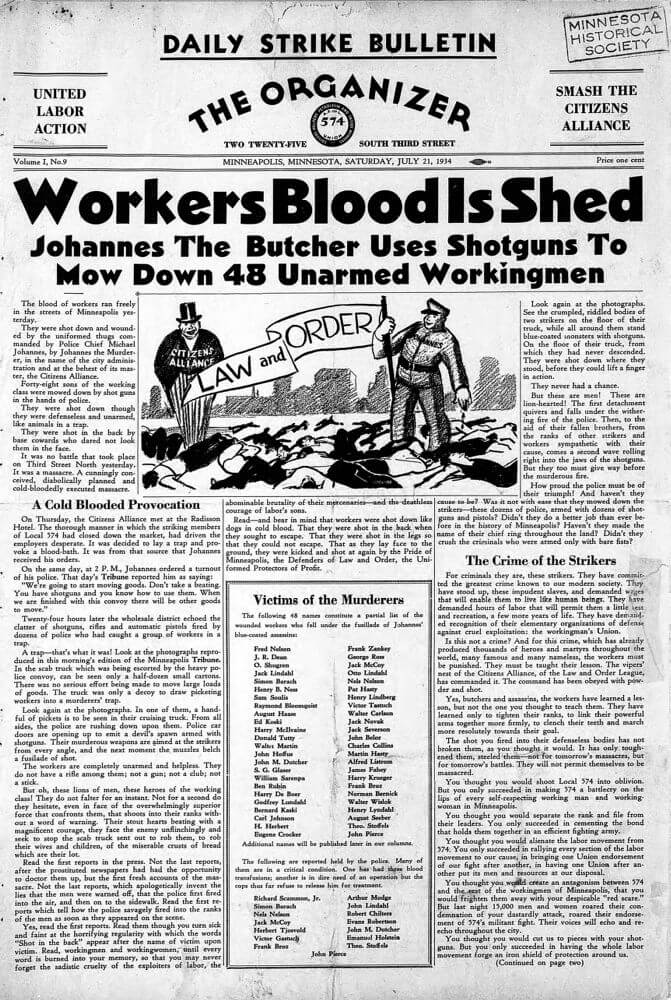
The strike, then, was not just a battle in the streets but also in print. To counter the relentless Red-baiting of the well-heeled Citizens’ Alliance and its supporters in the local press, the union began publishing its own daily strike newspaper: The Organizer. With a circulation approaching 12,000, the daily provided strikers and their supporters with key updates on the strikes and functioned as a kind of force field against the Red scare tactics of the local press. The strike was, indeed, led by Trotskyist communist organizers, but this did not seem to matter for rank-and-file workers. With an unflinching focus on gaining union recognition and improving the material conditions of workers, in addition to encouraging democratic participation in the union, the revolutionary Teamsters maintained the support of the rank-and-file throughout the strikes.
During the final strike in July, Olson’s devotion to law and order revealed itself when he declared martial law and mobilized the National Guard. These actions were aimed at breaking the strike and getting the streets moving again with commercial traffic through a permit system and National Guard convoys. The National Guard also raided and occupied strike headquarters, arresting organizers to immobilize leadership and break the strike. Over one hundred and sixty strikers would be arrested and held at a military stockade christened “Olson’s Resort.” But this attack only revived the furies of the strikers who disrupted scab deliveries, seizing trucks and dumping their goods in working-class neighborhoods. And, despite the raids, The Organizer continued to go to the press with the editor’s decrying Olson’s actions: “Answer Olson’s military tyranny with the General Strike of Protest!” Olson, realizing his plan to occupy strike headquarters and arrest leadership failed to bring the strike to an end, shifted gears. He revised the permit requirements and instigated a raid on the headquarters of labor’s enemies—Citizens’ Alliance. But this “both sides” approach was anything but symmetrical. While National Guardsmen arrested union members, occupied strike headquarters, and enabled scab deliveries, they simply seized evidence from the Citizens’ Alliance. No bosses were arrested or charged.
After half of a year of turbulence in the trucking industries, the conflict concluded with a vote for union representation. Workers voted to be represented by Local 574 in seventy-seven firms in the trucking industry, a notable achievement considering the May strike only targeted eleven firms. The Citizens’ Alliance was defeated, and Minneapolis became a rallying call for workers around the country. While the Citizens’ Alliance regrouped and formed new associations and affiliations, including with the fascistic Silver Shirts, members of the General Drivers’ Union responded by forming the Union Defense Guard. Led by Ray Rainbolt, a member of the Sioux Nation who played an active role in the 1934 strikes, the Union Defense Guard functioned as an antifascist patrol not unlike the patrols formed by the American Indian Movement in 1968 to counter police brutality against Indigenous peoples in Minneapolis.
By the late 1930s, Trotskyist militants were no longer the vanguard of the labor movement; the conservative elements of the labor movement had caught up and changed with the times. But establishment forces within the labor movement—for instance, Teamsters president Daniel Tobin—remained hostile to the radical organizers. Unionization drives by the Teamsters, often following the same tactics of industrial unionism of Local 574, expanded membership from 75,000 in 1934 to over 400,000 in 1939. The Trotskyist Teamsters, however, soon experienced the iron heel of state repression. Passed in 1940, the Smith Act was a pivotal moment in draining the Trotskyists of any place they claimed within the labor movement. Part of the “little red scare” of 1940, the anti-sedition law led to the arrest, trial and imprisonment of Trotskyist leaders.
Despite the remarkable expansion of union membership after the Wagner Act secured the right to organize in 1935, the labor regime of the New Deal entered the postwar period in a position Gabriel Winant has described as “contained and compromised.” The push to remove radical elements from the labor movement did not stop with the “little red scare” of 1940, further accelerated by the Taft-Hartley Act and McCarthyism.
But, as Palmer notes, the Minneapolis strikes still reveal how “trade-unionism, for all of its sorry history of compromise and adaptation to the ethos of capitalism within which it lives and fights, can be turned in different directions.” “Once this is done,” Palmer writes, “trade-unionism can be a vision as well as a power, a force for wide-ranging social change and a nursery of new possibilities of human relations.”
“A Real Emergent World”: Tending the Seeds of Revolt
When one of Le Sueur’s stories on the strikes (“I Was Marching”) appeared in New Masses, she noted how it was aimed at the “many artists, writers and middle class” people who supported the strike but appeared “isolated and emotionally incapable of acting with others.” Le Sueur observed an “awful hunger” to be a part of the “great struggle.” This was, in part, shaped by Le Sueur’s own experience. As she noted in her notebooks in 1934, “There is a strike going on in Minneapolis. I feel anxious…eager to see what is happening… I feel it is a real emergent world… Emergent… coming from the past… into the future.”
Le Sueur’s “I Was Marching” was a paean to the transformative power of solidarity. For the unnamed narrator of the story—anxious and confused about her role when she first entered the strike headquarters—this sense of solidarity emerged out of the “desperate labors” of the strike kitchens and from marching in the streets after the killing of Ness. Le Sueur depicted the funeral march as an enlivening collective experience: “I felt my legs straighten. I felt my feet join in that strange shuffle of thousands of bodies moving with direction, of thousands of feet and my own breath with the gigantic breath. As if an electric charge had passed through me, my hair stood on end. I was marching.” A year after the strikes, Le Sueur would write in her notebooks: “I can no longer live without communal sensibility.”
The spirit of “communal sensibility”—a specter that refuses to be banished to the dustbins of history—appears again in the struggles against ICE in the Twin Cities. Like the mass strikes of 1934, the revolt against “Operation Metro Surge” has encompassed the entire metro area. Through a variety of tactics, the people of Minneapolis have resisted and disrupted the abductions by ICE agents: rapid response teams, noise demonstrations, mutual aid networks, neighborhood block committees, direct encounters with federal agents and facilities, actions against hotels and businesses that enable ICE’s siege, and the old tool of labor: the strike. While the “Day of Truth and Freedom” was not a general strike in the classic sense, it reflected the generalized revolt that has spread across the metro area. And the ICE raids are, after all, a labor issue, a conflict pitting immigrant workers and their defenders against a masked group of fascistic federal agents.
In his study of working-class agency, Mike Davis noted how “prolonged strikes often enlarged the circumference of struggle to include whole communities.” “[T]he life or death of a strike,” Davis wrote, “typically depended on its lateral extension into other shops and related industries; in this sense every strike might be the seed of a general strike.” The work continues to water and tend these seeds, widening the circumference of struggle to abolish the deportation regime and grow new social relations rooted in “communal sensibility.” History may not offer any blueprints for what is to be done, but it does offer a way to think through the present and orient ourselves in a long history of struggles.
Banner photo credit: UE News.


