
Click on image to enlarge.
July 8, 2026, © Leeham News: With the announcement on July 1 that LNA founder and editor Scott Hamilton is on track to retire next year, his third book about commercial aviation—a trilogy of sorts—has been published.
Called 50 Years in Commercial Aviation, Memories and Inside Stories,” Hamilton reveals how he became infatuated with the airline industry. This led to a journalistic career that shifted in focus from general assignments and political reporting to joining the first airline to be certified by the Civil Aeronautics Board for scheduled service in 40 years.
His career in the airline industry was rather short. But he returned to journalism, writing about the airline industry and, later, Airbus, Boeing, and related manufacturers and the supply chain. By the time he retires from aviation journalism next year, he will have spent 50 years affiliated with this dynamic business.
50 Years includes personal stories, never-before-told stories about the airlines, many of which include his experiences and the battles he fought as an aviation journalist. Pursuing information from the Federal Aviation Administration became a federal case. Reporting on the final failure of Pan American World Airways put him on a path of conflict with Delta Air Lines. Diving deep into aircraft transactions and the financial condition of the second Braniff Airways revealed information that gave pause to potential lenders, leading to the airline’s collapse.
Hamilton tells his stories of conflicts with Airbus and Boeing; how Mitsubishi and Bombardier missed opportunities for a global presence; and diversions into personal, non-business events that are part of who he is and what helped shape his writings.
Below is an excerpt from 50 Years in Commercial Aviation, Memories and Inside Stories.
A note from Hamilton: Jon Ostrower observed that today marks the 19th anniversary of the Boeing 787’s rollout. This wasn’t planned, but there must be some kind of karma about this coincidence.
Taking on Delta Air Lines
By Scott Hamilton
Excerpt of “50 Years in Commercial Aviation, Memories and Inside Stories”
© 2026 Scott Hamilton

Scott Hamilton
IN 1991, PAN AMERICAN WORLD AIRWAYS (more commonly known as Pan Am) was in its death throes. This led, indirectly, to a row I had with Delta Air Lines.
Delta began operations as a crop-dusting outfit in the Mississippi Delta (hence the name). Founded by C. E. Woolman, Delta grew into a paternalistic company where layoffs never happened, Woolman knew just about everybody, and the employees were considered part of the Delta “family.”
Successors to Woolman followed in his tradition, until Ron Allen.
Allen was not a popular chief executive officer at Delta Air Lines. Allen, a career employee, moved up through the ranks to become CEO, as did those before him. Allen came through the personnel department, which, considering his lack of people skills, was ironic.
Delta had a policy of never laying off an employee and paying high wages to keep the unions off the property. Even today (2026), the only unions are the ones for the dispatchers (small in numbers) and the pilots (thousands of members). Even the usually militant Air Line Pilots Association was docile at Delta because the company always paid “industry-leading” wages and benefits.
The paternal approach worked well. From World War II until the late 1980s, Delta only lost money once or twice. Employees always pitched in for whatever task was required. Delta’s approach worked well against its arch-rival, Eastern Airlines, which couldn’t seem to figure out how to make money and whose labor relations were among the worst in the industry.
1990 Persian Gulf crisis

Click on image to enlarge.
But Delta’s magic wore thin, and finally wore off altogether, after deregulation
and the Persian Gulf Crisis. Although Delta managed to handle deregulation rather well, by the time Saddam Hussein invaded Kuwait in 1990, spiking oil prices dramatically and scaring the bejeebers out of airline passengers who feared terrorist activities, the airline industry was in real trouble. Pan Am, TWA, Midway, America West, Continental, and Eastern were all in bankruptcy. Everyone else except Southwest was losing money heavily, including Delta.
Delta made a concerted effort to reduce its operating costs. Using Southwest Airlines as the target, whose costs were about 7 cents per available seat mile (or ASM, which is how airlines measure their operating costs), Ron Allen established a cost-cutting program called Leadership 7.5, for 7.5 cents per ASM. Since Delta had lots of long-haul routes which, on a relative basis, costs very little per ASM, the theory was that this, along with cost-cutting measures, would enable Delta to reach the magic 7.5 number and transform itself into a low-cost airline.
Unfortunately, this required cutting not just the fat, but also the meat and the bone. Delta’s vaunted customer service and amenities suffered, and passenger complaints rose sharply. More importantly, relations with employees started to deteriorate, eventually to the point where today there is no longer serious talk of the “Delta Family.” There was no paternal leadership but, rather, leadership-by-the-numbers. Ron Allen was blamed for all this—and rightly so—and his arrogance eventually cost him his job when the Delta Board of Directors declined to renew his contract. But a few will also argue that Ron Allen saved the company in an environment that required dramatic changes.
Pursuing Pan Am assets
It was Allen, detractors said, who salivated for Pan Am assets—against the advice of many on his senior management team, who believed that Pan Am was in such bad shape that any association would threaten Delta’s stability.
Delta’s chief financial officer at the time, Tom Roeck, was known in the financial and analyst community to be particularly opposed to going after Pan Am. Delta at the time was one of the few airlines to maintain an investment-grade credit rating. This was not just a source of pride for Delta. The higher the investment grade, the less costly it was to borrow money and finance airplanes.
Delta had one of the lowest interest-rate structures of any airline in the U.S. It could borrow a billion dollars on an unsecured basis. The debate over the Pan Am route system was controversial. United had already bought the crown jewels of Pan Am: the Pacific routes and the London Heathrow hub-and-spoke authority. What was left in Europe was Pan Am’s Frankfurt hub, once a valuable franchise in the world of strict regulation but by now of growing dubious value as “open skies”7 began to take hold. Airlines were already beginning to fly point-to-point from the U.S. to Europe’s interior, bypassing the traditional hubs of New York, London, Paris, and Frankfurt.
Additionally, Pan Am’s ground facilities in Europe and at JFK Airport suffered from years of neglect. They would require millions of dollars in refurbishments. Moreover, the aircraft Pan Am offered as part of the Frankfurt deal were planes nobody at Delta wanted: Airbus A310-200s, with barely enough range for trans-Atlantic use, and the longer-range A310-300s. These would be an entirely new fleet type to Delta.
Investing in a reorganized Pan Am
The other part of the package involved a plan for Delta to invest in a Pan Am that would be reorganized out of Chapter 11 bankruptcy. This Pan Am would serve Latin America from Miami. In effect, this was a return to the airline’s 1927 origins. Clunky, old, tired Boeing 747-100s would be the mainstay of this operation.
On top of that, Pan Am Europe would bring the usual employee integration issues. Pan Am’s infrastructure, such as its reservations system and ground equipment, was also a mess. Nothing about the deal made anybody happy.
As for the Pan Am Latin side of things, apparently even Allen had doubts about that because the contract permitted Delta to pull out in the event of a material adverse change in Pan Am’s condition. Considering that Pan Am was already in bankruptcy, one might argue things couldn’t get much worse, but they did—Pan Am failed to meet its forecasts. Soon, it was clear that Pan Am Latin would be nothing but a black hole. Delta exercised its “out.” Pan Am ceased operations shortly thereafter, with United later buying the Latin route authority.
As might be expected, the creditors, employees, and lawyers looked for deep pockets and someone to sue. Delta was it. Out-of-work Pan Am employees filed a lawsuit seeking $1 billion in damages, and the creditors filed another suit seeking $2 billion. It was against this backdrop that Commercial Aviation Report caused a little heartburn for Delta, the third-largest airline in America. [Editor’s note: Commercial Aviation Report was co-owned by Hamilton.]
Clashing with Delta
When Iraq invaded Kuwait, CAR was only fourteen months old. Although just a newsletter at that point—CAR had yet to convert to a magazine—it already had become known for its hard-hitting, in-depth reporting. The airline industry in the U.S. and Europe tended to give the publication their time for interviews. But not Delta.
Delta’s public relations department was set up so that one person handled general media, another handled the travel media, another the financial media, and so on. CAR fell under the financial media umbrella, and that fell to Neil Monroe. Monroe wasn’t the typical, good ol’ boy Delta employee. He had a bit of a temper, but that’s OK. This did play into the game of hardball that later developed between CAR and Delta, however.
As Delta, along with the rest of the industry, suffered huge losses due to the Persian Gulf situation, CAR naturally wanted to cover Delta and what was happening to it: the losses, Leadership 7.5, and eventually the entire Pan Am situation. I repeatedly requested interviews with the chief financial officer, Tom Roeck. Monroe repeatedly said no, eventually saying (in effect) that CAR was some pissant little newsletter that Delta’s executives had no time for.
Okay, fine. It was time for the two-by-four upside the head. The convergence of Leadership 7.5 and the Pan Am deals gave me not one, but two opportunities. (Two two-by-fours proved necessary before I had Delta’s complete attention.)
Allen seeks ALPA concessions
As part of Leadership 7.5, Ron Allen made the case to employees that wage concessions were necessary. With all employees except dispatchers and pilots being non-union, Allen could (and did) impose wage cuts on those groups. The small number of dispatchers wouldn’t present a problem if they did not go along. But the pilots were another story. Allen badly needed the pilots to go along, and they were having none of it. Their contract was not amendable for some time to come, and they weren’t inclined to amend it before they had to. Very un-family-like, but indicative of how badly the “family” spirit had already sunk under Allen.
Allen made it worse by making the pilots out to be a greedy, uncooperative bunch—which they were, but that’s beside the point. You don’t insult someone when you want concessions from them. Amid all this, Allen wrote a two-page letter to employees explaining the need for wage cuts and pointing out that the pilots refused to play their part.
Right about then, Delta filed a document with the Securities and Exchange Commission (SEC) in which the airline reported that its board of directors had approved a 25 percent, $100,000 raise (which brought his compensation up to $500,000, nearly $1.2 million in 2025 dollars) for Mr. Ron Allen.
Obtaining a copy of Allen’s two-page letter, I used ten column inches in CAR’s Despatch section (brief news items) to recap what he had written to Delta employees. The need for frugality. Wage concessions. Pilot participation.
The story was too long to be a “brief,” but the very next item, a simple, one-sentence piece, reported that the Delta board just approved Allen’s 25 percent raise.
The battle is joined
CAR went to the printers. I took a photocopy of the page with these two items, slipped them into an unmarked envelope, and mailed it to Delta’s Air Line Pilots Association (ALPA) chapter. It wasn’t very long before Neil Monroe called to express his displeasure and that of CFO Roeck. Ron Allen’s reaction wasn’t recorded for my benefit, but he gave back the raise.
Monroe suggested that the SEC filing was not what it seemed. Since it was a mere paragraph long, I was at a loss as to how the filing could be misunderstood, but instead of saying this, I replied in wide-eyed, innocent wonderment: “You mean Delta is filing false documents with the SEC?”
Monroe came unglued.
But still no interview with Tom Roeck.
The next two-by-four had to do with the Pan Am–related lawsuits mentioned above, but first it’s necessary to provide some background for context. Some years before, Getty Oil, Texaco, and Pennzoil became embroiled in a huge lawsuit. Getty and Pennzoil had agreed to merge, but Texaco jumped in, made a larger offer to Pennzoil, and killed the Getty-Pennzoil merger. Getty sued, claiming tortious interference. The lawsuit was filed in Texas, a plaintiff-friendly state also known for huge awards. To the surprise of many, most of all Texaco, Getty won and won big: a multi-billion-dollar award. The amount would break Texaco, and Texaco wanted to appeal.
Unfortunately for Texaco, state law required an appellant, when filing an appeal, to post a bond equal to the amount of damages awarded. Texaco couldn’t afford that, either, so the otherwise healthy company filed for protection under the bankruptcy code while it pursued the appeal.
Delta’s bankruptcy potential
Back to Delta and the multi-billion-dollar lawsuits filed against it by the Pan Am creditors and employees. Clearly, if they prevailed, it would ruin Delta. Delta, of course, said that the lawsuits had no merit. The airline said so right in its 10Q quarterly filing with the SEC. But that’s all Delta said. Nothing about that if it were to lose, there would be a “material adverse impact” on Delta’s financial condition.
So, I wrote a story about all this, recounting the Texaco case and the bankruptcy it was forced to file when it lost the Getty lawsuit. I pointed out that Delta faced a similar situation; Delta might have to seek bankruptcy protection should it lose. I pointed out that Delta failed to disclose the possible “material adverse impact” of losing in its federal securities filing.
This was the first time anyone, anywhere, at any time ever used the words “Delta” and “bankruptcy” in the same breath. To make matters worse (from Delta’s standpoint), an airline analyst-subscriber picked up the piece and reported it (though without attribution, to my annoyance) in one of his reports.
Neil Monroe came unglued (again). He called to complain.
I innocently suggested that I was just doing what a good reporter does in reporting this fact. When Monroe asked why I had not called Delta for comment, I replied that all previous requests to interview Tom Roeck had been declined.
I got my Delta interviews from then on, including one I had not even asked for: with Mr. Ron Allen himself.
Monroe’s boss at the time, Bill Berry, later told me that after the bankruptcy story, he directed Monroe to make me happy. After that, Neil was the model of cooperation.
Close to the truth
A full ten years later, I learned that I had been far closer to the truth than I knew. A former Delta executive revealed to me that Delta had at the time prepared bankruptcy papers, in part because of the pending Pan Am lawsuit, to be filed in the event Delta lost its appeal. This closely held secret nearly was blown when the Washington Post got wind of it. But because the papers were withheld even from Ron Allen by Delta’s legal department,
Delta’s public relations department could truthfully tell the Post that Allen had not reviewed any such documents, a narrowly-based answer to a narrowly-based question. The story died, and Delta dodged this bullet.
Other Books by Scott Hamilton
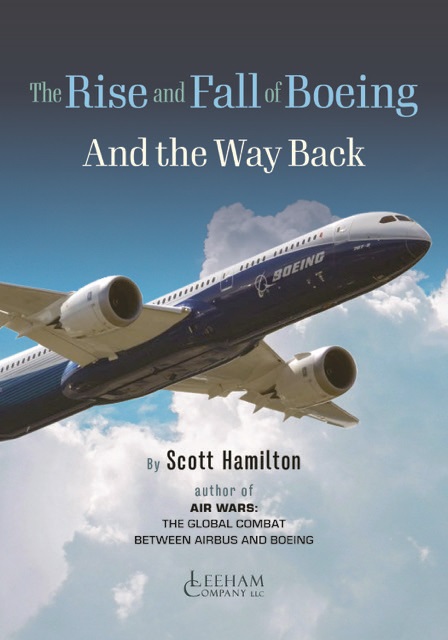 The Rise and Fall of Boeing and the Way Back, published in 2025, begins with how Boeing overtook Douglas Aircraft Co and Lockheed as the jet age began in 1954, when Boeing first flew the prototype 707. Boeing’s 1960 strategy of a family of airplanes vanquished Douglas, which didn’t follow this path, Convair, with its failed effort, and Lockheed, which chose to pursue a turboprop aircraft.
Boeing ignored the threat of Airbus, which entered the market in 1974 with its first airplane, the widebody A300. For 20 years, Boeing viewed Airbus as another failed jobs program in Europe.
Rise and Fall continues its examination of Boeing’s fall from dominance in the 2000s, through its back-to-back-t0-back crises through the 737 MAX accidents and groundings, the pandemic, the 20-month delivery suspension of the 787 due to a production defect, the January 2024 setback of its recovery when a doorplug flew off a new 737-9 MAX operated by Alaska Airlines, and the bitter 2025 53-day strike by the IAM 751.
At long last, with the appointment of Kelly Ortberg as president and CEO, Boeing is on its way back to profits. It remains a tough task, and Rise and Fall includes these challenges.
Interviews with top executives and salesmen for both companies pepper the book with first-hand accounts.
Rise and Fall is available through Amazon. 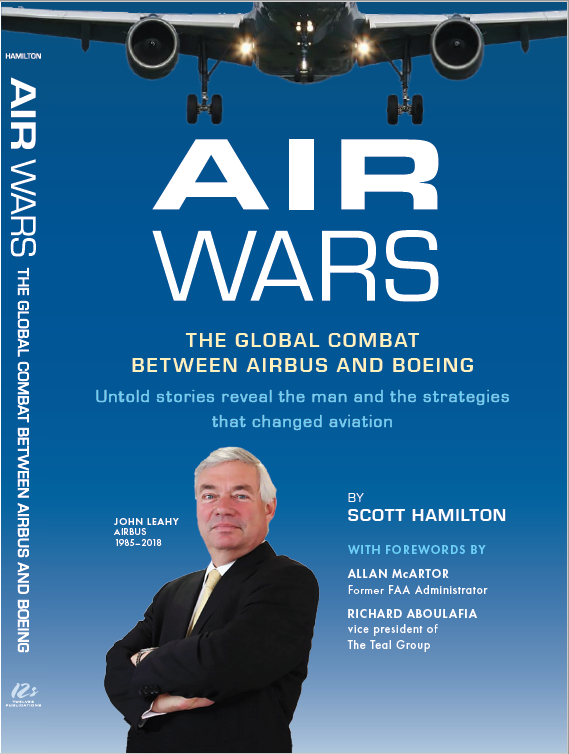
Air Wars, the Global Combat Between Airbus and Boeing, is the first in the trilogy of books by Hamilton about commercial aviation. Air Wars closely follows the career of John Leahy, who joined Airbus from his sales position with Piper Aircraft. He spent the next 33 years playing a key role in bringing Airbus from a distant competitor to Boeing to overtake the US manufacturer in the 2000s. Airbus today commands more than 55% of the single-aisle airplane market, and its wide-body aircraft put Boeing on the defensive in a sector where it traditionally had overwhelming superiority.
Air Wars details the product and market strategies of competing companies, as well as their successes and failures.
Interviews with top executives and salesmen for both companies pepper the book with first-hand accounts.
Air Wars is available through Amazon.
Related