The $50 million business of child sponsorship in Christian music

How much are overseas children worth?
A cool $50 million, according to one of the top names in the Christian music industry.
This is why sponsoring vulnerable children has become a mainstay of the contemporary Christian music (CCM) scene — as much as the prayer and praise music.
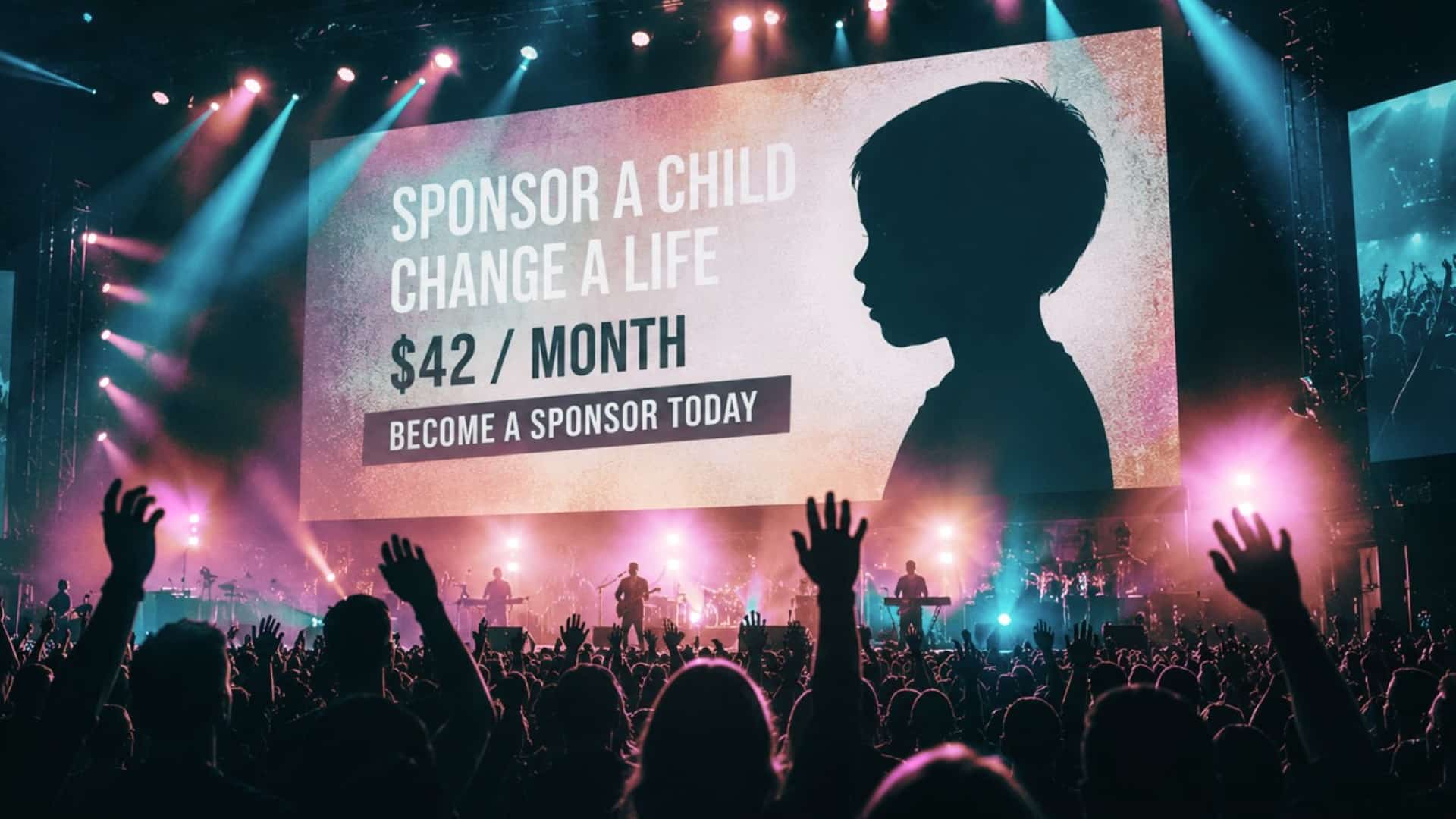
Scarcely a concert goes by where the audience doesn’t see a heart-wrenching video, then hears a plea to pledge money to children in the Global South to transform their lives. Such a request, usually delivered by the artists themselves amid smoke machines and lights, is hard to refuse.
Many people raise their hands for a piece of cardboard with a child’s face on it. Later, in a tent filled with branded merchandise and music, concertgoers sign up to sponsor that child monthly until he or she turns 18.
Your tax-deductible gift supports our mission of reporting the truth and restoring the church. Donate $50 or more to The Roys Report, and you can elect to receive our featured offer, “Kiss and Tell: The Innocent Moment That Shattered Mark Driscoll’s Cult” by Vince Manuele – click here.

What the donors don’t know is that the initial downpayment goes to the event organizer for administration fees. It may take up to a year for any of their funds to directly reach the child they signed up to help.
They also don’t know the band makes money from these sponsorships.
Nonprofits like World Vision, ChildFund, Feed The Hungry and Compassion rely on CCM concerts to net many of their donors. For that, they need the artist to bring their charity onto the stage.
Some of this backstage bargaining got revealed in a recent lawsuit filed by Wes Campbell, owner of the band Newsboys Inc., a leader in recruiting fans to sponsor children.
The band was so successful that Campbell estimated child sponsorship is a $50 million business.

In his April 20 lawsuit, he said charities are so integral to the chaotic economics of CCM that “most agree that without nonprofit participation, there would be no live CCM touring market.”
Campbell alleges that a host of defendants, including the band MercyMe, promotion agency LiveCo/TPR and nonprofit World Vision Inc., conspired to deprive him of a $50 million sale to Dutch holding company Waterland.
Campbell also named Roys Report (RR) as a defendant. He claims an RR article destroyed Campbell’s brokerage business, Thriving Children’s Advocates (TCA), which acts as a liaison between artists and nonprofits such as World Vision. Waterland then stole TCA’s business model, the suit alleges.
For the public, what was most shocking wasn’t the amount of money that almost changed hands. It was the idea that child sponsorship is a business opportunity.
“I’m not at all surprised by the lawsuit,” said Threads user @joshuarcrocker. “What’s worse, though, IMO is the details of those kickbacks from World Vision for every sponsor that signs up during a bands tour. Y’all really out here profiting off the back of starving children in Jesus name?”
Touring artists receive a payment of $200 to $500 for each sponsor who signs up, the lawsuit states. This gives an artist who completes at least 60 shows per year the chance to earn up to $7.2 million. Many CCM artists struggle with this.

“We always felt very uncomfortable taking money from a nonprofit,” said Mike Donehey, lead singer of Tenth Avenue North (TAN). “Here’s the problem: they’re a nonprofit and I’m a for-profit.”
Donehey’s group partners with Compassion International, a nonprofit that serves more than 2 million children in 29 countries through educational, nutritional and other programs. In TAN’s early days, Donehey would promote the cause voluntarily with no remuneration. Compassion later offered them a fee structure, which gave them tour support and payment in return for advertising Compassion during their concerts.
Naturally, the group had mixed feelings about accepting money on behalf of the poor.
“I think as a Christian, anything I do is ministry,” Donehey said to RR. “So, one of the ways we came to terms with our conscience feeling conflicted is we started a charity golf tournament once a year. I hear that through that event, year after year, we’re able to raise more money for Compassion than we ever received in tour sponsorships. To me as an artist, that’s the goal. I’m in partnership.”
The common thread among CCM artists is they want to use their platform for good. Early in their careers, many bands lack the resources or means to do so substantially. When a charity or a go-between like Campbell’s TCA reaches out with a lucrative offer, it seems like a perfect opportunity to make a difference.
Successful and philanthropically minded artists such as Donehey face questions about the moral structure of this system.
“The reason I would give up stage time to an organization is because I personally believe in what they are doing,” he said.
“I think the saddest part — it isn’t that anyone didn’t do anything necessarily (wrong). I think from a business perspective, I don’t know that I could say anyone did anything that wasn’t above board, right? But philosophically . . . as an artist, am I cool with just whomever made the biggest bid?”
The business of child sponsorship
“Partnering with CCM artists gives Compassion access to audiences we may not otherwise be able to reach,” Tim Glenn, head of Compassion’s global public relations, told RR in an email.
“We have found that this model is one of the most cost-effective, financially efficient ways to reach Christian audiences and connect them to our mission of releasing children from poverty in Jesus’ name.”
Compassion has partnered with more than 100 artists to date, resulting in more than 400,000 children being sponsored. It’s fair to say that many of those sponsorships wouldn’t have occurred unless a Christian music artist had spoken about the organization at a concert.
The staggering figures in the Campbell lawsuit left many shocked. But Glenn says that people can rest assured that the largest part of every donation to Compassion goes toward the child and family that sponsors designate. He added that any child shown as available for sponsorship, either on a packet at a concert or on Compassion’s website, is already receiving some benefits. This occurs through a church-based, or occasionally home-based, development center.
According to Glenn, “Seventy-five to 82 cents of every dollar goes directly to support our programs, which provide educational, health, spiritual and socio-emotional support for each child. The remaining 18-25 cents goes toward administrative and fundraising costs, which includes artist partnerships.”

Often, the nonprofit sees its relationship with the artist as a way for that artist to give back.
“Compassion’s focus in every partnership is to work alongside those who share our commitment to Jesus and a desire to release children from poverty around the world,” Glenn said.
“The Christian music industry can be volatile. By partnering with Christian artists, we are also able to help them build their ministry through support of their gifts and talents.”
In other words, a rising tide floats all boats. And now, they are tied to each other.
Sponsorship deals distinguish the CCM touring industry from its secular counterpart. At a Christian concert, Campbell said in his lawsuit, fans and artists “share a mutual sense of engagement, goodwill and trust.” Fans expect to be moved and empowered to change the world — whether it comes through buying an album, purchasing a Christian-themed T-shirt or sponsoring a child.
If just 6% of an audience of 4,000 sponsor a child, the band will receive at least $48,000. This could make up to half of the artist’s entire budget for a performance.
In this environment, artists and child sponsorship organizations have become linked to each other and incorporate each other in their budgets. With funds from sponsorships, Christian artists can afford bigger stages, more lights and bigger trucks.
A glance at the Newsboys 2016-2017 rider — a contract given to the event promoter prior to the performance — reveals how a typical band used these funds.
In addition to what the band earned through sponsorships, the Newsboys were paid 100% of the performance fee: what a promoter pays an artist for a show. The more prominent the artist, the bigger the fee. Given the Newsboys’ stature and their vaunted ability to sell out events prior to front man Michael Tait’s resignation in January 2025, their fee ranged from $40,000 to $74,999, according to Celebrity Talent International.
Throw in $48,000 from sponsorships, and that’s a 64% jump to $122,999 per show, not including extras like corporate partnerships, which Campbell often negotiated. Such a substantial budget helped the band with perks like a 45-foot bus, a 20-foot trailer and one 65-foot semi-truck for equipment and instruments, plus ample space for 12 people to sleep, work and live on the road.
And it doesn’t include costs that Campbell passed on, such as having the promoter or venue pay for hotel rooms, some production and lighting equipment, security and catering. When the Newsboys required an opening band, that was either subsidized by the promoter, or the band covered its own expenses.
Thus, sponsorships made life much easier for the Newsboys, and luckily for its members, TCA took care of all the business details. All the band had to do was deliver the message during the concert.
Thriving Children’s Advocates
Campbell opened TCA in 2016 and quickly became a lucrative middleman between nonprofits and CCM artists or promoters. Along with the Newsboys, artists on the brokerage’s line-up included MercyMe, Tauren Wells, Danny Gokey and Micah Tyler. With TCA’s help, the musicians worked with child sponsorship charities, including World Vision, a defendant in Campbell’s lawsuit.
The relationship between TCA and World Vision ended acrimoniously in October 2019, Campbell alleges, when World Vision set up its own department to manage artist relationships. As of 2025, TCA was publicly working with only one nonprofit, Children International.
The charity-artist-middleman model isn’t exclusive to TCA. But it was one of the first intermediaries between artists and charities, so it’s fair to say that Campbell changed the face of the Christian touring market. The model is straightforward. TCA approaches the charity on behalf of the artist, offering to give the nonprofit roughly 15 minutes of airtime during a show. This mainly consists of a video and the artist encouraging fans to sponsor a child.
In return, the charity gets a new sponsor, and the artist gets a commission on each new child sponsored. TCA also receives a percentage of the total deal for its services. Just how much remained an industry secret prior to the lawsuit, but filings by a former nonprofit partner suggests the arrangement was highly lucrative.
For instance, when TCA partnered with ChildFund International in 2019, TCA raised $11.3 million in sponsorships and donations. However, ChildFund retained only $2.06 million (18%) and TCA got the remaining $9.2 million or 82%, as first reported by Ministry Watch.
The next year, when TCA raised $16.5 million for the charity, TCA pocketed $3.2 million with ChildFund getting the rest ($13.2 million). However, the same IRS 990 form shows ChildFund paying TCA $7.9 million that year as a contractor, which combined with the earlier amount, equals $11.2 million. Thus, ChildFund ended up with more money — $5.3 million or 32 percent — but TCA still retained the bulk (68%) of the proceeds.

Some of that money gets passed onto the artists. Donehey says TCA approached him early in his solo career with an attractive offer. Despite being promised a “very lucrative” return, he turned them down.
“The opening pitch was, ‘You already love this, you’re already great at this, and how would you like to make far more than you’re currently making doing it?’” Donehey said.
Donehey soon saw TCA’s involvement drive up the costs for child sponsorship nonprofits. Brokerages such as TCA started pitting nonprofits against each other, and they started seeing each other as competitors, he told RR.
With TCA’s brokerage business flourishing in August 2024, Dutch hedge fund Waterland offered Campbell $50 million for his company, including the exclusive model and artist roster.

Campbell’s lawsuit alleges that Waterland broke a confidentiality contract it signed during negotiations. Waterland, Campbell says, then went on to replicate TCA’s model, using its recently acquired tour promotion agency LiveCo/TPR as a broker and World Vision as the charity of choice.
TPR soon came to represent about 80% of all Christian music tours and shows, giving it a monopoly in the Christian concert business, Campbell said. Artists were promised a $500 kickback per sponsorship, allegedly boosting Waterland’s top line by $60 million.
Then in June 2025, RR began publishing multiple stories alleging that Michael Tait had sexually assaulted nine people. In addition, RR published a story alleging Tait watched while a woman was reportedly raped by a Newsboys contracted crew member in Fargo, North Dakota, in December 2014.
Soon afterwards, Newsboys, owned by Campbell, lost radio airplay, tour dates and a record contract.
Campbell believes the June 2025 article was “formed, facilitated and fomented, to destroy Campbell and his companies as a competitor, seize his business for themselves and thereby consolidate and maintain their monopoly power.” As a result, he says, TCA was worthless by the end of June.
MercyMe allegedly broke their contract a month later, Campbell said. Children International followed suit in September when its contract ended. Along with MercyMe, Children International moved to LiveCo/TPR as their broker of choice.
Consequently, Campbell says, he and his businesses became pariahs. He put a five-bedroom villa — Bellavista — on St. Thomas, U.S. Virgin Islands, on the market to pay bills. Previously advertised as a bed and breakfast, it’s worth almost $1.7 million.
A new way forward
Brokers such as Campbell’s TCA aren’t the only entities that profit from child sponsorships. Major conferences, book tours, popular podcasts and YouTubers also partner with charities to finance their work.
On a recent episode of the podcast Faith Adjacent, social commentator Jamie Golden explained how this works.

Her employer, Popcast Media Group, had also been offered a lucrative sponsorship deal in the past, she said, by an unspecified nonprofit that offered $200 per child sponsorship for a tour. But the media company negotiated the contract for a pre-established fee per show, rather than per child, because it felt “icky.”
“It’s pretty easy to justify and to be like, well, we’re really changing people’s lives. But when you’re not disclosing it and saying I’m a tentmaker (to the audience)?” Golden added.
“So we negotiated the contract where we were like, ‘No, we’re not going to make money (per child).’ They’re like, ‘We’ve never done a contract like that.’”
Golden and other staff members would later travel overseas to see the nonprofit’s work. She said they refused to publish photos from their trip, believing it commodified the people they were visiting.
“We were the only people on that trip that did not take photos of children and post them publicly,” she said. “We are not white saviors.”
Some artists are rejecting the sponsorship model and giving 100% of funds donated at concerts to nonprofits they’ve started themselves.
One of those is David Zach, lead singer of Christian rock band Remedy Drive. After partnering with a small nonprofit for 13 years, Remedy Drive started its own charity last year called Daylight United. All funds raised go toward a network of organizations that fight human trafficking, with a focus on raids and investigation.

“I love that we know exactly where our impact is,” Zach said. “I’m allergic to the customer acquisition model. Instead, we have introduced this cause to people and helped raise millions of dollars and millions of in-kind donations.”
Zach told RR he believes the sponsorship model is “morally ambiguous at best.” He added, “Ninety-nine percent of audiences would be shocked and disillusioned to hear how this works and what is being kept from them.”
For Zach, this conviction led him to leave a Christian record label in 2013. At the height of the band’s success, he began volunteering with a counter-trafficking organization.
Volunteering undercover in sting operations in Thailand, Zach helped gather intelligence and evidence against traffickers. He wanted to make music about the survivors he met, but his record label disagreed, and Remedy Drive became independent.
This made the band less commercially successful. But it also prompted more fans to participate in anti-trafficking efforts like band members were doing.
“Why ask our fans to risk their lives if we are not also risking our lives?” Zach asked.
Zach isn’t the only artist to find a new way forward in the Christian music/nonprofit model.
Chris Tomlin and his wife Lauren founded the charity For Others in 2019 to help end the child welfare crisis in America. They work with churches and volunteers to support struggling families, provide for children who have aged out of foster care, and reunite families. In 2025, they served 152,940 children and raised $14,503,449, 7.42% of which was invested in fundraising and 6.9% covered the salaries of 13 staff.
Likewise, Jars of Clay founded Blood:Water in 2004 with activist Jena Lee Nardella to help end the water and HIV/AIDS crises in Africa. The band doesn’t currently perform, yet fans have helped raise more than $40 million to help communities in 10 African countries.

Once the charity commits to a community, it stays for eight years. In 2025 it earned $2,020,361. With a staff of 13, including a Kenya office, 56.67% went toward salaries and 17.46% went towards fundraising.
Other artists stay close to traditional charities but work closely with artist liaisons who cultivate an ethical relationship between the band and a nonprofit partner.
Donehey’s former bandmate, Jason Jamison, left Tenth Avenue North in 2018 to become an artist liaison with Compassion. This relationship gives artists space to ask questions about financial transparency, ensuring profits are reaching the promised children.
Other artists sponsor children and travel overseas before promoting a sponsorship nonprofit.
In the CCM world, it is difficult to cover the costs of touring without a nonprofit partnership, especially if fans or record labels expect a show filled with bells and whistles.
For Donehey, the tension of profiting from child sponsorship will remain until he can platform them for free, no strings attached. He hopes his fellow CCM artists will follow suit.
“My goal is to keep advocating for Compassion and just stop taking money, which I’m scared to do because it means I will probably be back in a van (and) I’ll make less money on a tour. I’ll have to be gone from my family longer.” he said.
“(But) a pure heart is worth fighting for. We’re gonna get it wrong often. We’re gonna fail and fall. Keep striving to go back to your first love. When you make a career out of something, it’s easy to make concessions in the name of good things.”
*The author of this article sponsors a child through Compassion International.
*This article has been amended to reflect new information from Compassion international.
 Jessica Morris is a music journalist, podcaster and author based in Melbourne, Australia.