Teaching Forensic Anthropology Through Touch: Reflections on Tactile Teaching with Blind and Partially Sighted Learners


Satu Valoriani, Amber Collings, Nicholas Marquez-Grant, Karolina Cameron-Werens, Micol Zuppello, Rachael Carew, Sarah Ellingham, Alexandra Makay, and Rebecca Strong (British Association for Forensic Anthropology Committee)
On 4th October 2025, a small group gathered in one of the more iconic spaces of British natural history: the Oxford University Museum of Natural History. The occasion was not a typical public lecture, nor a formal conference panel, nor even the familiar “handling session” that museums often host. Instead, it was a hands-on forensic anthropology workshop designed specifically for blind and partially sighted participants. Around twenty delegates attended, working in small groups, guided through the human skeleton from head to toe by touch rather than sight.
The workshop was organised by the British Association for Forensic Anthropology (BAFA), and led by its chair, Dr Nicholas Márquez-Grant, alongside committee members Dr Amber Collings, Karolina Cameron-Werens, Dr Satu Valoriani and Dr Micol Zuppello. They were joined by BAFA member and local resident Prof Robert Rogers and supported by museum Community Engagement Officer Susan Griffiths. What might sound like a straightforward outreach activity was, in practice, a thoughtful experiment in sensory pedagogy and disciplinary translation.
Touching the skeleton, rethinking the discipline
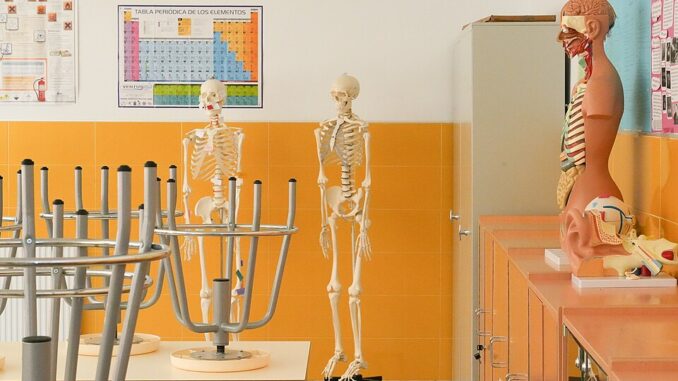
Forensic anthropology, like much of archaeology and biological anthropology, is deeply visual in its standard modes of teaching practice and research, and communication. We project images of bones, point at landmarks on slides, and rely heavily on diagrams to convey morphological variation. Even when students handle skeletal material, sight is usually assumed as the primary interpretive sense. In this workshop, participants were instead invited to learn through touch first and foremost, using plastic models, real bones, and casts of diagnostic features such as the pubic symphysis for age estimation or pelvic breadth for sex estimation.
Participants explored age-at-death estimation, biological sex estimation, and pathological conditions including osteoarthritis and trauma, sometimes using casts to safely explore peri-mortem damage. The workshop structure, moving from head to feet, feature by feature, mirrored conventional osteology teaching, but the interpretive process unfolded differently. Instead of “seeing” a wide sciatic notch, one had to feel the breadth of the pelvic opening. Instead of visually spotting bone growth (lipping) osteophytes on articular surfaces, one traced its contour with fingertips comparing a bone without lipping and one with. The shift was subtle but profound: morphology became something encountered through pressure, texture, and spatial orientation rather than through image recognition.
Accessibility as method, not add-on
This workshop suggested a different model of outreach practice: accessibility as a starting premise that reshapes the method itself.
Designing activities for blind and partially sighted participants required rethinking how key forensic concepts were communicated. How do you explain the difference between ante-mortem and peri-mortem trauma without relying on colour changes or fracture appearance? How do you convey the variability of the auricular surface or the subtleties of degenerative joint disease through touch alone? These questions forced facilitators to distil what actually matters in each diagnostic criterion. In doing so, they revealed the conceptual core of osteological reasoning in ways that could arguably benefit all learners, not just those with visual impairments.
Small groups, large conversations
The format, around twenty delegates including their companions, working in small groups, was not merely logistically convenient; it was pedagogically essential. Tactile learning is inherently slower and more dialogic than visual demonstration. Each participant needed time to explore the bones, ask questions, and compare impressions. Facilitators had to narrate spatial relationships carefully, guiding hands to landmarks and encouraging participants to articulate what they were feeling.
The conversational dynamic that was created between the participants and the instructors also blurred the boundary between experts and learners. When one relies less on visual authority and more on shared exploration, knowledge production becomes more collaborative. Participants were not passive recipients of expert insight, but they were active interpreters whose sensory observations shaped the discussion. In this sense, the workshop echoed broader anthropological commitments to co-production and dialogic knowledge, albeit in a distinctly osteological context.
A series of inclusive outreach sessions
The session also marked a continuation of an initiative first piloted in the UK by Dr Márquez-Grant in 2011. That historical continuity matters as inclusive outreach often appears as isolated, one-off events, dependent on individual enthusiasm rather than institutional commitment. By framing this workshop as part of an ongoing initiative, BAFA signalled that accessibility is not a novelty but a sustained responsibility.
There is, perhaps, a lesson here for professional associations more broadly. Outreach to visually impaired audiences is still relatively rare in archaeology and forensic anthropology, despite the tactile richness of our material culture. Bones, artefacts, and casts are, after all, eminently touchable objects, far more so than the digital images that increasingly dominate teaching. Yet institutional caution about handling collections, combined with the inertia of visually oriented pedagogy, often limits such engagement. This workshop demonstrates that, with careful planning and the use of replicas or casts where necessary, these barriers are surmountable.
What forensic anthropology learns from accessibility
It would be easy to frame the workshop as primarily beneficial for its participants and indeed, it clearly was. Yet the more interesting question may be what forensic anthropology itself learns from such encounters. When experts are required to explain diagnostic features without relying on visual shorthand, they must clarify their own reasoning processes. Why, exactly, does a particular morphological trait indicate age or sex? Which aspects are essential?
This reflective process can sharpen methodological rigor. It pushes practitioners to distinguish between genuinely diagnostic criteria and those that have become habitual through visual pedagogy. Moreover, it highlights the embodied nature of osteological expertise, reminding us that bone assessment is as much about feeling surfaces and forms as it is about seeing them.
Toward a more inclusive disciplinary future
The success of this workshop, measured not only in participant engagement but in the evident enthusiasm of facilitators, suggests a pathway forward. If BAFA members are encouraged to replicate similar sessions across the UK, as proposed, the initiative could foster a broader culture of inclusive engagement within forensic anthropology. Such efforts would not only expand public access but also challenge the discipline to diversify its sensory and pedagogical assumptions.
In a moment when anthropology is grappling with questions of relevance, ethics, and public engagement, small-scale workshops like this one offer a quietly compelling model. They demonstrate that accessibility is not merely a compliance issue but an opportunity to rethink how knowledge is produced, taught, and shared. By inviting participants to literally sense the human, the workshop reaffirmed a simple but powerful idea: anthropology begins with bodies, and bodies are encountered through multiple senses.
If the discipline takes that lesson seriously, inclusive outreach may cease to be an occasional initiative and become instead a central methodological commitment. And perhaps, in the process, forensic anthropology will rediscover something it has always known but rarely articulated: that bones are not just things we look at, but things we learn through touch, conversation, and shared exploration.