In October 2020, Croatia became the next chapter of our full-time travels during one of the most uncertain periods the world had experienced.
Borders opened and closed, travel rules changed constantly, and making long-term plans had become almost impossible. We had just bought a campervan a few months earlier to make traveling still possible for our family, so after leaving Italy, we slowly made our way through Slovenia and into Croatia. It was one of the few countries we were able to enter at the time, and since none of us had ever visited before, we decided to cross the border and see where the journey would take us.
We arrived without expecting Croatia to become such a long chapter of our travels. What began as a practical decision slowly turned into almost three months of exploring the country, from October until the middle of January.

For most of that time, our campervan was our home. We wandered from national parks to quiet islands, from ancient cities to peaceful campsites, following our curiosity rather than a fixed itinerary. As Christmas approached and the weather grew colder, we traded the campervan for a house on the Dalmatian coast, where we spent four weeks celebrating the holidays, slowing down, and simply living for a while before returning to the road.
Croatia wasn’t just another stop on our journey. It became a very special chapter of our lives, filled with empty beaches, spectacular sunsets, Roman ruins, hidden caves, new adventures, and the simple rhythm of everyday family life during an extraordinary moment in history.
We went because Croatia was open.
We stayed because it quietly captured our hearts. During such an uncertain time in the world, it made us feel safe, welcome, and grateful to keep exploring.

Arriving in Croatia: An Unexpected Chapter
Crossing the border into Croatia felt like the beginning of a new adventure, even if we had little idea of what lay ahead. We hadn’t planned every stop or mapped out a detailed itinerary. Instead, we let the country reveal itself one place at a time.
Our first stop was Zagreb, although we didn’t really explore the city. We spent the night there and used the opportunity to take care of the practical things that come with life in a campervan: grocery shopping, laundry, and getting organized for the road ahead. We found a fun shopping mall where all three kids could play while we did the shopping, which made the whole process much easier. It wasn’t exactly a sightseeing day, but it was a very real part of traveling full-time as a family.
Once the campervan was stocked, the laundry was clean, and everyone had enjoyed some time playing, we were ready to begin exploring. We left Zagreb behind and drove toward our first real stop in Croatia: Plitvice Lakes National Park.

For nearly three months, our campervan became our home as we made our way from north to south and back again. We followed the coastline, ventured inland to discover waterfalls and caves, crossed to islands by ferry, wandered through ancient towns, and settled into peaceful campsites where the evenings were filled with little more than the sound of the sea or the wind through the trees.
Traveling during the pandemic gave us a very different perspective of Croatia. Some of its most famous places were unexpectedly quiet, allowing us to experience them at a slower pace and often with very few other visitors around. While the circumstances that brought us there were far from ideal, they gave us a chance to appreciate the country in a way we’ll probably never experience again.

Without a strict schedule to follow, we simply let curiosity guide us. Some days that meant stopping because a view caught our attention, while on others it meant staying an extra night because a campsite felt too beautiful to leave. Over time, we realized that Croatia wasn’t a country to rush through. Because it wasn’t crowded with the tourists it normally welcomes, we had the rare opportunity to take our time and truly appreciate what it had to offer.
Looking back, it wasn’t one destination that made us fall in love with Croatia. It was the journey between them.

Plitvice Lakes National Park & Barać Caves
Our first real stop in Croatia was Plitvice Lakes National Park, and what an introduction it was!
Plitvice is Croatia’s oldest and largest national park and has been a UNESCO World Heritage Site since 1979. It’s famous for its crystal-clear lakes, countless waterfalls, and the wooden boardwalks that allow you to walk right through the heart of this incredible landscape.

We had seen plenty of photos before arriving, but they really don’t prepare you for seeing it in person. The water was unbelievably clear, waterfalls seemed to appear around every corner, and every turn in the path revealed another beautiful view.
There are several different routes through the park, depending on how much time you have. We chose one that included walking, a boat ride across one of the lakes, more walking, and finally a shuttle bus back. It turned out to be a great way to experience different parts of the park as a family.
We visited in autumn, which turned out to be the perfect time. The trees were changing color, and after several days of rain, the waterfalls were flowing with incredible force. In some places, the spray reached the boardwalks, turning our peaceful walk into a fun little challenge as we tried to make it across before getting soaked. Needless to say, we didn’t always succeed!

What I remember most, though, was simply being surrounded by nature. The sound of the waterfalls followed us almost the entire way, and more than once we stopped just to take it all in. It was the perfect way to begin our Croatian adventure.
As much as we loved the waterfalls, our next stop took us somewhere completely different.
If you’ve been following our adventures for a while, you’ll probably know that we have a bit of a tradition. No matter which country we’re visiting, if there’s a cave nearby, chances are we’ll want to explore it. Croatia turned out to be the perfect place for that. Almost half of the country is made up of limestone, creating the ideal conditions for thousands of caves to form over thousands of years.
One of our favorites was the Barać Caves, tucked away in a peaceful forest setting. The whole area was lovely, with wooden walkways, a playground for the kids, and several hiking trails. Unfortunately, after days of heavy rain, many of the trails had turned into huge muddy puddles, so we had to skip the hikes and head straight for the cave. That wasn’t exactly a disappointment.

As soon as we stepped inside, the kids slowed down and started noticing every little detail. Rock formations, tiny passages, and the stories our guide shared kept everyone interested from beginning to end. It’s one of the things I love most about worldschooling. Instead of reading about geology or history in a book, the kids were standing right there, asking questions and seeing it all for themselves.
By the time we left Barać Caves, we had already experienced two completely different sides of Croatia. We had only just arrived, yet the country had already surprised us with its incredible diversity, and we couldn’t wait to see what was waiting for us next along the Adriatic coast.

Pula & Glavani Adventure Park
Our next stop took us to one of the places I had been dreaming of visiting for years: Pula.
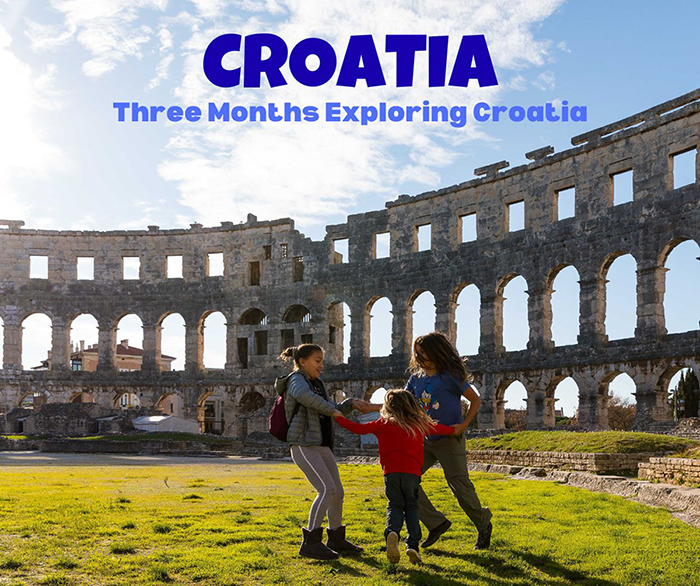
Located on Croatia’s Istrian Peninsula, Pula is best known for its incredible Roman amphitheater, the Pula Arena. Built in the 1st century AD, it is one of the best-preserved Roman amphitheaters in the world and one of only a handful that still has all four of its original side towers standing. Ever since I first saw photos of it, I knew I wanted to visit one day.

Because we were traveling during the pandemic, the city was unusually quiet. Walking into the amphitheater and finding only another family there felt surreal. Instead of crowds, we were able to wander through the ancient stone corridors at our own pace, imagining what life might have been like almost 2,000 years ago.
Watching the kids explore the arena reminded me why we love worldschooling so much. History becomes something completely different when children can experience it for themselves instead of only reading about it in a book. They ran through the corridors, imagined what life might have been like 2,000 years ago, and asked question after question as we explored together.
The moment that stayed with me most came naturally. Emma and Cosimo started imagining what it would have been like to stand in the arena as gladiators, acting out a scene while trying to picture the crowds, the excitement, and what life might have been like all those centuries ago. Meanwhile, little Luca stood nearby cheering them on as if he were one of the spectators. It was one of those simple moments where history stopped feeling like something from a textbook and became something they could truly imagine.

Visiting Pula left such a lasting impression on our family that, when I later wrote The Adventure Globe: Secrets of Europe, I knew the amphitheater had to become one of the places Sydney, Cairo, and Everest would visit. It felt like the perfect way to bring one of our favorite travel memories into the story.
That evening, we watched another unforgettable sunset from Arena Stoja Campsite. Looking out over the Adriatic as the sky slowly changed color was the perfect ending to a day that had been on my bucket list for so many years.
As we made our way up the Istrian Peninsula towards Pula, we spent a few days at Camp Porto Sole, near the lovely town of Vrsar. It was there that we met another traveling family whose children would end up having a lasting impact on our own. Their kids were about the same age as Cosimo and Emma, and before long they were spending their days together as if they had known each other for years. One evening, they came over to our campervan with a little surprise. They had brought us handmade gifts they had created themselves using knitting and crochet.
Emma and Cosimo were completely fascinated. Not only by the beautiful decorations, but by the fact that kids their own age had made them with their own hands. The very next day, they were searching YouTube for tutorials. Emma decided she wanted to learn how to knit, while Cosimo was determined to learn crochet. They spent hours practicing, making mistakes, starting over, and slowly improving.

Looking back now, that chance meeting sparked a new passion for both of them. Before long, they were the ones making handmade gifts for new friends we met during our travels. It’s amazing how something as simple as meeting another family at a campsite can quietly shape a child’s interests for years to come.
After leaving Pula, we continued through the Istrian countryside towards a place that wasn’t originally part of our plans.
The owner of Glavani Adventure Park had kindly invited us to come and spend a day at the park and stay overnight in our campervan, so of course we said yes. Opportunities like these have often led us to places we might never have discovered otherwise, and this turned out to be one of them.

Glavani Adventure Park is one of Croatia’s oldest adventure parks, with rope courses, zip lines, climbing challenges, and activities for all ages. It was the perfect change of pace after spending the previous day immersed in Roman history.
The five of us threw ourselves into the different courses, encouraging one another, laughing at our wobbly moments, and celebrating every little victory. Watching the kids become more confident with each obstacle was just as rewarding as completing the courses ourselves.

I love how these two days perfectly captured the way we like to travel. One day we were stepping back almost 2,000 years into Roman history, and the next we were climbing through the trees and challenging ourselves in completely different ways. That balance between learning, adventure, and simply spending time together is something we’ve always tried to create during our travels, and Croatia gave us plenty of opportunities to do just that.
Zadar: Our First Taste of the Adriatic
After exploring Croatia’s lakes, waterfalls, and caves, it was finally time to reach the Adriatic coast.
Our first stop was Zadar, a city with more than 3,000 years of history that perfectly blends ancient Roman ruins with modern attractions. Walking through the old town, we found Roman remains, medieval churches, lively squares, and narrow streets that invited us to wander without any particular destination in mind.
By late autumn, the city had a completely different atmosphere from the busy summer months. The streets were quieter, the beaches were almost empty, and it felt as though we had the place almost to ourselves.
For our stay, we chose Falkensteiner Premium Camping, which is usually incredibly busy during the peak summer season. Since we arrived right at the end of the season, it felt like we had the place almost to ourselves. It was the perfect time to enjoy the campsite and the nearby beach without the crowds.

Of course, we couldn’t leave without visiting two of Zadar’s most famous attractions: the Sea Organ and the Greeting to the Sun. The Sea Organ was unlike anything we had ever experienced. Hidden beneath the marble steps along the waterfront are a series of pipes that use the movement of the waves to create music. There are no musicians and no set melody, just the sea composing a different tune every few seconds. We ended up sitting there much longer than we had planned, simply listening while the kids ran around enjoying the natural soundtrack.

Right next to it is the Greeting to the Sun, a large circular installation made up of hundreds of glass solar panels. During the day it quietly collects energy from the sun, and after sunset it transforms into a colorful light display. We arrived just as the daylight was beginning to fade, making it the perfect way to end our visit.
One question we often get asked whenever we’re near the sea is whether we actually went swimming.
The honest answer is… yes, although it took a little convincing!
The Adriatic was absolutely beautiful, but it was definitely on the chilly side. Luca and I needed a bit more encouragement than everyone else, but little by little Croatia won us over. By the time we reached Zadar and later Dubrovnik, we had both taken the plunge. It was cold, but it was also one of those experiences we wouldn’t have wanted to miss.

After a few days by the sea, we headed inland once again. Croatia had already shown us incredible waterfalls at Plitvice, but another national park was waiting for us.
Krka National Park
Before continuing our journey south, we made one more stop to explore another of Croatia’s beautiful national parks: Krka National Park.
While Plitvice Lakes National Park is Croatia’s most famous, Krka has its own unique charm. Following the course of the Krka River, the park is known for its series of waterfalls, wooden walkways, and lush scenery. The most famous of them all is Skradinski Buk, one of the largest travertine waterfall systems in Europe.

One of the things that makes Krka especially unique is the small island of Visovac, located in the middle of the river. The island has been home to a Franciscan monastery since the 15th century and can be visited by boat. Surrounded by the calm waters of the Krka River, it adds another layer of history to a park that’s already full of natural beauty.

After visiting Plitvice earlier in our trip, we were curious to see how the two parks compared. Although both are centered around waterfalls, they each have their own character. Krka felt more open, with the river winding through the landscape and waterfalls appearing as we followed the walking trails.
The sound of rushing water accompanied us for most of the visit, and every now and then we stopped to admire another beautiful viewpoint. It was another reminder of just how much Croatia’s natural beauty had surprised us throughout our journey.
By this point, we were beginning to realize that Croatia offered so much more than its beautiful coastline. Between waterfalls, caves, islands, and historic towns, every few days seemed to bring a completely different landscape.
After spending the day at Krka National Park, we climbed back into the campervan and continued south toward the beautiful town of Trogir.

Trogir
Continuing our journey south, we arrived in the beautiful coastal town of Trogir.
Built on a small island connected by bridges to both the mainland and the island of Čiovo, Trogir is often described as an open-air museum. Its historic center is a UNESCO World Heritage Site, with a maze of narrow stone streets, charming squares, and buildings that reflect centuries of Greek, Roman, and Venetian influence.
Our plan was simple: wander through the old town, soak in the atmosphere, and enjoy another beautiful Croatian coastal town.
The weather, however, had other ideas. As we arrived, the rain started coming down, making our visit a little different from what we had imagined. But after traveling full-time for a couple of years, we had learned that bad weather rarely ruins a destination. Sometimes it simply changes the experience.
So, umbrellas in hand, we explored anyway.

The shiny cobblestone streets, the sound of the rain echoing through the narrow alleys, and the almost empty squares gave Trogir a completely different atmosphere. While we may not have seen it under blue skies, we still enjoyed wandering through its historic streets and imagining what life here must have been like hundreds of years ago.
One thing we’ve learned over the years is that travel doesn’t have to be perfect to be memorable. Sometimes the places you remember most are the ones where things didn’t quite go according to plan. Luckily, Croatia still had plenty of sunshine waiting for us further down the coast.

Dubrovnik
Our next destination was one we had been looking forward to from the very beginning: Dubrovnik.
Often called the “Pearl of the Adriatic,” Dubrovnik is one of Croatia’s most famous cities. Surrounded by impressive medieval walls and overlooking the crystal-clear Adriatic Sea, it’s easy to see why it has been a UNESCO World Heritage Site since 1979.

During our time there, we decided to take a short break from campervan life and rent a house for a few days. It was a nice change of pace and gave us the chance to explore the city without worrying about moving the campervan.
One of the highlights, of course, was walking the famous city walls. Stretching for almost two kilometers around the Old Town, the walls offer incredible views over the terracotta rooftops, ancient fortresses, and the Adriatic Sea. We took our time making our way around, stopping often to admire the scenery and imagine what life must have been like when these walls protected one of the most important maritime republics in the Mediterranean.

One of my favorite memories wasn’t actually the views, though. It was watching Luca.
He was only four years old at the time, and before we started, we weren’t sure if he would make it all the way around without asking to be carried. To our surprise, he walked the entire circuit by himself. It might seem like a small achievement, but as parents, those little milestones become some of the memories we treasure most.

There was plenty more to discover beyond the Old Town.
One day, we took the short ferry across to Lokrum Island, a peaceful nature reserve just a few minutes from Dubrovnik. According to legend, this is the island where King Richard the Lionheart was shipwrecked after returning from the Crusades. Today, it’s a wonderful place to escape the crowds, with walking trails, rocky swimming spots, beautiful gardens, and plenty of peacocks wandering freely around the island. The kids loved trying to spot the peacocks as we explored, and it was a nice change of pace after spending time inside the city walls.

Another day, we rode the Dubrovnik Cable Car to the top of Mount Srđ. The cable car only takes a few minutes, but the views from the top are incredible. Looking down over the terracotta rooftops of the Old Town, Lokrum Island, and the Adriatic Sea really gave us a new perspective of the city. It was one of those views that made us stop for a while instead of immediately reaching for the camera.
As if Dubrovnik wasn’t already special enough, it also became the place where we celebrated Mass’s birthday. Instead of buying presents, we decided to surprise him with something a little different: a day aboard a sailboat exploring the islands just off the coast. It turned out to be one of the best decisions we could have made. The weather was absolutely perfect, the sea was calm, and the different shades of blue in the Adriatic almost didn’t seem real. Throughout the day, our captain, Nico, shared stories about sailing, life on the Adriatic, and what it’s really like to spend your days following the wind.

One of the highlights of the trip was swimming into the Blue Cave. It was absolutely breathtaking. It was also freezing! Luckily, the cold water didn’t stop any of us from enjoying the experience. Looking back, I’m still not sure whether I remember the beauty of the cave more or just how cold that swim was, but it was worth every second.
After a day on the water, we returned to Dubrovnik with an even greater appreciation for this part of Croatia. Whether we were walking along centuries-old city walls, watching another spectacular sunset over the Adriatic, or sailing between tiny islands, Dubrovnik gave us some of the most memorable moments of our entire Croatian journey.

Ston
While staying in Dubrovnik, we also took a day trip to the small town of Ston, home to one of Croatia’s most impressive historical landmarks.
Often referred to as the “European Great Wall,” the Walls of Ston were built in the 14th and 15th centuries by the Republic of Ragusa to protect the valuable salt pans, which are still among the oldest active salt works in Europe. Stretching for over five kilometers, they form the longest fortified wall system in Europe.
That day, our family split up for a few hours. Cosimo and I decided to tackle the walls together, while Mass stayed behind with Emma and Luca for a slower morning. We don’t often divide up, but every now and then it’s nice to spend some one-on-one time with one of the kids.

The walk was definitely more challenging than we expected. The walls climb steeply over the hills between Ston and Mali Ston, with what felt like an endless number of steps. Every time we thought we had reached the highest point, another section appeared ahead of us. Thankfully, the views made every step worthwhile.
Looking down over the rooftops of Ston, the Adriatic, and the famous salt pans, it was easy to understand why this defensive system was built here centuries ago.
While Cosimo and I were exploring the walls, Mass enjoyed some true quality time with Emma and Luca. They stayed near the entrance to the Walls, spending the morning making art, playing games, and simply enjoying being together.

I think that’s what made the day so special. Nobody had to give up what they wanted to do. Cosimo got the long walk he was excited about, I enjoyed sharing that adventure with him, and Mass, Emma, and Luca had a relaxed morning doing exactly what felt right for them. At the end of the day, everyone came back happy, and that’s one of the things we’ve learned over the years of traveling together. Sometimes the best family days aren’t the ones where everyone does the same thing, but the ones where everyone gets exactly what they need.

Mljet National Park
After exploring Dubrovnik and Ston, we were ready for another island adventure. We caught the ferry to Mljet, one of Croatia’s greenest islands and home to Mljet National Park, which covers the entire western part of the island. According to Greek mythology, this is also believed to be the island where Odysseus was held captive by the nymph Calypso for seven years. Whether that’s true or not, it’s easy to understand why the legend exists.

The island has a peaceful feeling about it, especially during the quieter months when we visited. At times, it almost felt as though we had the entire national park to ourselves.
After parking our campervan, we got our bikes and spent the day cycling around Veliko Jezero (Great Lake). Surrounded by forests and calm water, we stopped whenever we felt like it, enjoying the scenery and appreciating just how different this island felt from the places we had visited before.
One of the things we loved most about Croatia was how quickly the landscape could change. Just a day earlier we had been walking centuries-old city walls, and now we were cycling through a national park, listening to little more than birds, the wind in the trees, and the occasional splash from the lake.

The following day, we drove to the opposite side of the island to explore a few of its beaches. Once again, there were very few people around, giving us plenty of space to simply enjoy the views and peaceful atmosphere.
Mljet was one of those places where we naturally slowed our pace. There wasn’t a long list of things we felt we had to do, and that was exactly what made our time there so enjoyable. After two relaxing days on the island, it was time to catch another ferry and continue our journey to Korčula.

Korčula
Our next ferry took us to the beautiful island of Korčula, often referred to as one of the most beautiful islands in Croatia.
The island is perhaps best known for its medieval Old Town, which many believe to be the birthplace of the famous explorer Marco Polo. Whether that’s true or not is still debated, but wandering through the narrow stone streets, it’s easy to imagine what life might have been like centuries ago.
We spent time exploring both Korčula Town and the western side of the island around Vela Luka. Like many of the places we visited during our trip, the quieter season meant we could enjoy it at a much more relaxed pace. There were no crowds to navigate, just peaceful streets, beautiful coastal views, and plenty of time to explore.
One of my favorite memories from Korčula wasn’t a famous landmark but rather a moment during our exploration. While walking through one of the streets, the kids spotted a single tangerine hanging over a garden wall. They became completely fascinated by it, trying to figure out if there was any way they could reach it. Of course, they never did, but it gave us all a good laugh and ended up becoming one of those funny little memories we still talk about today.
Even the ferry rides became part of the adventure. Luca was especially excited every time we boarded. Watching him explore the almost empty ferry and enjoy every minute of the crossing reminded us that, for children, the journey is often just as exciting as the destination itself.
After spending a few wonderful days exploring Croatia’s southern islands, it was time to begin making our way north again, where we would settle into one place for the next four weeks and celebrate Christmas in a way we never had before.

Christmas on Krk Island
By the time we reached Krk Island, we had been on the road for a couple of months and were ready to slow down for a while.
Instead of celebrating Christmas in our campervan, we rented a house where we would stay for four weeks. It was a welcome change of pace and gave us the chance to unpack a little, settle into a routine, and enjoy having a place to call home for the holidays.
Our host was one of the kindest people we met during our time in Croatia. Before we arrived, he had found us an empty Christmas tree that we could decorate ourselves, but he also left us a box of ornaments to use if we wanted. He left everything up to us, and it was such a thoughtful gesture that immediately made the house feel welcoming.

Every year, we collect a keychain from each country we visit, and over time they’ve become our Christmas ornaments. We had actually bought a small tree that was just the right size for our growing collection, so decorating a full-sized tree with our little souvenirs from around the world made it even more special.
By then, spending Christmas abroad wasn’t something new for us. We had already celebrated the holidays in India and the Philippines, and now Croatia would become another special chapter in our family’s Christmas memories.
Those four weeks also gave us something we don’t often have while traveling full-time: routine.
We cooked more meals at home, caught up on work and homeschooling, went for walks around the island, and simply enjoyed not having to pack up and drive somewhere new every few days. As much as we love life in our campervan, these longer stays give us the chance to recharge before setting off again.

One of my favorite memories from our time on Krk came completely by surprise. Another traveling family reached out to me after spotting our campervan parked outside the house. They were a French family traveling during their gap year and wondered if we’d like to meet up. Of course, we said yes.
We spent a wonderful day together sharing stories from the road while the kids quickly became friends. Their sons were passionate about solving Rubik’s Cubes and had brought several with them. Cosimo was completely fascinated. Looking back now, that afternoon was the exact moment his own passion for Rubik’s Cubes began. It’s funny how a chance meeting during our travels can spark an interest that stays with you for years afterward.

Whenever people ask us what we love most about full-time travel, it’s often moments like these. Visiting beautiful places is wonderful, but meeting other families living similar lifestyles and forming unexpected friendships along the way has become just as meaningful.
We also took the opportunity to explore different parts of Krk Island. One thing I remember most were the sunsets. Even on cloudy evenings, the sky somehow managed to put on an incredible display of colors. We were also there for New Year’s Eve. As midnight arrived, we stood together on the terrace of our temporary home, watching fireworks light up the sky all around us. It was a simple celebration, but one we’ll always remember.

As our four weeks on Krk Island came to an end, we packed up the house and moved back into our campervan. Rather than continuing our road trip straight away, we found a campsite where we could safely leave it for the winter.
After more than a year without seeing my mom because of the pandemic, we had finally found an opportunity to fly to the United States. It was a chance we couldn’t pass up. So, for a little while, our Croatian adventure was put on hold. We said goodbye to our campervan, boarded a plane, and headed across the Atlantic to reunite with family. A few months later, we would return to Croatia, pick up our campervan once again, and continue the journey exactly where we had left off.
Returning to Croatia: One Last Adventure
A few months later, we were back. As the world slowly began to reopen, we returned to Croatia to pick up our campervan and continue the journey we had paused. Our plan was to make our way down the Adriatic coast once again before crossing the border into Montenegro, but there was one more stop we had been looking forward to.

Omiš. Nestled between dramatic mountains and the Adriatic Sea, Omiš was once famous as the home of fearless pirates who controlled this stretch of coastline. Today, it’s known for its beautiful beaches, outdoor adventures, and the Cetina River, making it a great destination for families looking for something a little more active.
One of the things we’ve always tried to do during our travels is say yes to new experiences, so when we found a windsurfing school that was willing to teach all five of us, including Luca, we couldn’t resist. None of us had ever tried windsurfing before.

Over the next few lessons, we spent plenty of time falling into the water, trying to balance on the boards, laughing at ourselves, and cheering each other on. Some of us picked it up a little faster than others, but that really wasn’t the point. What made the experience special was that we were all learning together.
Looking back, it was the perfect way to end our time in Croatia. Throughout our three months in the country, we had explored Roman history in Pula, wandered through medieval towns, cycled around peaceful islands, walked beneath waterfalls, explored caves, celebrated Christmas, and met wonderful people along the way. Finishing our journey by learning something completely new together felt like the perfect reflection of everything this chapter had been about.
Soon after, we crossed the border into Montenegro, ready for a new adventure.

As I look back on our time in Croatia today, I realize we arrived because it was one of the few places we could travel during an uncertain time in the world. We left with so much more than beautiful photographs and wonderful memories.
Croatia gave us almost three months of discovery, adventure, quiet moments, new friendships, and experiences that continue to shape our family years later. From Cosimo discovering his passion for Rubik’s Cubes to seeing the Pula Arena find its way into The Adventure Globe, from decorating our Christmas tree with souvenirs collected around the world to watching Luca proudly complete the walls of Dubrovnik, this country became much more than another stop on our journey.
It became a chapter of our family’s story that we’ll always look back on with a smile.
If you’re planning a road trip through Croatia, I hope our journey has given you a few ideas for your own adventure. And if you discover a special place that wasn’t on your original itinerary, don’t be surprised if it becomes one of the highlights of your trip. That’s exactly what happened to us.

Before arriving into Coatia we went trhough Slovenia, here you can see more of our travels there.