
Play a recording of a crying human baby at the edge of a pond full of Nile crocodiles, and something unsettling happens: the crocodiles swim toward the sound. The more distressed the cry, the more of them come. That’s not a horror-movie premise—it’s the finding of a 2023 study published in Proceedings of the Royal Society B.
Two decades ago, when I first wrote about the so-called reptilian brain, the accepted story was that reptiles were cold, instinct-driven eating machines with no room for anything as fancy as emotion. An reptile responding to a baby’s distress call seemed to poke a hole in that idea. It still does—though, being the cynic I am, I’ll point out what the crocodile researchers themselves note: these are opportunistic hunters, and a distressed cry might simply sound like an easy meal. Back to the pure reptilian brain, indeed.
So why should a marketer care about crocodile hearing? Because an entire school of persuasion advice is built on the premise that your customer is walking around with a “reptilian brain” you can sell to directly. It’s worth asking whether that premise actually holds up in the present day.
What is the reptilian brain?
The reptilian brain comes from the triune brain model, proposed by physician and neuroscientist Paul MacLean in the 1960s. MacLean divided the human brain into three evolutionary layers: the reptilian brain (the brain stem and basal ganglia), in charge of instinct and survival; the limbic brain (the amygdala, hippocampus, and related structures), which handles emotion in mammals; and the neocortex, home to language, logic, and abstract thought. The idea was that evolution stacked newer, smarter brains on top of older, more primitive ones, like rings on a tree.
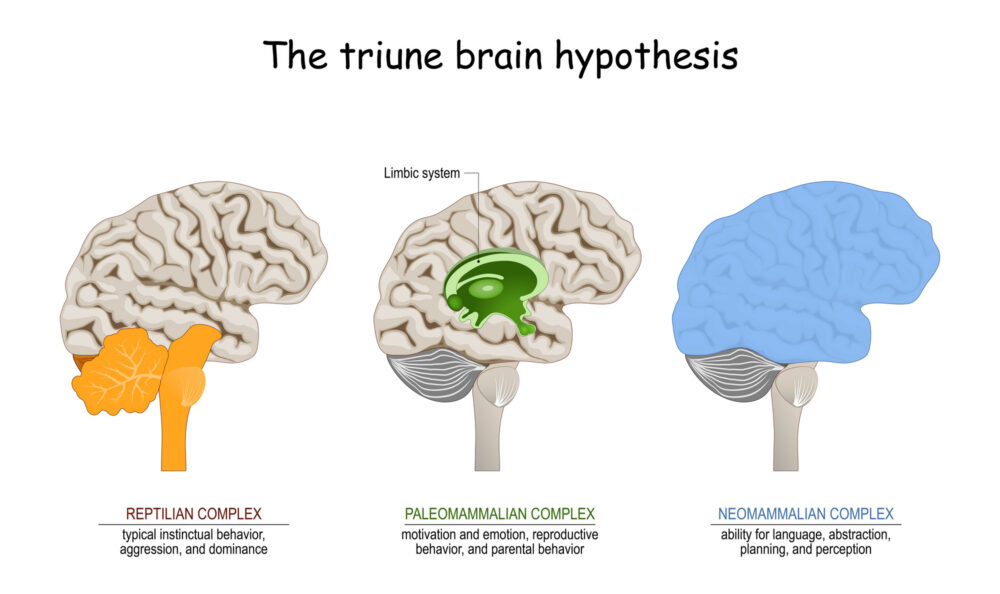
That tidy story filtered into the popular press and, eventually, into marketing—where people began talking about appealing directly to the reptilian brain. Usually those appeals involve very basic drives: fear, hunger, sex, survival.
Why marketers love the lizard brain
You can see the appeal. If a primitive, self-interested decision-maker sits beneath your customer’s rational mind, and if it controls what gets attention, then persuasion becomes a matter of learning to speak its language.
That’s essentially the pitch behind SalesBrain, the neuromarketing agency founded by Patrick Renvoise and Christophe Morin, whose 2007 book Neuromarketing: Understanding the Buy Buttons in Your Customer’s Brain helped popularize the approach. Their framework casts the reptilian brain as the attention gatekeeper and true decision-maker, and prescribes specific stimuli for reaching it: lead with the customer’s pain, make it about them, use contrast, keep it visual and tangible, front-load your message, and strike an emotional chord. My guest contributor Heidi Haskell laid out seven ways to engage your customer’s reptilian brain in a popular post that’s still worth reading.
The good news: those techniques largely work. The trouble is the label.
Is the reptilian brain real?
Modern neuroscience has mostly retired the triune brain. In a 2020 paper with the wonderful title “Your Brain Is Not an Onion With a Tiny Reptile Inside,” psychologists Joseph Cesario and David Johnson and neurobiologist Heather Eisthen note that the layered-evolution idea (old structures for instinct, newer ones bolted on for higher thought) has long been discredited among neurobiologists, and stands in contrast to what they describe as clear and unanimous agreement among researchers who actually study how nervous systems evolve.
A few of the problems:
- Mammals didn’t evolve from reptiles. We share a common ancestor. Evolution didn’t bolt a “mammal brain” onto a “reptile brain”; different lineages elaborated the same basic vertebrate blueprint along separate paths.
- Reptiles and birds have their own sophisticated forebrains comparable in function to our cortex. A “reptilian brain” buried inside your skull is a metaphor.
- Emotion and reason aren’t in separate boxes. The limbic system isn’t a self-contained emotion center, and the cortex isn’t a pure logic engine. They’re deeply interconnected—feeling and thinking happen together, across the whole brain.
Neuroscientist Lisa Feldman Barrett puts it bluntly in Seven and a Half Lessons About the Brain: you have one brain, not three. It operates as a single, integrated system.
And those unfeeling reptiles? Crocodilians guard their nests, carry hatchlings gently in their jaws, and, as that baby-cry study shows, respond to signs of distress. The cold-blooded-automaton premise was shaky to begin with.
Should you throw out “reptilian” marketing advice?
In short, no.
The techniques SalesBrain and others teach aren’t wrong. Grabbing attention quickly, leading with a clear benefit, using contrast, making things concrete and visual, and engaging emotion are all well supported by real cognitive science. They map onto how attention, memory, and decision-making genuinely work (think Daniel Kahneman’s fast, intuitive System 1, not a literal lizard). They’ll make your landing page or your pitch more persuasive, with or without lizards.
My advice: drop the pseudo-neuroscience wrapper. Telling your CMO you’re going to “hack the customer’s lizard brain” is the kind of jargon that invites eye-rolls, and, worse, bad predictions. Notice that even SalesBrain has moved on: in their 2018 follow-up The Persuasion Code, the “reptilian brain” became the “primal brain.” The techniques stayed; the sketchy biology got renamed.
If you want a case where brain science genuinely does illuminate buying behavior, see the pain of paying. And if you’re worried marketers are secretly pushing buttons in your skull, I made the case for calm years ago in Guard Your Reptilian Brain!—no ad has ever turned a customer into a mindless drone.
Brainfluence Takeaway
The reptilian brain is a useful metaphor… not an anatomy lesson. Use the persuasion techniques like pain, contrast, clarity, emotion, visuals, etc. because they’re grounded in how the brain actually works. Just don’t sell them, to your customers or your boss, as button-pushing on an inner lizard. And as always: test, test, test. Your audience will tell you what works far more reliably than any three-layer diagram.
[This is a substantial revision and expansion of an article first published in 2005.]
Related