
Cables are an important part of modern airplanes. Regardless of engine type, most airplanes use them for rudders, elevators and ailerons. Cables provide a mechanical linkage system, allowing pilots to move these flight control surfaces by interacting with the appropriate control mechanism in the cockpit. Control cables, however, often feature special fittings like fork end fittings.
What Are Fork End Fittings?
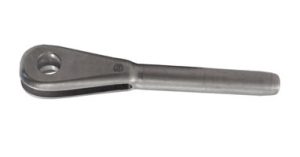
Fork end fittings are attachments that provide an anchor point for control cables. They are used to connect the ends of cables to various mechanical components. Rather than connecting cables directly to mechanical components — which may result in excessive wear and tear — you can use fork end fittings.
You can find fork end fittings in different materials, some of which include:
- Stainless steel
- High-carbon steel
- Titanium
How Fork End Fittings Work
While there are different types of fork end fittings, many are designed to be swaged onto cable ends. They feature a hollow, tubular body. You can place the end of a cable into the tubular body, after which you can swage it. Swaging the fork end fitting will cause the tubular body to partially collapse against the enclosed cable end, resulting in a tight and secure fit.
Once the fork end fitting has been swaged, it can then be connected to an anchor point. Fork end fittings feature two primary parts: a tubular body and a connector. The connector is found on the opposite side of the tubular body. It’s used to connect the fork end fitting to an anchor point.
Why Aircraft Cables Use Fork End Fittings
Aircraft cables often use fork end fittings to protect against stress-related damage. Cables, of course, can always be connected directly to mechanical components, but doing so exposes them to repeated stress. The cables will bend each time they are engaged. Over time, these bending cycles can damage the cables, causing them to fray and fail.
Fork end fittings protect cables from stress-related damage. They allow cables to safely pivot and rotate without succumbing to damage. The end result is a safer, smoother operation for the respective mechanical component.
Fork end fittings also provide excellent load transfer. They transfer otherwise heavy tensile loads from the cable to the connected mechanical component.
In Conclusion
Fork end fittings may be relatively small, but they play a big role in modern aviation. Consisting of a tubular body on one end and a connector on the other end, they are used to secure control cables to mechanical components like rudders, elevators and ailerons. Fork end fittings allow pilots to move these flight control surfaces without exposing the aircraft’s control cables to unnecessary wear and tear.