Trump Decides He’d Rather Have Tax Crimes and Rewards for Terrorists Than a Todd Blanche Confirmation

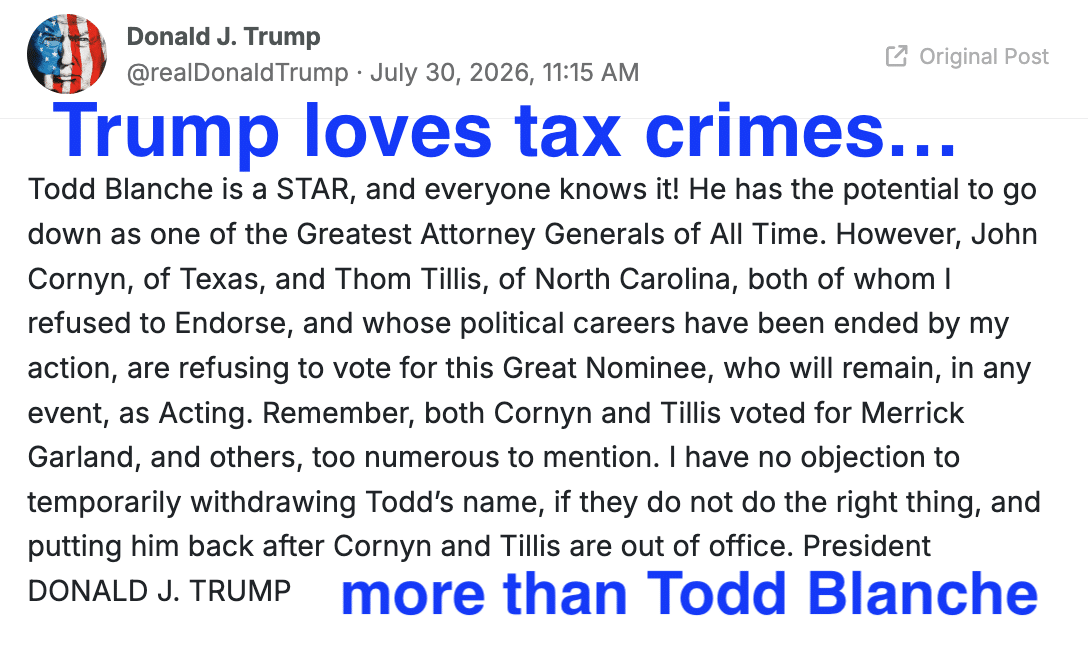
As John Cornyn, with the backing of Thom Tillis, insisted on the tiniest fragment of integrity, Trump has announced that, “I have no objection to temporarily withdrawing [Todd Blanche’] name [from consideration for the full time job of Attorney General], if they do not do the right thing, and putting him back after Cornyn and Tillis are out of office.”

If you didn’t already need reason to help James Talarico and Roy Cooper win their Senate races, Trump just gave you another.
The background, of course, is that Cornyn, especially, was demanding something in writing to back Blanche’s verbal assurances that the Terrorist Slush Fund — the $1.8 billion stolen from taxpayers in a fraudulent “settlement” to pay off people including adjudicated terrorists whom Trump has since pardoned — was dead.
But it’s not just Trump’s push to reward the people who attacked the Capitol on January 6. In final reports before Trump claimed (as if the President is passive in such matters) that he had no objection to pulling the nomination, Cornyn made it clear that the part of the settlement that immunized Trump for his tax crimes was a problem too.
Hours before Mr. Trump posted, Mr. Cornyn told reporters that he believed “higher-ups at the White House” were blocking efforts to reach a deal to modify the settlement in Mr. Trump’s lawsuit against the I.R.S.
Mr. Cornyn said he had sent a proposal to the Justice Department that included limits on a provision in the settlement protecting Trump from I.R.S. audits, a guarantee he said he needed before voting to advance Mr. Blanche’s confirmation.
“I thought we were pretty close to landing the plane last night,” Mr. Cornyn said. “But this morning there’s been some more complications.”
David Kurtz does some important analysis of the public statements about Cornyn’s demands.
If the reporting on Cornyn’s demands is correct, then Trump, Don Jr., Eric, and their company still get the $100 million gift from the President’s own administration to himself. And locking that in has the political (though not legal) effect of Senate Republicans publicly ratifying the corrupt bargain by voting to confirm Blanche.
That is, Cornyn’s demands are an attempt to make this legally sustainable.
Those who emphasize that Blanche can continue to serve are correct. But I think the temporary surrender is important for a few legal reasons.
Blanche has to turn over Epstein documents to Judge Emmet Sullivan today, and that could reveal damning new details on Blanche’s cover-up. But I’m more sanguine than others: Sullivan is not demanding action on the most important of Katie Phang’s asks, the privilege index explaining every redaction.
Pulling Blanche’s nomination means the submissions that Judge Arun Subramanian required will be litigated before the Senate reconsiders his nomination — Sean Buckley did buy enough time for Jay Clayton to be confirmed, but not for Blanche. And that could matter, not least because Subramanian was already considering sanctions.
But the potentially biggest impact is in the lawsuits about the Terrorist Slush Fund. In Floyd (the lawsuit in Virginia by people targeted by Blanche’s own politicized DOJ), Trump tried to get rid of the lawsuit by claiming that Blanche had promised under oath saying it was gone.
Subsequent events underscore that the Fund will not move forward, mooting any concern of the Court or Plaintiffs that the Acting Attorney General’s prior comments were “not under oath” and thus could not be afforded the presumption of regularity. As Acting Attorney General testified, under oath, at his Senate Confirmation hearing on July 15, 2026, the Fund “is a moot issue, meaning there is no weaponization fund. The weaponization fund is dead, it’s not moving forward.” Senate Judiciary Committee, Nomination Hearing of the Honorable Tood Blanche to be Attorney General of the United States (“Nomination Hearing”), at 1:26:42–:49. When pressed further, he emphasized, “the settlement fund is just not moving forward there’s no modification it’s just it never started no money went from the Treasury to any other account there’s no commissioners it’s not moving forward.” Id. at 1:27:12–:22. Later in the same hearing, he reiterated, “I’m under oath today, and I’ve said it’s dead repeatedly.” Id. at 2:30:44-:53
Cornyn’s resistance has shown, no matter how performatively, that Congress doesn’t believe Blanche’s representations.
And in the primary challenge to Trump’s lawsuit, before Judge Kathleen Williams, her opinion focused closely on the legal problem with the Attorney General deciding whose tax crimes will and will not be prosecuted.
On that same day, Acting Attorney General Blanche issued an “order” (the “Release Order”) which referenced the “settlement agreement” and released the President, his relatives, companies, and affiliates from “any and all claims, counterclaims, [and] causes of actions” that “have been or could have been asserted” against Plaintiffs that arise out of “(1) any matters that were raised or could have been raised in the Case or the Pending Agency Claims; (2) Lawfare and/or Weaponization; (3) any matters currently pending or that could be pending (including tax returns filed before the Effective Date) before Defendants or other agencies or departments.”15 Unlike the “settlement agreement,” which was signed by purported representatives of both Plaintiffs and Defendants, only Acting Attorney General Blanche’s signature was on the Release Order. 16 Also on that day, it was reported that IRS officials had prepared a 25-page memorandum17 that outlined major flaws with Plaintiffs’ claims and listed the various defenses that could be advanced on behalf of Defendants, defenses that had been raised in other litigation arising from the disclosures.18
On June 2, 2026, in testimony before the United States House of Representatives, Acting Attorney General Blanche advised that the Anti-Weaponization Fund would not be moving forward.19 He did not, however, commit to a similar termination of the audit and immunity protections set forth in his Release Order. Six days later, President Trump nominated Mr. Blanche to permanently serve as Attorney General of the United States.
17 Andrew Duehren, The IRS Thought It Could Fight Trump’s Lawsuit, but It Reached a Deal Anyway, N.Y. TIMES (May 19, 2026), https://www.nytimes.com/2026/05/19/admin/irs-trump-lawsuit-deal.html. The actual memorandum has yet to be published by the Government.
18 The Court notes that in a subsequent response to a Freedom of Information Act request by Citizens for Responsibility and Ethics in Washington, the DOJ stated that there were no “responsive records within the Civil Division pertaining to [this litigation].” Letter from Brian Flannigan, Div. Couns. for Recs. & Info., Civ. Div., U.S. Dep’t of Just., to Kayvan Farchadi, Citizens for Resp. & Ethics in Wash. (June 3, 2026).
[snip]
Moreover, the Release Order, signed only by Acting Attorney General Blanche, extends a blanket grant of immunity to all Plaintiffs and their families and “affiliates,” and precludes all “current or possible” investigations or actions before any other agencies or departments.50 The Release Order also purports to bar the IRS from conducting any future tax audits of President Trump, his sons, and their entities.51 This provision directly contravenes 26 U.S.C. § 7217, titled “Prohibition on executive branch influence over taxpayer audits and other investigations,” which states:
It shall be unlawful for any applicable person to request, directly or indirectly, any officer or employee of the Internal Revenue Service to conduct or terminate an audit or other investigation of any particular taxpayer with respect to the tax liability of such taxpayer.
26 U.S.C. § 7217(a).
The explicit text of this statute prohibits President Trump and his lawyers—one of whom was former White House Counsel—from asking for or promoting termination of an audit directed toward him.52 And acquiescing to any such demand is wholly incompatible with the duties of DOJ attorneys (as well as CEO Bisignano for the IRS) to enforce the law and protect the public interest.
52 This proviso of the “settlement” also raises the question of whether the agreement violates Article II, Section 3 of the United States Constitution, which directs that the President “shall take [c]are that the Laws be faithfully executed[.]” U.S. CONST. art. II, § 3.
There is a legal problem with any decision to rewrite the tax provision. Several of them, actually, since Blanche’s memo didn’t include buyoff from the purported parties to the lawsuit. Any changes would reopen the legal question, would provide amici in that case to revisit Blanche’s unlawful tax crimes.
Judge Kathleen Williams effectively said that Blanche and Trump, in tandem, had violated the one law that names the President specifically 26 USC 7217. Any change to the unlawful immunity provision would repeat the crime after both men were put on notice that it was a crime.
I suspect the White House may not have been able to placate Cornyn not because they weren’t willing to, but because they couldn’t find a way to do so that would not expose Trump and Todd to further legal exposure (which may be why Cornyn thinks a Trump advisor is the one holding this up: because Trump still has advisors to try to limit the ways in which he can be held legally accountable for his crimes).
Still, pulling Blanche’s nomination leaves things unsettled. And, particularly with an election in which Talarico and Cooper are currently ahead in polls, you never do know where unsettled things could settle.