Please tell us a little about the types of firms that work with STS Digital and what you can deliver for these clients.
We work with institutional clients across the spectrum: hedge funds, proprietary trading firms, asset managers, family offices, and a growing set of channel partners such as wealth managers and platforms that distribute to their own clients. What they share is a need to trade crypto seriously rather than casually.
What we deliver is simplicity on top of a complicated market. We act as a principal counterparty, not a broker, so a client faces one entity, one credit line, and one settlement relationship. Behind that, we cover spot, options, and structured products across more than 400 tokens. A client signs a single Master Trading Agreement or ISDA and gets access to the whole market without managing a dozen exchange accounts, fragmenting capital, or reconciling across venues. We carry the operational and credit complexity so the client can focus on the trade. We sit in Bermuda under a DABA Class F licence, with desks across Zurich, London, Singapore and Austin, so clients also get a regulated, institutional counterparty rather than an unregulated venue.
The mission of STS Digital is to become the world’s leading institutional options dealer-platform by blending three core ingredients, Quality, Consistency, Integrity, into everything you do. Why are these so important?
In OTC derivatives, the client is trusting you with price, with execution, and with their assets. Those three words are how we earn that trust.
Quality means tight pricing and reliable execution every time, not just on the easy trades. Consistency matters most in crypto, where volatility is the norm. Plenty of desks quote happily in calm markets and disappear when things move. We are built to keep pricing and keep our commitments when the market is stressed, which is exactly when a client needs a dealer to stand firm. Integrity is the foundation. We operate as principal, client assets are fully segregated, and they are never used for our own trading. Clients can verify that, not just take our word for it. Get those three right and everything else follows.

What range of options and structured products can be traded through your platform?
On the options side, we quote vanillas (from simple calls and puts to packages such as risk-reversals, butterflies and strangles) barrier options (reverse knock-ins/outs) and digitals across the major tokens, BTC, ETH, SOL, XRP as well as around 400 other altcoins (such as HYPE, NEAR, SYRUP, APE, HBAR and many more) with both physical and cash settlement and a wide range of strikes and expiries. Clients can get exposure where exchanges have little or no liquidity.
On structured products, we cover the building blocks institutions actually use: dual currency investments for yield enhancement, accumulators and decumulators for building or reducing a position at a discount, autocallables, barrier reverse convertibles, and principal protected notes. We also build bespoke payoffs when a client has a specific view or hedging need that a standard structure does not fit. Gold via XAUT sits alongside the crypto names, so a client can express a cross-asset view through a single counterparty.
How does the platform simplify the pricing and execution of more complex options strategies?
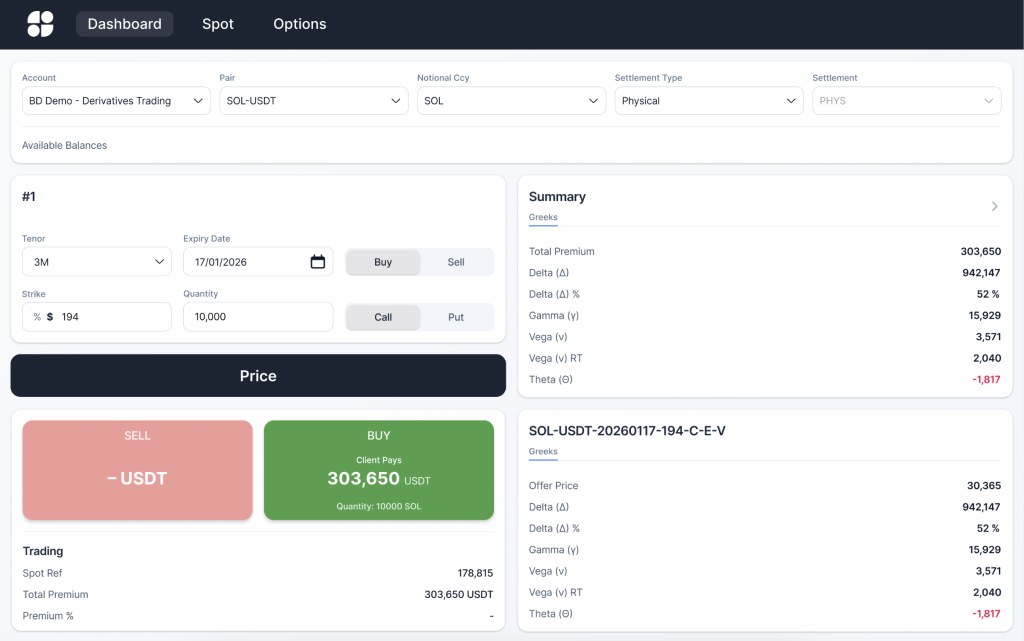
A multi-leg strategy is priced as a single package. Instead of legging into a spread or a collar across different venues and hoping the prices hold, the client requests a quote on the whole structure and receives one net price. They then execute the entire thing in a single click or a single voice instruction.
The strategy builder lets clients construct, price and save common structures, then recall and re-price them later as the market moves. That removes a lot of manual work and a lot of execution risk. There is no slippage between legs, no partial fills leaving an unwanted naked position, and no need to work out the net cost by hand. The complexity sits with us. The client sees a clean price and a clean fill.
What tools are available to help clients compare structures, scenarios and potential hedging outcomes?
Our Markets and Research section, which we are launching soon, gives clients a volatility dashboard and scenario analysis tools. Before committing to a trade they can see the payoff profile of a structure, and how its value changes across moves in spot, shifts in volatility, and the passage of time.
The point is to let clients compare options side by side. If someone is choosing between an accumulator and a put spread to hedge a position, they can lay both out, stress them against the same scenarios, and see which one behaves the way they want. We surface the trade-offs clearly rather than burying them, and we show the numbers a risk manager actually needs. Clients make better decisions when they can see the likely outcome before they commit, and that is what these tools are for.
How do you balance sophisticated functionality for experienced derivatives users with usability for less specialised market participants?
By giving clients three ways in and letting them choose. A sophisticated desk can trade by FIX or REST API, work with full Greeks, set custom strikes and barriers, and run its own systematic flow. A client who trades less often, or who is newer to options, can use the portal’s guided flows and plain language, or simply trade via or 24/7 trading desk via Telegram.
The key is that the same liquidity and the same pricing sit behind all three channels. We do not water anything down for the simpler interface. The complexity is there when you want it and out of the way when you do not. A treasurer hedging once a quarter and a quant trading daily can both use us well, each on their own terms.
How does the platform streamline the workflow from idea generation and price discovery through to trade execution?
The whole journey lives in one place. A client starts in research, forms a view, requests a price, executes, settles, and sees it reflected in their reporting, without leaving the platform. That replaces the old reality of fragmented email and chat threads, where an idea, a quote and a confirmation lived in three different tools and nothing reconciled cleanly.
Price discovery is immediate through our RFQ workflow. Execution is one step from the quote. Settlement runs through our custody setup, and everything lands on a single statement. Taking the handoffs out of that chain saves time and removes the errors that creep in when information is copied between systems. The client moves from idea to position in minutes, with a clear record of every step. It also means our own desk and the client are working from the same numbers, which makes support and post-trade questions far quicker to resolve.

We are using automation to compress onboarding and to speed up the RFQ and quoting process
What risk analytics and exposure-management tools are available to clients?
Clients see their positions, Greeks and exposure in real time, not in a report that arrives the next day. The portal shows margin utilisation, initial and maintenance margin, exposure broken down by asset and by structure, and how close a portfolio is sitting to its limits.
On the roadmap are scenario and stress views, so a client can see what a sharp move in spot or volatility would do to their margin and their P&L before it happens. This matters because surprises in a derivatives book are expensive. Giving clients the same risk picture we use internally means there are fewer of them. The tools are built to answer the question every risk manager asks: if the market moves against me, where do I stand.
How are technologies such as APIs, automation and AI influencing the future development of the platform?
Our REST and FIX APIs already let clients automate price discovery and execution, and our smart order router and execution algorithms automate the work of finding liquidity and reducing market impact. That is the baseline.
AI is where it gets interesting. Our voice trade feature lets a client state a trade in natural language and turns it into a structured order, which lowers the barrier to entry for complex strategies. We are using automation to compress onboarding, which has long been a pain point in this industry, and to speed up the RFQ and quoting process. The direction is clear: take the manual, repetitive work out of trading derivatives so clients spend their time on the decision, not the mechanics. We are careful to automate in ways that make execution safer, not just faster.
What enhancements to the platform can clients expect over the next 12 to 24 months?
More self-service and more breadth. We are expanding what clients can do without picking up the phone, adding structured product types, and deepening the analytics so clients can model and manage more of their book themselves.
We are broadening venue coverage and API functionality for systematic clients, and pushing further on automation across onboarding, reporting and post-trade. On the product side, expect more cross-asset capability, with gold and FX legs sitting naturally alongside crypto, and continued work on capital efficiency through cross margining and portfolio margin.
The constant through all of it is the goal we started with: give institutions a single, trusted counterparty that makes trading crypto derivatives as clean and as capital efficient as the rest of their book. The next two years are about widening that lead.