Free for nonsubscribers
By Karl Sinclair
July 28, 2026, © Leeham News: Boeing chief executive Kelly Ortberg has reiterated that the airframer expects to soon secure an amended type certificate for its long-delayed 737 Max 7, the smallest variant in Boeing’s flagship narrowbody family.
FAA certification of the Max 10, the most-stretched 737 Max, should follow shortly thereafter.
“These certifications pave the way for both airplane variants to start deliveries in 2027,” Ortberg said during Boeing’s second-quarter earnings call.

Ortberg has been on a mission to stabilize Boeing’s commercial aircraft production system and return the company to profitability. Photo credit: Boeing
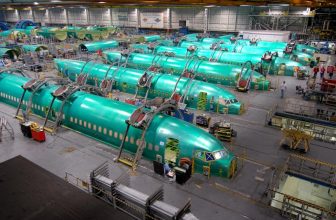
While finally securing certifications for the Max 7 and Max 10 would be welcome news, about 35 already-produced aircraft awaiting delivery in Renton, Washington will have to wait at least another six months before getting in the hands of airlines.
Boeing has been producing some of those aircraft since the end of last decade, as it previously expected that the Max 7 and Max 10 would have been in service with global airlines for more than five years by now.

Aircraft that sit undelivered for long periods cannot be simply left alone but rather require continued maintenance that add costs and further erode margins on the 737 Max program.
Southwest Airlines is by far the largest future operator of the Max 7, as it holds 269 orders for the smaller narrowbodies. The carrier has been planning for years to replace its ageing fleet of more than 270 737-700s, which has an average aircraft age of about 20 years. Those jets represent the oldest type in Southwest’s fleet.
Meanwhile, the Max 10 will start out at a five-to-one disadvantage when compared with the Airbus A321neo, which owns the lion’s share of the large narrowbody market. Whereas the Max 7 is considered a niche aircraft in a shrinking market as airlines continually upgauge to larger jets, the Max 10 is viewed by Boeing as a critical profit-driver for the near future.
Earnings pressure points
Boeing Commercial Airplanes (BCA) posted a net loss of $322 million during the second quarter, on revenue of $11.8 billion. The segment delivered 171 aircraft during the April-June period.
Boeing’s commercial division has not posted a positive net result since 2018.
Asked about BCA’s eventual return to profitability, chief financial officer Jay Malave said: “Margins will approximate on the 737 what they were in 2018 by the end of the decade, and we expect on the 787 to actually surpass what they were in 2018 by the end of the decade, as well.”
As previously reported by LNA, Boeing will have to work its way through a low-margin portion of its aircraft delivery backlog, as aircraft that were promised to airlines years ago now have compensation penalties attached. Only then can earnings ramp up.
“The program cash margins…we’re at the press level slightly above break-even on 737 and 787, and that’s largely due to these pricing drags,” Malave said. “It does take some time for those [drags] to fully dissipate, and the benefit of our delivery cadence will drive that.”
Indeed, Boeing’s quarterly delivery pace of 171 aircraft would translate to an annual rate of nearly 700 jets. But it cost the company $322 million to hand over those 171 aircraft, or about $1.9 million per delivery.
777X marks the spot
Orberg told investors and analysts that he is pleased with headway made by the 777X program as BCA works through FAA certification of the long-awaited widebody.
“We’re making good progress here,” he said. “I wouldn’t be overly concerned with the 55% complete [flight test program]. That will accelerate pretty quickly here.”
He added that engineering and certification resources previously devoted to the 737 Max 7 and Max 10 can now be diverted to pushing the 777-9 over the finish line.
Meanwhile, Boeing’s planned ramp-up of 787 Dreamliner production has been slowed by supply chain snarls, mostly notably those related to engine maker GE Aerospace.
“In Charleston, on the 787 program, we’ve now stabilized at eight airplanes a month,” Ortberg said. “We did make the decision to temporarily slow production systems for several days in April to allow portions of the supply chain to recover.”
Boeing is tracking to deliver about 90 787s for the full year of 2026.
Defense side upside
Despite a $280 million charge on the VC-25 presidential aircraft program, Ortberg was generally upbeat about the direction of Boeing’s defense segment.
“We are in much better shape than we were two years ago,” he said. “We continue to do a good job on improving our underwriting of new contracts and being selective on the programs we bid [for].”
This marks a change at BDS. Now, the division appears to bid on programs that make financial sense, rather than bidding purely to keep programs out of the hands of competitors.
Malave struck a similarly optimistic tone on the defense side. “Excluding the impact of the VC-25B adjustment, BDS operating margin was 3.5% on the quarter, reflecting better operating performance cost across the rest of the business in line with our expectations for steady margin improvement.”
Both Ortberg and Malave expressed the sentiment that BDS—along with the broader company—has finally turned a corner.
For a more detailed financial breakdown of Boeing’s second-quarter financial results, refer to Karl Sinclair’s earlier story for LNA.
Related