Welcome to our coverage of the middle chapter of 1976’s Justice League of America/Justice Society of America crossover event, guest-starring “Shazam’s Squadron of Justice” — i.e., the Fawcett Comics heroes that DC had licensed the rights to a few years previously. Although if you missed last month’s post about JLA #135, you might want to go back and catch up on things there before digging into today’s entry — because, as we’ll soon discover, this comic’s very own writers opted fifty years ago not to offer even a brief recap of this frankly overstuffed storyline’s first installment — and this blog is opting to take its cues from them. Hey, fair is fair.
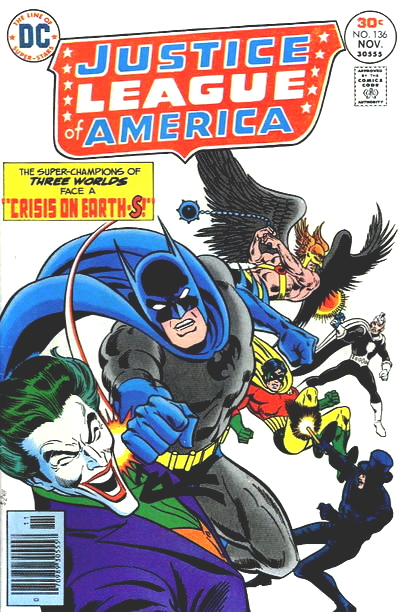
Before getting into JLA #136’s interiors, however, we’ll take a moment to note that — not counting last issue’s floating headshot — this issue’s cover by Ernie Chan and Frank Giacoia features the first appearance of the Golden Age/Earth-Two Batman on a comic-book cover since — well, whatever your personal headcanon holds to be the last published issue of Batman, Detective, or World’s Finest featuring the OG Caped Crusader. And now, on to our main event:

While there’s a lot more superheroes than the ones shown in this symbolic splash page involved in this three-part story overall, most of them split into smaller units in the previous issue, so we have a tidier group of eight featured in this one: Earth-One’s Hawkman and Hawkgirl, Earth-Two’s Batman and Robin, and Earth-S’s Bulletman, Bulletgirl, Mr. Scarlet and Pinky. Why double the number for Earth-S? Well, this installment of the trilogy is entitled “Crisis on Earth-S!” — and that, along with the fact that this crossover more or less serves as that world’s DC Multiverse debut, is probably justification enough for giving these lesser known costumed crimebusters a larger share of the spotlight.
So, anyway — we have eight heroes. Which makes it something of a head-scratcher that the credits box at the top of the next page, in addition to acknowledging the efforts of writers E. Nelson Bridwell and Marin Pasko, illustrators Dick Dillin and Frank McLaughlin, and editor Julius Schwartz, makes a jokey reference to “12 heroes!” But, rest assured, all will be made clear by the time we get to the end of this comic…


Hmm, I’m not sure exactly how the organic systems of a human body — OK, fine, a Thanagarian body — could continue to function normally if a significant chunk of its living tissue was suddenly transformed into presumably nonliving volcanic rock, as has just happened to Hawkman. But we’ll just have to chalk it up to comic-book science, or magic (at this point, it seems it could be either), and roll with it — especially since this sort of thing is going to keep happening throughout the issue.

With the entrance into the story of Billy Batson, one might say our hero-count has risen to nine — even if Billy isn’t exactly the same person as the guy he turns into when he says “Shazam!”, i.e., Captain Marvel (at least, not in every version of the Fawcett heroes’ continuity). Yeah, it’s a bit of a cheat, but I think we’re going to have to allow it.


Given that they’re on Earth-S, Robin seems to be leaping to conclusions in assuming that only the Earth-Two Joker could be responsible for these unfortunate construction workers’ death-grins. It’s not like there isn’t at least one other Joker active in the multiverse whose existence he should easily be able to hypothesize, regardless of whether or not the Justice League have ever explicitly told their Justice Society comrades about Earth-One’s own Clown Prince of Crime. For that matter, some completely unrelated villain native to Earth-S could easily have adopted a similar M.O. to the Joker’s. But, as it turns out, the ex-Boy Wonder is right on the money — so, no harm, no foul, I guess.

Naturally, the Joker needs no more introduction to the readers of this blog than did the Penguin in the previous issue. But the Weeper has had rather less exposure than either of those Bat-foes, so some of you might be interested to know that this Fawcett villain, who was also known as Mortimer Gloom, was a recurring foe of Bulletman and Bulletgirl who first appeared in Master Comics #23 (Feb., 1942).


Searching the scene of the crime for clues, our heroes notice some distinctive scratch marks on the sidewalk. “Nml tmng hrd enmph tdm tht s dmndmph!” observes Batman — which Robin helpfully translates for the others (and us) as: “Only thing hard enough to do that is diamonds!” The two dynamic duos dutifully follow the trail left by the weird markings all the way to a run-down brownstone…


Just when you might be thinking that Mister Scarlet and Pinky are no more than knockoffs of Batman and Robin, the former whips out his “infra-red ray pistol” and lets the Joker have it. Let’s see Bats pull one of those out of his utility belt, eh? (On second thought, forget about it; he probably could.)


Say, did you miss that earlier panel that showed Pinky’s hair turning to diamond? Me too. I think that’s because there wasn’t one.
The heroes leave the lab so that Jim Barr can change into his Bulletman gear; while he does, Robin points out the obvious: these weird crimes are way out of the Joker’s league. “This is Kull’s work,” he asserts, “what we were sent here to intercept!” At that point, the Hawks and Bulletgirl arrive on the scene, the latter bearing a couple of photos she’s just pulled off the Associated Press’ wire service:

If not quite as familiar to the comics-reading audience of 1976 as the Joker, both the Shade and Doctor Light were at least better known than the Weeper — especially if you’d been following DC’s output since the Silver Age. The Shade had been introduced as a foe for the original Flash, Jay Garrick Flash Comics #33 (Sep., 1942); that debut ultimately proved to be his one and only Golden Age outing, as he had to wait almost two decades for his return in Flash #123 (Sept. 1961). There, he’d fought Jay Garrick and Barry Allen in “Flash of Two Worlds” the classic story that got the whole parallel-Earths thing rolling at DC; his latest appearance prior to this one had come just one year before, in 1975’s JLA/JSA crossover. As for Doctor Light, he’d begun his perfidious career by taking on the whole Justice League in JLA #12 (Jun., 1962), and had appeared multiple times since then; sometimes battling the entire League, other times going up against individual members.

You can see what plotter E. Nelson Bridwell was going for in this middle chapter of this storyline in trying to do something novel with the familiar tropes of the JLA/JSA crossover events. Hey, he may have thought, instead of having the JLA and JLA and their allies split up into purely random smaller teams, why not have these smaller units made up of heroes with the same basic shtick? And why not have the villains they fight parallel that in reverse, by pairing bad guys with opposite shticks? These aren’t bad ideas, necessarily, but since there’s no good in-story justification for them, the contrivance of it all is quite glaring. The same goes for the extra wrinkle added here, with the Hawks and Bullets switching partners so as to “confuse” their enemies. Yeah, tell me another one, guys — although I will give our storytellers points for allowing the two superheroines to team up with no hand-wringing about whether a couple of females could be expected to handle things without a guy hero around.
Another downside of the “four heroes with the same shtick” notion is that the action within each individual segment of the story ends up being rather samey; after all, one of the big draws of seeing superheroes team up is seeing how their different powers and abilities play off each other. Besides which, if you’re not careful, one set of similarly-operating crusaders may outshine the other to the extent that a reader might well wonder why anyone would ever want to read about, say, Mr. Scarlet and Pinky, when Batman and Robin are also around. Just sayin’.

With the arrival of Mary Batson and Freddy Freeman, we can add two more superheroes — albeit currently powerless ones — to our count. Even so, we’re still one short of the credits box’s total of twelve.

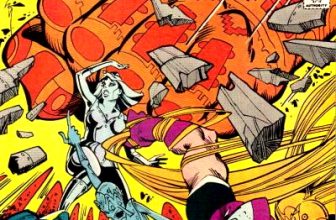
I suspect that all of the “painted figures come to life” we see on these pages are based on actual masterpieces hanging in the Louvre — but with the exception of the tall woman in the robe (who’s gotta be the Mona Lisa), I have no idea who’s who. Anyone with more art history expertise than your humble blogger care to take a guess?


Once the Shade has been brought to earth, he confesses to Hawkman that he’s been using his cane to control an orbiting satellite that’s causing the artificial darkness covering half the world. But when Hawkman tries to use the cane to reverse the process, nothing happens — a fact that comes as much of a surprise to the villain as to the hero…


Why are Dr. Light’s suddenly sentient light-duplicates so much nicer than the diabolical doc himself? Um… because the plot needs them to be? Honestly, that’s all I’ve got.


And now, we finally have our twelfth and last hero: Johnny Thunder. Gee, I wonder what use a guy who can summon a genie in the form of a magical thunderbolt can possibly be to three heroes who transform into theie super-selves when struck by a magi — oh, wait, I think I got it.
Anyway, if you were a comics reader in August, 1976 who was simply looking for a JLA/JSA crossover installment featuring lots of heroes, villains, and action, you might well have been satisfied with Justice League of America #136 — that is, as long as you didn’t stop to think about why our main bad guy King Kull, who was obviously perfectly able to operate his matter transformation satellite technology without any help, bothered to enlist four subordinate bad guys in the first place — let alone give them the ability to move said satellites, so that they could be made to collide and blow up his plans.
And if I’d first read this story as a nine-year-old, rather than a nineteen-year-old — or, gods forbid, a sixty-nine-year-old — those questions might not have occurred to me, either. But, here we are.
Still, we’ve got one more chapter to go — and surely the Fawcett heroes everyone actually wants to see, i.e., the Marvel Family, are going to finally get to go into action early in the next issue. Won’t they? I guess we’ll find out, come the first week of September. I hope to see you then.