How Do I Know My Garmin Strap Size?

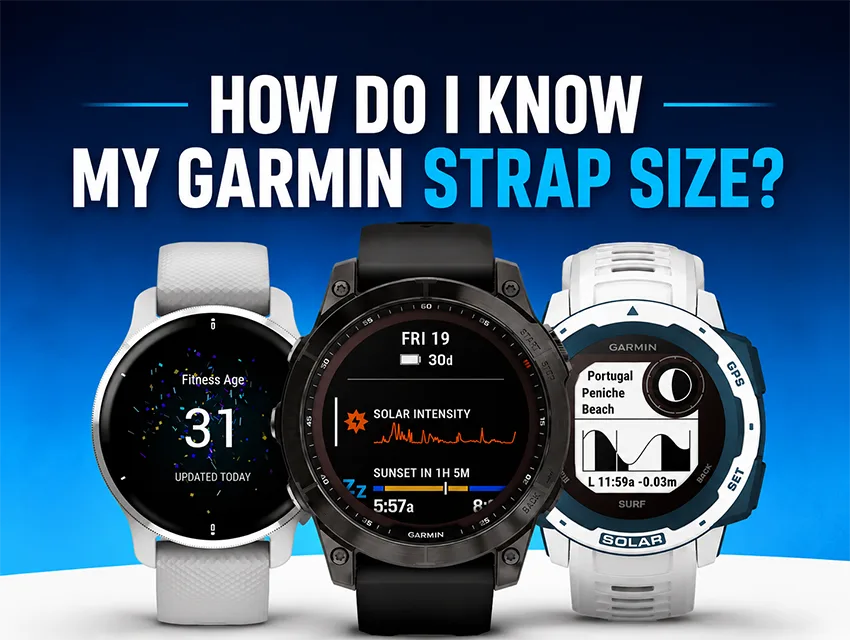
Most Garmin smart watches use one of three band sizes: 20mm, 22mm, or 26mm. Ordering the wrong size is one of the most common mistakes Garmin owners make when buying replacement bands.
It almost always comes down to one thing: mixing up the model itself. Standard, S, and X variants have nearly identical names but completely different band widths, so the model mix-up becomes a sizing mix-up.
Key Takeaways
- Garmin mainly uses 20mm, 22mm, and 26mm band widths.
- Garmin S models usually use 20mm.
- Standard Garmin models usually use 22mm.
- Garmin X models usually use 26mm.
- Garmin uses both QuickFit and standard quick-release connector systems.
- Band width alone doesn’t confirm compatibility.
- Many Garmin watches stamp or print the band width directly on the watch band.
- A ruler or digital calipers confirms lug width in under 10 seconds.
- Fenix 7, Fenix 7S, and Fenix 7X all use different band widths despite nearly identical names.
Garmin’s Band Sizes and the S / Standard / X Split
Most Garmin watches fall into three band widths: 20mm, 22mm, or 26mm.
Examples include:
| Model Variant | Lug Width | Example Models |
|---|---|---|
| S (small case) | 20mm | Fenix 7S, Instinct 2S, Epix Pro 42mm |
| Standard | 22mm | Fenix 7, Forerunner 255, Venu 2, Instinct 2 |
| X (extra large case) | 26mm | Fenix 7X, Epix Pro 51mm, Tactix 7, Descent Mk2 |
The Garmin Fenix lineup causes more sizing mistakes than almost any other Garmin category because the model names look almost identical while using completely different band widths.
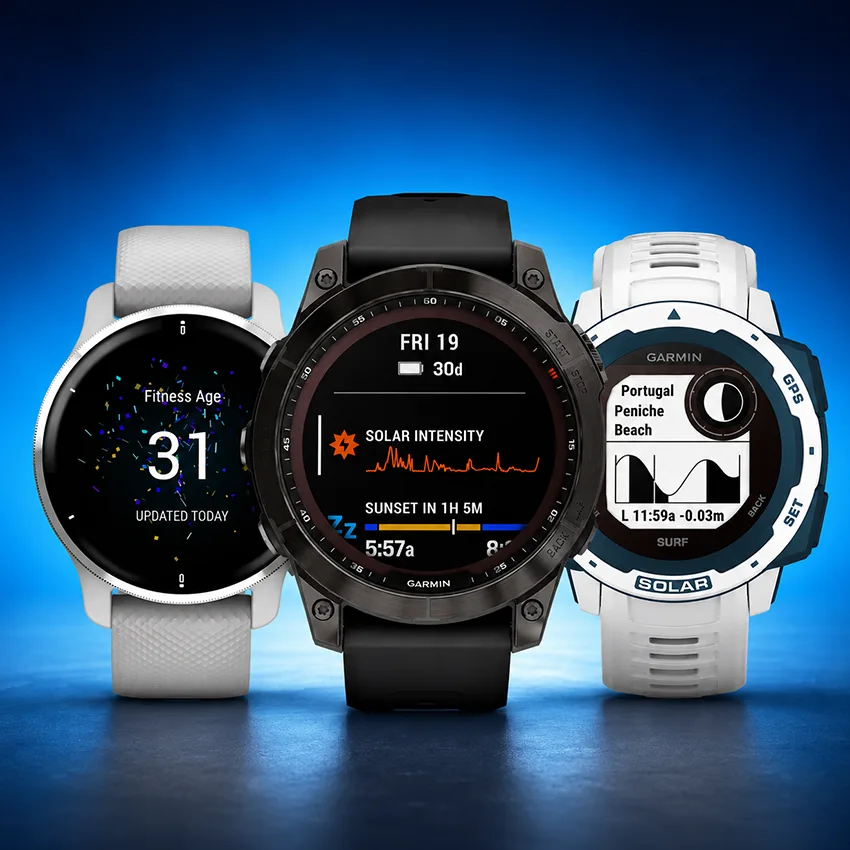
The Fenix 7S uses 20mm bands, the standard Fenix 7 uses 22mm, and the Fenix 7X uses 26mm.
While the S and X suffix rule is the quickest Garmin sizing shortcut, it is not always true in more recent models, like with the Garmin Fenix 8. It keeps the same three QuickFit widths but drops the S/Standard/X naming entirely. Garmin labels it by case size instead: the Fenix 8 – 43mm uses 20mm, the Fenix 8 – 47mm uses 22mm, and the Fenix 8 – 51mm uses 26mm.
Garmin also breaks its usual sizing patterns in lineups like Approach, D2, Descent Mk3, and Vivoactive, where connector systems and widths can vary significantly between closely related models.
The Vivoactive lineup is one of the biggest examples of jumping sizes between models. Following the S naming convention highlighted above, the Garmin Vivoactive 4 uses 22mm, while the Garmin Vivoactive 4S uses 18mm. The newer Garmin Vivoactive 5 offers only a 20mm band, meaning straps aren’t compatible across the three models.
Connector type matters just as much as band width. Garmin’s Approach golf lineup is a good example of this. The Approach S40 and S42 use 20mm standard quick-release bands. The Approach S60 and S62 switch to Garmin’s QuickFit connector system, at 22mm. A quick-release band from an S42 won’t attach to an S62 at all, regardless of width.
QuickFit vs Quick Release Connector Type
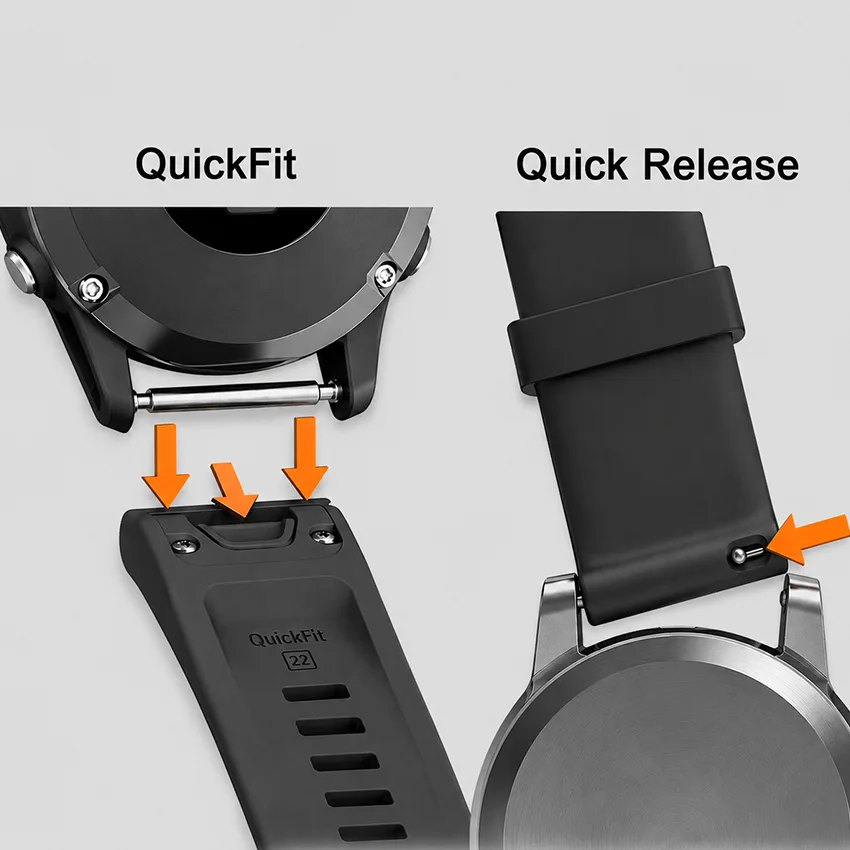
Garmin band compatibility depends on more than width alone because Garmin uses two completely different connector systems: QuickFit and quick-release.
QuickFit and quick-release are completely different attachment systems. Even if two bands share the same width, a QuickFit band still won’t attach to a quick-release Garmin watch because the connector mechanisms are completely different.
| Connector System | How It Attaches | Example Models |
|---|---|---|
| QuickFit | Snaps onto proprietary adapter ports, no tools needed | Fenix 5+, Approach S60/S62, Forerunner 970 |
| Quick-Release (spring bar) | Spring bar pins seat into lug holes | Fenix Chronos, Forerunner 255/255S, Venu 2, Vivoactive 4/4S/5 |
Garmin QuickFit
QuickFit uses proprietary snap-on connectors built directly into the watch case. They have rectangular connector ports, release tabs, and tool-free installation.
Examples:
- Garmin Fenix 7 and 8
- Garmin Epix
- Garmin Tactix
- Garmin Forerunner 970
Garmin has kept the QuickFit connector system largely consistent from the Garmin Fenix 5 through the Garmin Fenix 8 lineup. The bands remain cross-compatible when the width matches correctly.
Some older bands may not sit perfectly flush on newer case shapes, but the attachment mechanism itself remains compatible.
A properly built connector shouldn’t loosen from normal band swapping. Cheap aftermarket bands often use painted connector coatings that scratch quickly or develop wobble over time.
Garmin Quick Release
Quick-release Garmin watches use traditional spring bar pins, seen on various smart watches and classic watches alike.
Quick-release watches have round lug holes, visible spring bars, and small sliding release tabs underneath the band. These can be changed using a spring bar removal tool or by using your fingers to push the small lever to release it.
Garmin models like the Forerunner 255/255S, Venu 2, Vivomove, Vivoactive 4/4S, and Vivoactive 5 all use quick-release connectors rather than QuickFit.
How To Find Your Garmin Watch Strap Size
Check Your Current Band for a Stamp
The fastest way to confirm Garmin strap size is to check the number stamped near the connector ports on the underside of your current band.
How to Check Your Band
- Turn the band over so the underside faces up.
- Look at the band near the end that connects to the watch case.
- Find the printed or stamped millimeter number.
That stamped number is your lug width. No ruler or measuring tool is required.
Look Up the Garmin Model Name
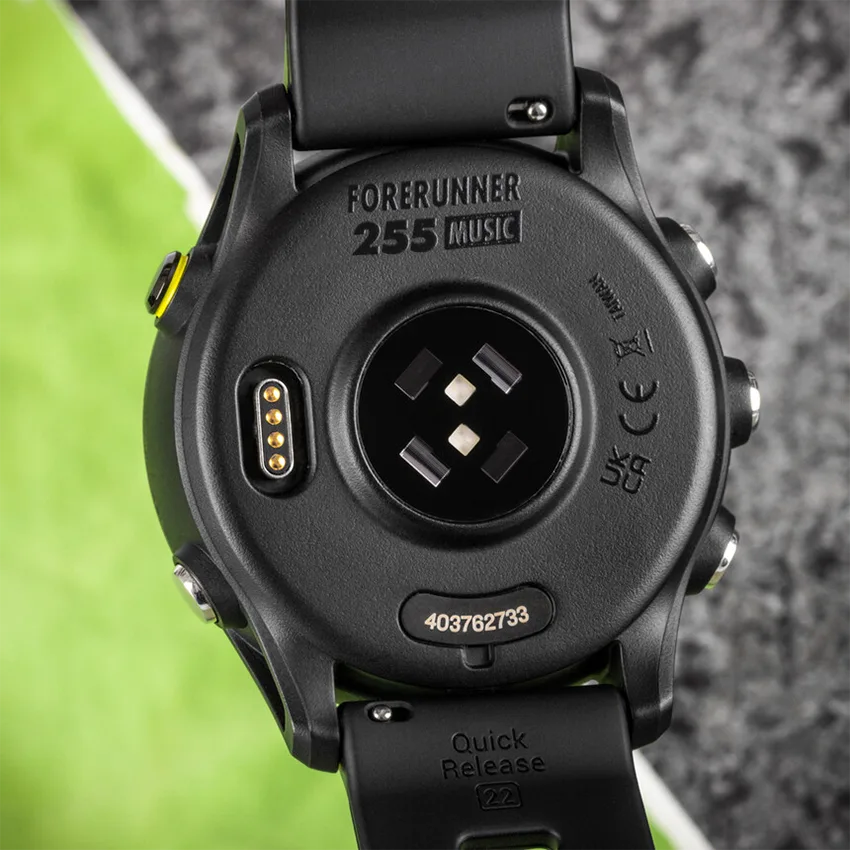
Another easy way to narrow down Garmin strap size is checking the exact model name printed on the watch itself.
Garmin usually prints the full model name on the case back. The full model name also appears inside Garmin Connect device settings and on the original product box.
From there, you can use our Garmin lug width and strap size guide to determine your exact strap size. Be careful not to get confused by the case size printed on the back of your device. The measurement you need to replace your band is the band size, or lug width.
Examples
| Model | Case Size | Lug Width/ Band Size |
|---|---|---|
| Garmin Fenix 7S | 42mm | 20mm |
| Garmin Fenix 7 | 47mm | 22mm |
| Garmin Fenix 7X | 51mm | 26mm |
| Garmin Forerunner 255S | 41mm | 18mm |
| Garmin Forerunner 255 | 46mm | 22mm |

After getting your size, you can check out our Garmin 22mm watch bands and Garmin 20mm watch bands to easily access the right watch band for your model.
How to Measure the Lug Gap Directly
If the other methods don’t give you a clear answer, measuring directly will. Most Garmin watch bands use standard widths like 20mm, 22mm, or 26mm, so even a basic ruler is usually enough to confirm the correct size.
If that doesn’t give you a clear lug width, digital calipers give the most accurate measurement.
How to Measure Garmin Lug Width
- Place the watch face-up on a flat surface.
- Position a ruler or calipers across the lug opening.
- Measure the inside gap between the lugs where the band attaches to the case.
- The measurement in millimeters is the band width/lug width.
Digital calipers are the most precise option, but a standard ruler works perfectly for confirming if it’s 20mm, 22mm, or 26mm.
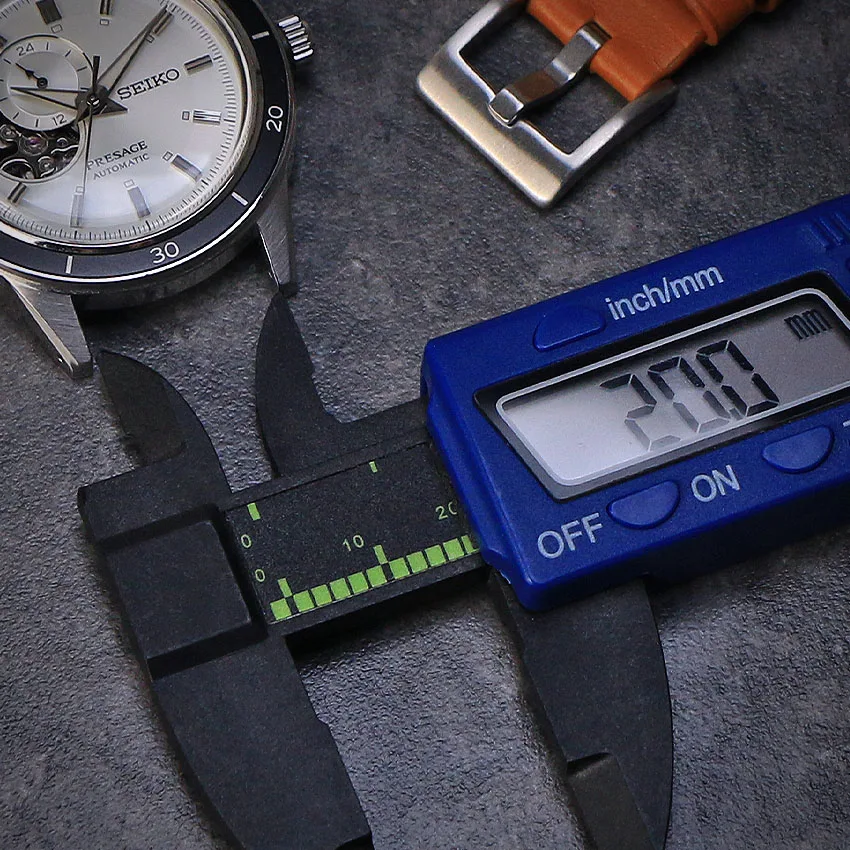
If the reading falls slightly between sizes because of manufacturing tolerances, always round down instead of up.
Finding Bands for Your Garmin Model
Getting your Garmin band size right comes down to two things: the number stamped on the watch band (lug width) and whether your watch uses QuickFit or quick release.
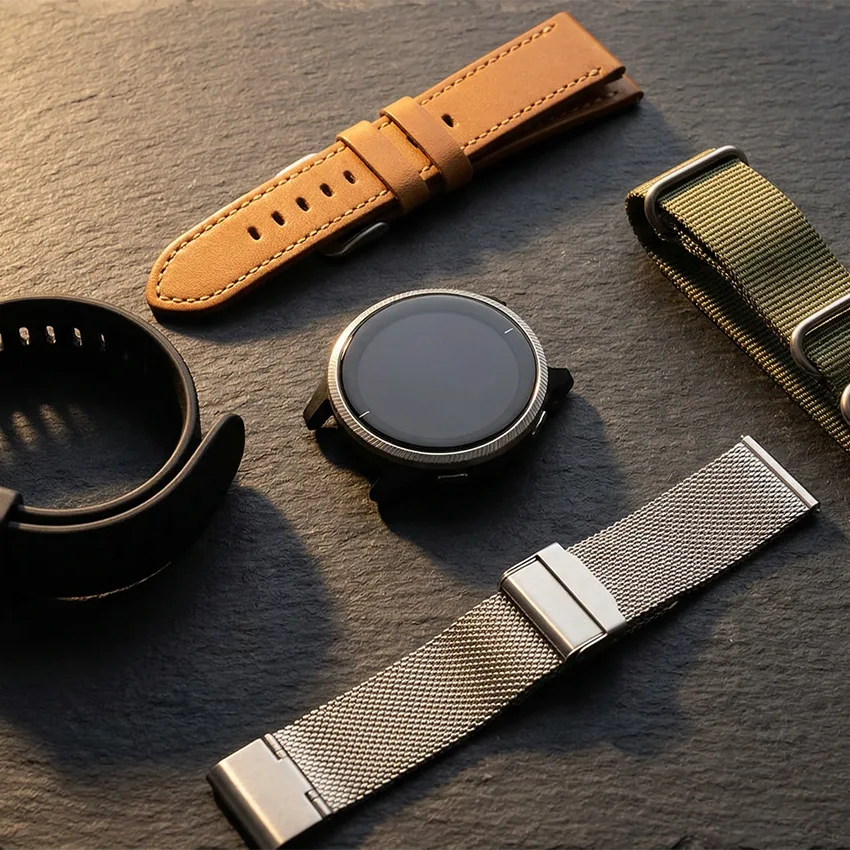
Once you’ve confirmed both, browse all our Garmin watch bands filtered by your specific model. We carry Garmin-compatible bands in DuraFlex FKM, silicone, nylon, leather, and metal styles with model-specific compatibility across the full Garmin lineup.
What features are you looking for in your next watch strap?
Frequently Asked Questions
What band size does the Garmin Fenix 7 use?
The standard Fenix 7 uses 22mm QuickFit. The S and X suffixes determine the size category across the Garmin Fenix lineup. The Garmin Fenix 7S uses 20mm QuickFit. The Garmin Fenix 7X uses 26mm QuickFit for its larger 51mm case.
What size strap does the Garmin Vivoactive 5 use?
The Garmin Vivoactive 5 uses a 20mm standard quick-release band. It doesn’t use 22mm or 18mm like the Garmin Vivoactive 4 and 4S.
All three Vivoactive models use quick-release bands, so only the width changes between them.
Do all Garmin bands fit all Garmin watches?
No. Garmin compatibility requires both the correct width and the correct connector type. A 22mm QuickFit band doesn’t fit a 22mm quick-release Garmin watch.
Both measurements must match, so always confirm the connector type before ordering a replacement band.
How do I know if my Garmin uses QuickFit or quick release?
QuickFit watches use rectangular connector ports with snap-on attachment tabs.
Quick-release watches use visible spring bar pins inside round lug holes.
Turn the watch over and check the connector shape. If you see rectangular ports, it’s QuickFit. If you see round holes with visible spring bars, it’s quick-release. When in doubt, look up your exact model name to confirm.