Portugal is small enough to drive from north to south in about six hours and dense enough that you could spend a month here and still miss half of what is on this list. That is the real planning problem. Not finding the famous landmarks in Portugal, but working out which ones justify a detour, which ones need a ticket bought weeks ahead, and which ones you can walk up to on a Tuesday morning with almost nobody else there.
So this list is organised the way you would actually travel it, region by region from Braga down to the Algarve and out to the Azores. Under every entry you will find what it costs, if you need to book in advance, and the hour I would go. Prices are approximate and worth checking on the official site before you commit, because most of the big ticketed sites in Lisbon and Sintra have raised their entry fees in the last two years.
A quick note on how to read it. Roughly a third of the landmarks of Portugal on this list are free and you can turn up whenever you like. Another third need a ticket but rarely sell out. The remaining handful genuinely sell out days ahead in high season, and those are the ones that ruin trip planning when nobody warns you.
The eight landmarks I would build a Portugal trip around: Torre de Belém and Jerónimos Monastery in Lisbon, Pena Palace and Quinta da Regaleira in Sintra, the Dom Luís I Bridge in Porto, Batalha Monastery in the centre, Benagil Cave in the Algarve, and the Caldeira das Sete Cidades in the Azores. Everything else on this list is worth adding depending on where you are driving.
Book these ahead in summer: Pena Palace, Quinta da Regaleira, Livraria Lello, Jerónimos Monastery, Torre de Belém, and any Benagil Cave boat or kayak tour.


This post may contain affiliate links. If you purchase through them, I may earn a small commission at no extra cost to you. Thanks for supporting my small business.
Where These Portugal Landmarks Are: A Map by Region
Portugal sits on the western edge of the Iberian Peninsula and divides neatly into six travel regions. The north around Porto and Braga is green, hilly and wine country. The centre holds the monasteries and the surf coast. Lisbon and Sintra sit in the middle. The Alentejo is flat, hot and empty. The Algarve is the southern coastline. The Azores and Madeira are Atlantic archipelagos, and the Azores are covered at the end of this list.
Below is a map of every landmark in this guide, colour coded by region, so you can see which ones cluster together and plan driving days around them. If you are still deciding on a route, my Portugal itinerary for 7 to 14 days puts most of these in a workable order.
Best Time to Visit Portugal’s Landmarks
Spring and autumn. That is the short answer and it is not a close call for landmark travel specifically.
In July and August the queue at Jerónimos runs along the outside wall in full sun, Sintra sells out its timed entry slots, and the Algarve coast roads back up. In April, May, late September and October you get the same weather most days, half the crowds, and cheaper accommodation. Portugal sits far enough south that the climate stays mild through winter, so December to February is genuinely usable for the indoor landmarks, and you will have the monasteries close to yourself. The trade off is shorter daylight and a real chance of rain on the coast.
If your trip is built around photography rather than sightseeing, aim for the shoulder months when the light stays soft for longer and the sites are empty enough to shoot without waiting for people to clear the frame. There is more detail in my full guide to the best time to visit Portugal, and if you are considering winter, Lisbon in winter covers what actually stays open.
PRO TIP: the last entry slot of the day at ticketed sites is usually the quietest, but check the closing time first. Several Portuguese monuments stop admitting visitors a full hour before they close, so a 5pm slot at a site that closes at 6pm can leave you rushed.
How to Get Around Portugal to See These Landmarks
How you travel changes which of these landmarks are realistic. Lisbon, Porto and Sintra are all doable without a car. Everything in the Alentejo, most of the central monasteries, and the good stretches of the Algarve coast are not.
By car
Driving in Portugal is straightforward; the motorways are good, and the distances are short. You can reach Batalha, Alcobaça, Óbidos and Tomar in a single loop from Lisbon, which is impossible by public transport in one day. I compare rental prices on Discover Cars because it pulls in the local Portuguese agencies alongside the big international brands, and the local ones are often significantly cheaper. Read what to know before renting a car in Portugal first, particularly the section on the electronic toll system, which catches out almost every first time visitor.
By train and bus
The Lisbon to Porto line is fast, comfortable and cheap, roughly three hours on the Alfa Pendular. Regional trains reach Sintra, Cascais, Coimbra and Aveiro easily. Buses fill most of the remaining gaps, though services to the smaller Alentejo towns can run once or twice a day. If you are travelling solo and would rather not drive, build your trip around the rail line and treat the rest as day tours.
By tour
A few of these landmarks are genuinely easier on an organized tour, either because access is restricted or because the driving is the annoying part. Benagil Cave can only be reached from the water. The Douro Valley is much better enjoyed when you are not the one driving between wine tastings. Sintra combines badly with parking.
PRO TIP: if you only rent a car for part of your trip, make it the central Portugal leg. That is where the monastery cluster sits and where public transport is weakest. Lisbon and Porto are both easier without a car than with one. I book all my tours on VIATOR.
The most famous landmarks in Portugal in the Northern Region
1. Bom Jesus do Monte, Braga


Bom Jesus do Monte is a baroque stairway climbing a wooded hill above Braga to a church at the top, with a garden, a funicular and a couple of hotels attached. The stairway is the reason to come. It zigzags upward in symmetrical flights with fountains at each landing, and it photographs best from partway up looking back down rather than from the base.
You can walk up in about twenty minutes or take the water counterbalanced funicular, which has been running since 1882 and is the oldest of its kind still operating in the world. Walk up and ride down if you want both.
Cost: free to enter the sanctuary and gardens, around €2 each way for the funicular. Booking: not needed. Best time: early morning, before the coach groups from Porto arrive around 11am.
PRO TIPS – There are two hotels by the sanctuary if you want to spend a couple of nights in style with breathtaking views over the city – One by the lake Hotel do Lago and two right by the Sanctuary, Hotel Elevador and Hotel Do Parque
2. Jardim de Santa Barbara, Braga


A formal garden laid out in geometric beds beside the medieval walls of the Archbishop’s Palace in central Braga. It takes fifteen minutes to walk and it is one of the few green spaces in a city that otherwise has very little. The flowers are at their best in late spring.
Cost: free. Booking: not needed. Best time: late afternoon, when the low sun hits the palace stonework behind the beds.
3. Castelo de Guimarães


Guimarães Castle is where Portugal as a country begins, which is why the town calls itself the cradle of the nation. Built in the 10th century to defend the region against raids, it sits at the highest point of Guimarães and was voted one of the Seven Wonders of Portugal in 2007.
It is a compact site, and you can see it properly in forty minutes. Combine it with the Palace of the Dukes of Braganza, a hundred meters downhill and the whole historic center, which is a UNESCO site in its own right. It works well as a day trip from Porto, about an hour by train.
I visited from Braga, instead, where I stayed for 5 days and enjoyed exploring the city and it’s surroundings.
Cost: around €2 for the castle, or a combined ticket with the ducal palace for around €6. Booking: not needed. Best time: any weekday morning. Weekends fill with Portuguese families.
4. Douro Valley


The Douro Valley is the demarcated region where the grapes for Port and Douro wines are grown, and the terraced hillsides above the river are a UNESCO World Heritage Site. It is the oldest demarcated wine region in the world, established in 1756.
Three ways to see it, and they give completely different days. Driving the N222 between Peso da Régua and Pinhão gives you the best views and the most freedom, though it is a slow winding road. The train from Porto to Pinhão runs along the riverbank for the final stretch and is one of the better rail journeys in Europe. Boat cruises are the most relaxed and the least flexible. If wine tasting is the point, do not drive.
Instead, since I don’t drink wine, I decided to visit in a couple of days while staying in Amarante in a beautiful Vila Coura and loved it very much.
➤ Douro Valley day trip from Porto with two wine estates and a river cruise. Get Info
Cost: free to drive, around €20 for the train from Porto, day tours from around €90. Booking: book quintas ahead, most require reservations for tastings. Best time: September and early October during the harvest, or spring when the terraces are green.
Portugal Landmarks in Porto
Porto packs more landmarks into a walkable center than anywhere else in the country. You can cover everything below on foot in two days, though the hills are steep and the granite pavement is slippery in rain. My full Porto guide and three-day Porto itinerary go into more depth on the city itself.
5. Dom Luis Bridge


The double deck iron bridge connecting Porto to Vila Nova de Gaia across the Douro, designed by Théophile Seyrig, a former partner of Gustave Eiffel. The upper deck carries the metro and pedestrians. The lower deck carries cars and pedestrians. Walk the upper one, because the view over the Ribeira rooftops and the river only exists from up there.
It is free, it is open, and it is the single best vantage point in Porto. Cross to the Gaia side at sunset and the whole old town lights up in front of you.
Cost: free. Booking: not needed. Best time: forty minutes before sunset from the Gaia side, or first light from the Porto side when the river is still.


6. Lello Bookstore
Livraria Lello is a neo-Gothic bookshop from 1906 with a crimson staircase curving through the middle of it and a stained glass skylight overhead. The J.K. Rowling connection is heavily marketed and lightly evidenced, but it is why the queue exists.
Here is the practical reality. You need a paid voucher to get in, bought online or at the ticket office around the corner, and the voucher value comes off the price of a book if you buy one. The queue in summer regularly runs over an hour, and the interior is small enough that at peak times you are shuffling, not browsing. If architecture is the draw, book the earliest slot of the day, and you will have twenty usable minutes before it fills. If you are not going to buy a book and you are not attached to the Harry Potter story, this is the one landmark in Porto I would tell you to skip without guilt. I did.
Cost: voucher from around €10, redeemable against a book. Booking: yes, book online and choose the opening slot. Best time: first entry of the day, or the last hour before closing.


7. Palácio da Bolsa
Porto’s 19th century stock exchange palace, built by the city’s merchant association to impress visiting European traders. It worked. The Arab Room at the centre of it is a gilded Moorish revival hall covered floor to ceiling in carved and painted arabesque, and it is genuinely one of the most elaborate interiors in Portugal.
You can only visit on a guided tour, which runs every thirty minutes in several languages and takes around forty five minutes.
Cost: around €14. Booking: recommended in summer, tours sell out. Best time: mid morning, and ask for the English tour time when you book so you are not waiting around.

8. Clérigos Tower
A baroque bell tower attached to the Clérigos church, 75 metres high and 240 steps to the top. The staircase is narrow and two way, so it is not a good choice if stairs or tight spaces are a problem for you. What you get at the top is the full 360 view over Porto with the river on one side and the terracotta roofs on the other.
Cost: around €10 including the church and museum. Booking: timed entry, book online in summer. Best time: the last slot before closing for evening light, though the tower can get crowded at the top with only a narrow walkway.


9. São Bento Railway Station


A working train station whose entrance hall is lined with around twenty thousand blue and white azulejo tiles depicting scenes from Portuguese history. It is free, it is open whenever trains run, and it takes ten minutes. There is no reason not to go.
Cost: free. Booking: not needed. Best time: before 9am or after 8pm, when the hall is empty enough to photograph the tile panels straight on.
10. Ribeira
The riverfront district below the cathedral, a wall of narrow tiled houses in mismatched colours stacked up the slope above the Douro. It is a UNESCO listed area and the most photographed view in the city. It is also thoroughly touristed, so eat one street back from the water rather than on the quay itself.
Cost: free. Booking: not needed. Best time: shoot it from the Gaia side across the river in the late afternoon when the sun is on the facades.
Historical Monuments in Central Portugal
This is the densest concentration of historical sites in Portugal and the part of the country most travellers skip on their way between Lisbon and Porto. Batalha, Alcobaça and Tomar are all UNESCO listed, all within an hour of each other, and all doable in one long driving day. If you are following the coast instead, my Lisbon to Porto road trip covers the route.
11. Costa Nova do Prado, Aveiro


A strip of striped wooden fishermen’s houses facing the lagoon just south of Aveiro, painted in vertical bands of red, blue, green and yellow. The stripes were originally a practical thing, painted so fishermen could identify their own hut through sea fog.
It is a short row and you will have seen it in twenty minutes, but it is one of the more distinctive coastal images in the country and it pairs naturally with the canals of Aveiro. There is more on this stretch in my guide to Portugal’s coastal towns.
Cost: free. Booking: not needed. Best time: morning, when the sun is on the front of the houses. By afternoon they are in their own shadow.
12. Coimbra University, Coimbra


One of the oldest universities in continuous operation in Europe, founded in 1290, occupying the former royal palace at the top of the hill in Coimbra. The historic core is the Paço das Escolas, and the reason to buy a ticket is the Joanina Library, a gilded baroque reading room from the 1720s.
Entry to the library is timed and limited to twenty minutes per group, because the interior is climate controlled. Slots sell out in summer. Coimbra is a student city, so term time is when it feels alive and August is when it feels empty.
Some historical facts: the Joanina Library keeps a small colony of bats, which have lived there for centuries and eat the insects that would otherwise destroy the books. The staff cover the reading tables in leather every night.
Cost: around €14 for the full ticket including the library. Booking: yes, the library is timed entry and sells out. Best time: weekday during term, mid morning.
You may find these posts useful
Here are some useful posts that you might be interested in:
13. Batalha Monastery
Batalha Monastery, properly the Monastery of Santa Maria da Vitória, was built to mark the Portuguese victory at Aljubarrota in 1385 and took over a century and seven reigns to finish. It became a UNESCO World Heritage Site in 1983.
Two things make it worth the stop over the other monasteries. The Royal Cloister has stone tracery in the arches so fine it looks like it was cut from paper rather than limestone, and it is one of the best interiors in Portugal for photography because of how the light comes through it. And the Unfinished Chapels at the back are exactly what the name says, an octagonal chamber left open to the sky when the money and attention moved to Belém. Give yourself at least ninety minutes for the whole complex.
Cost: around €10. Booking: not needed. Best time: mid morning for the cloister light. It is one of the calmer UNESCO sites in Portugal even in summer.


14. Sanctuary of Our Lady, Fátima
ne of the largest Catholic pilgrimage sites in the world, built around the spot where three shepherd children reported apparitions of the Virgin Mary in 1917. The main square is roughly twice the size of St Peter’s Square in Rome and around six million people pass through each year.


Be clear with yourself about why you are going. If you have a religious reason, this is one of the most significant places in the country. If you are going as a sightseer, the architecture is modern and plain and the experience is the crowds rather than the building. The 12th and 13th of May and October are the major pilgrimage dates and the town becomes impassable.
Cost: free. Booking: not needed, but book accommodation months ahead around the May and October dates. Best time: outside the pilgrimage dates unless the pilgrimage is the point.
15. Convento de Cristo, Tomar


The headquarters of the Knights Templar in Portugal, later the Order of Christ, sits inside a castle above Tomar. It is a UNESCO World Heritage Site and it is much larger than the word convent suggests, taking in a round Templar church, eight cloisters built across four centuries, the surrounding woodland, and an aqueduct.
The single most photographed detail is the Manueline window on the western wall of the chapter house, an explosion of carved ropes, coral, and maritime knots that is the defining example of the style. Allow two hours.
Cost: around €15. Booking: not needed. Best time: afternoon, when the sun is on the western facade and that window.
16. Forte de São Miguel Arcanjo, Nazaré
A 16th century fort with a red lighthouse on a headland above Praia do Norte, and the viewing platform from which every photograph you have seen of the giant waves at Nazaré was taken. It has been open to visitors since 2014 and now houses a small surf museum.


The waves are a winter phenomenon, roughly October through March, and they depend entirely on the swell. On a big day the fort platform is shoulder to shoulder. On a flat day in July, you get an empty fort and a nice view of the beach curving south. Both are worth the walk; they are just different visits. There is a lot more on timing and where to stand in my Nazaré guide.
My first time in Nazare was to see the giant waves, but I fell in love with this magical place and went back the following year for 3 months and I am already planning for next year. It’s a special place.
Cost: around €2. Booking: not needed. Best time: winter for the waves, and check the swell forecast the night before rather than hoping.
17. Alcobaça Monastery


The Alcobaça Monastery is the largest church in Portugal and the first fully Gothic building in the country, founded by the Cistercians in 1153. It is also where the tombs of Pedro and Inês sit, one at each end of the transept, facing each other.
The carving on those two tombs is the finest medieval stonework in Portugal, and it repays getting close to. The interior of the church itself is almost bare, tall grey stone with no decoration, which is the Cistercian point. The monastic kitchen at the back has a chimney the size of a room and a stream diverted through the middle of it so the monks could take fish straight from the water.
Some historical facts: Pedro was heir to the throne and Inês de Castro was his Galician lover. King Afonso IV, Pedro’s father, had her killed in 1355 to end the relationship and its political consequences. When Pedro became king two years later he hunted down her killers and had her declared queen. The tombs were placed facing each other so that, as the legend goes, the two would see each other first on the day of judgement.
Cost: around €10, or a combined ticket with Batalha and Tomar for around €15. Booking: not needed. Best time: any morning. There is more to fill a day with in my guide to things to do in Alcobaça.
18. Óbidos Castle and Walls

A walled medieval town on a hill about an hour north of Lisbon, with a castle at one end that is now a pousada, meaning you can sleep inside it. The walls are the real attraction. You can walk almost the full circuit at around 13 metres up, looking down over the whitewashed houses and out across the plain.
Two warnings. The wall walk has no railing on the inner edge in most sections and the stone is uneven, so it is not for anyone unsteady on their feet or uncomfortable with heights. And Óbidos receives an enormous number of day trippers, so the main street is essentially a souvenir corridor by midday. Arrive before 10am and it is a completely different town. See the best castles in Portugal if this is your kind of landmark.
Cost: free to enter the town and walk the walls. Booking: not needed. Best time: before 10am or after 5pm.
19. Mafra National Palace
The largest baroque building in Portugal, containing a palace, a basilica and a convent under one roof, built with Brazilian gold by King João V and finished in about thirteen years by a workforce that at peak numbered tens of thousands.
The library is the reason to come. Around forty thousand volumes in a rococo hall over eighty metres long, and like Coimbra it has a resident bat colony doing pest control. The basilica has six historic organs built to be played together, which is unique. The palace apartments are a long walk through many rooms and they get repetitive, so pace yourself.
Cost: around €6. Booking: not needed. Best time: combine with Sintra or Ericeira, it is 20 minutes from both.
Landmarks in Sintra and West of Lisbon
Sintra holds more famous landmarks per square kilometre than anywhere else in Portugal and it is also the single most badly managed visit in the country. The town is built on a steep wooded hill with narrow roads, the parking is genuinely a problem rather than an inconvenience, and the major palaces run timed entry that sells out.
Take the train from Rossio in Lisbon and use the 434 bus loop, or book a tour. Details on the options are in how to get from Lisbon to Sintra, and if you are driving anyway, read the Pena Palace parking situation before you set off. Two palaces in one day is realistic. Three is not.
➤ Sintra day trip from Lisbon with Pena Palace and Quinta da Regaleira entry included. Get Info
20. Pena Palace
Pena Palace is the red and yellow romanticist palace on the highest ridge above Sintra, built in the 1840s by Ferdinand II on the ruins of a monastery, and it is the image most people have in their heads when they think of Portugal. It was voted one of the Seven Wonders of Portugal in 2007.

The ticket comes in two forms, park only or park plus palace interior. If you are short on time or the interior slots have sold out, the park ticket alone is a reasonable visit, because the exterior terraces are what you came for and the surrounding park has the best walking in Sintra. The interior is genuinely interesting but it is a one way route through crowded rooms with no going back.
The other Sintra castles and palaces are covered separately if you are building a full day.
Cost: around €20 for park and palace, around €10 for park only. Booking: essential, timed entry, book several days ahead in summer. Best time: the first slot of the day, or after 4pm when the coach groups have gone and the light on the yellow wall is much better.
121. Castelo dos Mouros

The Moorish Castle sits on the neighbouring ridge to Pena, built by North African Moors in the 9th century as a military lookout. It is a ruin rather than a restored building, which is exactly why it is the more interesting visit for some people. You walk the walls along the spine of the hill with Sintra below on one side and the Atlantic on the other.
It gives you the best view of Pena Palace, which you cannot get from Pena itself. If you only have time for one palace interior, pair it with this for the views and skip the second interior.
Cost: around €12. Booking: advisable but less critical than Pena. Best time: late afternoon, and wear proper shoes because the wall walk is uneven stone with a lot of steps.
22. Quinta da Regaleira


A private estate from the turn of the 20th century built by a wealthy collector and an Italian set designer, filled with Masonic and alchemical symbolism. The gardens hold grottoes, towers, chapels, and a network of underground tunnels you can actually walk through.
The Initiation Well is the famous part: a nine-level spiral staircase descending 27 meters into the ground and connecting to the tunnels at the bottom. Nine levels for the nine circles of Dante’s Inferno. It is also the single most photographed spot in Sintra, and there is a queue to walk down it, so go straight there when you arrive rather than working through the gardens first. Full details in my Quinta da Regaleira guide.


Cost: around €15. Booking: yes, timed entry. Best time: first slot of the day and head directly to the well. Bring a wide lens, the well is narrow and dark.
23. Queluz National Palace


An 18th century rococo summer palace between Lisbon and Sintra, modelled loosely on Versailles, with formal gardens, a tiled canal, and a mirrored throne room. It receives a fraction of the visitors that Sintra does and it is fifteen minutes from the centre of Lisbon by train.
If Sintra has sold out its slots or you want the palace experience without the logistics, this is the answer. More on it in my guide to Queluz Palace.
Cost: around €12. Booking: not needed. Best time: any time. It is rarely busy.
24. Cabo da Roca


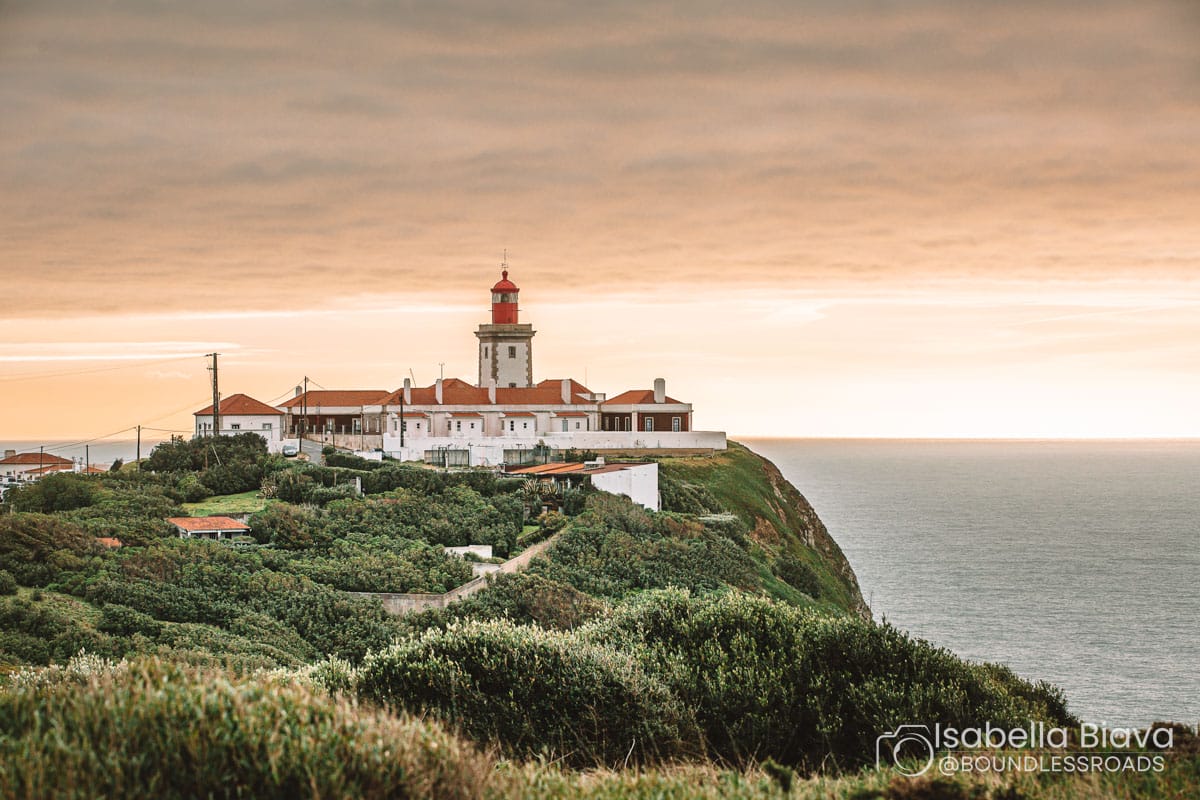
The westernmost point of mainland Europe, a cliff 140 metres above the Atlantic with a lighthouse and a stone marker carved with a line from Camões about where the land ends and the sea begins. It is 20 minutes from Sintra and it makes the obvious end to a Sintra day.
Two practical things. It is genuinely windy, consistently and hard, so bring a layer even in August. And the cliff edge is unfenced in places with a long drop, so keep well back, particularly if you are setting up a tripod.
Cost: free. Booking: not needed. Best time: sunset, and stay for the twenty minutes afterwards when the sky goes orange behind the lighthouse.
Portugal Historical Landmarks – Lisbon
Lisbon’s landmarks split into two clusters. The castle and the downtown squares sit in the centre and are walkable from each other if you accept the hills. The Belém monuments sit six kilometres west along the river and are a separate half day, reached by tram 15, bus, or a walk along the waterfront. Do not try to combine them into one afternoon. My two days in Lisbon itinerary splits them properly, and getting around Lisbon covers the transport.
25. Castelo de São Jorge
Castelo de São Jorge sits on the highest hill in central Lisbon, a Moorish fortification captured in 1147 and later a royal residence. What survives is the outer walls, eleven towers, some excavated ruins, gardens, and a terrace looking out over the whole city and the Tagus.


Be honest with yourself about what you are paying for. There is not much building left to go inside. You are buying the walls, the walk, and one of the best views in Lisbon. If the view is all you want, the miradouros at Graça and Senhora do Monte are free and arguably better, because they include the castle in the frame. If you are climbing up, the tram 28 stops nearby, or the walk up through Alfama is steep but the more interesting approach.
Cost: around €15. Booking: online ticket saves queueing in summer. Best time: late afternoon into sunset.
20. Elevador de Santa Justa
A wrought iron lift built in 1902 to connect the flat downtown Baixa with the higher Bairro Alto, designed by an engineer who had trained under Eiffel. The viewing platform at the top looks over the Baixa grid, the castle, and the roofless ruin of the Carmo Convent.
Here is the thing nobody tells you. The queue for the lift regularly runs an hour and costs around €6, and you can reach the same upper walkway for free by walking up through Largo do Carmo from the other side. Do that instead, and pay only the small fee for the top viewing platform if you want it. The lift itself is a two minute ride.
Cost: around €6 for the lift, or free to reach the upper level on foot. Booking: not possible. Best time: early morning, or skip the lift entirely.
21. Praça do Comércio
The great riverside square in downtown Lisbon, rebuilt after the 1755 earthquake on the site of the destroyed royal palace, and one of the largest squares in Europe. Three sides are arcaded yellow buildings, the fourth side is open to the Tagus, and the triumphal arch on the north side can be climbed for a view straight down Rua Augusta.
The cafés under the arcades charge for the location. Sit on the steps down to the water instead, which is where locals actually sit in the evening.
Cost: free, around €4 to climb the Rua Augusta arch. Booking: not needed. Best time: early morning for an empty square, or dusk when the arcade lights come on.


28. Padrão dos Descobrimentos
A 56 metre concrete monument on the Belém waterfront shaped like the prow of a caravel, with 33 figures from the Age of Discoveries carved along both sides, led by Henry the Navigator. It was built in 1960 under the Salazar regime, and it is worth knowing that it was a piece of nationalist state messaging as much as a memorial.
You can take a lift to the top for a view over Belém and, more usefully, down onto the huge compass rose mosaic set into the pavement in front, which is the shot you cannot get from ground level.
Cost: around €10 to go up. Booking: not needed. Best time: late afternoon, when the west facing side is lit.
29. Jerónimos Monastery
The Jerónimos Monastery in Belém is the high point of Manueline architecture and a UNESCO World Heritage Site since 1983. It was funded by the pepper tax on the spice trade, took most of a century to build, and holds the tombs of Vasco da Gama and the poet Camões.
The church is free to enter and the cloister is ticketed, and the cloister is the part you actually want. Two storeys of carved arcading around a square courtyard, every column different, covered in nautical rope, coral, armillary spheres and knots. It is the best cloister in the country and it is worth the ticket even after Batalha.
The queue is the problem. In summer it wraps around the building and can run over ninety minutes. Buy the timed online ticket, which uses a different entrance.
Cost: around €18 for the cloister, church free. Booking: essential in summer, buy the timed slot online. Best time: first slot at 9.30am, before the coaches from the cruise terminal arrive.
30. Torre de Belém


The most recognised landmark in Portugal and Lisbon’s defining image, a fortified tower built between 1514 and 1520 on what was then an island in the Tagus, to guard the approach to the city. Manueline outside, with Moorish influenced turrets and a stone rhinoceros carved on the western side, one of the first depictions of the animal in European art. It shares its UNESCO listing with Jerónimos.
Inside it is small, the staircase is a single narrow spiral controlled by a traffic light system, and the queue to go up moves slowly. Many visitors get more from photographing it from the causeway and the shoreline than from going inside. At low tide you can walk out onto the sand for the angle everybody wants.
Cost: around €15. Booking: yes if you want to go inside. Best time: sunset from the outside, when the stone goes warm and the tower is backlit against the river.
31. 25 de Abril Bridge
The red suspension bridge across the Tagus connecting Lisbon to Almada, opened in 1966 and built by the same American company that built the Bay Bridge in San Francisco, which is why the resemblance is so strong. It carries road above and rail below.
It was originally named after the dictator Salazar and renamed for the date of the 1974 Carnation Revolution that ended the regime. There is a visitor experience at the northern pillar with a glass floored viewing platform 80 metres up.
Cost: free to view, around €6 for the Pilar 7 platform. Booking: not needed. Best time: shoot it from the LX Factory area underneath, or from Cristo Rei across the water.


32. Cristo Rei
A 28 metre statue of Christ on a 75 metre pedestal on the Almada side of the river, inspired by the Rio de Janeiro statue and built as thanks for Portugal staying out of the Second World War. A lift takes you to the platform at the base of the statue.
The reason to cross the river is the view back. From up there you get Lisbon, the full span of the 25 de Abril Bridge, and the Tagus all in one frame, which is the best wide view of the city that exists. Take the ferry from Cais do Sodré to Cacilhas and a bus up, which is a better trip than driving over.
Cost: around €8 for the lift. Booking: not needed. Best time: late afternoon, when the sun is behind you and lighting Lisbon across the water.
Landmarks in Alentejo, Portugal
The Alentejo is the flat inland third of Portugal between Lisbon and the Algarve, and it is where you go for Roman ruins, border fortresses and empty roads. You need a car here. It is also very hot from June to September, routinely over 40 degrees, so plan indoor sites for the middle of the day.
33. Forte de Nossa Senhora da Graça, Elvas
An 18th century star fort on a hill above Elvas near the Spanish border, part of the UNESCO listed garrison town, and considered one of the finest surviving examples of Vauban style bastioned fortification anywhere. It was built by German engineers and took twenty five years.
The site is large and exposed with almost no shade. Combine it with the Amoreira Aqueduct in Elvas itself, which runs for eight kilometres on four tiers of arches.
Cost: around €5. Booking: not needed. Best time: early morning in summer, and take water.
34. Roman Temple of Évora


Fourteen Corinthian granite columns standing in the middle of the historic centre of Évora, dating to the 1st century AD and the best preserved Roman structure in Portugal. It is commonly called the Temple of Diana, though there is no evidence it was dedicated to her.
It survived because it was walled up and used as a butcher’s shop and slaughterhouse through the medieval period, which protected the columns until it was uncovered in the 1870s. It sits in an open square with the cathedral behind it and you can walk right up to it at any hour.
Cost: free. Booking: not needed. Best time: after dark, when it is floodlit and the square is quiet.
I went to Evora from Lisbon as a one-day trip by car, but if you don’t feel like driving, there are great tours that take you there, like this one on VIATOR, with great reviews.
29. Chapel of Bones, Évora


The Capela dos Ossos is a small chapel attached to the Church of St Francis whose walls and columns are lined with the bones and skulls of around five thousand people. Franciscan monks built it in the 17th century, partly to solve an overcrowded cemetery problem and partly as a deliberate meditation on mortality.
The inscription over the entrance translates roughly as “we bones that are here, we await yours.” It is a genuinely unsettling room and it is very small, maybe eighteen metres long, so the visit is short. Worth knowing if you are travelling with anyone who would find it distressing.
Cost: around €6, including the church and a small museum. Booking: not needed. Best time: first thing. It is one room, and it gets congested quickly.
36. Castelo de Mourão
A 14th century border castle above the Guadiana River close to the Spanish frontier, built in 1343 from schist, marble and granite. Most of it is ruined but sections of wall are accessible and the view across the Alqueva reservoir from up there is the reason to make the detour.
Cost: free. Booking: not needed. Best time: combine with Alqueva and stay for the evening.
37. Alqueva Dam and Dark Sky Reserve
Alqueva created the largest artificial lake in western Europe when it was completed in 2002, flooding a valley to bring irrigation to the dry southern Alentejo. The engineering is impressive but that is not why most travellers come.
The area around the lake is the world’s first certified Starlight Tourism Destination, with almost no light pollution across a huge area. Observatory sessions run at Cumeada with telescopes and a guide, and there are dark sky accommodations around the lake with rooftop beds. If astrophotography is something you have wanted to try, this is the place in Portugal to do it, and the new moon is what you plan around.
Cost: free to see the dam, observatory sessions from around €20. Booking: yes for the observatory, sessions are small. Best time: new moon, and check the forecast because a cloudy night is a wasted trip.
Landmarks in Algarve, Portugal
The Algarve’s landmarks are geological rather than built. Limestone cliffs, sea caves and rock stacks along a coast that runs roughly 150 kilometers from Sagres to the Spanish border. A car makes an enormous difference here, because the good spots are between the towns rather than in them. My 7 day Algarve itinerary and the guide to the best Algarve beaches cover the wider coast.
38. Benagil Cave
A limestone sea cave with a circular opening in its roof and a small beach inside, formed by a combination of wave erosion and rainwater eating down through the rock from above. It is the most photographed natural landmark in Portugal.
The rules changed and this matters. You can no longer land on the beach inside the cave or swim in unaccompanied. Access is by licensed boat, kayak or stand up paddleboard with an operator, and boats enter without stopping. Kayak and SUP tours get you closest and give you the longest inside. The light drops through the roof opening most strongly around midday, which is also when it is busiest, so there is a real trade off between light and space. The current rules and how to choose an operator are in my guides to visiting Benagil Cave and picking the best Benagil tour.
➤ Benagil Cave kayak tour with a guide and small group. Get Info
Cost: boat tours from around €25, kayak tours from around €35. Booking: yes, especially July and August. Best time: the first tour of the morning for calm water and space, midday for the light beam.

33. Ponta da Piedade
A headland of ochre limestone stacks, arches and grottoes just south of Lagos, and the best concentration of rock formations on the whole Algarve coast. You can see it three ways. From above on the clifftop path and the walkways down to Praia do Canavial. From the 182 steps that descend to the water where the small boats leave. Or from a boat threading between the arches, which is the only way to see the formations from underneath.
The clifftop is free and open at all hours and the lighthouse car park is right there. If you are basing yourself in Lagos, this is a fifteen minute drive or a forty minute coastal walk.
Cost: free from the clifftop, around €20 for a boat trip through the grottoes. Booking: not needed, boats leave on demand from the steps. Best time: sunrise from the clifftop or the last hour of light, when the rock turns properly orange.


34. Fortaleza de Sagres
A fortress on a flat windswept promontory at the southwestern tip of Portugal, on the site associated with Henry the Navigator’s school of navigation. The walls enclose a large open headland rather than a building, and you walk a circuit around the cliff edge.
The single strangest thing there is the wind rose, a 43 metre circle of stones set in the ground, uncovered in 1921 and still not definitively explained. Allow an hour for the walk and expect serious wind. Cabo de São Vicente, the actual southwestern corner of Europe, is five minutes further and free. Add both to a Lagos itinerary.
Cost: around €5. Booking: not needed. Best time: late afternoon, then drive to Cabo de São Vicente for sunset, which is the better of the two for that.


Portugal Landmarks in the Azores Islands
The Azores are nine volcanic islands in the middle of the Atlantic, a two-hour flight from Lisbon and the landmarks there are craters, peaks and coastline rather than palaces. Weather is the governing factor. Cloud sits on the high points for days at a time, so build in flexibility rather than planning a single crater day. Start with my Azores travel guide if you are new to the islands.
41. Mount Pico
The highest mountain in Portugal at 2,351 metres, a near perfect volcanic cone rising straight out of the Atlantic on Pico Island. You can see it from Faial and São Jorge on a clear day, floating above the water.
Climbing it is a regulated activity. You register at the Casa da Montanha, carry a tracker, and the round trip takes roughly six to eight hours over loose volcanic rock with significant elevation gain. It is a genuine mountain, not a walk. If you are not climbing, the vineyard landscape on the island’s western coast is UNESCO listed, black lava stone walls built in grids to shelter vines from the salt wind, and it is one of the more unusual landscapes in Europe. More in the best hikes in Portugal.
Cost: around €20 to register for the climb, free to drive the vineyard coast. Booking: register in advance and check the weather window. Best time: May to September for the climb.


42. Caldeira das Sete Cidades, São Miguel


A collapsed volcanic caldera on the western end of São Miguel holding two joined lakes, one that reads green and one that reads blue depending on the light and the sky. It is the defining image of the Azores.
The classic viewpoint is Vista do Rei, with the abandoned Monte Palace hotel beside it. The rim road and the walking trail around the crater edge give you better angles than the car park does. Cloud is the deciding factor and it can sit on the rim all day, so keep the visit flexible and go on the clearest morning of your trip rather than the day you scheduled it.
Cost: free. Booking: not needed, but you need a rental car in the Azores. Best time: mid morning on a clear day, once the overnight cloud has lifted but before the afternoon build up.
43. The Fajãs of São Jorge


São Jorge is a long narrow ridge of an island with cliffs dropping several hundred metres to the sea, and at the base of those cliffs sit the fajãs, flat shelves of land formed by lava flows and landslides. Some hold a handful of houses, a chapel and a lagoon, reached only by a steep trail or a rough track.
Fajã da Caldeira de Santo Cristo is the best known, accessible on foot or by all terrain vehicle, with a brackish lagoon that produces clams found nowhere else in the Azores. This is the landmark on the list that fewest travellers reach and it is the one that feels least like anywhere else in Portugal. Full details in my São Jorge seven day itinerary.
Cost: free. Booking: not needed for the walk, book ahead for a 4×4 transfer. Best time: summer, and start the descent early because the climb back out is the hard part.
Photography Spots at Portugal’s Landmarks
Most of these landmarks have one angle that works and several that do not, and the difference is usually the hour rather than the lens. Here is where I would set up at each of the main ones.
Architecture and interiors
The cloisters at Batalha and Jerónimos both need a wide lens, somewhere around 16 to 24mm on full frame, and both are best in mid morning when the sun comes over the far arcade and throws the tracery into relief without blowing out the courtyard. Shoot from the corner rather than the middle of a side, because the corner gives you two runs of arches converging.
The Initiation Well at Quinta da Regaleira is narrow, dark and busy. You need the widest lens you own, a high ISO, and the first entry slot of the day. Shooting straight up from the bottom is the shot everyone wants and it requires the spiral to be empty for about four seconds, which only happens early.
Pena Palace works best in the late afternoon when the sun is on the yellow and red walls. In the morning the main terrace is backlit and the colour goes flat. São Bento station in Porto needs an empty hall, so before 9am, and a lens that does not distort the tile panels at the edges.


Coast and cliffs
Ponta da Piedade at sunrise gives you the ochre rock lit from the side with almost nobody there, and the clifftop is accessible at any hour. Cabo da Roca is a sunset location and the twenty minutes after the sun has gone are better than the sunset itself, though you will need to weight your tripod because the wind is constant.
Belém Tower at low tide from the sand gives you the reflection foreground you cannot get from the causeway. Check the tide table rather than guessing. For Benagil, midday is when the light column drops through the roof opening, but it is also when the cave is fullest, so a kayak tour buys you the time to wait for a gap.
Landscape and wide views
Sete Cidades from Vista do Rei is a clear morning shot and a waiting game, because the cloud decides. The Douro terraces photograph best in the hour before sunset from the Miradouro de São Leonardo de Galafura, where the low sun rakes across the terrace lines. Porto from the upper deck of the Dom Luís bridge is the classic city shot and the forty minutes before sunset is the window.
If you want to see how these places actually look shot properly rather than in a stock photo, I have a set from Sintra and a larger one from four months photographing São Miguel.
PRO TIP: tripods are banned or restricted inside most of the ticketed monuments in Portugal, including Jerónimos, Pena and Regaleira. Plan on handheld and a fast lens rather than turning up with a tripod you cannot use. Drones are prohibited over almost all of them, and over the Sintra park entirely.


Visiting Portugal’s Landmarks on a Budget
Portugal is still one of the cheaper countries in western Europe to travel in, but the headline monuments have raised their prices sharply since 2023 and a Lisbon and Sintra trip can add up faster than people expect. Two full price Sintra palaces plus Jerónimos and Belém Tower will run you close to €70 in entry fees alone.
Ways to cut it down:
- The free ones are genuinely good. Praça do Comércio, Cabo da Roca, Ponta da Piedade, Ribeira, São Bento station, the Roman Temple in Évora, Bom Jesus grounds, Óbidos walls, Sete Cidades and Costa Nova cost nothing.
- Combined tickets. Batalha, Alcobaça and Tomar sell a joint ticket that saves around a third if you are doing all three. Sintra sells combinations across Pena, Moorish Castle and the National Palace.
- Free entry Sundays. Several state run monuments admit residents free on Sunday mornings. It varies and it is not universal for visitors, so check the specific site rather than assuming.
- Skip the redundant one. If you have seen the Batalha cloister, the Alcobaça cloister will not surprise you. If you have done Pena’s interior, the Moorish Castle for views is a better second ticket than another palace interior.
- Off season. Accommodation in Lisbon and the Algarve drops substantially between November and March, and the monuments cost the same but you are not queueing for them.
Portugal Landmarks Frequently asked questions
What is the most famous landmark in Portugal?
Torre de Belém in Lisbon. It is the closest thing Portugal has to a national symbol, it appears on most tourism campaigns for the country, and it shares a UNESCO World Heritage listing with the Jerónimos Monastery a few hundred metres away. Pena Palace in Sintra is the most photographed and probably the most recognisable to people who have never been.
How many days do you need to see the main landmarks in Portugal?
Ten days covers the mainland highlights at a reasonable pace. That gives you three days in Lisbon including a full day for Sintra, two days driving the central monasteries, three days in Porto and the Douro, and two for the Algarve. Seven days means dropping either Porto or the Algarve. The Azores need their own trip of at least a week.
Which Portugal landmarks need tickets booked in advance?
Six of them, and only in high season. Pena Palace and Quinta da Regaleira in Sintra both run timed entry that sells out days ahead in summer. Jerónimos Monastery and Torre de Belém have queues long enough that a timed online ticket is worth it regardless. Livraria Lello requires a voucher bought in advance. Benagil Cave tours fill up in July and August. Everything else on this list you can turn up to.
Can you visit Portugal’s landmarks without a car?
Most of the famous ones, yes. Lisbon, Sintra, Porto, Coimbra and Aveiro are all reachable and walkable by train and local transport. What you lose without a car is the central monastery cluster of Batalha, Alcobaça, Óbidos and Tomar, most of the Alentejo, and the good stretches of Algarve coastline between the towns. If those matter to you, rent a car for that leg only.
What is the best month to visit Portugal’s historical sites?
May or late September. You get long daylight, reliable weather, and roughly half the crowds of July and August. October is also good if you accept a higher chance of rain in the north. Avoid the first two weeks of August, when Portuguese domestic holidays overlap with peak international arrivals.
Are Portugal’s landmarks easy to visit solo?
Yes, and unusually so. Almost everything on this list is a self guided visit rather than a group activity, the ticketing is all online and in English, and the country is straightforward to move around alone. The only entries that push you into a group are the Benagil Cave tours and the Palácio da Bolsa, and both run small groups. When you travel alone the main practical adjustment is timing, because the early slots that avoid crowds are much easier to take when you are not negotiating with anyone else’s morning.
Which Portugal Landmarks Are Actually Worth It?
If you only had four days, I would spend them on Lisbon and Sintra, and I would build them around Jerónimos, Belém Tower, Pena Palace and Quinta da Regaleira, with Cabo da Roca at the end of the Sintra day for the sunset.
If you have longer, the central monasteries are the part of Portugal that most visitors skip and should not. Batalha’s cloister is the finest interior in the country and you can often have it close to yourself, which is not something you can say about anything in Belém.
And the two I would give up first are Livraria Lello, unless the queue does not bother you or you want the book, and the Santa Justa lift, which you can reach on foot for free from the other side. Portugal has enough landmarks that saying no to two of them costs you nothing.