
Twenty-four-year-old Kareem Hassan Awad Al-Tanah woke up one morning in July 2024 feeling too weak to work. He had been spending his days selling children’s toys out of a stall on Gaza’s coast in Az-Zawayda, where he had arrived two months earlier after fleeing the Israeli military’s invasion of Rafah. When he tried to open his stand that day, every movement hurt, so he went back to his family’s tent and tried to sleep. The temperature hovered just under 90 degrees Fahrenheit.
“I felt like all my bones were broken,” Al-Tanah says. “Later that day, my sister wanted to drink, so I handed her my bottle of water. She looked at me and shouted, ‘Do you want to make me sick?’ When I asked her why, she told me that my face and eyes had turned yellow.”
Al-Tanah had developed regaan, the local term used to describe jaundice. The condition causes the skin and eyes to turn yellow due to a buildup of bilirubin in the blood and in many cases is associated with hepatitis A, a disease tied to contaminated water that has spread widely in Gaza. He spent the next ten days in bed unable to move and suffering from headaches, diarrhea, and periods of delirium. Now, two years later, he feels like he still hasn’t fully recovered.
“Even after I started feeling better, my body wasn’t the same,” Al-Tanah says.
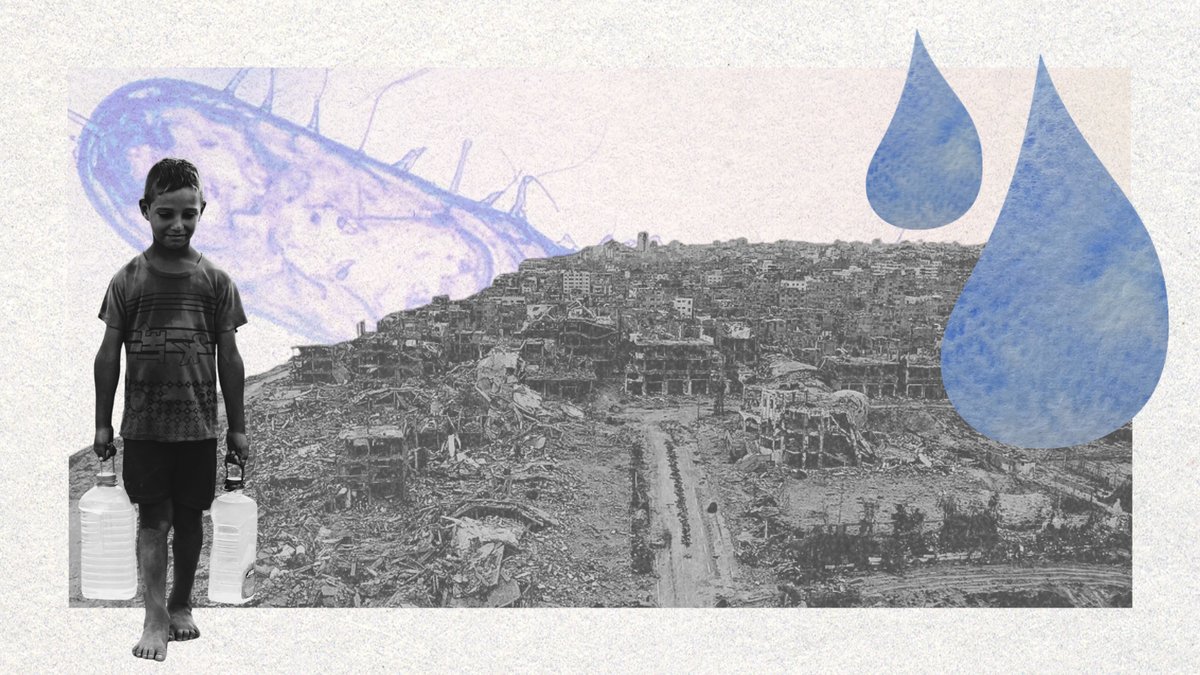
Because Israel had cut off power to the nearby water desalination plant, Al-Tanah spent his first two months in Az-Zawayda drinking non-potable water, which was likely contaminated and caused his illness. For Palestinians in Gaza, repeated displacement, damaged water networks, fuel shortages, and the collapse of sanitation systems have transformed water access into one of the Strip’s most urgent crises. According to the United Nations, the Israeli military has damaged or destroyed nearly 90 percent of water, sanitation, and hygiene infrastructure in Gaza and blocked many clean water supplies from entering, forcing Palestinians to rely on unsafe water sources for drinking, cleaning, and bathing.
Only four major desalination plants are currently operating in Gaza. Because much of the region’s piping infrastructure has been blocked or badly damaged, municipalities and humanitarian organizations must collect and transport water from these plants using tanker trucks to nearby communities at the more than 2,600 water distribution points across Gaza. It is estimated that 63 percent of households cannot access more than 1.5 gallons of drinking water per day.
Before Israel’s genocide in Gaza began in October 2023, seventy-six-year-old Fathiya Salman Shallah had undergone three separate procedures to break down urinary stones in her kidneys. Her doctor told her to drink mineral water, which can help prevent crystals from forming in a person’s kidneys and which she could easily find in the market. She would also buy malt drinks, barley-based beverages often consumed for their perceived soothing effect on the kidneys.
After the war began, malt drinks became impossible to find throughout Gaza, and mineral water was sold at extremely high prices.
“I prioritized spending money on flour and basic food supplies rather than mineral water and malt drinks,” Shallah says.
By early 2024, water pumping and desalination systems serving Gaza City stopped functioning due to fuel shortages and widespread destruction of water infrastructure. Shallah was later displaced further south to Deir al-Balah where, due to the large number of displaced people, desalination facilities have been under pressure to produce water as quickly as possible to supply the demand.
With little access to clean water, Shallah has had to drink non-potable water, which can increase the risk of kidney stone formation.
“Just by taking a sip of that water, I knew it would lead to serious consequences, as I could taste its salty flavor,” Shallah says.
To make matters worse, she says, her grandchildren have not been able to swim in the sea on Gaza’s coast—damaged wastewater infrastructure has caused sewage to flow straight into the sea, spreading harmful bacteria and viruses and contaminating local seafood.
Israeli forces have also targeted water distribution sites. In 2025, Doctors Without Borders was forced to shut down at least 137 water distribution points due to intense military blockades and localized bombardment from the Israeli military. In April 2026, two water truck drivers were killed by Israeli fire while working at a water distribution point.
“For thousands of displaced families [like mine], these water trucks remain the primary source of potable water,” says Mohammed Abu Al-Mehza, a twenty-four-year-old accountant living in southern Gaza. “We have no other alternative in the whole Strip.”
In January 2024, after being besieged for a month in Gaza City, Al-Mehza and several of his neighbors left their building to walk to a nearby water truck. They had spent their time under siege pumping non-potable water with energy from the building’s solar panels. On the walk back, Al-Mehza says he heard an Israeli tank and bulldozer approaching the group from behind.
“I was terrified of being targeted, but I couldn’t leave the gallon behind,” Al-Mehza says. “It was the only amount of potable water we could find in weeks, so I ran, carrying the gallon in my hand. I do not know how I survived, but several people near me were killed or injured.”
For many Palestinians in Gaza, clean water is not guaranteed, and instead something for which they must constantly search. Access to potable water remains uncertain, while damaged infrastructure, limited fuel supplies, and overcrowded living conditions continue to affect daily life.
“Since the beginning of the genocide, the water has never been truly clean,” Al-Mehza says. “Almost every week, someone in my family suffers from a stomach infection.”