Where Silence Becomes a Public Language
Pejac has built an international reputation through images that whisper rather than shout. Born in Santander in 1977 and based in Madrid, the Spanish painter and street artist creates works that rely on subtle intelligence, technical discipline, and emotional clarity. His interventions often appear understated at first glance, yet they linger in the mind long after the first encounter. This rare ability to pair restraint with impact has made him one of the most distinctive voices working between contemporary painting and urban art today.
His training in Fine Arts in Salamanca, Barcelona, and later Milan gave him a rigorous foundation, yet it also led him to challenge the exclusivity often associated with institutional art spaces. Around 2000, while studying in Italy, he began working in the street, seeking a direct relationship with viewers outside museums and galleries. That decision shaped the identity of Pejac, an artist committed to making thoughtful visual experiences available to anyone passing by.
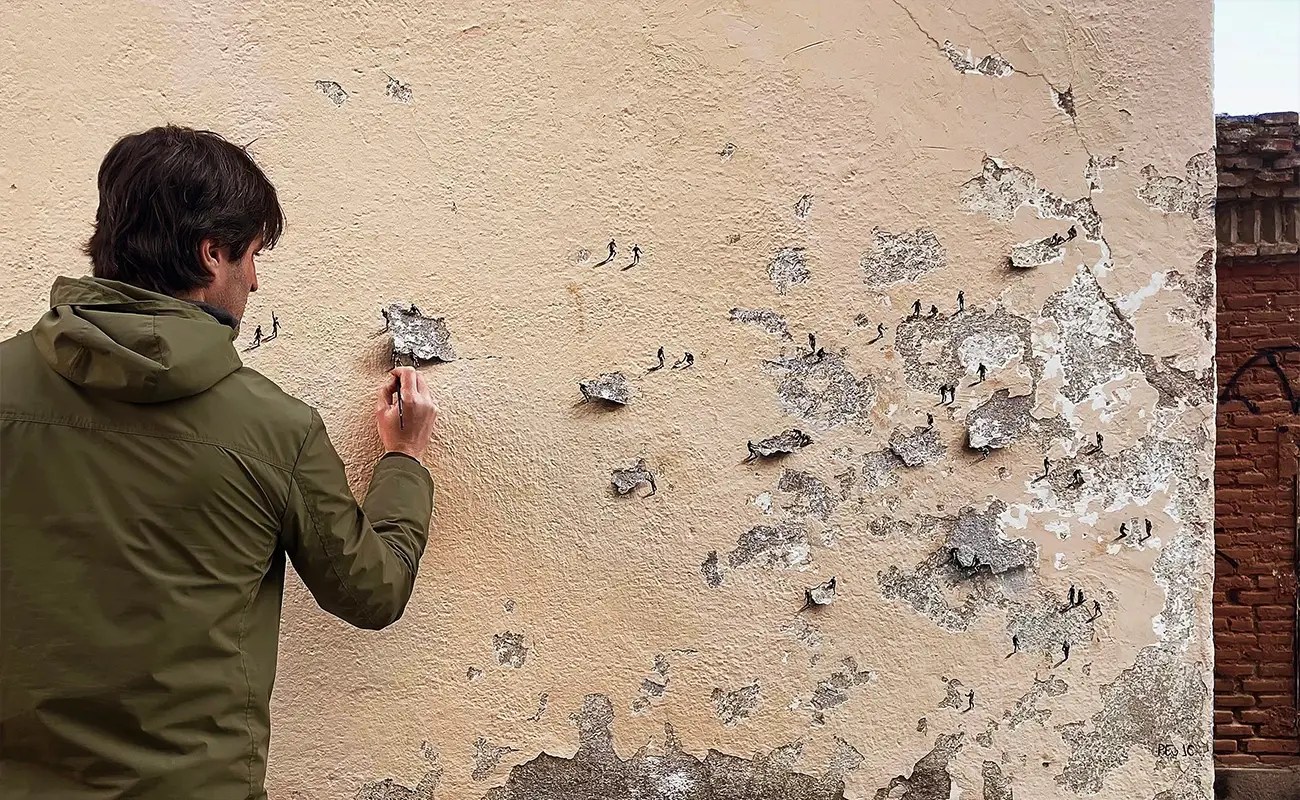
What defines his practice is not scale or spectacle, but attention. A crack in a wall, a rusted surface, a window shutter, or a drain cover can become the starting point for a complete visual statement. Rather than treating architecture as background, he transforms existing surroundings into active collaborators. Through this sensitivity to place, ordinary environments become sites of reflection, surprise, and renewed awareness.
Pejac: Illusion, Precision, and the Poetry of Context
Few artists use location with the precision that Pejac does. Each intervention seems inseparable from where it appears. In Istanbul, he created trompe l’oeil works such as Lock, Poster, and Shutters, using architectural details to question freedom, privacy, and confinement. In New York, fossil imagery emerged in the dense energy of Bushwick. In London, light poles became supports for gravity-defying shoes. Everyday structures were transformed into poetic disruptions.
This intelligence reaches remarkable depth in Stain, created in Santander. In the work, a melting map of Earth appears to drain into a sewer, turning street infrastructure into a sharp environmental warning. The image is simple, but its implications are vast. Through minimal means, Pejac made climate anxiety visible in a way that felt immediate and unforgettable.
Another celebrated example came during the pandemic with Social Distancing at Marqués de Valdecilla University Hospital. Conceived as a tribute to healthcare workers, the mural reflected his belief that art can serve in times of crisis. While others donated medical supplies, he explained that painting was what he could offer best. That gesture captures his larger philosophy: visual art can be an act of solidarity.
Studio Experiments and Historical Echoes
Although widely known for public interventions, Pejac maintains a rich studio practice shaped by experimentation. He works across oil, watercolor, charcoal, pencil, stencil, burning, scraping, spray paint, sculpture, and installation. Rather than committing to one signature technique, he selects the material that best expresses the emotional tone of an idea. This flexible approach allows each concept to find its most fitting form.
His drawings on graph paper are especially revealing. Using the rigid geometry of the grid, he creates illusions in which figures seem to carve through the page, emerge from its surface, or manipulate space itself. These works show that his fascination with perception is not limited to city walls. Whether on paper or concrete, he repeatedly asks viewers to reconsider how images occupy space.
Pejac also engages deeply with art history. References to Monet, Manet, Munch, Hokusai, Fontana, and Giacometti appear throughout his oeuvre, not as decorative homage but as living dialogue. In Vandal-ism, for instance, a paintball splatter reveals a transformed version of Manet’s Luncheon on the Grass. By merging classical painting with street vocabulary, he connects past cultural symbols to present social realities.
Pejac: Moral Clarity in an Age of Noise
Many of Pejac’s strongest works address urgent collective concerns, including war, displacement, ecological collapse, and inequality. In refugee camp settings in Jordan, he scraped silhouettes into weathered walls, using absence itself as an image. These pared-back forms carried profound emotional force, suggesting memory, loss, endurance, and the persistence of identity under pressure.
His recurring shadow figures are central to this power. Usually anonymous and reduced to essential shapes, they invite projection rather than dictating interpretation. Viewers may see themselves, strangers, or entire communities in these forms. Through this openness, deeply personal readings can coexist with broader political meaning.
Across exhibitions such as Oximoron, Law of the Weakest, and Waterline, as well as projects spanning Europe, Asia, and the Americas, Pejac has remained committed to visual economy and ethical purpose. Whether painting on a ship hull, a hospital wall, a city street, or a sheet of graph paper, he continues to prove that softness can carry extraordinary force when guided by intelligence and conviction.