The First Alarm Wristwatch, the Amazing Transforming Eterna

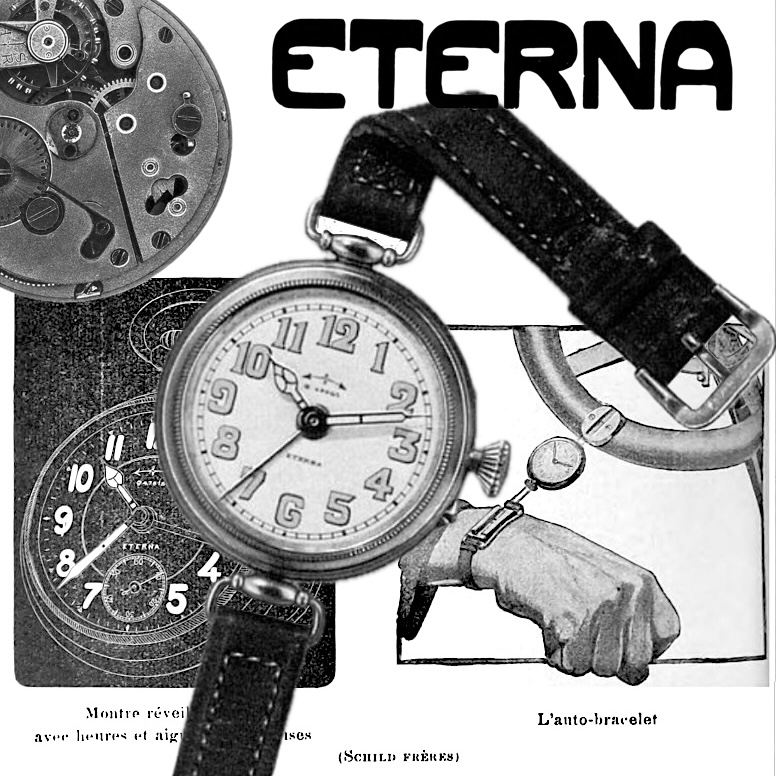
There is a certain joy in a chiming watch: My children certainly consider the Jaeger-LeCoultre AMVOX1 to be the highlight of my collection! Vulcain discovered this following their 1947 launch of the famous Cricket, kicking off an alarm watch craze that lasted into the 1970s. But the first alarm wristwatch actually appeared three decades earlier, with a clever and versatile offering from Schild frères’ new Eterna brand! As wristwatches were still in their infancy, this early watch appeared in numerous guises, from the pocket to the wrist to the automobile, and found its way into the trenches of World War I.

The Rise of the Alarm Watch

What is a watch? The answer was not at all clear in the early years of the 20th century. Pocket watches were dominant, but these varied in size from the smallest ladies’ chatelaine to slim and stylish models for gentlemen to hefty and sometimes complicated tools for timing and chiming. Soldiers and adventurers even began wearing a watch on their wrist, as popularized by the charismatic Brazilian aviator, Alberto Santos-Dumont. And watches were appearing on the dashboards of automobiles and in the pockets of travelers, often with an alarm function.
Although radium painted numerals was reducing the demand for chiming watches, alarm clocks were becoming popular in Europe and America. Grenchen-based manufacturer Schild frères saw an opportunity in a simplified alarm movement patented in 1898 by Dürrstein & Co. of Dresden, Germany1. Their innovation was the use of a single spring to power both the alarm and timekeeping functions, with a mechanism that prevented the alarm from exhausting the spring entirely while ringing. The alarm was switched on and off using a lever on the back of the movement, accessible through a slot in the inner case back. One additional design choice carried through to the later Eterna movements is the lack of a click on the spring barrel; the alarm mechanism serves to stop the barrel from unwinding.

Schild frères introduced a line of pocket watches with this alarm function between 1898 and 1902. The large 20 ligne movement, Calibre 51, featured a novel mechanism to set the alarm time: The knurled bezel was geared internally to the alarm hand, allowing the alarm to be set precisely without a second crown or other complex mechanism. This was Shild’s own innovation.
Although many modern claims suggest the Eterna brand was used as far back as 1875, there is no evidence of this. In fact, the Eterna name was trademarked by Schild frères & Co. only on November 11, 1905 and it is not seen prior to this date. It was one of a few brands used by the company in this era, starting with IXL and ICL in the 1890s. The company used the Victoria brand on their alarm watches despite the fact that it was trademarked and used by other companies, including Léon Sichel, Cortébert, and Perfecta. Eterna was a much better choice, a unique name with a contemporary sound. Embracing the name, the company was officially re-named “Fabriques Eterna, Schild frères & Co” on July 1, 1906.
About 1908, a new alarm watch was introduced using both the Eterna and Victoria brand names. This movement, Calibre 52, measured 18 lignes in diameter, and was thinner at 7.3 mm. The power-preserving mechanism was improved, leveraging Gustav Häusler’s2 patent CH47816 with a visible gear and lever on the back of the movement. And the clever rotating bezel was improved, enabling the alarm to be set in either direction. This was patented in 1908, with subsequent Victoria and Eterna alarm watches featuring patent number 42203 printed on the dial.
Eterna’s alarm watch movement was widely successful, not just in pocket watches but also in the burgeoning market for travel clocks and compact alarm clocks. Victoria and Eterna alarm watches are often still seen at auction, often noting the appearance of “42203” on the dial. The inside case back typically includes Häusler’s “Brevet 47816”, but Dürrstein’s patent 17104 soon expired and was no longer mentioned.
The First Alarm Watch for the Wrist and Automobile

Eterna was early to embrace the emerging trend of wristwatches, patenting a case with wire lugs for a “montre-bracelet” in 1904. By 1909, Eterna advertising regularly included primitive wristwatches alongside pocket watches of various sizes, ultra-thin pocket watches, and the famous alarm watch. The small and slim movements produced by Eterna presented an opportunity: A compact alarm movement.
In May 1914 Eterna appeared at the Swiss National Exhibition in Berne, showing a wide range of watches in five of “the richest and most interesting” cases at the show. But one offering in particular attracted the attention of Eugène Buffat, correspondent for the Journal Suisse d’Horlogerie: “A 29.5 mm (13 ligne) alarm clock, which is, without a doubt, the world’s first small, factory-made alarm clock.”
This was the new Eterna Calibre 68, the first alarm movement small enough to be used in a wristwatch. It was closely related to the previous Victoria and Eterna alarm movements, sharing a similar overall layout and using the same single-spring power, bezel control, and rear-mounted switch. It even included patent numbers 42203 (on the dial) and 47816 (on the case back) like its larger siblings. At just 5.4 mm thick and 29.5 mm in diameter, Cal. 68 could be used in a wide variety of watches. But how could the company catch the attention of buyers?
Unsure how to proceed, Eterna brought their new compact alarm movement to market in a wide range of products:
- A compact pocket watch with Eterna’s first radium-painted numerals and hands, designed to sit upright and be used as an alarm clock as well as carried throughout the day
- A simple wristwatch with Eterna’s patented wire lugs. The small seconds hand was omitted, as it would have sat at 9, opposite the crown at 3.
- A soldier’s watch, complete with a steel mesh screen over the crystal and simple welded wire lugs. Again, no seconds hand was provided.
- An ingenieus “auto-bracelet” with both a strap and steering wheel bracket, allowing the watch to be used on the wrist or in an automobile. The crown was placed at 6, and the quick-change bracket gave this watch a highly unusual look.
- A line of compact travel alarm clocks were also produced using this movement.

Buffat of the Journal said of the watch shown in Berne, “it can be used interchangeably as a wristwatch or, by means of a slide, attached to the steering wheel of an automobile, as shown in one of the illustrations opposite; it is very ingenious.”
The ingenious clip was patented in 1914, and the illustrations give us our best sense of the design. It featured a simple spring lever with a catch, allowing the watch to be slid into a tapered groove and held securely in place. The patent specifically mentions used on a bracelet or automobile steering wheel, but this clip could also be used in other circumstances. Sadly, it does not appear that Eterna pursued this idea, as it is not mentioned again in contemporary sources and I do not know of any such watch appearing at auction or in later coverage.
An Idea Whose Time Had Not Come
Although clever and practical, the compact Eterna alarm watch movement appears to have found little success. It is sparingly mentioned in the press between the 1914 introduction and purported phase-out in 1945. Only the most careful historians mention it in their writing: Louis Loze includes the best available photo in his 1956 history of the alarm watch for Revue Internationale de l’Horlogerie and Joël Pynson includes this in his 2003 article, “Les Montres-Bracelets-Réveils” for Chronométrophilia. It is overlooked or barely mentioned by most other writers and historians, perhaps because it entirely failed to connect with buyers.
The best examination of this pioneering watch came in Jörg Hein’s 1986 article for Alte Uhren und Moderne Zeitmessung, “Eine Frühe Armbanduhr Mit Wecker“. Hein located a soldier’s watch with Eterna’s Cal. 68, carefully describing the clever design of the movement and giving us the only known photos of the movement itself.
Wristwatches were in their infancy in 1914, and the war created new challenges. Although soldiers embraced wristwatches in the trenches, they may not have appreciated the noise or complexity of an alarm watch. Dashboard clocks quickly took hold in the automotive market, with most buyers opting for an 8-day movement. And Swiss and German makers rapidly reduced the price of alarm clocks, opting for cheap pin lever movements in large tabletop models rather than compact portable travel clocks. But perhaps Eterna simply tried to take on too many roles with Cal. 68, failing to make a compelling case in any market: I wish I could find one of the novel clip-on models, but I’m not sure I would wear such a bulky watch!

Image: Revue Internationale de l’Horlogerie, November 1956
Those who have covered this rare alarm watch suggest that production was phased out in 1918, though examples continue to be seen as late as 1945. Perhaps Cal. 68 was so unsuccessful that Eterna continued to use new old stock movements for over 20 years?
Ironically, it was just two years later that Vulcain introduced the Cricket, igniting alarm watch fever from Wall Street to the White House and creating a lasting market for alarm wristwatches. But Vulcain was exceptionally clever in their introduction, focusing on efficiency-obsessed American businessmen and making the most of high-profile customers like Presidents Harry S Truman and Dwight D. Eisenhower. Indeed, it became a tradition for the White House Press Corps to present each new president with a Vulcain Cricket for decades. That’s the kind of marketing watch companies today can only dream of!
The Grail Watch Perspective
The world’s first alarm wristwatch wasn’t the famous Vulcain Cricket but the virtually-forgotten Eterna Cal. 68. Based on a German design with roots in the 19th century, Eterna was too early to market with their alarm wristwatch. Although pairing it with a novel interchangeable base and equipping early dress and soldier’s watches with the innovative movement, it failed to find a market or make a lasting mark. Hopefully, articles like this one (following in the footsteps of Joël Pynson, Jörg Hein, Louis Loze, and Eugène Buffat) will help draw attention to this pioneering watch!
Special thanks to Dr. Miranda Marraccini, Head Librarian at the Horological Society of New York, for providing a copy of Hein’s 1986 article. Without it I would not have been sure of the construction or heritage of this important watch movement. And thanks as always to the incredible Watch Library Foundation, a reference more useful than I could have dreamed possible!
Footnotes
- The story of Dürrstein & Co is quite interesting! The Dresden company represented A. Lange & Söhne in the market and became an important source of German watches, especially in America. Dürrstein was a founder of the Union factory in Glashütte, a brand that has been revived today.
- Gustav Häusler was quite an inventor, later being known for the “Torpedo” adjustment device.