Leaving the darkness into the brightness with a whole bunch of sailors helping me sail that ship, because I couldn’t sail it all alone, and I needed other people to help me take that big ship into the brightness, and so it became kind of a good thing for me to look back on over and over.
Listen to the entire Schapera Show here
Listen to the Interview audio here
Hello and welcome to The Schapera Show where Viv and Neil explore this big adventure called life.
Our guest today is someone who has lived a lot of life, our most senior guest ever traversing some very severe downs and willing to share how he navigated those downs, turning them back into ups.
Let’s welcome Larry Freeborg
Hi Larry, thank you for coming on the show.
Thank you, it’s very nice to be here Vivian.
Thank you so much Larry.
Larry, I wonder if you can begin by telling us the title of your book and something about your background and what happened that inspired your book.
 Thank you, the title of the book is always at choice, not always at choice, but always at choice, and that’s on purpose because of the lesson that I learned when I was trying to be covered from my wife, our four children died the day after Christmas when she was years old and quite frankly I wasn’t handling it very well, but I was getting some help and that was the result of the help, learning that I was always at choice and my choice was to take care of my kids rather than pursue a career at that time and it all worked out.
It all worked out, that’s a way to sum up some very difficult times isn’t it? It is, because there were lots of, lots of, how can I say, ups and downs in that journey, but that was a good part of the journey, learning how to handle the ups and the downs and to just send it.
What I like is the lesson that I’ve learned in the last few years is you have a down and you just accept that it’s there and then eventually you convert it into a gift and an opportunity and that’s seemingly the way that it’s worked is I’ve been able to take every down and eventually, not right away, but after thinking about it for a while, see it as a gift and as an opportunity to do something else and that’s really where a lot of the growth comes from because they’ve identified what’s the next lesson for me to grow in, what’s the next lesson for me to improve my life with and so I’ve used other people to give me ideas on how to do it.
I haven’t been at all alone, I didn’t come up with all these ideas on my own, but in the book I’ve captured the lessons that I’ve learned from others and I’ve played a lot of things.
Not everything I’ve tried works, but I wrote about the ones that worked and hopefully that’ll be helpful to the people who read the book.
Yes, so it’s very interesting, isn’t it, that we can summarize so many years.
How many years has it been since your first wife passed, Larry? How many years is it? Well, she passed in so not past that much, but today is so that was the…
Yeah, so someone can do the arithmetic and not us, not in the age of alchemists, calculators, so it’s interesting how we can package something that’s very raw, very intense, very messy and then it can get packaged and streamlined into a few sentences like you just did now.
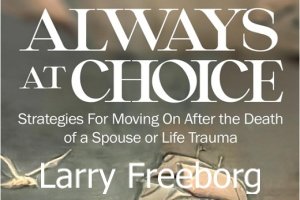
But what I want to do is just open that up a little bit and I think where we can begin is what is the meaning of the ship on the cover of your book? Thank you for that question, I love that question because the ship on the book is so meaningful.
I was in the psych ward with an art project and what that is is a picture of my actual cockle rubbing and when I did that ship, it meant for me leaving the darkness into the brightness with a whole bunch of sailors helping me sail that ship because I couldn’t sail it all alone and I needed other people to help me take that big ship into the brightness and so it became kind of a good thing for me to look back on over and over.
I love looking at it on my cover because it means so much to me about leaving what was really a dark time and I didn’t know whether I was going to make it or not to the time that I’m living now and that I just have a much different attitude about life and I was going to show up and the ship means that to me.
 And now it’s going to mean that to me, I love that it’s about the fact that we need a village and that we cannot do these things on our own and in that moment when you were most on your own is when you discovered how to resource other people is what it sounds like.
One of the biggest lessons that I learned is how to ask for help.
You know that’s not normal in a lot of men’s itinerary is that they think that they’re supposed to do it themselves, kind of like the Superman or the Mighty Mouse or all those things that we’re trusting so we’re going to do it on our own.
I don’t believe that is all anymore.
I know that I get stuck and when I get stuck the best thing for me eventually when I realize that I’m stuck is to ask for help, to find some resource that can help me through my problem and that works and I mean I’ve met some really wonderful people along the way that I’ve learned from but I have to be willing to learn and that isn’t always the case with some of the people that I coach and they’re not necessarily ready to learn right away.
They want to hold on to their old belief system and you have to take a look at your current belief systems and see if they’re working for you.
Are they going to really help you succeed or not? And in many cases they’re not, so you kind of discard them and pick up something else and work with that one for a while and if it works keep working it.
These are wonderful lessons.
I mean you’re saying these almost as throwaway lines and I know that they aren’t.
The capacity for a man to ask for help, you could be the best man I ever met Larry.
You’re saying what every woman discusses behind a man’s back, “Why can’t they just ask for help?” And so although I will be fair, Neil, my husband, he does ask for help when he needs directions particularly which can be a male failing too, not to ask for directions, but let’s continue.
What’s unique about the life lessons you’ve shared in the book? They’re experiential lessons, in other words they’re not me just pontificating about what you should do with your life.
These are lessons that I applied to situations that I was in and they helped me through the situation that I was in.
So I have a little confidence at least from my personal experience that the ideas work.
Now there were other ideas that I tried that didn’t work so they didn’t get into the book but the ones that got into the book are the ones that I had tried and applied and worked for me and ended up being my core belief system that I chose to live my life by and that was the whole thing is to realize that I was always a choice and at the very beginning of course when I was years old I thought that I had learned all the life lessons from my folks, let’s say the church, the community, the school and then I began to realize, “Wow, I just had a pretty limited look at life and there were lots of different ways to look at solving the problem and I have a line that I use a lot just in conversation because it means so much to me, is to be an observer of the observer you are.” In other words, to constantly look at how am I looking at the situation, how am I looking at the problem.
A lot of times I’m finding the way that I’m looking at the problem is the problem.
I laugh at myself when I get those wonderful insights that, “Hey, the way that you’re looking at this thing is probably the wrong way, if you look at it another way you could probably solve it.” So that’s been really helpful, a lot less than I didn’t come up with it but I learned it from Julio Olalla from New Field Network.
So you tested it, everything in your book is not theoretical, it’s tried and tested and applied and it’s been practical for you in your life and that’s what you’re sharing, that’s what I’m hearing.
Is that right? Yes, it is.
I wish I’d said it your way.
No, I’m just saying what you said, we did have a previous discussion and in that previous discussion you said that beliefs are important and that’s a place where we are also in alignment because in my work I also have to seek out the beliefs.
But let’s hear about it from you, why is the search for the source of beliefs so important in your coaching work? Well probably the best place that I can apply that belief statement is I struggled trying to put another relationship together after Shirley Yag and it probably took me or years before I finally found a woman that I was interested in making a life with but I was learning something about myself is that because of the belief system that I had adopted I made up is that I could trust the women that I love to leave me.
The lesson was to be attractive to the women and then as they got closer I would push them away so the lesson for me was so I was busy living life this way and I went to a workshop and what I learned is hey the women that I love don’t leave me, they are there forever.
I’m at choice about whether I want to be in love with them, access them, but they aren’t going anywhere, if they loved me back before they died then they also love me now and that’s been really helpful and that’s helped me have a wonderful year relationship with my second life.
It wouldn’t have been possible if I hadn’t shifted my point of view.
And this whole thing of finding a partner, it’s a fascinating process because it’s something that I’ve watched over the years and I’ve seen the beliefs in a completely different pattern from the beliefs that you’re talking about but where people are looking in the wrong package for what they want and that’s such a pity because they’re not really seeing what’s in front of them, they’re looking for, they have an idea of something, it’s like looking for a jigsaw puzzle piece and you’ve got the strong idea of what that jigsaw puzzle piece should look like, but really you want to get the right shape because the right shape is what’s going to fit in the jigsaw puzzle, not the right, the look you don’t know until you see it and I see people looking for their partners, their life partners in packages that have got what they think is the right look but they haven’t got the right shape.
I think that’s a good way to put it.
It’s really interesting, you can set up a whole list of criteria up front and one of the courses that I took had us write Miss Cinderella, you know, and put all the characteristics of this beautiful woman that you wanted to be in a relationship with.
They did it for the women too, looking for Mr.
Wonderful, the terrific guy and then you realize, hey that’s fantasy land, you’re looking for the perfect person and there really isn’t a perfect person out there, except if you look and say that person is perfect for me, but they’re not perfect.
Right, there are no perfect people because that’s what it is to be human, is not to be perfect, right? Except for us.
I call myself a perfectly imperfect person.
Me too, that’s two of us, okay, now you’ve got something else very, very interesting that I’d like you to share with our listeners.
What are some of the lessons you have learned and used to manage FEAR, F-E-A-R, tell us first what you made FEAR stand for and then some of the lessons you learned.
Okay, for one thing, the word FEAR became an acronym for me, it’s not my original idea, but FEAR is False Expectations Appearing Real and I had that particular lesson come forth for me in a couple of incidents when I was doing an outward bound experience and I was climbing a cliff and I did all right climbing up, but boy I was scared to go down the cliff and to trust somebody that was at the end of the belay rope and just, you know, basically it was like or feet straight down and I said, “Wow, am I going to do this thing or not?” And finally after minutes of processing it, I allowed myself to be let down and to trust the guy that is at the bottom of the cliff, and what I had built up in my mind of course is that I was supposedly jumping off the cliff but was out of the belay line.
Well that wasn’t true, the truth was that I was well structured to be safe, but that was really important in the outward bound high rope course, is that you’re all tied up and you were jumping in space, but at the same time you were very safe because you were in a big harness that was holding you up in case you didn’t make it to the next stop.
So learning about False Expectations Appearing Real really came forth when I was whitewater rafting in Costa Rica, and one of the things that you try to do is you try to stay in the raft and if you don’t stay in the raft, it’s a little dicey and so we hit this big wave that we had to get over and the guy who was guiding us said, “You know, if you hit it fast enough, you can ride the top of the wave over it, but if you hit it too slow, the wave will pop you over and you’ll pop out of the raft like toothpicks.” Well I was a toothpick and I came up underneath the raft, I was fluttering around with my sandals and finally I decided, “Hey, you know what, I’ve got to get out and get some regular air instead of just the air bubbles that are around me, around the raft.” But I got scared and the next day I fell out of the raft again.
So I was really frightened because the trip got worse.
There were class four and class five rapids at the end of the trip.
And so there were a bunch of river guides from the United States that were leading these trips.
And I thought, “Certainly they had worked with people that had fear before.” So I asked the first river guide, “I said, “You know, you’ve worked with people that had fear before.” He says, “Well, you know, what I experienced is people, if they had an experience of getting out of the raft, and so they anticipate the rapid that’s coming up.
And then what happens, they anticipate the next rapid that’s coming up and they anticipate the next rapid that’s coming up, and pretty soon they have this huge rapid that they need to go over.
And so my lesson is you take one rapid at a time.” Wow, has that been helpful information because I take that approach when I do problem solving.
Take one rapid at a time instead of being intimidated by the whole problem.
And the next guide that I talked to said, “You know, most people, there aren’t that many accidents down the river itself.
Most people have a problem being on the shoreline and being playing badminton or catch or something like that.
But if you do follow the rules of whitewater rafting and you’re faced down the river and you don’t step up on the river and break your leg, it’s pretty safe.” And then the third guide, he was really smart.
He said, “You know, you really have fun.
So take a chance and when the river is really smooth, jump in the water and experience what it’s like to experience the water in Costa Rica.” And I thought, “What a great idea!” I had went to the University of Minnesota, been part of a record-breaking relay team, and I’m thinking, “My God, here I am afraid of the water and I’m a swimmer.
That doesn’t make a lot of sense.” And that just kind of tapped off the learning that I had.
I was doing one rapid at a time, and that letting my false expectations of pretty real stopped me from taking action.
Wow, Larry, can you tell everybody where they can get your book? Because this is real stuff and this is very helpful.
In fact, the day after we spoke to each other, I was recommending your book to somebody who really needed it.
So please tell everybody how they can get hold of your book and tell them the title again.
The easiest way to get hold of the book is to go to Amazon and look up “Always at Choice.” And you can acquire it through Amazon both on Kindle and also as a hard copy print.
I kind of like the hard copies because I like seeing the boat or the ship on the cover.
And then you also do coaching, and you’ve got a website, haven’t you? Yes, I do.
That’s “Stepping Through the Gate.” That is, again, also one of my learning experiences, is the woman said, “You know, what you’ve done is you’ve allowed me to step through the gate.
I’ve wanted to do all these things all my life, and I’ve never had the courage to step through the gate, and what you’ve done is you’ve opened up the gate.” That was the result of an equine guided workshop that I was running.
Oh, horses, too.
Okay, so steppingthroughthegate.com.
That’s your website.
Thanks, Larry.
We’re going to take a break now.
And when we come back from the break, I hope you don’t mind that I want to take a little bit more look at you as a person and share more about you as a human being for everybody’s benefit.
So, everyone, please join us again after the break.
Welcome back to “The Schapera Show,” where we are interviewing our most senior guest ever, Larry Freeborg, author of “Always at Choice,” a book about navigating the downs of life so that we can turn them back into ups.
Hi, Larry, we’re back, and you told me that you’re years old.
Why are you still working? Well, “Always at Choice,” I had decided when I was I looked at the word “retired.” And when I looked at the definition of a word, it wasn’t a very good word for me.
I knew that retirement was just a man-made concept that didn’t exist and some years ago.
But I was at choice about what I wanted to do with my life, and I liked the idea of having fun.
I still have fun.
I love being of service to people and working, having a purpose.
And so I decided instead of retiring, I would refire, do what I love to do, maybe just shrink it down a little bit because the workload was pretty heavy when I was before and trying to carry that same workload at doesn’t make a lot of sense.
But even yesterday, I just designed a program where I’m going to be delivering a faculty discussion group to the senior center that I live in.
And I think it’s going to be a wonderful thing because people still need to talk.
They still need to express their opinion.
So that’s going to be a fun thing, and then I’m going to do a talk on “Always at Choice” later on in July.
And it’s still being of service, and that’s the purpose is to make a contribution as long as I can.
Now, like a couple of things that you said there, the one is turning retire into refire.
I think that’s fabulous.
I think that’s absolutely fabulous, and if you don’t mind, I’m going to be borrowing it.
And then the other thing that you said that’s absolutely delightful for me is that you’re talking about life being fun, and that is exactly, exactly, exactly my …
I say my middle name is Fun.
My first name is Sirius, and my middle name is Fun.
I like to have serious fun.
And the more properly I do things, the more fun they are.
And ChatGPT even asked me, “What do you want to look back on? What do you want to be saying when you’re on your deathbed?” Or asked me this question, probably thinking that I made a contribution to others or something like that would be my answer.
And I said, “No, I just want to be able to say that was fun when I look back on my life.” And it’s why we call our Chaperu show this big adventure called life, because life is a big adventure, isn’t it? It really is.
And you know, I live in gratitude about the fact that I’ve been given the gift to live a life with all its trials and tribulations and opportunities for learning.
Basically, I’ve had a good life.
I’ve enjoyed my life.
I still am enjoying my life.
Sure, I have some down times when I’m sad and I’m feeling kind of wondering, but that isn’t too often, because I regularly celebrate the good parts of my day.
I have what I call a blessing practice, where every day I listen to ten blessings.
Blessings are things that come to me that I don’t have any control over.
There’s things like flowers and birds and trees and weather, and it’s really interesting because that helps set my mood in a positive way that I’m just a guest here.
I’m not in control of anything.
Some of the life is going around me all the time.
I just have to recognize that it’s there, and since I adopted that blessing practice about seven years ago, my days are a lot better.
It is so interesting to speak to you about this.
Now, of course, we’re not speaking gladly about just life being fun, because both of us, we’ve had some terrible grief to deal with in our lives.
And so that challenge, the challenge of dealing with grief, is that where you developed your blessings practice, although you said that that came about seven or eight years ago, and there was a lot of grieving before that.
So how did you deal with grieving, Larry? At the beginning, not well.
I was still planning to be the old person that I was with my first wife, and I wasn’t able to do it.
I wasn’t able to work the way that I was working, take care for kids, be an agent in my community of making things happen.
It was too much, and I had to accept that it was too much, but the way that I did it, I broke down and started crying in the office and said that I needed help, so I called my folks and asked them if they’d watch over my kids for a few days.
And they said, “Is there somebody at the office that could help you out?” So I talked to the psychiatrist.
He listened to my story, and he said, “Would you be willing to put yourself on a psych ward for a while,” and at that time, “psych ward” was a bad name, and I said, “Absolutely.” And what I had figured out is that I was already using outside consultants in my business life.
And I thought, “If it’s okay for me to use outside consultants in my business life, why is it okay to use outside consultants in my personal life?” And I didn’t feel any stigma at all about going to the psych ward and asking for help.
And that’s where I got the little first lesson that I was always a choice.
It was a huge lesson.
I mean, it’s the foundation of how I live today that I’m always a choice, and it’s just I wouldn’t have been able to have that if I hadn’t gone there at that time.
So the first step really is to accept the situation, isn’t it? Yes, it is.
And accept that we can’t do it alone as well.
Well, the lesson was the therapist asked me, “What do you want to do with your kids?” Because I was complaining that I had to cook for my kids, because that’s what I had to do with an assignment, was cook at the psych ward, and it really got out of hand.
I had a bunch of knives in my hand, and I got angrier and angrier and angrier, and finally I said, “I need to stop this and take a break.” And that’s when the nurse came in and got me to think about being always a choice.
When she got me to finally admit that I was a choice about how I wanted to take care of my kids, it made all the difference in the world, because it shifted my whole trajectory.
Instead of trying to become an executive in a corporation and making money, my focus became take care of my kids, and I am so fortunate today that I have four lovely adults.
I’ll finish high college, and they’re taking care of me right now.
So it’s amazing, and do you have grandchildren, Larry? I just have one grandson, he’s years old, and the circumstances are that my other children didn’t necessarily end up marrying and having kids.
And it’s not the only reason to be alive, isn’t it? There are other ways to live our lives.
Okay, and that’s the choice, isn’t it? So here we are, Larry, let’s just say again, Always a Choice is the title of the book, and SteppingThroughTheGate.com is the title of the website.
And this is Larry Fribourg, who has written this book, wonderful book, Always a Choice, that helps us when we’re in a down of life, grief and loss, and it’s real, it’s been tested, and it’s just wonderful of you, Larry, to share all this information with us.
Thank you so much for coming on the show.
It’s been delightful.
Thank you.
Alright, everyone, we’re going to take a break now, and when we come back, Neil will be reporting from the Spirit Realm.