Discovering the Flavors of Holland in the Amsterdam Area

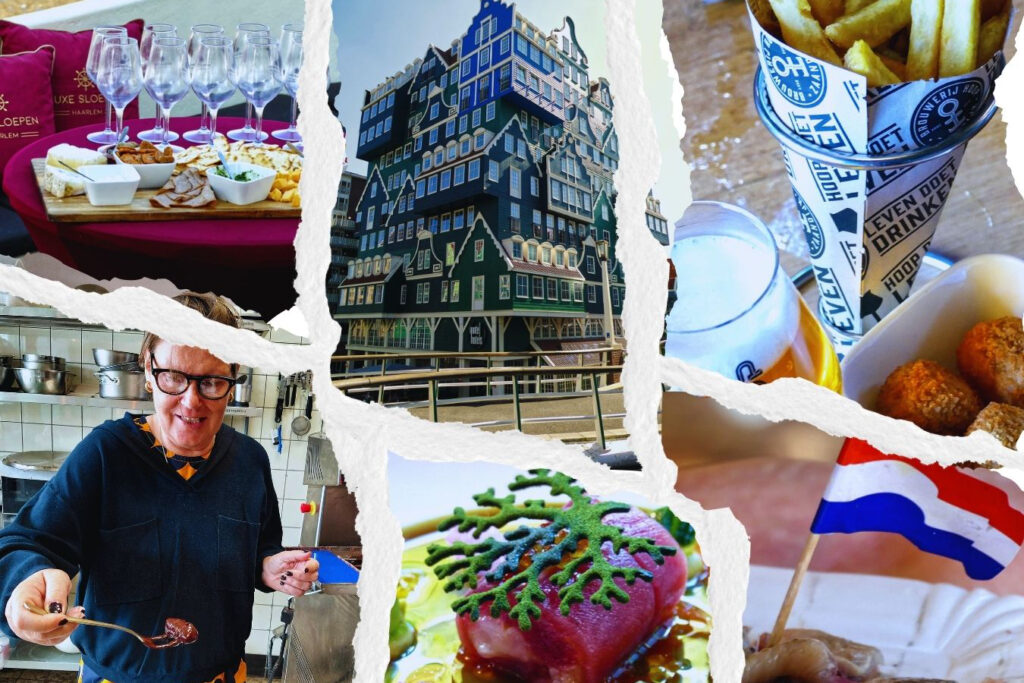
From artisanal cheese and craft beer to centuries-old cocoa traditions, the area northwest of Amsterdam is a place where every local flavor tells a story.

On a culinary journey through North Holland, I discovered some of the region’s signature specialties as well as a couple of incredible gourmet restaurants.
A Taste of Haarlem
We are standing in a semicircle in the Grote Markt in the heart of Haarlem. In the middle stands our tour guide, Mariet, pointing. “Here was the fish market, and in that building, meat was sold. They didn’t slaughter animals there. Only the sales took place. Over there, the bakers sold bread.” Mariet emphasizes all that information by pointing in the respective direction. Since there is so much to point to, her arms spin like Dutch windmill sails.

When the topic of cheese comes up, my French travel companions’ eyes light up. And then they close them in blissful anticipation as they savor the creamy taste of young Gouda on their tongues at the cheese stall in the Botermarkt. They make me laugh: They’ve come all the way from a country with around 1,000 varieties of cheese, and yet they’re still ecstatic over a piece of Gouda.
Once a gourmet, always a gourmet, am I right?
We are on a culinary tour through the Amsterdam Area at the invitation of Amsterdam & Partners*. This makes perfect sense, because the region northwest of Amsterdam’s city limits has long been a land of plenty, feeding not only the local population but, as we’ll later learn, large parts of the world.
Haarlem’s Century-Old Love for Food in a Nutshell
Haarlem is one of the oldest cities in the Netherlands and developed into an important trading and craft center as early as the Middle Ages. Its favorable location between the North Sea, Amsterdam, and the fertile polder landscapes made the city a hub for agricultural products, fish, and trade.

In the 13th century, Haarlem received its city charter, and eventually, markets, guilds, and trade shaped its economic life. Beer was the most important everyday beverage at that time, as water was often contaminated, and numerous breweries made Haarlem famous far beyond its city limits.

During the so-called Gilded Age of the 17th century, Haarlem experienced an economic and cultural boom. At the same time, a vibrant culinary culture developed. Wealthy citizens were supplied with spices, sugar, coffee, tea, and exotic products brought into the country by merchant fleets.

In addition, the fertile soils in the immediate vicinity yielded fruit and vegetables, while the polders offered pastureland for dairy farming. Last but not least did the surrounding dunes provide clean water, which was essential not only for breweries, but also for food production.
Eat Local
Today, Haarlem deliberately embraces this tradition. Historic market squares, regional producers, artisan bakeries, cheese dairies, breweries, and delicatessens shape the culinary scene. Weekly markets and restaurants increasingly rely on ingredients from North Holland. In this way, Haarlem combines its centuries-old history as a trading and market town with a modern food culture that prioritizes regionality, craftsmanship, and quality.

Speaking of regionality and quality: We were able to see for ourselves on the very first evening of our culinary journey through the Amsterdam Area that eating in Haarlem is more than just sustenance.

DeDakkas*, which is a play on words meaning the greenhouse on the roof, is far more than some restaurant. It’s one of Haarlem’s most extraordinary culinary destinations, where gastronomy, sustainability, and urban life come together in a particularly harmonious way.

Tucked away on the roof of a parking garage, we enjoyed a three-course meal made with seasonal, regional ingredients—and, of course, the sensational view over the city’s rooftops.


A Culinary Cruise
But back to our culinary city tour. After Mariet whetted our appetites with the delicious food on our tour of the city, it’s time for lunch.

To do this, we board a sleek boat from the company Luxe Sloepen* at the jetty in front of the historic KoepelKathedraal, where Captain Nils has richly set the table with small delicacies and snacks.

To the great delight of our French companions, there are also two types of Gouda cheese cubes. Nils starts the engine, and the quiet hum is then almost the only sound we hear on the tour across the Spaarne River.

(Photo: Mara Kalkbrenner)
Summertime and the living is easy.
Zaanse Schans – Traditional Crafts and Dutch Staples
It’s not easy saying goodbye to Haarlem. The city has practically chained our hearts’n’stomachs to its eateries. On the other hand, we know we’re heading to the heart of Holland’s breadbasket, and that makes the farewell a little easier.
The Zaanse Schans. Another place whose legend precedes it worldwide. The photos of windmills on endless dikes—I can’t even count how many of them I’ve seen. And as we arrive, we’re certainly not alone: groups of curious visitors are milling around the charming gabled houses and magnificent windmills. But the Zaanse Schans is one of those places whose magic can’t be broken even by the largest crowds.

But what exactly is the Zaanse Schans? Well, it’s an inhabited district belonging to the municipalities of Zaandam and Zaanstad. It was developed starting in 1961 as a historical ensemble to preserve the characteristic architectural and industrial heritage of the region. Numerous historic wooden houses, barns, and windmills from various locations in the area were relocated to this site.
Home is Where the Mill is
Today, there are privately owned, inhabited houses. However, there’s also a myriad of museums, workshops, stores, cafés, and other businesses. Let’s face it: the residents live amidst one of the most popular tourist destinations in the Netherlands.

The windmills also serve a variety of purposes. Some are open to the public as museum exhibits, while others are still operational, producing items such as paint, mustard, or oil.


(Photos: Jill Breuker)
The area is freely accessible. Tickets are only required for individual museums and windmills. A combined ticket costs 29.50 €uro and can be ordered online* or purchased on-site.
Albert Heijn – a Dutch Success Story
We skip the cheese department and head straight for my personal pilgrimage site: the small Albert Heijn Museum*.
During the two weeks I’ve been in the Netherlands at this point, I’ve visited Albert several times a day. Thirsty? Albert carries my favorite juices. Hungry? Albert has everything I need to fill my stomach. Out of toothpaste? A quick trip across the street before Albert closes for a few hours at night. Albert waited practically on every corner, and whatever I needed, Albert handed it to me with a reassuring smile.

Albert Heijn was my perfect travel companion, and here in the museum, we learn how it all began when he opened his first grocery store in Oostzaan in 1887. From this tiny spot in North Holland, it was a meteoric rise to success.
Today, Albert Heijn stores are only found in the Netherlands and Belgium. Nevertheless, the parent company, Ahold Delhaize, is one of the world’s largest food retailers. Interestingly, it generates more than half of its revenue in the USA, where it operates around 2,000 supermarkets and holds a market share of approximately five percent, placing it fourth in that segment.
Way to go, Albert!

The choice of a snake stems from the practical idea of a long, curved hanging mechanism. Later, this evolved into a traditional design element.
Smart Cookies – the Verkade Experience
After visiting the replica model shop, we head to the main building of the Zaanse Schans*. There, we find information and tickets, souvenirs, and a café where we take a break with coffee and Verkade biscuits.
Verkade was founded in 1886 by Ericus Gerhardus Verkade in Zaandam – right in the heart of a region that had been considered one of Europe’s most important industrial areas since the 17th century. The company began by producing rusks but soon expanded its product range to include biscuits, chocolate, and other confectionery. Mind you, Verkade was among the pioneers of industrial food production in the Netherlands.

The historic production site in Zaandam remained the company’s center for many decades and is still closely associated with the brand. Since 1990, however, Verkade has been part of the international confectionery manufacturer Pladis.
Despite the change in ownership, Verkade remains one of the Netherlands’ most traditional and well-known food brands.
Molen de Zoeker – We Strike Oil
We visited the retail outlet and gained an impression of a local factory. Of course, a mill is still missing to complete the picture. It’s fortunate, then, that De Zoeker* is one of the last regularly operating oil mills in the Netherlands and also the only one where peanut oil is still pressed almost daily the traditional way. The mill was built around 1672 as an oil mill, originally in Zaandijk, from where it was moved to Zaanse Schans in 1968.

Technically, an oil mill differs significantly from a grain mill: The peanuts are first crushed and heated, then wrapped in fiber mats and pressed under high pressure. The result is a light-colored, heat-resistant cooking oil, the production of which can still be admired at De Zoeker today. The peanuts are imported from various growing regions, including Argentina, Brazil, China, and the USA. Historically, however, peanuts were brought via the Dutch trade networks primarily from the former colonies in Asia and West Africa.
The fact that products whose raw materials come from entirely different regions of the world are considered traditional today also tells a bit between the lines about the Netherlands’ inglorious colonial history.
From Bean to Bar – Smells Like Chocolate
The production of chocolate and cocoa also has a long tradition in the Netherlands. The beans used for the products at the small shop Smells Like Chocolate* come primarily from Angola—just like the founder, Kinito. Although born in the Southwest African country, he later studied in Brazil and Spain. Today, he works as a multilingual guide, among other things. His partner, Ingmar Niezen, is a food stylist and recipe developer. In their current concept, tourism, aesthetics, and the culinary world of cocoa are literally melted together.

“We are always looking for new, unusual items,” explains Ingmar. She sees the shop as a tribute to cocoa as a raw material. Hence, Kinito and Ingmar sell more than just chocolate. The range includes products made from cacao beans, cocoa butter cosmetics, beer infused with cocoa, and even paper containing ground cacao beans, produced by a local historic paper mill. “A woman sews these bags for us out of old cocoa sacks, for example.” Ingmar holds up a stylish tote bag. It’s a shame I’m already so weighed down with luggage, as this unconventional design would certainly suit me well.
Cocoa Valley
As a matter of fact, the name Smells like Chocolate isn’t just a marketing scheme. The Zaan region is actually one of the world’s major cocoa processing hubs. When the wind is blowing from a certain direction, the aroma of roasted cacao beans is clearly perceptible all around Zaandam.

Today, many people associate the Zaanse Schans exclusively with picturesque windmills. In reality, however, the Zaan region was one of Europe’s first industrial areas as early as the 17th century. In fact, at one point, there were around 600 windmills here. They laid the foundation for the food and cocoa industries that would follow.
In contrast to mass-produced industrial goods, Ingmar and Kinito focus on high-quality craftsmanship. They want us not just to taste the product, but to experience it with all our senses. Therefore, Ingmar leads us a few streets over to the workshop, where the magic happens. In Kin & Co’s small workshop, masterfully crafted bean-to-bar chocolate is produced in small batches. Here, everything is accomplished by hand, from the raw cocoa bean to the finished bar.
How exactly is it done? Ingmar’s colleague David explains the process with great passion before having us create our own tasty souvenirs.
Do I really need to mention that none of these sweet keepsakes survived long enough to make it past the workshop door?
Some temptations simply have to be given in to.
Brouwerij Hoop – the Way to a Man’s Heart is Through his Stomach
You probably can’t imagine that our small group could possibly eat another bite after all those cookies, chocolates, and whatnot. Neither could we. But when we finally take our seats at the long wooden table at Brouwerij HOOP* and a whole array of nourishing delicacies is laid out before us, the devoured sweets in our tummies give way to something savory like fries and bitterballen.

Obviously, we wash them down with the beer brewed right on site. In fact, they brew a variety of beers ranging from blondes to hoppy IPAs. Also, you can book a Brouwerij HOOP tour and tasting, just check it out on their website*.
And as for The Way to a Man’s Heart is Through His Stomach: I can only shake my head at this gender-based limitation. Our predominantly female group proves that gourmets can also be quite gourmand.
A bitterballen to that!
Verrassing aan de Zaan – Prepare to be Surprised!
At the end of this epicurean tour, I don’t want to deprive you of another culinary highlight. Because you don’t necessarily have to settle for the rather hearty’n’heavy traditional Dutch cookery. You might be surprised to learn that there are true gourmet temples in the region.
And surprise is the keyword when it comes to the Zaandam restaurant Verrassing aan de Zaan* as it translates to Surprise on the Zaan. This perfectly describes the entire restaurant concept. Instead of a traditional menu, the focus here is on the culinary experience. Guests simply select the number of courses, their preference for fish, meat, or vegetarian dishes, and inform the restaurant of any allergies. Everything else is left to the kitchen. The result is fine dining on the highest level in a relaxed atmosphere.
The culinary inspiration stems from the history of the Zaan region as a traditional industrial and trading center. Using top-quality ingredients and the available resources, the aim is to create something memorable time and time again. At the same time, the restaurant sees itself as a small, creative laboratory where flexibility, passion, and craftsmanship come together as one.


The culinary signature is the work of head chef Jermaine Liesdek. Born in the Netherlands to Surinamese parents, he gives French culinary art an Asian twist. His philosophy is: taste evokes emotions, and a special meal leaves a lasting recollection. Therefore, you don’t choose a dish, but leave your future recollection trustfully in Jermaine’s magic hands.
This being said, you can choose your surprise menu as two, three, or four courses.
Look Beyond Amsterdam
If you’re now tempted to experience the culinary paradise of the Amsterdam Area for yourself, then I have good news for you: You can easily and affordably organize it yourself, whether as a day trip during your Amsterdam visit or as your final destination. Direct trains run between Amsterdam Centraal and Haarlem approximately every ten minutes during the day. The journey takes only about 15 to 20 minutes, and a single ticket starts at 5.50 €uro.

Once you arrive in Haarlem, I recommend exploring the other facets of this intriguing yet often overlooked city beyond just cheese tasting and beer sampling. In Haarlem, you can sleep in a former prison, drink beer in a converted church, visit the Netherlands’ oldest museum, and much, much more. I’ve written it all down for you in my post The Best Spots in HAARLEM You Should Not Miss. There you’ll also find lots of practical information and tips to make your trip smoother and more enjoyable.
My Tip
The Iamsterdam City Card also includes several attractions and museums in the Amsterdam region, including those in Haarlem and the Zaan area. For example, you get free entry to Haarlem’s famous Frans Hals Museum and can visit certain museums and windmills in Zaanse Schans.
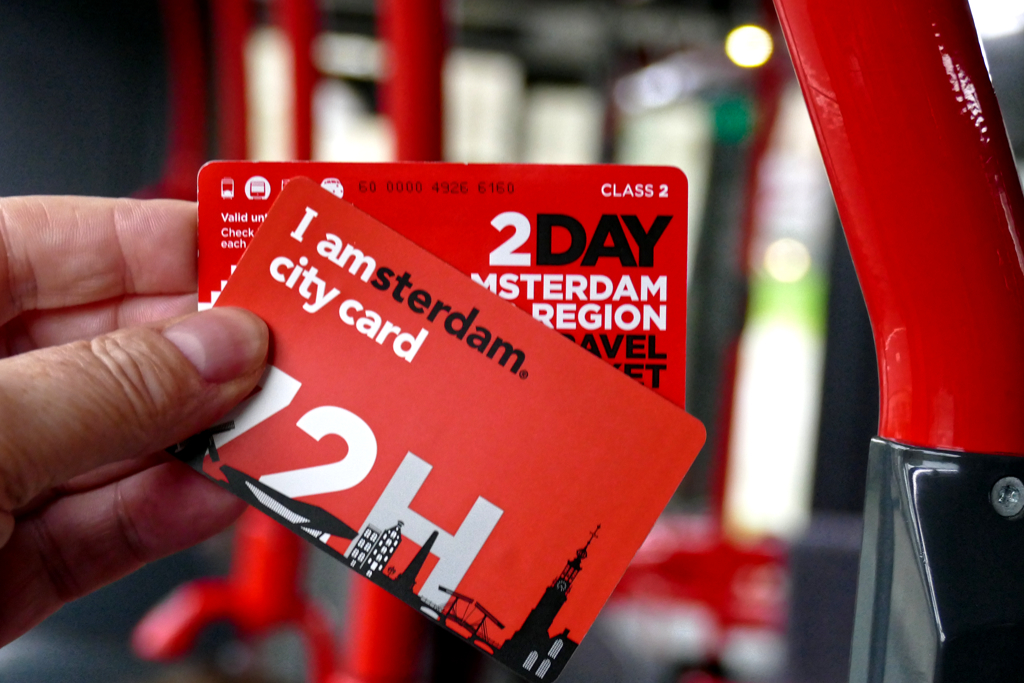
However, the Iamsterdam City Card does not cover travel to those destinations. You’ll need a separate ticket for trains and buses, or you can opt for the Amsterdam & Region Travel Ticket. You will find all the information about the Iamsterdam City Card — and of course a comprehensive travel guide to the city — in my post Four Days in AMSTERDAM – Unique Things To See on a Long Weekend.
How to Get Around
It would have been a big blunder if I had answered this question by any other means of transportation than the legendary fiets, which translates to bicycle, obviously. The Netherlands is the undisputed world leader when it comes to everyday use of bikes and the related infrastructure. After all, the nation boasts more bikes than people and has an incredible 35,000 kilometers of bike lanes.

This being said, I need to point out that riding a bike is not considered a kid’s game but a valid means of transportation. Therefore, locals get extremely annoyed by visitors meandering on the designated bike lanes, which they express by extensive ringing and loud swearing. Hence, do yourself a favor by walking only on the sidewalks for pedestrians, and don’t watch out only for cars when crossing the streets since those Dutch cyclists are hellishly fast.
I assume you won’t bring your own bike. Obviously, this is not a problem since there are many places where you can rent your personal fiets.
The second-best way to explore Haarlem as well as Zaandam and the Zaanse Schans is by walking. However, keep in mind that in the cities, sidewalks are paved with very uneven cobblestone. Therefore, ladies, make sure to wear flat, comfortable shoes. Good sneakers or even light hiking shoes will make your exploration of the region safe and enjoyable.
Where to Stay
Many visitors come to Haarlem as well as the Zaanstreek just on a day trip. While this is still better than nothing, I’d argue that an overnight stay gives you a whole different perspective on the places. Lately, I’ve been moving slowly but surely towards slow travel. This definitely includes overnight stays in cozy’n’comfortable accommodations.
The Metzlr House* in Haarlem is one of the most extraordinary hotels in the Netherlands: It’s located in the listed Koepelcomplex, a former 19th-century prison that has been meticulously converted into a boutique hotel. Historical elements such as the imposing dome, original staircases, and even some window grilles evoke the past, while the rooms impress with a modern design. So if you are looking for a truly outstanding place to stay, you’ll find a mix of history and contemporary hospitality right there.
If you are rather into classic, upscale hospitality, the Inntel Hotel* in Zaandam is the perfect choice for you. Already from the outside, it’s a real eye-catcher: The striking facade, composed of stacked Dutch gable houses, makes it one of the region’s most photographed landmarks.

Inside, you’ll get a comfortable, region-themed room. After a long day of exploring, you can take a refreshing dip in their indoor pool and unwind in the spa area. The hotel is just a stone’s throw from Zaandam’s train station, from where both Amsterdam and the historic Zaanse Schans are easily and quickly accessible.
This being said, you’ll find all kinds of accommodation that will suit your taste and budget on this map**:
Visiting Organized
I’m an avid solo-travelling woman. But solo travel shouldn’t equal solitude, hence, from time to time, I enjoy day trips in the company of fellow travellers.
Especially if you have only a short time for exploring the Amsterdam Area, an organized day tour will enable you to see the most in a relatively short period of time. However, make sure to book the activities of your choice well ahead, especially during the high season**:
Map
This map should help you to find all the wonderful places I’m introducing in this post. I split it into two layers, one for Haarlem and the other for the Zaanse Schans. This way, you can open them separately.
Clicking on the slider symbol at the top left or the full-screen icon at the top right will display the whole map, including the legend.
Pinnable Pictures
If you choose to pin this post for later, please use one of these pictures:


Did You Enjoy This Post? Then You Might Also Like These:
Disclaimer: This post is largely inspired by a press trip to which I was invited by amsterdam & partners International Press Office.
* These companies were part of the press trip’s official program organized by amsterdam & partners, hence, the products and services were complimentary. Nevertheless, the description of the activities and all opinions on their services are mine and were in no way influenced by my cooperation partners.
** This is an affiliate link. Hence, if you book through this page, not only do you get the best deal. I also get a small commission that helps me run this blog. Thank you so much for supporting me!