Some Thoughts on Library-centric parts of Through the Looking Glass: a SEEN in Publishing report into trans activism in children’s literature and library services

I am limiting my writing about Through the Looking Glass to the parts of the report that focus on libraries and the CILIP Carnegie Medals. I feel that I do not have the requisite knowledge and experience to comment on the medical chapters or those dealing with the publishing industry. If anyone with more knowledge than I is interested in writing about those chapters, I would be more than happy to collaborate.
The report Through the Looking Glass was put together by:
SEEN in Publishing – a network of publishing professionals, authors, and creatives, who recognise the material reality of sex, and support freedom of expression.
Biology in Medicine – a group of doctors and colleagues wanting patients to be treated according to their sex, and to know the sex of those caring for them.
Transgender Trend an organization that was set up ten years ago to promote evidence-based care for children with gender-related distress and for scientific, factual teaching about sex and gender in schools.
I have heard quite a few things about Transgender Trend over the past decade and none of it good but the other two groups are new to me. SEEN in Publishing was set up back in 2024, there is an interesting Reddit post about them that you can read called (Some publishing world drama) The formation of SEEN Publishing – a group for those who “recognise the material reality of sex, and support freedom of expression.”
Biology in Medicine purport to be medical professionals, but much like SEEN in Publishing remain mostly anonymous so while it is likely that many of them are medical doctors and publishing professionals, apart from Dr. Alice Hodkinson who is listed as a co-founder of BiM and contributed a chapter of this report, they have not put their faces and names on the work they are doing.
The people running Transgender Trend at least are open about who they are and why they are doing what they do although I will state here that I disagree with them entirely. Another red flag about SIP and BIM is that their work is hosted on Substack, a platform known for openly profiting from hosting Nazis newsletters. Note: I am not accusing them of being Nazis, but the Nazi bar analogy is quite apposite here as to why I am deeply suspicious of anyone who publishes on Substack these days.
Anne Fine’s vituperative screed sets the tone for the report as a whole. I have had a fondness for her books for decades now, but this endorsement, along with her review of Melvin Burgess’s Doing It back in 2003 that I discovered recently: Filth, which ever way you look at it has left my appreciation somewhat dimmed.
The widespread use of the term ‘trans activist literature’ in place of ‘children’s, teen or picture books featuring Trans characters’ shows the bias of the report’s authors.
Let us take a look at the recommendations of the report (to see the full recommendations, you can read the report as I am focusing on some of their main points):
1. Stop publishing trans-activist literature – fiction as well as non-fiction – for all age groups catered to by children’s publishing, up to and including YA.
The open advocating for censorship is wild!
2. Children’s librarians must stop shelving trans-activist titles. Particularly egregious is the mis-shelving of titles for young adults or even adults in areas accessed by much smaller children
Number two is a biggie for me – collection development by fiat and also saying that such books must not be in any part of the library that young people can access. Anyone that uses Public Libraries is (or should be) aware that no public areas of the library are off-limits to any patrons. There are some public libraries in the US that have started asking for identification for people to prove they are adults before being allowed to use some parts of the library:


Screenshot of an Instagram image from Donnelly Library blocking entry to unaccompanied minors or patrons without unrestricted library membership
They then jump on to Drag Queen Story Times with: Similarly, librarians should note that ‘drag queen story hour’ is not appropriate for young children. A man who makes money from sexualised performances while wearing ‘womanface’ has no place reading to babies and toddlers in any setting, let alone a publicly-funded one.
Attacks on drag performers and story times has been going on for as long as DQST have been organized. American anti LGBTQ+ agitators have a well-developed playbook when it comes to this and it looks as if protesters in the UK are learning from it. The ‘womanface’ accusation is one that has been hotly debated and studied (I highly recommend Drag as Marketplace edited by Mikko Laamanen from the Bristol University Press if you wish to find out more).
3. Librarians and booksellers must stop recommending trans-activist titles to parents and children – not just day-to-day, inside local and school libraries and bookshops, but also via long- and shortlists for prizes such as the CILIP Carnegie Medal
“Trans activist titles’ pops up again and a demand that CILIP stop listing books featuring trans characters shows a (possibly willful) misunderstanding of how the Carnegie Medals work when it comes to selections and the judging process. CILIP (the organization) remains resolutely hands off when it comes to nominations and how the judges select the long and short lists as well as the eventual winners, if CILIP ever tried to put a thumb on the scales I believe that it would kill the awards. You can read about The Carnegies Medals Awards Process here.
4. Instead of publishing trans-activist titles, children’s publishing should concentrate on putting out excellent stories with captivating characters that will foster a lifelong love of reading in every child – from picture book age to the uppermost reaches of the YA readership.
The report is written as if it is a foregone conclusion that books featuring trans characters have no chance at fostering a love of reading, are devoid of excellence, captivating characters and have no appeal and represent no-one any children might know or love.
5. The CEOs of publishing houses, their imprint heads and publishing directors should be mandating that acquisitions lists are broadened out again to attract genuinely diverse and excellent submissions from authors and agents…. The sharp downturn in reading is not just a sign that other media are competing for young readers’ time, money and focus – it is also indicative of recent publications simply not being up to scratch.
It is as if people have forgotten that publishing is a business and publishers publish books they believe will make money. In my research I have discovered that many books do not sell enough for authors to make a living solely as a writer, and the few that do are the exception, not the rule. There are a multitude of reasons why reading for pleasure is on a downturn, and to blame it all on the fact that some books are written by (& feature) trans people is intellectually dishonest.
6. Children’s publishing and the library services must move away from cancel culture by implementing robust HR practices like staff/author retraining.
Can’t really speak to how it is done in the publishing world, although most publishers are parts of massive multinational corporations these days and those have massive HR departments that know the law, I can say that Public Libraries as arms of local authorities also have robust employment policies.
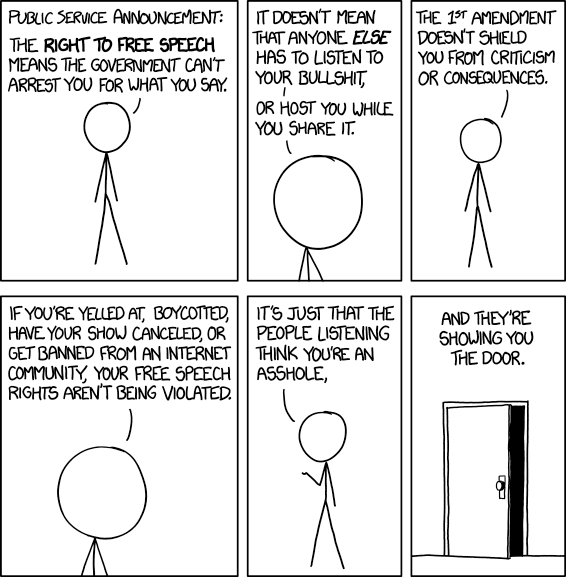
The terms ‘cancel culture’ (the practice or tendency of engaging in mass canceling as a way of expressing disapproval and exerting social pressure) and ‘consequence culture’ (facing consequences for socially unacceptable actions) the webcomic XKCD by Randall Munroe has a pretty good definition of what consequences people can face:


7. Educational publishing, libraries and schools must collaboratively observe statutory KCSIE and RSHE guidance, ensuring age-inappropriate and factually incorrect, trans-activist books no longer find their way into children’s hands in the school/peripatetic setting.
The demand that private businesses and Public Libraries limit themselves with the Keeping Children Safe in Education and Relationships and sex education (RSE) and health education, legislation aimed at schools an dedicational institutions makes no sense. Schools already adhere to this guidance and most (if not all) school libraries have robust collection development policies to make sure that appropriate materials are contained in their collections. Public Libraries already have collection development policies that are monitored and updated by library professionals. Publishing companies are businesses, and they select works to be published based on where they see the market going.
Indeed, the report reads like a ransom note with the hostage takers demanding that once their demands are met, they will start executing the hostages.
For a group claiming to support authors and others in publishing who have been unfairly censored and silenced they seem to be awfully keen on censoring and silencing those they disagree with and unwilling to put the onus of parents to monitor their children what they read.
Looking at Chapter 5: Discarded Girls: Libraries, Carnegies, Brontës by Sibyl Ruth
Much of this chapter is taken up by looking at the Chartered Institute of Library & Information Professionals (CILIP)’s Managing Safe and Inclusive Public Library Services: A Practical Guide. The author of this chapter reads much into the guide and raises the point that “the word ‘girl’ does not appear. Nor do the terms ‘woman’ and ‘female’.” This is true, but as far as I can ascertain neither do the words ‘boy’, ‘man’, ‘male’, ‘trans’ or ‘transgender’.
The guide is just that – a guide, indeed CILIP hopes and anticipates that “people will use it primarily as a reference resource or ‘checklist’ when strengthening their own policies, practice and preparedness.” They further envision that “library services will use the guidance as a structure for workshop or group discussions.” It was not created as prescriptive document, but rather as “guidance is intended primarily for public librarians and library staff who are responsible for making decisions, and defining and implementing policies” the fact that it is not legally binding advice is stressed several times as well as including an admonition that Public Libraries and Local Authorities make sure that their policies are legally sound and backed up by professional legal advice.
This chapter also decries the 50% loss of professional staff over the past 15 years a loss that is felt keenly by all supporters of libraries as well as library staff; I was an early casualty of cuts to library staff and have written about it here: Decimation. The ongoing loss of staff has and is causing difficulties with public library service, and many libraries have fallen out of statutory library service and are being run by community volunteers or outside organizations.
I find it peculiar that that the author is angry that it is “impossible for CILIP to shape services in a way that benefits girls” it smacks of whataboutism, the guidance covers library services to all users. One other question could be “why doesn’t CILIP shape library services to benefit boys?” after all they need guidance and safe spaces too. Singling out one particular set of users would lead to a ripple effect, quite possibly leading to demands for specific rules and guidance for every subset of users, rather than the overarching approach to provide space and materials for all users – as used by CILIP in their guide.
The focus then shifts to the Carnegie Medals, particularly the 2025 shortlisting of Theo Parrish’s graphic memoir Homebody for the Carnegie Medal for Illustration, you can read a review and interview with Theo about it here: Homebody.
That Homebody is a memoir appears to have been ignored and it is instead described as a graphic novel that could have been “a story that encouraged same-sex attracted young women to feel good about themselves” and is “a book that encourages self-harm” instead of being acknowledged that it is about Theo’s experiences growing up and into who they are.
Further umbrage is taken with the 2026 shortlist as the only novel for teenage girls is Tia Fisher’s Not Going To Plan. This at least is refreshing, as historically at least many of the complaints levelled against the awards is that there are too many YA books and not enough for younger readers. Previous complaints against the Carnegie Medals have mostly concerned the fact that often the outstanding books selected have been too advanced or contain subject matter that is not suitable for younger readers. Since the diversity review concluded in 2018, there has been the Shadowers’ Choice Awards (first awarded in 2019) selected by the young readers that participate in shadowing the Carnegie Medals. This often gives readers access to youth selected titles that may be considered more age appropriate than the outstanding titles chosen by Librarian Judges that follow the more rigorous selection criteria for written and illustrated works.
The question “What avenues are open to adults who aren’t happy about library services for children?” Is then asked – as arms of a local authority, feedback about library services can be submitted to the council under the contact button it is usually called ‘report a problem’ or something similar. Feedback can also be given directly to library management either written or via email (contact details will be provided when requested in the library).
Anger is then unleashed again on Drag Queen Story Time with another unsubstantiated accusation that men who perform in Drag are turned on by mocking women.
The chapter concludes with: “All too often the library service still offers girls dangerous ‘nonsense.’ And the way in which it treats them remains ‘scarcely fair’.” A subjective opinion masquerading as objectivity.
To quote the introduction of the CILIP guide:
‘A library should be a place of wonder and safety for children and adults.
It is a place in which people can discover themselves and learn about the world around them.
It is a place in which complex, sometimes conflicting ideas can be held up for scrutiny.
It is a place of dialogue and respect, tolerance and inclusion.
It is a place in which cultures can meet and be reconciled.’
If parents or guardians are concerned with what the children in their care are accessing, it is up to them to help the young people choose books and other materials they deem appropriate. It is not up to the library staff or strangers to attempt to influence what young people are reading.
Basically, if the information contained within a book upsets or offends you just put it down – no-one is forcing you to read it. If you believe that materials in a library collection are inappropriate you can request that they are reconsidered against the library’s collections development policy, if your request has merit the item(is) in question may be withdrawn or moved to a different part of the library, but that may not happen.
If anyone would like to comment or contribute to this post I am contactable here: Contact Information.