Symbolism ushered in a new age of imagination in European art making in an era when depicting reality prevailed. These artists delved into myth, spirituality, the subconscious, and the inner self to conjure fantastical worlds that evoke emotion and imagination. Despite the impact of their works – and the renown of many members – Symbolism is an undersung movement. In this article, I explore its complex origins and definition, detail eight of the key artists, and demonstrate approaches to creating your own Symbolist drawings and paintings.
Articles in the Techniques Series define the meaning and context of art making processes and give practical tutorials on how to work with them.

Definition: Symbolism describes the late-19th-Century movement of European artists who rejected depicting reality – seen in Naturalism, Realism, and Impressionism – and instead pursued the imagination by reaching into mythology, fantasy, and the inner self, to conjure new worlds. The movement can be difficult to define because the work of the Symbolists varies widely in style, technique, and approach, and because many of the artists straddle other movements. Yet, these artists are broadly grouped by the value they placed in evoking emotion and ideas over the rational depiction of their reality.

Odilon Redon
Oil paint and pastel on paper, 54.5 x 49.5 cm | 21.5 x 19.5 in
Rijksmuseum
What is the Effect of Symbolism?
Symbolism guided art history away from the depiction of the literal world toward the fantasised – opening up endless possibilities for the artists who followed. By exploring spirituality, myth, psychology, and alternate worlds, the Symbolist artists asserted the importance of the inner self, dreams, and the imagination. Many of the ‘symbols’ in their works aren’t those of mainstream iconography, but instead are individual to each artist. This makes many Symbolist works obscure and difficult to interpret. In doing so, they set a precedent for much of today’s contemporary art, which resists narrative interpretation in place of feeling.
Symbolism also challenges the linearity of Western art history, which so often credits progress to specific countries and set groups. This complication exists because the movement emerged naturally from a collective frustration with conventional art making across Europe. As a result, the artists of the movement were widely dispersed, and many never made personal contact. The movement also emerged simultaneously with Post-Impressionism, Art Nouveau, and the Pre-Raphaelites, making this an incredibly prolific period in Western art history, but also one of intricate overlaps. Many of the artists of those movements dabbled in Symbolism and vice-versa, making it amongst the most broadly grouped movements.

Sir Edward Burne-Jones
Oil on Canvas, 114.3 x 155.9 cm | 45 x 61.4 in
The Metropolitan Museum of Art
There’s also a huge variety in the mediums used by the Symbolists, including painting, drawing, printmaking, and sculpture. It’s impossible to describe a unifying Symbolist technique, since each artist was unique in their approach. There is almost no aesthetic or technical connection between the flowing forms in Munch’s paintings and the intricately layered watercolours by Moreau, yet they are connected to the movement for their pursuit of personal expression. For all these reasons, Symbolism is less discussed than those art movements with clear borders and straightforward definition, despite including some of the most influential artists in European history.
The stories of the Symbolists encourage artists to be flexible in their approach – to see what their own imagination may produce beyond relying on reality as a source. Following this vein, the Symbolists were an essential precursor to Surrealism, where many of their ideas on the subconscious mind, dreams, and alternate worlds had already been explored. Artists like Odilon Redon may be considered proto-Surrealist, for his bold invention. Modernism also shares many of Symbolism’s concerns, having both been born from a collective frustration at the state of our world. We feel the tension between the rejection of reality and the desire for change in art to this day.
The History of Symbolism
Symbolism isn’t purely a fine art movement. Its origins are literary rather than visual – stemming from the 1880’s French and Belgian literary movement of the same name. The term ‘Symbolism’ had its inception when the poet Jean Moréas published his ‘Symbolist Manifesto’ in 1886. He encouraged artists and writers to be more evocative in their response to nature, in rejection of Naturalism and Romanticism, which he scathingly called ‘dried out and shrivelled’. The Symbolist writers include Baudelaire, Verlaine, and Mallarmé, who are brought together for their rejection of the literary conventions of the day by imbuing mysticism and indirect suggestion into their works. Stéphane Mallarmé succinctly expressed his belief that poetry better expressed reality than depicting it:
‘To name an object is to suppress three-quarters of the enjoyment to be found in the poem… suggestion, that is the dream.’

Pierre Puvis de Chavannes
Oil on paper, laid down on canvas, 129.5 x 252.1 cm | 51 x 99.3 in
The Metropolitan Museum of Art
A generation of young painters began to identify with and pull inspiration from Moréas’ ideas and the Symbolist writers, which set the art movement in motion. Symbolism also emerged in Europe at a time of increasing industrialisation and scientific discovery. The ideology of the movement provided an escape into the intangible from this harsh reality. It allowed artists to obliquely express their cynicism on what they perceived as an international social and moral decline.
The first generation of Symbolists came from the 1870s, and included Gustave Moreau, Odilon Redon, and Pierre Puvis de Chavannes. These artists had a profound influence on the Symbolists who followed later in the 19th century, including Edvard Munch, Paul Gauguin, and James Ensor. Some artists straddle Symbolism and Art Nouveau, like Ferdinand Hodler, Gustav Klimt, and Aubrey Beardsley. The Symbolist artists also had much in common with the Pre-Raphaelites, so some of their members span both movements too, like Edward Burne Jones and Evelyn de Morgan.
They invented alternate realities – either reaching to the past by applying mythological and religious figures to the present day, turning to the future to conjure new idyllic worlds, or reaching inward to explore their own psyches. By using metaphor and individual symbols, they evoked meaning and emotion in their work, without directly transcribing fact.

Edvard Munch
Oil on canvas, 191 x 125 cm | 75.2 x 49.2 in
Nasjonal Museet
It’s difficult to condense the efforts of the Symbolist artists, since the movement includes such a broad group of artists. Some of the key members have already been written about in detail on the Jackson’s Blog, including Edvard Munch, Gustav Klimt, and Aubrey Beardsley. For this article, I’ll specifically focus on just eight of them: Odilon Redon, Gustave Moreau, Sarah Bernhardt, Camille Claudel, James Ensor, Fernand Khnopff, Ferdinand Hodler and Paul Gauguin.

Odilon Redon
Lithography in black on paper, 26.3 x 19.8 cm | 10.4 x 7.8 in
Art Institute of Chicago
Odilon Redon almost exclusively made black charcoal drawings and lithographs, sometimes referred to as ‘Les Noirs’, until he was in his fifties. In these drawings he developed a cast of unique characters and creatures, pulling from myth, folk tales, his imagination, and writers like Edgar Allen Poe. His monochrome palette aided the mystical atmosphere they conjure, making us experience them like drawn records of a faraway land. He was virtually unknown until 1884, when he was in his forties, when J. K. Huysmans’ book Against Nature narrated the fictitious tale of an eccentric aristocrat who collected Redon’s work, which became an important work of Symbolist literature.
His works are incredibly imaginative and incomparable to his contemporaries in style and technique. He wrote about struggling to find his stride in realism, before embracing the imagination in his journal:
‘I have often, as an exercise and as a sustenance, painted before an object down to the smallest accidents of its visual appearance; but the day left me sad and with an unsatiated thirst. The next day I let the other source run, that of imagination, through the recollection of the forms and I was then reassured and appeased.’

Odilon Redon
Pastel, conte, and charcoal on paper, 53.6 x 37.7 cm | 21.1 x 14.8 in
Art Institute of Chicago
In 1886, he began exhibiting amongst the Impressionists and Les XX in Brussels, and by the 1890s, he began working in pastel and oil. After introducing colour to his oeuvre for the first time, he never made another Noir after 1900. The influence of japonisme began to appear in his colourful works, combined with a growing interest in Buddhism, seen in Buddha, where the flowers harmoniously embrace the meditating figure. This sense of peace and comfort found in nature is also seen in Pandora below, where the mythological figure stands amidst a lush landscape, holding the box that will unleash irreversible evil into the world. It’s thought that this work was painted on the cusp of the outbreak of World War I, so here Redon’s Symbolism fuses together spirituality, mythology, and current affairs in a personal dreamscape.

Odilon Redon
Oil on canvas, 143.5 x 62.2 cm | 56.5 x 24.5 in
The Metropolitan Museum of Art
Gustave Moreau brought passion, character, and jewel-like colour to his opulently textured paintings and drawings, filled with mythological, biblical and imaginary subjects. He spent his life in Paris and was directly influenced by the Romantic artists Delacroix and Chassériau for the emotive purpose of their works. He travelled to Italy on one comprehensive tour in 1857, taking him across the country to study the art of the Renaissance. We see the influence of the Masters in his linear figuration and rich palette.
He began making works in a Symbolist vein in the 1860s, making him a forerunner of the movement. By reinterpreting classical themes in his dreamlike scapes, he deliberately brought fresh conviction to tales that were fading in relevance. He deliberately called himself a ‘history painter’, to breathe new life into the genre. He was also incredibly prolific, making over 15,000 works in his lifetime. Working as an influential tutor at the École des Beaux-Arts, he counted Georges Rouault and Henri Matisse among the students he inspired.
He wrote about his working method, ‘I believe neither in what I touch nor what I see. I only believe in what I do not see, and solely in what I feel.’

Gustave Moreau
Watercolour, gouache, pen and blue ink on paper, 29.9 x 23 cm | 11.8 x 9 in
Art Institute of Chicago
Like his contemporaries, he was also a collector of art and looked to Indian and Persian miniatures, Renaissance engravings, and Japanese prints for visual inspiration. We see his visual references converging in works like Salomé Dancing Before Herod, with evidence of Islamic, Etruscan, Roman, Egyptian, Persian, Indian, and Chinese art, clothing and architecture fused in one image, to create this new realm. The shimmering impasto application of the paint and deep tone in the vaulted room of the palace enhance the fantasy and exoticism of the work. Artworks with elements of ‘exoticism’ aren’t those that simply depict objects from other cultures, but those that mix them with fantasy, mystery and stereotype, without regard to their actual meaning.

Gustave Moreau
Oil on canvas, 143.5 x 104.3 cm | 56.5 x 41 in
Hammer Museum
One thematic characteristic of the Symbolist movement is the inclusion of the contrasting archetypes of the heroine and femme fatale – one being a woman who represents order and duty, and the other temptation and chaos. Mythology was a font of inspiration for these characters, drawing on stories of the sirens, goddesses and sphinxes. We see these ideas run through Moreau’s work, including his most famed work, Oedipus and the Sphinx, whose victims lay strewn at their feet, whilst the sphinx prowls up Oedipus’ chest.

Gustave Moreau
Oil on canvas, 206.4 x 104.8 cm | 81.3 x 41.3 in
The Metropolitan Museum of Art
Sarah Bernhardt was an internationally famed actress – whose image is best remembered today in the career-launching posters Alphonse Mucha designed for her role as Gismonda. Although she was a key muse of Art Nouveau, Bernhardt was an exhibiting and skilled artist in her own right. She also embraced the Symbolist idea of the femme fatale, seen here in her fantastical ink well, Self-Portrait as a Chimera, where she positions her own head atop a body complete with draconic claws, feline back legs, and bat-like wings.

Sarah Bernhardt
Brass ink well, 31.8 × 34.9 x 31.8 cm | 12.5 x 13.7 x 12.5 in
Art Institute of Chicago
Bernhardt was not the only Symbolist sculptor – Camille Claudel also created moving figurative works that embody the characters of myth and emotion, made in plaster, marble, and bronze. In their era, it was rare for women to practice sculpture, which was seen as a masculine field, and required the study of the nude, which was still deemed improper for women. Claudel pursued sculpture anyway, under the mentorship of Alfred Boucher and later Auguste Rodin, who became her lover. Her Symbolist works introspectively embody themes of love and loss. She amazed critics on the reception of her masterwork, The Age of Maturity, with one critic stating, ‘We can no longer call Mademoiselle Claudel a student of Rodin; she is a rival.’

James Ensor
Oil on Canvas, 94.6 x 112.4 cm | 37.2 x 44.3 in
Minneapolis Institute of Art
Les XX were an organised group of 20 Belgian artists at the cutting edge of fine art. They exhibited together after being united in 1883 by their frustration at the Salon and L’Essor – a group formed before Les XX that accepted traditional artists too, instead of focusing purely on the avant garde. They held an exhibition to showcase their members every year for a decade, and invited 20 international artists to join them each time, which included artists like Cézanne, Van Gogh, and Monet. As time progressed, they invited new artists to join, and the varied members of Les XX worked in varied styles – incorporating Post-Impressionism, Fauvism, and Symbolism.

James Ensor
Oil on canvas, 31.1 x 24.4 cm | 12.2 x 9.6 in
Philadelphia Museum of Art
James Ensor was their most prominent Symbolist member, who used carnivalesque characters and skeletons to form macabre crowds, combining themes of mortality with social satire. Masks were a key motif in his works, which embodied the facade people present to the world to expose their hypocrisy and absurdity. This morbidity and sense of humour can be seen in the Netherlandish artists of the past he was inspired by, such as Hieronymous Bosch and Pieter Bruegel the Elder. We know he was preoccupied with mortality from his writings, where he lamented his fear of dying from an early age. His work is regarded as highly influential in urban art, noted by the art historian Robert Rosenblum, Ensor had ‘opened a new world of urban anxiety that would soon become a central theme in Northern European painting’, seen in the work by artists like George Grosz and Otto Dix in the future.

Fernand Khnopff
Pastel, graphite, and chalk on paper, 34.9 x 74.9 cm | 13.7 x 29.5 in
The Metropolitan Museum of Art
Fernand Khnopff was another founding member of Les XX. He was motivated to create Symbolist artworks after an early career in Naturalism, born out of frustration at the lack of spirituality in the art of his day. In several works, he invoked the god of sleep, Hypnos, since dreams and the subconscious were key to his work. He often portrayed women in the Symbolist roles of angel or temptress, epitomised by his masterwork The Caress of the Sphinx. His works have a soft quality, with diffused tone and colour, arranged into experimental compositions that promote balance and harmony. They are quietly magical, as opposed to some of the other Symbolists whose works loudly envelop us in their worlds.

Ferdinand Hodler
Oil on canvas, 250.2 x 130.5 cm | 98.5 x 51.4 in
The Metropolitan Museum of Art
The Swiss artist Ferdinand Hodler began his career as a somewhat conventional painter of landscapes and portraiture before he painted Night in 1890 in his late thirties. The hunched-over figure of death, shrouded in black, crouches amongst a group of sleeping nudes. Whilst a man in the centre of the composition is startled awake and recoils in terror from the phantom figure. The work was a pivotal experiment in evoking sleep and death and set the precedent for his works to follow, depicting allegorical figures, often stylised into rhythmic compositions.
He called his technique ‘parallelism’, which asserted the importance of symmetry, repetition, and the symbolic potential in vertical and horizontal lines. In the above painting, The Dream of the Shepherd, a shepherd kneels atop a hillside, physically struck by the vision of ethereal women dancing above him. Like many Symbolist works, the narrative is evasive, but we are left with strong ideas on enlightenment, mortality, desire, the unconscious, and nature. This work was exhibited in 1896 and was among the first of his works to earn him notoriety.

Ferdinand Hodler
Pen and ink on paper, 18.9 x 16.2 cm | 7.4 x 6.4 in
Philadelphia Museum of Art
The first definition of Symbolism was published in 1891, in an article about Paul Gauguin’s work by Albert Aurier, who declared him the frontrunner, and defined the movement as the ‘painting of ideas’. By this point, the earlier generation of Symbolists had made their mark on European art since the 1870s. Gauguin’s first intentional Symbolist work was The Vision After the Sermon, where he depicted pious Breton women experiencing a vision from Genesis in the Bible, where Jacob wrestled with an angel. By combining the biblical with his contemporary experience in one picture plane, he invites us into a Symbolist dream world. He wrote about the painting in a letter to Van Gogh:
‘For me the landscape and the fight only exist in the imagination of the people praying after the sermon.’

Paul Gauguin
Oil on canvas, 113.7 x 87.6 cm | 44.8 x 34.5 in
The Metropolitan Museum of Art
Gauguin pursued the Symbolist ideal of turning away from reality and industrialisation in a very literal sense. In 1891, at the age of 43, he travelled to Tahiti, leaving behind his wife and children in pursuit of an untouched artistic ‘paradise’. Tahiti had been colonised by the French since 1880, and Gauguin was disappointed by the Western influence on the country when he arrived. In reaction, he intentionally sought out indigenous people and culture across the islands of French Polynesia, and painted them into bucolic works.
Although these paintings are amongst the most famous of the Symbolist movement, they are problematic for their exoticism, his pursuit of the ‘primitive’, and the eroticisation of the native women and girls he painted. Despite his recorded stance against French colonisation, the images we are left with are representative of a white male-centric perspective on indigeneity from the position of the coloniser, rather than a true representation of his subjects’ experiences. He had sexual relationships with many of his subjects, including Teha’amana – a 13-year-old child that he took as his ‘native wife’. This was common in the French colonies, and the majority of these ‘marriages’ were not legally binding, to benefit the men with food, care, and sexual relations without giving them any rights.

Paul Gauguin
Oil on jute canvas, 75 × 53 cm | 29.5 x 20.9 in
Art Institute of Chicago
Gauguin went back to France in 1893 because of poor health, and on his permanent return to Tahiti in 1895, Teha’amana refused to live with him again. Despite the distressing truth of his time in French Polynesia, Gauguin’s works are key to the established canonical history of the Symbolist movement.
Demonstration of Symbolist Drawing Techniques
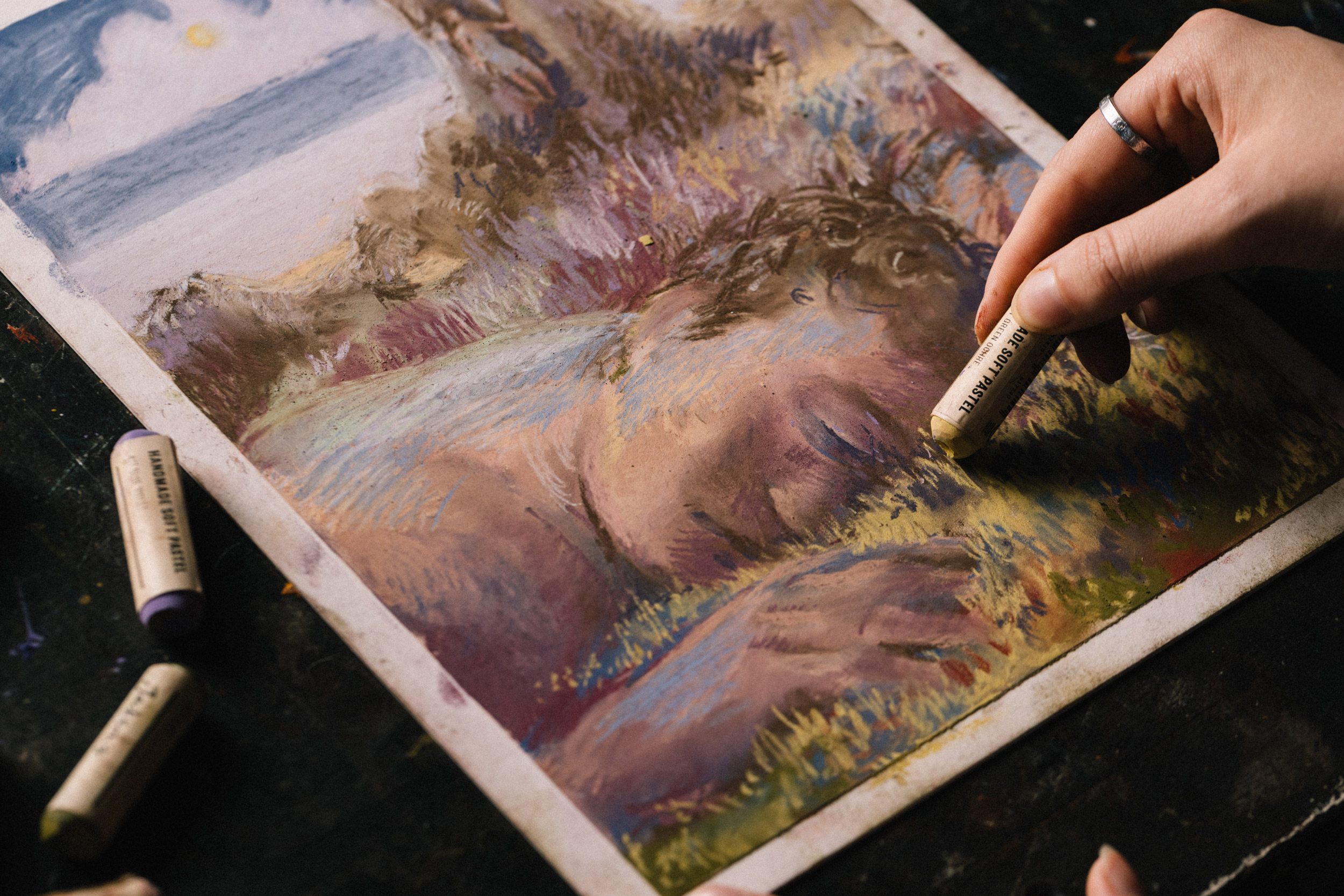
It’s impossible to demonstrate a singular ‘Symbolist drawing technique’ because the artists of the movement weren’t aesthetically or materially unified. Many of the Symbolist artists were prolific draftsmen to prepare and create their works, including Moreau, who made more than 40 preparatory works for Salomé Dancing Before Herod and left behind over 10,000 drawings. Odilon Redon was also a champion of drawing in his charcoal and lithographic works. I was inspired by his painting of The Cyclops to make a version of my own in pastel, by creating my own dream landscape and characters following the Symbolist ideology.

To begin, I collected my materials. I worked on a on a sheet of Art Spectrum Colourfix Original Pastel Paper, and drew on it with a selection of Jackson’s Handmade Soft Pastels, in Cadmium Orange, Pale Peach, Fade Cobalt Blue, Deep Wine Red, Pure Lavender, Dark Lavender Blue, Pale Cobalt Blue, Salmon Pink, Lime Green, Burnt Sienna, Dark Violet, Light Green Ochre, Burnt Carmine, Burnt Ochre, Blue Violet, Olive, and Smalt Blue White.

To begin, I lightly sketched the composition of my drawing using a blue coloured pencil, that would later be completely covered by the layers of soft pastel.

Then I methodically worked around the drawing with my selection of Jackson’s handmade soft pastels, to establish the first layer of colour.

On the second layer, I added more texture and depth of colour, by layering the pastels in hatched strokes. I picked out some detail around the Cyclops’ eye, the grass he lies in, and the blue light reflecting from his skin.

To complete my drawing, I added the nymph Galatea in the background, looking down on the Cyclops from a rocky outcrop on the beach in the distance.
Demonstration of Symbolist Painting Techniques
It’s equally as impossible to define a single Symbolist painting technique, since the majority of the artists of the movement developed individualistic painting styles. Instead, I wanted to work with one of the prevalent subjects of the Symbolist movement – the femme fatale. To do this, I created my own painting of Oedipus and the Sphinx, inspired by Gustave Moreau and Fernand Khnopff.

For my oil painting, I worked on a sheet of Arches Huile Oil Painting Paper, using a limited palette of Jackson’s Professional Oil Colours, in French Ultramarine Blue, Scarlet Lake, Yellow Ochre, Burnt Umber, and Titanium White.

To begin my painting I made a loose underpainting using my Burnt Umber, dispersed thinly with a touch of medium. I drew the characters with my brush, and blocked in the placement of a couple of areas of darker tone.

Next, I began painting my way around the composition, beginning with the Sphinx herself. Since my palette was limited, this first stage was more so a tonal study – painted in Burnt Umber, Yellow Ochre, and Titanium White.

To finish my painting, I added the jagged mountains in the background, and the startled Oedipus. Once complete, this brief work on oil paper could be used as a preliminary study for a more developed painting, or painted again with an altered composition, following Moreau’s detailed preparatory process.
Further Reading
Behind the Movement: Art Nouveau
Recreating the Colour Palette of Edvard Munch
Behind the Movement: Northern Renaissance
Soft Pastel for Beginners: What You Need to Get Started
Shop Art Supplies at jacksonsart.com