How Misinformation Makes Truth Feel Impossible

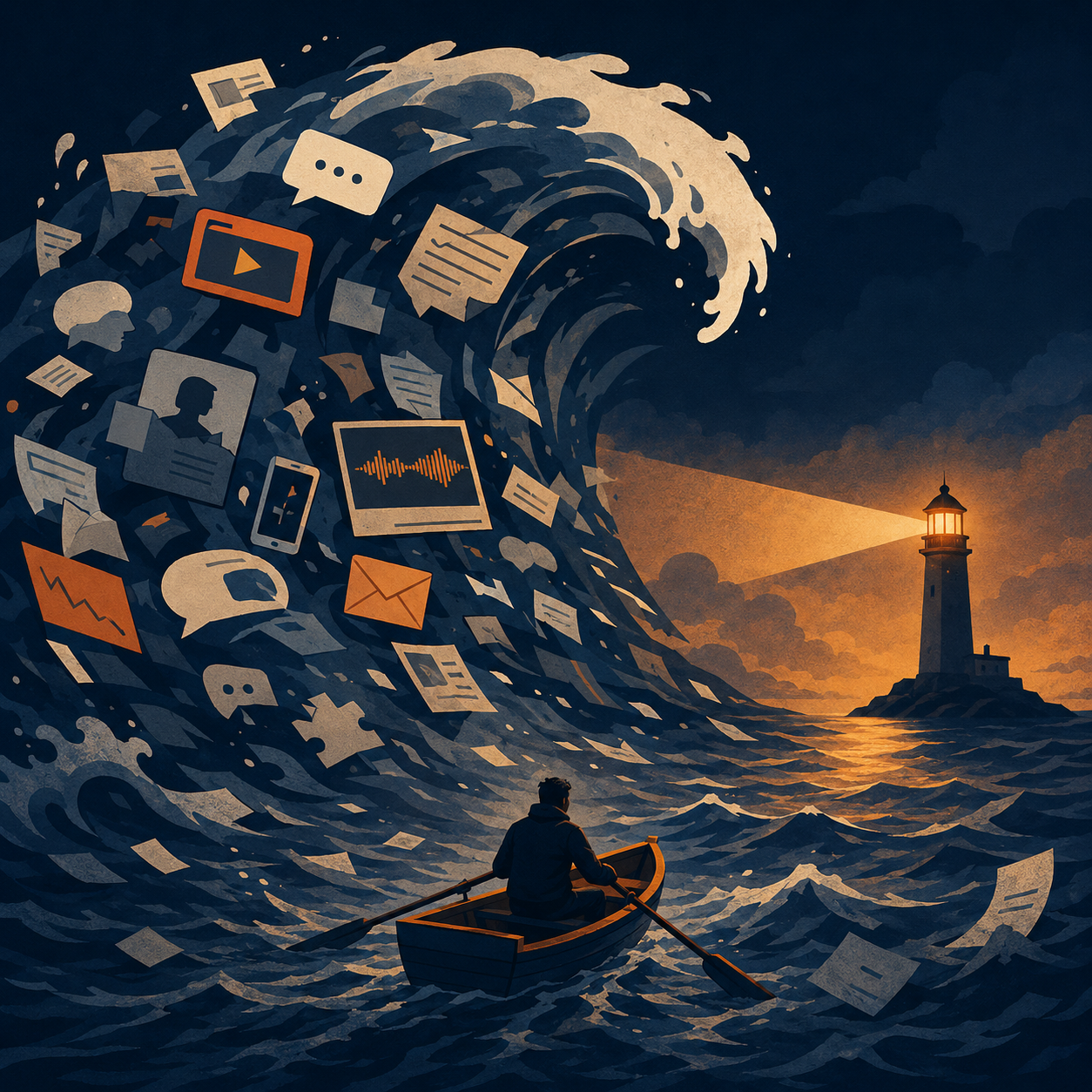
Flooding the zone isn’t about making you believe one lie. It is about overwhelming the information environment until truth itself feels impossible.
The most effective propaganda does not always tell you what to believe. Sometimes it leaves you unsure whether belief is possible at all.
A few years ago, I wrote about information pollution and how unreliable content poisons the internet as a shared resource. “Flooding the zone” is a more deliberate version of the same problem: contaminating the well until people begin to doubt that clean water exists anywhere.
A recent review in Trends in Cognitive Sciences calls attention to this broader strategy: misinformation can create epistemic overwhelm, erode shared reality, and damage our shared sense of truth even when no single false story wins out.
Saturation: Overwhelm the Mind
Flooding the zone means filling the information environment until no single story can rise above the noise. The truth doesn’t matter, just overload.
When a breaking news story first hits, claims, counterclaims, rumors, half-truths, edited clips, and endless speculation go into the pot, creating confusion.
Contradiction is not a weakness. It’s a strength. One person says the event was an accident. Another says it was planned. Someone else says it never happened. A fourth claims all the evidence was generated by AI. These stories cannot all be true, but together they can still achieve something: overwhelm and disorient you.
On social media, multiple narratives are built in parallel through influencer circles, algorithmic amplification, and targeted bot campaigns. Most of these narratives jump out in front of the facts so they can start shaping public opinion before the dust has settled. Sometimes the flood is deliberately created to obscure the truth. Other times, the incentives of the internet reproduce it automatically in the chase for likes and attention. It doesn’t matter if something is real, only if your audience wants to believe it.
Bots and generative AI take this to another level. A 2025 study analyzing Twitter conversations around major global events estimated that about 20% of the chatter came from bots. Perhaps the “Dead Internet Theory” is becoming a little more true every day. AI can generate unlimited text, images, audio, and video at low cost, then personalize those messages to appeal to different audiences.
Flattening: The Erosion of Shared Reality
The flood flattens the difference between reliable and unreliable information until everything starts to look the same.
Scientific studies become memes. News articles circulate as screenshots stripped of context. Influencers speak with the same confidence as experts. Everything becomes infotainment, with a stronger emphasis on entertainment than information.
The information pyramid is a guide for deciding what types of information deserve more weight than others. But social media compresses that pyramid into a flat feed. A scientific study, an anonymous screenshot, an influencer rant, and a meme all begin competing on the same level.
Truth, half-truth, and fiction flow through the same current until they become hard to distinguish.
That pushes competing narratives into separate silos, where each group believes its version of the truth is correct and everyone else is delusional or living in a different reality altogether.
Of course, people can disagree over values while sharing basic facts. But once each group has its own version of reality, disagreement becomes almost impossible to resolve. We are no longer arguing about what events mean. We are arguing over whether the events happened at all.
Surrender: When Truth Feels Impossible
Once you’ve been overwhelmed and disoriented, the final stage is epistemic nihilism: the belief that nothing can really be known.
You start thinking, “Everyone lies.” “Everything is propaganda.” “No one knows anything.”
This can sound like healthy skepticism at first, but it eventually becomes an excuse to stop trying to discern the truth. Skepticism searches for better evidence. Epistemic nihilism gives up on evidence entirely and asks, “Why bother?”
The result is “truth decay,” where facts and evidence matter less and every claim starts to feel like just another opinion. Trust drops across the board, including in the people and institutions we rely on for accurate information. Now it feels like there is nowhere left to turn, no reliable way to tell what’s up from what’s down.
Cynicism becomes both a symptom and a defense mechanism: people retreat into disbelief because caring, investigating, and being wrong or misled have become exhausting.
A person who believes nothing is not protected from propaganda. They are often easier to manipulate, because they have lost the standards needed to distinguish one claim from another.
Here’s how the progression plays out:
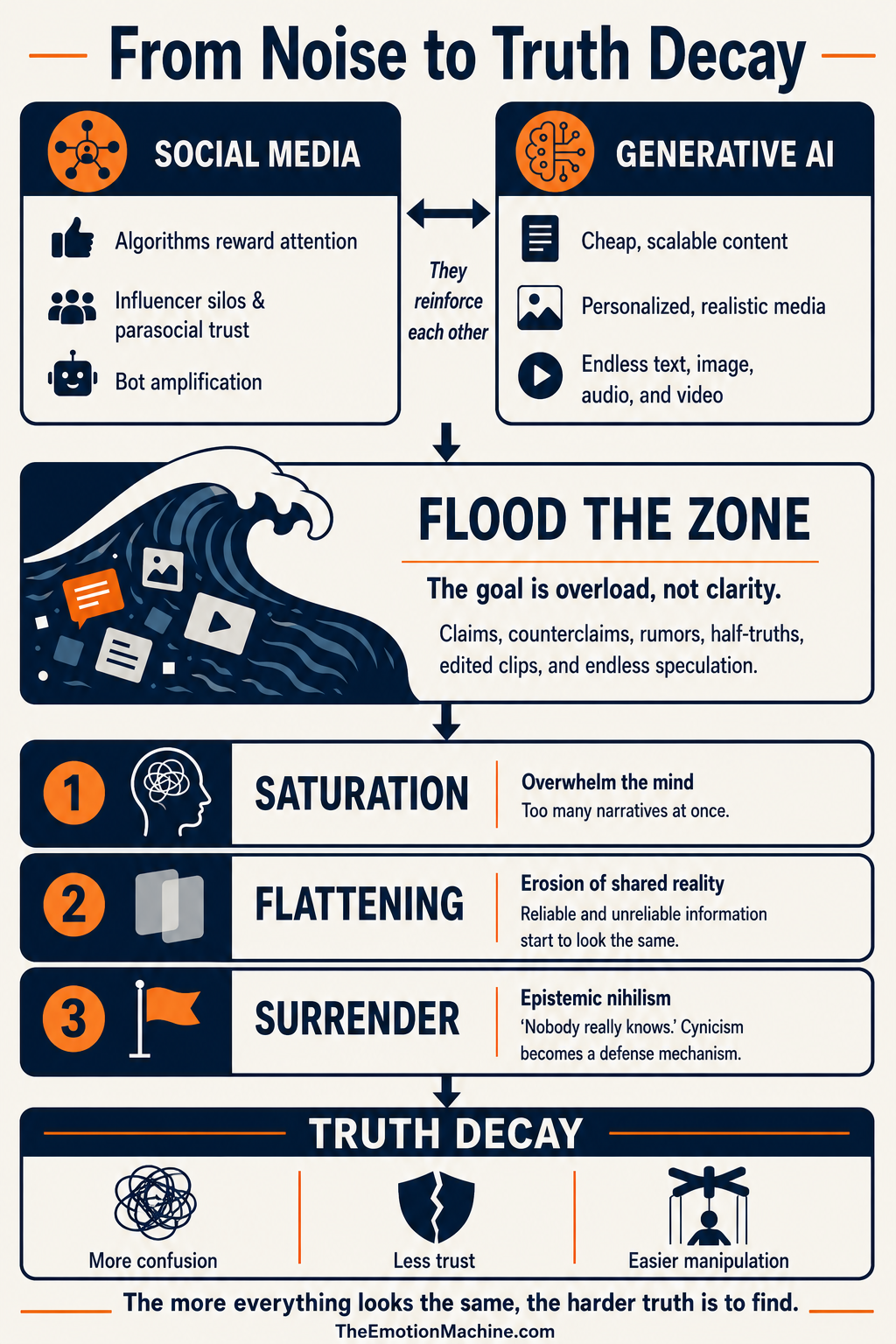
You need to monitor your information environment more carefully than ever, or chances are you’re being pulled down one rabbit hole or another. Being aware of information pollution isn’t enough. We also need to create better digital environments by keeping a close eye on our feeds and sources.
The flood does not need to convince you of one story. It only needs to make every story feel questionable.
Enter your email to stay updated on new articles in self improvement: