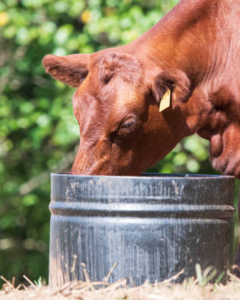
 In August, pastures can be deceiving.
You might see grass still standing and cows out grazing. From your truck, the pasture might look pretty good. But that does not mean the grass still has the nutrition your cattle need.
Protein tubs are useful if you want a low-effort way to help your cattle during tough times. You just set them out and the cattle eat them as needed, so you do not have to haul feed every day. That is important when you have fences to fix, water to check, calves to watch, hay equipment to maintain, and not enough time for everything. But remember, protein tubs are not a cure-all.
Protein tubs can be helpful, but only if they match your forage, your cattle, the season, and your budget. Not every herd needs them. Not every tub is worth the cost. And not every product called “protein” fixes the same issue.
Before you spend a lot at the feed store, take a moment to ask yourself a few things. What are your cattle missing? What does the tub actually cost? Will they eat the right amount? Do the minerals fit your needs? Can you move the tub safely? And where should you put it to help both nutrition and grazing?
Let’s go through these points together.
What Late-Summer Forage May Be Missing
Forage in August is different from what you get in the spring.
At the start of the season, grass is greener, leafier, and better quality. As summer goes on, especially in dry areas like Texas and the Southern Plains, the grass matures and gets more stemmy. Protein levels drop and it is harder to digest. Cattle might fill up, but that does not always mean they are getting what they need.
That difference matters.
A cow can eat plenty of dry, mature grass and still not get the nutrients she needs to stay in good shape, produce milk, and stay healthy. The rumen needs roughage, but it also needs enough protein and energy for the microbes to work. If the forage quality drops too much, cattle might not get enough nutrition.
This is where adding protein can help. Sometimes, extra protein helps the rumen microbes break down lower-quality grass better. That means cattle can get more out of the grass that is already in the pasture.
But protein is not always the only problem. Sometimes cattle need more energy, or there just is not enough grass. A protein tub cannot replace a full feeding program if there is not enough forage. It might help, but it cannot make grass appear where there is none.
That is why you should not start by buying a tub. First, figure out what problem you need to solve.
Do Your Cows Actually Need More Protein?
This might seem obvious, but people skip this step more often than you might think.
The best way to start is with a forage test. A forage analysis can tell you what your pasture, hay, or standing forage is providing in terms of protein, energy, fiber, and mineral content. That takes a lot of guesswork out of supplementation.
If you do not have a forage test, you can still make some useful observations. Walk your pasture and see what the cattle are actually eating, not just what is left standing. Watch their body condition, check their manure, and look at how the calves are doing. Notice if cows are grazing longer, traveling farther, or spending more time near tubs, gates, or feeding spots than usual.
Stage of production matters.
Also, consider what type of cattle you are feeding.
A dry, mature cow does not need the same nutrition as a young cow with a calf. A bred heifer has different needs than a bull recovering after breeding. A thin cow going into fall needs more help than one that is already in good shape.
A cow late in pregnancy needs more nutrients. A lactating cow needs even more. Young cows are still growing while raising a calf or staying pregnant. These cattle are more likely to need supplements when forage quality goes down.
Here is an easy way to look at it:
- What is the forage providing?
- What do the cattle need right now?
- Is there a gap between the two?
- Will a protein tub actually fill that gap?
If the answer is yes, a tub might be a good choice. If not, your money might be better spent elsewhere.
Know What That Tub Really Costs
The sticker price on a protein tub does not tell the whole story.
A $120 tub might seem expensive next to a $90 tub, but the cheaper one is not always the better deal. You need to know what you are really getting for your money.
It is better to compare the cost per pound of usable nutrient, not just the price per tub.

Doing this math helps you compare products more fairly. A heavier tub with more protein might cost more at first but less per pound of protein. A cheaper tub might not be a bargain if it has less of what your cattle need.
But do not just look at the protein percentage. Check the whole label.
Check:
- Crude protein
- Fat
- Fiber
- Salt
- Mineral levels
- Ingredients
- Expected intake
- Whether the protein source fits your forage situation
Some tubs are designed more for intake control. Some are more mineral-focused. Some include fly control products. Some are meant for low-quality forage situations. Others may not meet your herd’s needs at all.
That is why just comparing prices can be risky. The cheapest tub is not always the best deal, and the most expensive is not always the best either. The right tub is the one that fits your forage, your cattle, and your budget.
Watch Intake, Not Just the Label
A protein tub only helps if cattle eat the right amount.

The label should tell you how much cattle are expected to eat, usually in ounces per head per day. Pay attention to that number and see if your cattle are actually eating close to it.
If cattle eat too much, your daily cost per animal goes up fast. If they eat too little, the tub might not be meeting their needs.
For example, if a tub is meant for one pound per head per day but cattle eat twice that, your supplement costs double. If they barely touch it, you are not getting the results you hoped for.
This matters even more in August, since cattle behavior changes with heat and forage conditions. If grass is short or quality drops, cattle may use tubs more. If forage is still good, they might ignore them. If tubs are too close to water or shade, some cattle may stay by them while others miss out.
Do not just set tubs out and forget them.
Keep an eye on how quickly tubs are used up. Watch which cattle are using them, and make sure shy cows or younger animals are not being left out. If intake is too high or too low, talk to your feed dealer, nutritionist, or vet to see if the product is right for your herd.
Protein tubs save labor, but they still need some management.
Not All Minerals Work the Same
Many protein tubs have added minerals, which can be helpful. But the type of mineral matters.
You might see words like chelated, organic, sulfate, oxide, chloride, proteinate, or amino acid chelate on feed tags. These are not just extra words—they tell you about the mineral’s form.
Chelated minerals are bound to organic compounds or amino acids. They usually cost more, but they are often more available to the animal, especially during stress. You may see them listed as proteinates or amino acid chelates.
Non-chelated minerals are usually inorganic forms. These may be listed as oxides, sulfates, or chlorides. They are common in many feeds and supplements because they are generally less expensive. Some forms are absorbed more readily than others, and availability can depend on the mineral and the animal’s condition.
Here is the simple version:
- Chelated minerals usually cost more but may be better absorbed.
- Non-chelated minerals usually cost less but may not be used as efficiently in some conditions.
Does every ranch need a tub full of chelated minerals? Not always.
But if your cattle are stressed by heat, poor forage, breeding, weaning, transport, or disease, mineral availability matters more. In those cases, it is worth looking closely at the mineral mix.
For reproductive cattle, minerals like copper, zinc, selenium, and phosphorus can all play important roles in health and performance. Deficiencies may not show up overnight, but they can quietly affect immunity, reproduction, and calf growth.
The best plan is to match your mineral program to your area. Soil, forage, and water conditions are different everywhere. Some places have things that block mineral absorption, and some regions are known for certain deficiencies.
Need Fly Control? Check for IGR
Some protein tubs have IGR, which means insect growth regulator.
IGR does not kill adult flies. It passes through the animal and ends up in the manure. Since horn flies and other pests breed in manure, IGR helps stop fly larvae from turning into adult flies.
This can help, especially when you also use other fly-control methods like fly tags, back rubbers, sprays, traps, or keeping pastures clean.
But timing is important.
For best results, IGR needs to be fed before fly pressure gets heavy. A common recommendation is to begin feeding it about 30 days before flies emerge and continue through fly season. In many parts of Texas, that means starting in early spring when temperatures begin to warm.
That does not mean it is useless late in the season. It can still help reduce future flies if cattle eat it regularly, but it should be part of a bigger fly control plan.
Also, IGR only works if cattle eat the tub at the right rate. If intake is uneven, fly control will be uneven too.
Pick a Tub You Can Actually Use
The cheapest tub is not always the best choice for your ranch. If you cannot move it safely, it is not the right size for you.
Protein tubs come in many sizes, from about 40 pounds up to 250 pounds or more. Bigger tubs might be cheaper per pound, but they only make sense if you have the equipment to move them.
A 250-pound tub is fine if you have a tractor, skid steer, loader, or another safe way to move it. It is not a good idea to try to lift it out of your truck by hand.
Before buying, ask:
- How many heads will use the tub?
- Are you feeding cows, calves, bulls, or replacement heifers?
- What is the expected intake per head per day?
- How long should the tub last?
- How often do you want to replace tubs?
- Can you move that size safely?
- Can you get it where it needs to go in the pasture?
A common starting point is one tub for every 25 head, but this depends on the tub size, product, intake rate, and how your cattle act. Always check the label and adjust as needed. If cattle are crowding the tub, you may need more tubs or better spacing between them. If one boss cow camps on it and keeps others away, placement may need to change. If the tub disappears much faster than expected, intake may be too high, or cattle may be short on something else.
Make sure the tub helps you, not causes more problems.
It is fine to use smaller tubs if that works better for your equipment and labor. Saving a few dollars per pound is not worth it if you get hurt moving a heavy tub.
Use Placement to Improve Grazing Distribution
One benefit of protein tubs that people often overlook is where you put them.
Cattle are creatures of habit. They stick to certain trails, shady spots, water sources, and grazing areas. Over time, they might overgraze some parts of the pasture and leave other areas alone.
Protein tubs can help change these grazing patterns.
If you put a tub in a corner of the pasture that cattle usually ignore, you might get them to use grass they have skipped all summer. Place tubs away from overused water spots to take pressure off those areas. Move tubs as grazing changes to help cattle spread out more evenly.
This does not mean you should put tubs in the roughest or most inconvenient spot and expect cattle to use them. The spot still needs to be safe and practical.
Avoid placing tubs:
- In muddy areas
- On steep slopes
- Too far from water
- Where cattle may get trapped or crowded
- In spots you cannot check easily
- Where delivery or replacement becomes a headache
Good placement should help both the pasture and the cattle. It should encourage better grazing without making the animals work too hard.
Also, think about your own workload. If you have to deal with brush, mud, gullies, or bad gates every time you check the tub, you will get tired of it quickly. Put tubs where they help grazing but are still easy to manage.
Placing tubs strategically is one reason they are more than just a supplement—they can also help you manage grazing.
Protein Tubs May Make Sense If…
Protein tubs are not always the answer, but they can work well when the conditions are right.
They may make sense if:
- Late-summer forage quality is dropping.
- Cows are starting to lose body condition.
- Labor is limited
- Cattle are spread across rough or large pastures.
- You need a low-maintenance supplement.
- You want to encourage better pasture use.
- You can track intake and adjust if needed.
- The tub matches the actual nutrient gap.
They may not make sense if:
- Forage quality is already meeting cattle needs.
- Cattle need more energy than protein.
- The forage quantity is too short for the tubs to help much.
- Intake cannot be controlled.
- The product does not fit your cattle class.
- You cannot move or place tubs safely.
- The cost does not pencil out.
That last point is important. A protein tub should help your ranch, not just add another expense.
If the tub helps your cattle maintain condition, use forage better, save you labor, and prevent bigger problems, it could be worth the money. But if you are only buying it because your neighbor did, take a step back and ask more questions first.