
How has the cultural role of magazines changed in a digital world?
Magazines today fulfil a very different role to the one they’ve done in the past. Today they are cultural artefacts. They retain something they’ve always had, which is that they record the time in which they were published. They’ve lost that surface-level information and entertainment role and are now proper cultural artefacts. They record their time and delve into what people think and what people are experiencing around the subjects at hand, rather than simply giving basic information.
You described magazines as recording their time. What do you mean by that?
A magazine is a great time capsule of the era in which it was produced. Obviously, in terms of the movies that might be on the front cover, they record the time in which they were made. But they also record it through the illustration, the typography, the design and the visual style. All these different elements come together. Although making a magazine is a far slower process than much of our media today, there’s still a speed to it, which means that the production process picks up quirks and design trends. It presents things almost unconsciously from the people making it. When you look at something 10 or 20 years later, it’s a record of 2026.
What can people get from a print magazine that they can’t get online?
It’s not a matter of denying the role and importance of digital channels, but magazines are an oasis outside of that. They provide a more mediated, more considered, more edited set of proposals and ideas that have a beginning, middle and end. That offers something different to our digital world.
What difference does it make to sell magazines in a retail environment like Selfridges?
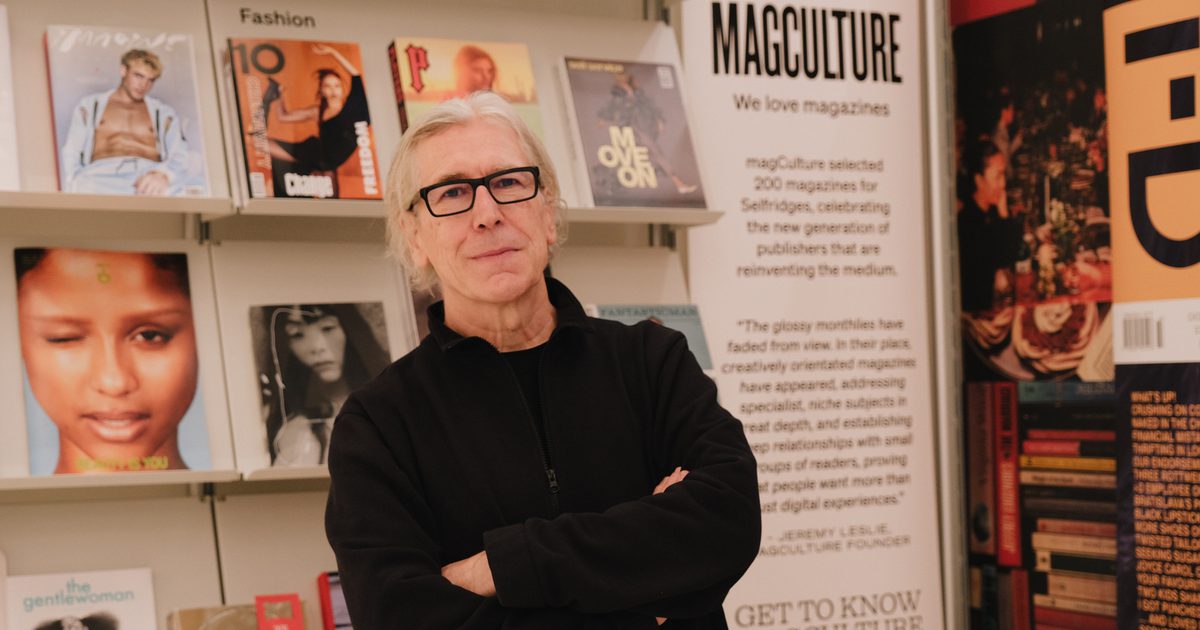
Our magCulture shop has now been around for 10 years, and it’s established itself as having a role within publishing. It’s become a destination for people who love magazines and love print, and that’s great. But it’s so important to reach beyond what can sometimes be quite a specific bubble. Selfridges is in a different part of town. It occupies a unique space between the tourists and visitors to London on Oxford Street, while just behind it is Marylebone, with lots of smaller independent brands. Together they present a really exciting opportunity to introduce the magazines we celebrate to a completely new audience.
Why is it important for people to support independent magazine shops?
People talk about globalism being over, but clearly it isn’t. Look at our high streets. The end of globalism hasn’t quite happened. Our high streets are either dominated by international brands or they’re empty. I think it’s more important than ever to support independent shops. Independent media and independent magazine shops need that support in order to keep those vital independent voices out there. Yes, they’re speaking to the converted, but they’re also hopefully bringing in new people who don’t yet know about these voices.
Do you think magazines offer an alternative to algorithm-driven culture?
The promise of the internet and all our digital channels, apps and social media was that it would open up and free the world. I think, increasingly, the algorithms that power all those channels are actually closing down our world. The idea that information was free and open to everyone has largely been stamped on by the internet giants, and now it’s a matter of algorithms dictating what we do and don’t see. That’s hugely frustrating.
I think it’s really important that we have forms of media that are free to publish what they want to publish and get it in front of people who might be interested in it, rather than being dictated by some kind of artificial intelligence that’s simply feeding you the same things again and again. Of course, there are elements online that need to be censored – we can have that argument – but there’s also a lot that should simply be shared, and it isn’t.
Magazines, in that respect, are far more open. They operate according to long-standing editorial rules about what’s acceptable and what’s not, and they’re able to present work that would very quickly be censored or closed down online. I think magazines have a fantastic role in doing exactly what they’ve always been good at and exactly what they’ve always done.