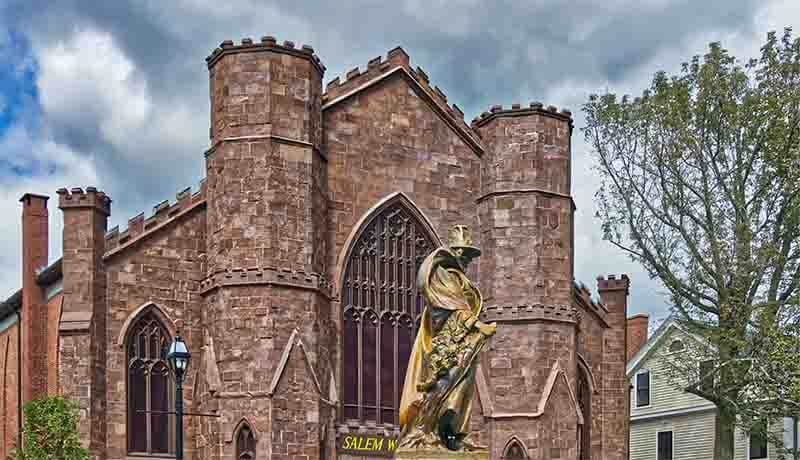

Photo by Pascal Bernardon on Unsplash
Salem hanged nineteen innocent people in 1692 for the crime of witchcraft. Not a single one of them was a witch. Three centuries on, the women that town tried to erase have become the reason the world keeps coming back.
Most people outside America picture fire when they imagine Salem, Massachusetts. Stakes, smoke, a crowd watching women burn alive. They are wrong on every count… but the real story is uglier than the myth.
Not one of the nineteen people executed during the trials in Salem in 1692 was burned. One man, Giles Corey, refused to enter a plea and was pressed beneath stones until he suffocated, the only person in American history to die that way for refusing to play along with a witch trial. Several more died chained in jail before they ever reached a courtroom. And of all of them, not a single one had practised witchcraft. There was no coven, no spellbook and no pact signed in blood.
What there was were teenage girls having fits nobody in a Puritan village could explain, a town already strung tight with smallpox, border war and the conviction that the devil walked among them, and a court willing to convict on something called spectral evidence, meaning a dream or a vision counted as proof. Imagine being hanged because a neighbour claimed your ghost pinched her in her sleep. Salem’s courts did exactly that and called it justice. Hysteria did the killing. Magic had nothing to do with it.
One of the accused wasn’t even old enough to understand what was happening to her. Dorothy Good was just four years old when magistrates examined her, extracted a confession from the frightened and confused child and had her chained in a Boston jail.
Her confession was its own small horror. Under questioning, Dorothy said a snake had bitten her and left a mark and that the snake belonged to her mother. A four-year-old had just told the court her own mother kept a familiar that fed on her blood. The magistrates wrote it down as evidence.
Nobody even bothered to get her name right. Court papers repeatedly call her Dorcas instead of Dorothy, an error that stuck for centuries. That single careless detail tells you exactly how seriously this four-year-old girl was taken by the grown men deciding whether she lived or died. There was no separate accommodation for a child in a Massachusetts jail in 1692, so Dorothy was shackled the same way an adult prisoner would be, in a cell built for adults, through a New England winter. While Dorothy would survive her ordeal, she spent the better part of eight months in that cell and was still locked up when her mother, Sarah Good, was hanged.
Witch was always code for woman
Look closely at the people who were accused, and the pattern is hard to miss. Fourteen of the nineteen hanged were women, and most of the men swept up alongside them were married to, related to, or defending the accused.
Rebecca Nurse was 71, devout and well liked in the village, but it didn’t save her.
Bridget Bishop was around sixty, married four times, and ran a tavern where she let young men drink and play shuffleboard past dark, dressed in a red bodice the town considered scandalous on a woman her age. She’d already survived one witchcraft accusation twelve years earlier and had been acquitted. The second one didn’t let her go. More witnesses testified against her than against anyone else in the entire panic, including a man who swore under oath that she’d visited him in the night wearing that same red bodice and sat on his chest until he couldn’t breathe, a nightmare the court accepted as evidence. She was the first to hang on June 10, 1692.
Another of the accused was Sarah Good. Poor, homeless and sharp-tongued when she begged for charity, these traits made her an easy target before they made her and her own daughter victims of the trials.
None of this was incidental. Age in a woman read as evidence. Independence read as evidence. Grief, sexuality, poverty, a sharp tongue and a too-comfortable claim on land or money a man wanted, all read as evidence in a way none of it ever did for a man standing in the same room. The crime was never witchcraft. The crime was being a woman who’d stopped making herself smaller to keep the peace.
Salem wasn’t unique in this, just unusually well remembered. Across three centuries of witch panics that swept Europe before America was even a colony, historians estimate somewhere between forty and sixty thousand people were killed for witchcraft. The overwhelming majority of them women. Widows. Midwives. Women who owned land a man wanted or who simply refused to shrink to the shape their era demanded. Salem was a late, small chapter in something far larger and far bloodier. It’s the one the world remembers anyway, probably because America likes to imagine its founding story started clean and Salem is the stain it has never managed to write out.
Remembering the accused
The Salem Witch Trials Memorial sits right alongside the Old Burying Point Cemetery. Standing inside it, fresh off the train from Boston, I could feel exactly how deliberately the whole space had been built to make you feel something. Chosen from 246 international entries for the trials’ three hundredth anniversary in 1992, every part of it is doing work. You cross a stone threshold carved with the accused’s own protests of innocence, lifted straight from the court transcripts… the words sliced off mid-sentence by the wall itself.
‘God knows I am innocent,’ reads one. And then nothing… The cut-off isn’t a flaw in the stonework. It’s the point. Nobody finished listening to these people the first time either.
I read every name because they deserve to be more than a body count.
Bridget Bishop. George Burroughs. Martha Carrier. Martha Corey. Giles Corey. Mary Easty. Sarah Good. Elizabeth Howe. George Jacobs Sr. Susannah Martin. Rebecca Nurse. Alice Parker. Mary Parker. John Proctor. Ann Pudeator. Wilmot Redd. Margaret Scott. Samuel Wardwell. Sarah Wildes. John Willard.
Inside the memorial, twenty granite benches jut out from a low stone wall, one for each of them, each etched with a single name, a method of execution and a date. Locust trees, the same kind believed to have been used for the hangings, are planted around the space. They are the last trees in Salem to flower each spring and the first to lose their leaves. Behind the wall, the headstones of the old cemetery face inward, like witnesses who watched it happen and said nothing at the time.
Elie Wiesel, a Holocaust survivor and Nobel laureate, dedicated the memorial in 1992. One line from his address has stayed with me since I first read it on a plaque there. “We still have our Salems,” he said.
I’m not easily rattled, and I’ve stood in my share of places built to hold grief, but running a finger along Sarah Good’s bench, already knowing her four-year-old was locked in a cell somewhere nearby while this was happening, hits differently when you’re a woman and a mother yourself. It stops being history and starts to feel like a warning, addressed directly to you.
It took 329 years to properly say sorry
Massachusetts moved reasonably fast to admit it had been wrong by the standards of the era. Convictions were reversed, and a handful of families were compensated within twenty years. But clearing every name took centuries longer than the killing did. A formal apology arrived in 1957. But five victims, including Bridget Bishop, weren’t legally cleared until 2001.
The last name on the list belonged to Elizabeth Johnson Jr, who was just 22 years old when she was convicted in 1693. She was never executed, but she was never pardoned either and her name sat on the books as a legally convicted witch for the next 329 years. Nobody got around to fixing it until a class of eighth-grade civics students in nearby Andover found her case, wrote the bill themselves and talked a state senator into attaching it to a budget bill. Massachusetts finally cleared her name in 2022.
A room full of teenage girls did what three centuries of adults hadn’t bothered to finish.
The witch who built the Salem brand
Modern Salem’s entire witch economy traces back to one woman who decided the label was worth keeping. Laurie Cabot moved to Salem in 1970 and opened the town’s first witch shop at a time when openly practising Wicca could cost a woman her job, her marriage or custody of her children.
That wasn’t paranoia. As recently as the early 2000s, an Indiana court ordered a Wiccan father to keep his young son away from his own religious beliefs and rituals, ruling them too “non-mainstream” to be safely passed on, and it took a civil liberties lawsuit to get the order overturned. That was not 1692. That was just two decades ago.
Despite the risk, Cabot did it anyway, in black robes and kohl eyeliner, on streets where women had been hanged for less. In 1977, then-governor Michael Dukakis named her the Official Witch of Salem, technically in recognition of her work with children with learning difficulties, and in doing so, handed an entire town its founding myth twice over.
Every tarot reader, candle shop and guided witch walk on Essex Street today exists because one woman refused to whisper a word her town had once used to kill people who looked like her.
Walk into stores like Hauswitch or Crow Haven Corner now, both run by women who treat the craft as something real rather than costume, and the sincerity catches you off guard. I sat for an aura reading at Hauswitch that left me shaken by its spot-on accuracy. Crow Haven Corner, a few doors down, is the same shop Cabot opened, though she renamed when she moved it from Derby Street to Essex Street a year after that first opening. It’s been in someone else’s hands for the last couple of decades, but it’s the place I went from a reformed sceptic to willing participant in a guided witch circle dance before I’d properly clocked what I’d agreed to.
Further along Essex Street, a nine-foot bronze statue of Bewitched’s Samantha grins from Lappin Park, a few minutes’ walk from the Witch Trials Memorial. When the statue went up in 2005, some Salem residents objected to exactly that, a fictional, friendly witch standing this close to where real ones were killed for nothing. Somehow it isn’t grotesque, not to me anyway. I can’t help but smile every time I pass it.
Reclaiming the word witch
None of this makes Salem comfortable, and it shouldn’t. The instinct that turned fear of an unconventional woman into a capital charge in 1692 hasn’t disappeared; it has only changed its paperwork. In 2022, the same year Massachusetts finally got around to clearing Elizabeth Johnson Jr’s name, the United States Supreme Court overturned Roe v. Wade, and several states moved, within months, to criminalise abortion. Almost all of those laws claims an exception to save the mother’s life. But it only applies once it’s almost, and in several cases actually, too late. Three hundred and thirty years apart, and the gap between then and now is smaller than anyone buying a broomstick keyring on Essex Street would like to admit.
The instrument has changed. The target hasn’t.
What Salem has done, deliberately or not, is refuse to let the word that condemned those women go on meaning what its accusers intended. It didn’t get over what it did to those nineteen people. It decided that if the word ‘witch’ was always going to follow them through history, they may as well be the ones who get to decide what it means.
I love this strange, sincere, slightly absurd little city more than almost anywhere else I’ve been, and that affection is tangled up with everything above, not separate from it. Salem doesn’t let you have the tarot readings and the candle shops without the memorial three minutes down the road. It refuses to let you pretend any of this is finished business.
Most places want to be remembered fondly. Salem wants to be remembered accurately, even if that costs visitors a little comfort.
For more Massachusetts inspiration, tips and travel guides, try these…
The Ultimate Boston Travel Guide
A love letter to Boston
The Isabella Stewart Gardner Museum – The greatest gallery you’ve never heard of
The Lenox Hotel Boston
How to spend 48 hours in Salem, Massachusetts
 An award-winning travel writer and photographer, Aleney de Winter was fresh from school when she first set off to explore the far reaches of Australia with a two-man tent and a beaten-up Kingswood for company. Three decades, and two kids later, and she’s still on the go, with her itchy-footed offspring in tow.