Black man found hanging from tree near Raleigh’s Caribbean Fest

Discovery of Deceased Individual Amid Downtown Event Sparks Community Concern
A man was found hanging from a tree in downtown Raleigh this afternoon (August 15), near the site of the annual CaribMask Carnival. The discovery, made in the back parking lot of Whiskey Kitchen on West Martin Street, has sparked widespread concern and calls for answers as the Raleigh Police Department continues its investigation.
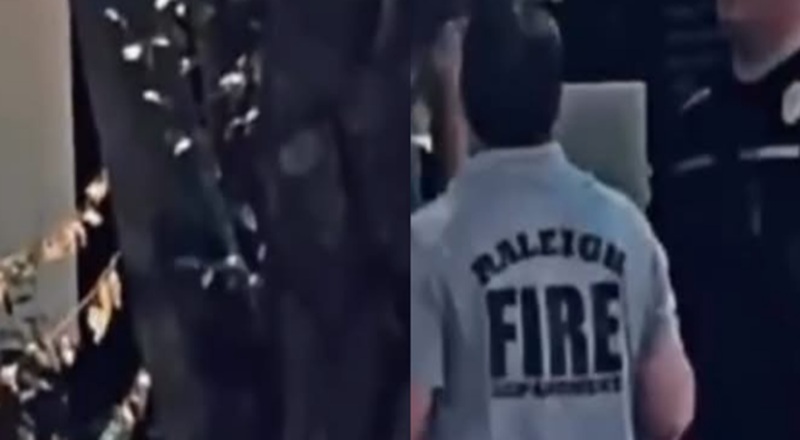
The location sits approximately two blocks from City Plaza, where the Caribbean festival was underway. A photograph circulating on social media shows the man hanging from a tree with a Raleigh Fire Department crew member visible nearby. No official statement has been released by police as of Saturday evening. The man’s identity, age, and cause of death remain unknown.
A Festival Day Interrupted by Tragedy
The 13th Annual CaribMask Carnival, organized by the Raleigh-Durham AfroCaribbean Association, had drawn hundreds of attendees to downtown Raleigh on Saturday. The free event featured a Parade of Bands starting at 11:00 a.m. along a route that included Salisbury Street and Davie Street. It was followed by a Festival Village at City Plaza continuing until about 8:00 p.m. Activities included traditional Caribbean cuisine vendors, arts and crafts, live entertainment, and a flag ceremony representing more than 15 countries.
At 2:30 p.m., a Black man was found in the back parking lot area of Whiskey Kitchen on West Martin Street, a location not far from the festival grounds. A woman who works nearby informed The NC Beat of the discovery. An anonymous source reported that the man had been observed earlier in the day walking and talking to himself. A festival-goer on Martin Street stated that the man approached them and asked for water before continuing onward. After that, workers later checked the back lot and found him hanging from a tree.
The man’s identity has not been released. His precise age, cause of death, and the manner of death—whether suicide, accident, homicide, or undetermined—remain unknown. The Raleigh Police Department had not issued a public statement as of Saturday evening. The NC Beat contacted the department at 4:46 p.m. seeking comment and had received no response by the time of its publication.
The Photo That Spread Across Social Media
The Facebook post circulating attributed the discovery to “جميلة القحارة.” It included a photograph of the scene with Raleigh Fire Department personnel visible. The post described the discovery as “crap” and called for protective vigilance: “protect your sons protect your children this is not a […] joke or a game not AI.”
The post emphasized the presence of children downtown for the Caribbean Festival and expressed frustration at the situation. An overlaid caption on the photograph read: “They Hung A Black boy at Carribean Fest yall please be safe and stay vigilant.”
The post rejected any interpretation of the content as fabricated, humorous, or artificially generated. It pointed to the visible presence of Raleigh Fire Department personnel in the photograph as corroboration. In addition, the woman who posted it described a personal physical reaction of nausea. Her post offered prayers for the family of the deceased. Also, the post asserted that the situation was wrong regardless of any alternative explanation.
The post pointed to the visible presence of Raleigh Fire Department personnel in the photograph as confirmation: “YOU SEE RALEIGH FIRE DEPARTMENT it made me sick to my stomach 💯 Prayers for the family experiencing this lost.” It urged others to view the image for themselves: “IM NOT ADDING NOBODY SEE IT HOW YOU DO ❤️ […] NOT RIGHT EITHER WAY KIDS WAS DOWNTOWN FOR CARIBBEAN FESTIVAL SOMETHING AINT TF RIGHT.”
The post asserted that the matter was not fabricated, humorous, or artificially generated. It offered prayers for the family of the deceased and linked the discovery to the presence of children at the Caribbean Festival.
The Fire Department’s Presence at the Scene
Raleigh Fire Department personnel responded to the scene. The photograph shows a shirtless individual positioned near a tree trunk outdoors, with ground debris visible. A person in a light-gray shirt bearing “RALEIGH FIRE” on the back is visible. He was wearing a harness and blue gloves, oriented toward the tree. A second person in dark clothing and helmet appears partially at the edge of the frame.
Emergency personnel routinely respond to medical, rescue, and death-scene calls alongside police and EMS. The visible presence of firefighters at the scene is consistent with standard emergency response to such incidents. Their presence does not indicate any specific cause or manner of death.
The Raleigh Police Department had not issued a public statement as of press time. The story is still developing.
A Pattern of Concern Over Hanging Deaths
The discovery occurred against a backdrop of heightened sensitivity surrounding deaths of Black individuals by hanging. In recent years, multiple cases across the country have drawn community scrutiny and calls for investigation. In several instances, families and advocates have disputed preliminary official characterizations of suicide or absence of foul play.
These cases include the 2024 death of 21-year-old Javion Magee in Vance County, North Carolina, 40 miles from Raleigh. After that, there was the 2025 death of Demartravion “Trey” Reed at Delta State University in Mississippi. Next, there was the February 2026 death of 21-year-old Kyle Bassinga in Marietta, Georgia. Subsequently, there was May 2026 death of 16-year-old Juliana Nzita in Charlotte, North Carolina. More recently, there was the June 2026 death of 36-year-old Cedric Tayuhe in Harrisburg, North Carolina. All of these situations have drawn attention.
In each case, families, community members, and advocates have raised questions about the circumstances of the deaths and the adequacy of official investigations. They have cited historical associations of hanging with racial violence and lynching. Official responses have typically included medical-examiner reviews, statements noting absence of defensive wounds or signs of assault in some instances, and ongoing investigations.
The Historical Shadow of Lynching
North Carolina has a documented historical record of lynchings of Black individuals in earlier decades. The state was among those with the highest numbers of documented racial terror lynchings in the post-Reconstruction era. The legacy of that history continues to shape community responses to deaths by hanging.
A local historical parallel is the case of Lynn Council, who in the 1950s was hanged from a tree by Wake County deputies attempting to coerce a confession. He survived, later received public apologies, and died in August 2026 at age 93. His case is one of the few documented instances of official misconduct involving hanging in the area.
The explicit framing of the Raleigh discovery as a hanging of a “Black boy” at a Caribbean cultural festival activates community concerns about safety, potential racial motivation, and the adequacy of official response. Because the discovery took place during a large public cultural event attended by families and children, the spatial and temporal proximity amplifies perceptions of threat.
Conclusion
The man’s identity has not been released. His precise age, cause of death, and manner of death remain unknown. The Raleigh Police Department has not issued a public statement.
In prior similar cases, delayed or limited official statements have coincided with online narratives emphasizing cover-ups or historical parallels, which can escalate public distrust. Once official findings—autopsy, toxicology, scene analysis, witness statements, and any available surveillance—become available, they may corroborate foul play, support an alternative determination such as suicide, or leave the manner of death undetermined.
Each outcome carries distinct implications for community confidence, the family of the deceased, and broader public discourse. The gap between social media assertions and verified institutional information remains significant. The story remains developing.