An Indian CEO to lead major Indian carrier will need a drastic change in mindset at HR and Founder level

Within the space of a few weeks, India’s two largest airlines have handed their top job to a foreigner. IndiGo has brought in Willie Walsh, fresh off his stint as Director General of IATA, to run the airline. Air India has appointed Tewolde Gebremariam, who spent 37 years at Ethiopian Airlines and over a decade as its Group CEO, to take over from Campbell Wilson. Two airlines that between them carry the overwhelming majority of Indian domestic passengers, and their announcements opened up the old debate if they could ever find the next CEO within their own ranks or within the wider Indian aviation talent pool.
IndiGo and Air India had some parallels last time around as well. Campbell Wilson’s appointment was announced on May 12, 2022, while Pieter Elber’s appointment was announced on May 18, 2022. Elbers joined in September that year, while Campbel joined in the last week of July. Pieter Elbers left suddenly in March 2026, while the announcement of Campbell’s early departure was made in the first week of April this year.
This debate of Indians at the helm of an Indian carrier is not new. Every now and then when it’s time to appoint a CEO at one of the two large Indian carriers, this debate comes up backed by the usual argument that Indians or people of Indian origin are leading tech companies worldwide but we don’t see Indians leading Indian carriers. In a recent interview to Economic Times, IndiGo’s co-founder Rahul Bhatia was asked about this and he said that “there will be individuals who come out and lead Indian airlines”. The full link to that article is available here. In 2018, Rahul Bhatia had said the same about hiring expats for leading Network Planning teams. Subsequently, today the network planning team is led by an Indian.
The government owned Air India (and Air India Express) had Indians leading the airlines and in fact some of the expat appointments did not go down well. Star Air, the longest serving regional carrier in India, has an Indian as CEO who in fact is a pilot himself. Yet, there is no denying the fact that IndiGo (and later Air India) has had expats man the corner office.
The career maps that got them there
Walsh’s journey started as a cadet pilot at Aer Lingus in 1979. He flew the line, made captain on the Boeing 737, and only then moved into management — running Aer Lingus’s charter subsidiary Futura, then becoming COO and eventually CEO of Aer Lingus itself. From there it was British Airways, then IAG, then IATA. At every step, the job changed shape. He went from the cockpit to commercial strategy to running a multi-airline group to representing the entire global industry as a regulator-facing body. Each role forced him to see the business from a completely different vantage point before he ran the whole thing.
Tewolde’s path reads similarly, just in a different geography. He joined Ethiopian Airlines in 1985 as a transportation agent, rose through cargo traffic handling, and then moved into area management roles in India, Saudi Arabia, and North America — genuinely different markets with different customer behaviour and different regulatory regimes. In 2004 he was made Executive Officer of Marketing & Sales. Two years later, COO, running commercial, flight operations, customer service, and engineering all at once. Only after that layered exposure did he become Group CEO in 2011, a role he held for eleven years while growing Ethiopian’s revenue fourfold and its fleet threefold.
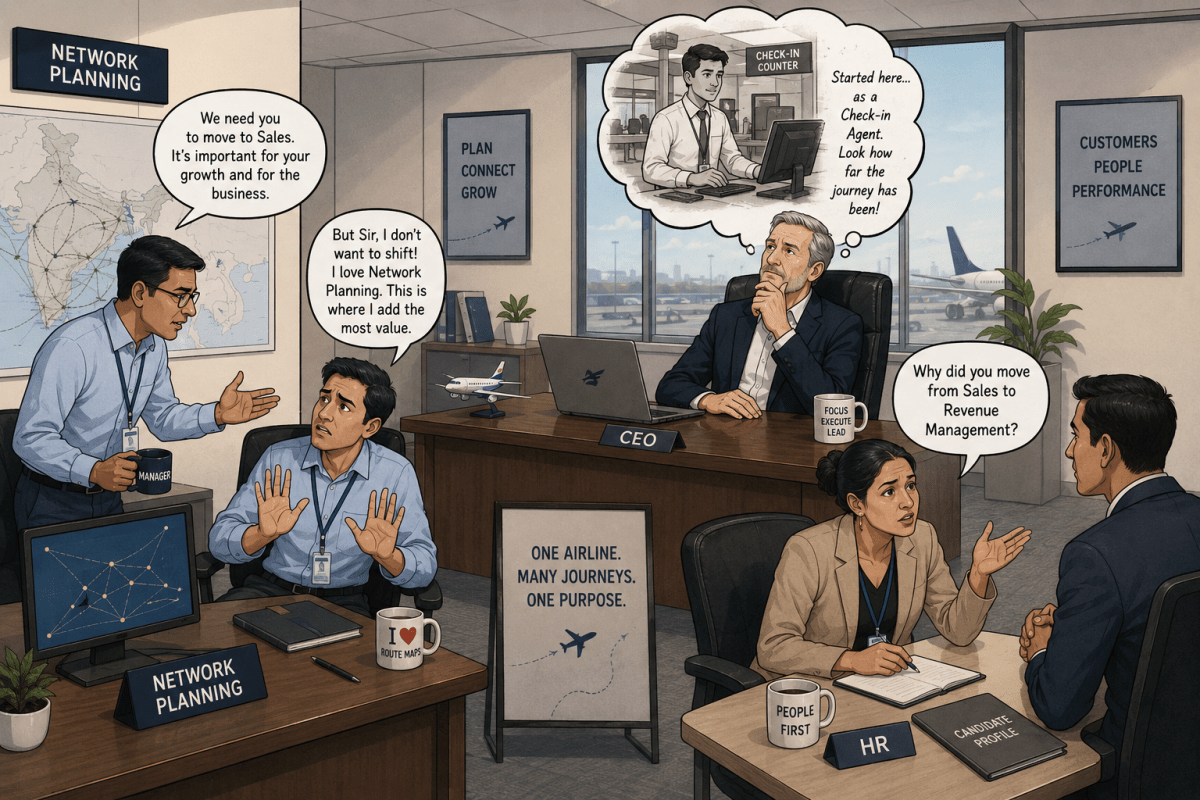
Neither man stayed in one department and waited for the rung above to open up. Both were deliberately, or circumstantially, moved sideways — cargo to sales, sales to operations, single-country to multi-market — long before anyone was thinking about handing them a CEO’s chair. This is exactly where Indian aviation has a challenge. It may not be aviation centric, but more of a Human Resource and culture centric. In my years with the airlines’ and later years following them closely, I have rarely (if at all) seen lateral shifts, at the same or a level below across departments. A person who joins in the airports team has grown to be Airport Manager, Regional Airports head and eventually Head of Airports at Corporate office, but has not moved to say Sales. Likewise, shifts from Network Planning or Revenue Management to sales or vice versa have been entirely absent or rare exceptions. At this stage, I am not even talking about areas like Finance or Engineering which require specialised skills and in some cases licensing as well.
Why Indian carriers rarely produce this profile
Indian aviation has grown at a pace few other markets have matched, but the career structures inside its airlines have stayed remarkably rigid. Someone who joins commercial planning typically stays in commercial planning. Someone in ground handling or airport operations climbs that ladder alone. Cargo, revenue management, network planning, and cabin services all function as separate tracks with their own hierarchies, and lateral movement between them is the exception rather than the norm. Seniority within a function is prized far more than breadth across functions, and that preference shapes who gets promoted. As a person grows in Indian aviation, the portfolio increases with departments considered similar to core competencies. Sales gets clubbed with marketing, Network Planning gets clubbed with Revenue Management and Distribution, and so on.
There also is a cultural challenge, where an individual is not keen to shift departments because that may jeopardise the career and possibility of jumping to another company since this move will be questioned while recruiting or the ability to come back to the original department (or core skill) could be lost.
This isn’t unique to airlines — it mirrors a broader pattern across Indian corporate structures, where specialisation is rewarded early and department heads guard their teams rather than rotate talent out. But airlines are unusually cross-functional businesses. A CEO has to understand fuel hedging, slot economics, crew rostering, MRO contracts, and loyalty programme design more or less simultaneously. If nobody inside the organisation has touched more than one of these areas, the pool of people who can credibly run the whole airline shrinks to almost nobody and then we look for people who have all round experience which we more often than not find in expats.
What this actually costs an airline
The immediate cost is visible in exactly what’s happened this year — two marquee Indian carriers going outside the country, and outside their own leadership pipelines, for a CEO. That’s an expensive admission. Search costs aside, an external CEO takes longer to understand local operating quirks, airport politics, and regulatory relationships that an internal candidate would have absorbed simply by having worked adjacent to them for years.
The less visible cost is what happens two or three levels below the CEO. When lateral movement isn’t encouraged, an airline ends up with excellent functional specialists — someone who genuinely knows revenue management inside out, or can sell like a miracle, or is superb at ground operations — but very few people who have run more than one piece of the business. That’s precisely the profile boards look for when a CEO search comes up short internally, and it’s precisely the profile Indian carriers have struggled to build in-house.
Tail Note
I’ve worked at two Indian carriers — one full-service, one low-cost — and the pattern held at both, despite them being very different businesses with very different cultures. In neither did I see meaningful movement of people across departments. Someone in network planning stayed in network planning for the length of their career unless they left the company entirely. The people who did eventually make it to senior leadership were almost always the ones who had spent the longest in a single function, not the ones who had been exposed to the most functions.
That’s a structural choice, and it has structural consequences. Boards can hire a Walsh or a Tewolde exactly once or twice a decade, and both hires happening for India’s two biggest carriers in the same year should be read as a signal, not a coincidence. If Indian airlines want their next set of CEOs to come from within, the fix isn’t more leadership training programmes bolted onto the existing structure — it’s actually rotating high-potential people through commercial, operations, and network roles early enough in their careers that by the time a CEO seat opens up, there’s someone in the building who has already seen the airline from more than one seat. The switching has to start in the 30s, so that people are confident in their 40s, handle the second to CXO position in early 50s and subsequently take over as CXOs in late 50s. Will this happen or the industry works too thin a margin to be bothered about risking these shifts? With a duopoly like scenario, the chances of this happening now are way more than what they were anytime in the past.
Found this article informative? Think of supporting Network Thoughts with Power of 10

Running this website incurs some cost, along with the data sourced for analytics. If you have liked this article, consider paying INR 10 via UPI. The site will continue to be free. This will help with the maintenance, upkeep and funding the research. You can also pay via Debit or Credit card by clicking on this link.
You can support Network Thoughts by ordering Network Thoughts baggage tags and lapel pins !
Follow NetworkThoughts on X (Formerly Twitter), Bsky, Facebook and YouTube
Related