That Woman Huldah – Istoria Ministries

You can’t say you believe the Bible if you contradict the Bible you say you believe.
She said to them, ‘This is what YHWH, the God of Israel, declares… (II Kings 22:15)

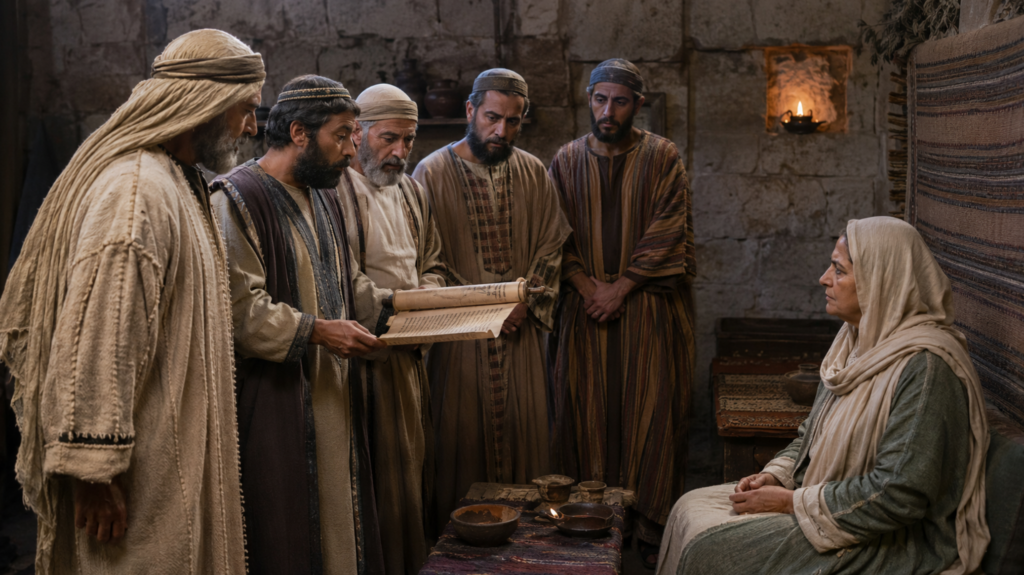
Huldah teaches the Word of God to five leading religious and political leaders of Judah – all men – and instructs them how they are to respond to God’s Word.
The Southern Baptist Convention is moving well beyond the narrower question of whether a woman may hold the formal ‘office of pastor.’
Increasingly, some of our institutional religious leaders like Al Mohler are arguing that women should not even perform the functions long associated with pastoral ministries, functions that include teaching the sacred Scriptures to the assembly, exhorting the congregation, or exercising any form of spiritual leadership in the presence of men.
There is just one problem.
The Bible.
In 622 BC, five of the most influential religious and political men in Jerusalem went to a woman named Huldah because they needed her to explain the Word of God.
They did not go to instruct her; they were commanded by the good and God-honoring King Josiah to go and let her teach them the Word of God.
The Rediscovered Scroll of Deuteronomy that Shook the Nation of Judah

The rediscovered scroll of Deuteronomy was read to Josiah, who reigned as King of Judah from 640 to 609 BC. Josiah immediately commanded the leading religious and political leaders of Judah to find Huldah and have her teach them God’s Word.
Josiah had become king of Judah when he was only eight years old. In the eighteenth year of his reign, when he was twenty-six, he ordered repairs to the Temple. During those repairs, Hilkiah the High Priest of the Temple announced, ‘I have found the Book of the Law in the house of YHWH.’
The scroll was given to Shaphan, the royal secretary, who then read it aloud to King Josiah. When the king heard its words, he tore his clothes in distress.
Most scholars believe the scroll was Deuteronomy, or a portion of the book in your Bible by that name. Josiah immediately recognized that Judah had violated the covenant and therefore stood under divine judgment (see Deuteronomy 28-29).
That’s when King Josiah ordered five men to find Huldah: ‘Go, inquire of YHWH for me, for the people, and for all Judah concerning the words of this book.’
Josiah did not appoint a committee, nor did he request a denominational position paper.
He simply sent five men to Huldah.
The Five Men Huldah Taught the Word of God

A representation of Solomon’s Temple in the days of Huldah and Josiah, with Hiliah as the High Priest (640 to 609 BC).
These five men were not obscure servants of the court. They represented the religious, political, and administrative leadership of Judah itself.
1. HILKIAH, the High Priest
His name in Hebrew means ‘YHWH is my portion.’
He was the highest-ranking religious leader in the nation, the man who supervised the Temple and who had personally discovered the scroll. Yet Hilkiah did not say, ‘I am the High Priest. I am a man. I will determine what this text means. I dare not be taught by a woman with the gift of prophecy.’
The High Priest went to Huldah not to correct her theology, but to receive it.
2. AHIKAM, a Royal Official
He was the man who years later would protect the prophet Jeremiah when priests, prophets, and political leaders wanted him executed. ‘The hand of Ahikam’ kept Jeremiah from death, and Ahikam’s own son Gedaliah would later become governor of Judah.
Ahikam’s family was influential in Judah, but he went to Huldah to be taught.
3. ACHBOR, a Government Official.
His position is never precisely spelled out, yet his inclusion in so small and select a royal delegation shows that he was a senior government official. His son Elnathan later served in the court of King Jehoiakim and appears several times in the Book of Jeremiah.
Achbor was another powerful man going to Huldah to be taught God’s Word.
4. SHAPHAN, the Royal Secretary
His position is equivalent to a modern secretary of state. He enjoyed direct access to the Temple treasury, the high priest, the palace, and King Josiah himself. Shaphan’s family repeatedly supported the prophet Jeremiah: his son Ahikam saved Jeremiah’s life, his son Gemariah allowed Jeremiah’s scroll to be read from his chamber, and his son Elasah carried Jeremiah’s letter to the exiles in Babylon.
Shaphan was Josiah’s most powerful officer, and he went to Huldah to learn.
5. ASAIAH, ‘the King’s Servant.’
He was not Josiah’s household slave. This phrase in Hebrew describes a trusted palace officer who acted personally on Josiah, the Palace, and the royal family.
Asaiah represented the king in Huldah’s home, and Asaiah went to Huldah.
The five men who read the scroll of Deuteronomy with Huldah seated in the traditional seat of ‘Master Teacher’ while the learners stood.
Who Was Huldah?

Huldah, the ordinary woman of Judah, gifted from the Most High as a prophetess.
The Bible identifies Huldah simply as ‘the prophetess, the wife of Shallum.’
Shallum and Huldah operated what you would call in our day ‘clothes cleaners.’ They washed, dried, and folded the royal garments of the palace, as well as possibly the priestly servant garments of the Temple, or both. The Bible simply calls Huldah the ‘keeper of the wardrobe.’
Huldah and Shallum lived in Jerusalem’s ‘Second Quarter,’ a newer section of the expanding city in 622 BC. She was therefore not an isolated woman living in some unknown village.
Huldah’s a working woman living in Jerusalem and is known for her giftedness.
The gifts of the Spirit are never gender-qualified. Prophesying, teaching, exhorting, and all the gifts God bestows on His people are sovereignly dispensed, independent of the receiver’s gender. That’s taught in the Bible and is the experience of the Church.
King Josiah recognized that a female prophet lived in the capital city of Jerusalem.
Huldah was a contemporary of Jeremiah. Jeremiah had already been prophesying for five years when the lost scroll of Deuteronomy was discovered in 622 BC. God did not use Huldah because no male prophets were available. Jeremiah was alive. Zephaniah was alive. The High Priest was standing in Huldah’s house.
God commanded Josiah to send the five men to the female Huldah to learn the Word of God.
- The biblical writer offers no apology.
- He does not explain why a woman was allowed to speak to men.
- He does not assure nervous readers that Huldah’s husband supervised the conversation.
- He does not claim she taught only women and children.
- The men went to Huldah because Huldah was the prophet of YHWH.
Huldah Explained the Word of God to Men
Huldah did not merely offer emotional encouragement. She interpreted the spiritual significance of the newly discovered scroll of YHWH, declared that its covenant warnings applied directly to Judah, announced coming judgment, and explained what the sacred text meant for the king, the government, Jerusalem, and the entire nation.
She spoke with the formal prophetic declaration ‘Thus says YHWH.’ She then told the five men that Judah’s judgment was certain, yet Josiah would receive personal mercy because his heart was tender and he had humbled himself before God.
- Huldah spoke to the assembly of men.
- Huldah spoke authoritatively to men.
- Huldah taught the actual Word of God to men.
- Huldah instructed a king, a Temple, and a nation.
The five men listened. The high priest did not interrupt. The royal secretary did not edit her words. The king’s representative did not remind her that women should not exercise spiritual authority over men. They simply carried Huldah’s message back to Josiah as the Word of God.
The Woman Behind Josiah’s Reformation

Listening to Huldah’s teaching, Josiah and Hilkiah led the nation to repent of its idolatry and tear down the Asherim and idols to Baal.
After hearing Huldah’s message, Josiah gathered the elders, priests, prophets, and people of Judah. He read the Book of the Covenant publicly, renewed the covenant, destroyed pagan altars and idols, removed the priests of Baal, tore down the houses connected with pagan worship, destroyed the altar at Bethel, centralized worship in Jerusalem, and commanded the nation to keep the Passover.
The meaning for the nation as discovered in the Word of God was authoritatively declared by a woman. Huldah stands between the discovery of the scroll and the reformation of Judah.
Read the Bible Before You Believe SBC Men Silencing Women in the Assembly Is of God

The author seeks to prevent a horrific violation of God’s Word and will in the SBC.
Genesis 3:16 says of fallen humanity, ‘He (Adam, the man) will rule over you.’
That is not a command for Christian men to obey; that is a curse Christ came to overcome.
Men who turn the consequences of the Fall into a blueprint for the church have mistaken the wreckage of Eden for the architecture of the Kingdom.
In a place of grace, men and women mutually submit and serve. In a house resembling the curse, men seek to rule over others, and women think it’s normal for men to rule.
- The issue for Christ’s church is gifting, never gender.
- The issue for Christ’s church is calling, never control.
- The issue for Christ’s church is humility, never honors.
- The issue for Christ’s church is function, never form.
- The issue for Christ’s church is service, never status.
Christ is the Head, and we are His Body. Christ has the right to assign function to individual Body members however He chooses.
Huldah taught men. She exhorted men. She exercised spiritual leadership over men. She interpreted sacred Scripture for men. She delivered God’s judgment to men. She gave the Word of YHWH to the high priest, the royal secretary, Jerusalem’s senior officials, and ultimately the king. No man in the story objected.
The only men who object to Huldah are men living centuries later whose theology has no room for her. Before men silence women, they must silence Huldah and the Bible.
Before they forbid women to teach men, they must explain why the high priest went to a woman to understand the Word of God.
Huldah did not violate sacred Scripture.
Men who erase Huldah do.
A Mole May Interrupt Your Man’icured Church

Huldah’s name in Hebrew means ‘weasel’ or ‘mole.’
For a full harvest of crops, soil aeration is needed. In ancient days, moles provided the aeration through their digging in the dirt. Moles were wonderful natural pesticides, eating all the nasty pests that would destroy an otherwise full harvest. Moles had to be present for the health of any workman attempting to bring in a full harvest.
In our day, we see moles as pests because they sometimes appear on the surface, disrupting our carefully man’icured lawns.
Which is more important? The harvest or the lawn’s appearance?
Christian ladies, be like that woman Huldah. Christian men, be like those five men she taught.