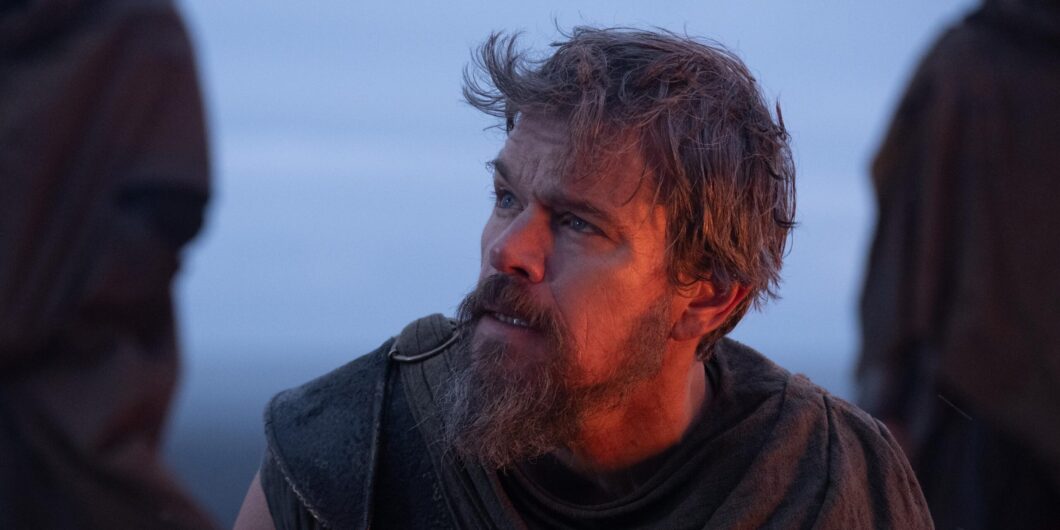
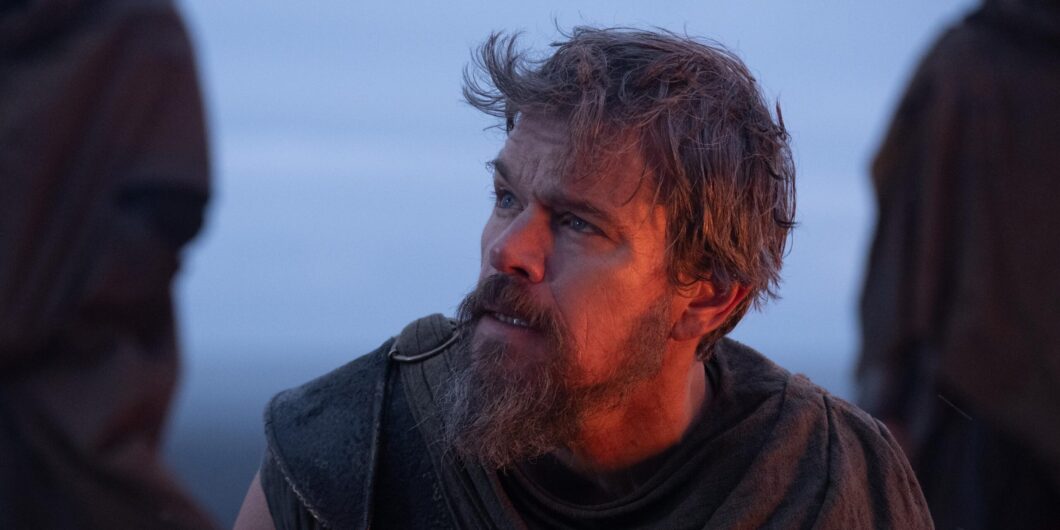
There’s too little sex and violence in Christopher Nolan’s Odyssey. And it matters. There’s too little religion and supernaturalism, too. That the anodyne Epicureanism of Nolan’s Odyssey is widely construed as Nolan “Christianizing” Homer’s story is testimony to the insipidity of much of what passes today for Christianity.
We’ll start with sex and violence, and then get to religion.
First, though, a preliminary comment on film adaptations of books: Screen adaptations of books must necessarily alter the story. Even a three-hour movie cannot reproduce an epic poem the length of Homer’s Odyssey. But the necessity of change does not grant a director or screenwriter carte blanche. Viewers (and readers) can ask about the film’s selection of scenes from a book and whether the changes made by a director faithfully reflect a book’s story.
It’s also fine for directors to be inspired by a story to adapt it to other situations or thematic ends. That said, these directors often signal the significance of the changes they made by renaming the film. Apocalypse Now (based on Joseph Conrad’s Heart of Darkness), O Brother Where Art Thou (also based on The Odyssey), or even Clueless (based on Jane Austen’s novel Emma) are examples.
There is a middle area, however, in which directors are inspired by a book’s story, and maintain formalistic elements of the plot, but want to tell a different story than the original. All adaptations do this to some degree. But there is a risk that a movie adaptation can be something of a bait and switch in which the director uses the cache of the original story to increase ticket sales from viewers interested in a cinema version of the original story but not necessarily interested in the director’s insights unconnected with the original story.
At its core, much of the argument over Christopher Nolan’s Odyssey concerns whether, while drawing on the cache of Homer’s Odyssey to attract viewers, he changed Homer’s Odyssey in ways that matter. In other words, is Nolan’s Odyssey a bait and switch?
Christopher Nolan wants to speak to the topic of civilizational decline in his version of The Odyssey. That’s an interesting and provocative topic and I’m personally interested in Nolan’s take on the subject. But it’s not what Homer writes about in his Odyssey. In his adaptation of The Odyssey, Nolan gives the audience a kinder, gentler Odysseus, if not a more neurotic Odysseus, than Homer did. Even though I’m more comfortable with the behavior of Nolan’s Odysseus than I am with Homer’s Odysseus, that comfortableness is a problem with the film’s adaptation of the story, not a virtue of it.
The Cold-Blooded Violence of Homer’s Odyssey
There remains a fair amount of violence in Nolan’s Odyssey. The cyclopes, the attack on Troy, Odysseus’s fight with Penelope’s suitors on his return to Ithaca. Yet for all the action in Nolan’s Odyssey, Nolan dulls the sharp, even shocking, edge of violence in Homer’s Odyssey. Homer describes a much less sympathetic Odysseus for modern audiences than Nolan does.
Start with the dramatic ending of Homer’s story in which Odysseus clears out the suitors from his home. This is the conflict to which Homer’s epic crescendos from the very start. Homer’s story culminates with Odysseus exterminating the suitors. All of them. It is a brutal conclusion to the story.
For all the action of Nolan’s fight scene in the film between Odysseus and the suitors, he blinks at the systematic, murderous violence of Homer’s Odysseus. In the film, after Odysseus dispatches perhaps two-thirds of the suitors, the remaining suitors one-by-one take a knee in surrender, yielding to Odysseus and asking for quarter from his vengeance. Nolan’s Odysseus extends mercy to them and accepts their surrender.
In contrast, in Homer’s epic, Odysseus gives no quarter to any of the suitors, including those who surrender and beg him for mercy. In Homer’s telling,
Leodes rushed in and caught the knees of Odysseus,
and spoke to him in winged words and in supplication:
‘I am at your knees, Odysseus. Respect me, have mercy’;
Odysseus rejects Leodes’s petition and kills him without mercy:
Looking darkly at [Leodes] spoke resourceful Odysseus:
‘… Many a time you must have prayed in my palace, asking
that the completion of my sweet homecoming be far off
from me, that my dear wife would go off with you, and bear you
children. So you cannot escape from sorry destruction.’
… With this he cut through the neck at the middle,
and the head of Leodes dropped in the dust while he was still speaking.
The only nod that Odysseus gives to the slain suitors in Homer’s story is to chasten his wife against exulting openly at their deaths because “it is not piety to glory so over slain men.” Nonetheless, Odysseus has no qualms about what he has wrought; responsibility for the slaughter lies fully on the victims. They were “destroyed by the doom of the gods and their own hard actions. … By their own recklessness they have found a shameful death.”
The extermination of the suitors without mercy does not exhaust the vengeance of Homer’s Odysseus. He next instructs Penelope to “assemble here the women [servants] who are in the palace, both those who have done me no honor, and those who are innocent.”
In Nolan’s telling, Odysseus fails to return home; he trades a new exile for the old one on account of his sins.
In Nolan’s screenplay, the fate of Melantho, Penelope’s quisling maid, is left ambiguous; we last see her cowering under a table.
In Homer’s telling, twelve of the 50 female servants in the house were disloyal, collaborating and cohabitating with the suitors. Odysseus tells his son Telemachos to have the twelve collaborators first clean up the bloody mess created by the slaughter of the suitors. Then, after they have cleaned up the house, Odysseus instructs his son to kill the traitorous maidservants:
After you have got all the house back in good order,
lead all these maidservants out of the well-built palace …
and hew them with the thin edge of the sword, until you have taken
the lives from all …
Yet Telemachos thinks that Odysseus’s order shows too much mercy to the maidservants. Rather than “cleanly” killing them with the sword, in Homer’s stomach-turning description, Telemachos instead hangs the women,
like thrushes … or pigeons, who have
flown into a snare set up for them in a thicket …
so their heads were all in a line, and each had her neck caught
fast in a noose, so that their death would be most pitiful.
Finally, in both Nolan’s film and in Homer’s epic, Odysseus anticipates that the families of the slain suitors will seek to kill Odysseus to avenge their relatives’ deaths. Nolan’s Odysseus takes the opposite action of Homer’s Odysseus in response to this threat: Nolan’s Odysseus flees into exile in the face of this threat; Homer’s Odysseus remains to fight and vindicate his return to Ithaca.
In Nolan’s story, Odysseus and Penelope quite literally sail into the sunset. Nolan’s exile of Odysseus is the capstone to Odysseus brooding over his (ostensible) sin for destroying Troy. Nolan draws on the trope of the scapegoat in concluding his Odyssey: Nolan has Odysseus again returning to exile to save Ithaca from the destruction of the suitors’ blood avengers. As scapegoat, Odysseus carries the consequences for his sin against Troy (and the consequences of his totalizing vengeance against the suitors) away from Ithaca. Odysseus pays the price of his sin and of his love for Ithaca and home. He is forever exiled from the city he loves and to which he sought to return. (The “scapegoat” is a well-known trope in the Bible. See, for example, Leviticus 16.21–22 and Hebrews 13.11–13. René Girard argued for the broad, archetypal nature of the theme.)
In contrast, in Homer’s Odyssey, not only did Odysseus not flee from the blood avengers of the suitors, he and Telemachos “would have killed them all”—that is, they would have slaughtered all of the suitors’ blood avengers—had it not been for the intervention of Athena to stay Odysseus’s and Telemachos’s hands against them. Homer’s story concludes with both sides making peace, and with Odysseus victoriously reestablished on the throne and at home in Ithaca.
The difference in the conclusion to Nolan’s Odyssey relative to Homer’s is both significant and telling: The trajectory of Homer’s Odyssey has Odysseus victoriously returning from de facto exile to home and throne. This is the sweeping telos of Homer’s entire epic. In contrast, in Nolan’s telling, Odysseus fails to return home; he trades a new exile for the old one on account of his sins.
To be sure, the conclusion to Nolan’s Odyssey is poignant and thought-provoking. But he gives us an insipid, hand-wringing Odysseus where Homer gives us a victorious, if disturbingly sanguine, Odysseus. It’s a stark difference, and it necessarily affects the narrative arc of the respective story each tells from the very start. That Nolan’s Odyssey has a cyclops and a Circe is mere formalism; we encounter a fundamentally different Odysseus and narrative arc in Nolan’s telling than we do in Homer’s telling.
Nolan’s odyssean melancholy derives from a neurotic Odysseus who wrings his hands over the conceit that his actions inaugurated the end of civilization.
This is not to suggest greater sympathy for Homer’s bloodthirsty Odysseus relative to Nolan’s tamed Odysseus. It is a canard that classical literature is necessarily uplifting or edifying. But Nolan softens his Odysseus to avoid challenging modern sensibilities as Homer’s more brutal Odysseus does. And that’s a loss. One reason to engage literature from other times and places is that it exposes us to worlds and worldviews different from our own. Learning about them does not entail that we approve or embrace those worldviews. Nonetheless, they expand our understanding of the world even if—or even because—we are appalled by what we see and learn. I learn more from Homer’s unexpurgated Odyssey than I do from The Odyssey that Nolan calibrated for modern sensibilities.
Odyssean Melancholy
Odysseus’s victory over the suitors (in Homer) does not mean that Homer’s Odysseus is uninflected with melancholy. Nolan’s odyssean melancholy derives from a neurotic Odysseus who wrings his hands over the conceit that his actions inaugurated the end of civilization. (In a jarring anachronism, Nolan’s Odysseus expressly refers to the end of the age of bronze.)
The melancholy of Homer’s Odysseus, however, derives from the telling exchange in the epic that Odysseus has in Hades with Achilles’s spirit. In that exchange, Achilles subverts the honor ethics of the Greeks. This ethic is a signal motivating force for Odysseus in Homer’s Odyssey. It is a fascinating development for Homer to place at the very center of his story. Achilles utterly dismisses the value of being remembered by humans or gods after one’s death for heroic deeds.
When Odysseus meets Achilles’s spirit in Hades, he lauds Achilles as the most blessed man who ever lived and who ever will live. Achilles is the epitome of the fulfilled life in ancient Greece:
No man before has been more blessed than you, nor ever will be. Before, when you were alive, we Argives honored you as we did the gods, and now in this place you have great authority over the dead. Do not grieve, even in death, Achilleus.
Achilles melancholy reply, however, is shocking. He tells Odysseus that his afterlife in Hades is misery; he would prefer to be a slave to a subsistence farmer than king of the dead:
O shining Odysseus, never try to console me for dying. I would rather follow the plow as thrall to another man, one with no land allotted him and not much to live on, than be a king over all the perished dead.
Nolan is correct to pick up on the melancholy theme in The Odyssey. But the sources of Odysseus’s melancholia differ entirely in Nolan’s telling and in Homer’s telling.
The great Achilles’s melancholy response to Odysseus’s praise in Homer’s epic casts a pall over the whole of the Greeks’ honor/glory ethic. The implications of Achilles’s comment for Odysseus (and other Greeks) are that Odysseus can at best eke out what pleasures remain in the days he has remaining in this life in small pleasures of domestic life with Penelope. That is the only joy he has in the face of an unremittingly grim future after death. This thematically underscores the need in Homer’s story for Odysseus to reestablish himself in his home with Penelope; that is the only glimmer of happiness Odysseus can attain in Homer’s epic.
Sex in Nolan’s Odyssey
The omission of much of the sex in Nolan’s Odyssey relative to Homer’s Odyssey is perhaps not as pivotal to the poem’s narrative arc as Nolan’s decision to tame the violence in Homer’s story; nonetheless, the omissions are telling.
First, while not narrowly limited to sex, in Nolan’s telling, Helen’s abduction from Sparta and the violation of hospitality—“Zeus’s law”—was merely the pretext for the Trojan war and was not its true cause. Rather, the real motivation of the war was economics: King Menelaus desired to eliminate Troy’s dominance over the trade routes. That is, money, not sex, was the real cause of the conflict. Given the significance Nolan ascribes to “Zeus’s law” of hospitality throughout the film, his substitution of a crass economic motivation for the violation of Zeus’s law as the cause of the war against Troy is jarring.
More directly related to sex, Kalypso held Odysseus captive as an object of her sexual obsession. “By nights,” Homer writes, Kalypso would force Odysseus to sleep with her “against his will.”
Kalypso subsequently retorts to the god Hermes when Hermes informs her of Zeus’s command to let Odysseus go, “You are hard-hearted, you gods … when you are resentful toward the goddesses for sleeping openly with such men as each has made her true husband.”
Amusingly then, while Odysseus maintains that “all he pines for is to go back to my house and see my day of homecoming”—note again how Nolan’s exile of Odysseus at the end of his story dramatically changes the narrative arc of Homer’s epic—he nonetheless spent his final night with Kalypso “withdrawn in the inner recess of the hollowed cavern, enjoy[ing] themselves in love and stay[ing] all night by each other.”
Despite being held against his will as Kalypso’s sex slave, Odysseus is not so aggrieved that he would deny Kalypso a departing tumble for the road, apparently.
So, too, in his interaction with Circe, hospitality required that he sleep with her in Homer’s epic: “let us two go up into my bed so that, lying together in the bed of love, we may then have faith and trust in each other.”
In the cases of both Kalypso and Circe, Odysseus was, as it were, coerced into bed with the women (except perhaps in his last night with Kalypso). Yet when sex was a matter of choice, Odysseus was able to resist temptation to continue his return to Penelope: He declined an offer of marriage to Princess Nausikaa of the Phaiakians despite Nausikaa’s desire as well as her parents. (And sleeping with Princess Nausikaa without benefit of marriage would have been an offense against the king and the gods.)
Religion and the Gods
Finally, the gods are present and pivotally acting characters throughout Homer’s Odyssey. They intervene personally and repeatedly in the affairs of men. Through Athena (and Hermes), the gods provide Odysseus with warnings, disguises, and protection. Nolan naturalizes all of this. When Odysseus asks (the largely silent) Athena, “Why can’t the gods speak in a way we understand,” Nolan’s screenplay has Athena responding that the gods communicate through such natural events such as thunder and smiles. The actions and activity of the gods are human projections in Nolan’s materialistic Odyssey.
So, too, Nolan turns “sacrifice” into a rarefied event relative to what it is in Homer. To wit, in Nolan’s telling, a sacrifice matters only relative to the size of what the offeror gives up to make the sacrifice. (Hence, the significance of Agamemnon’s sacrifice of his daughter, Iphigenia, at the start of the war against Troy, and the significance of Odysseus sacrificing his homecoming and going into exile instead in atonement for his sins at Troy in Nolan’s story.)
As with the violence and sex in Homer’s Odyssey, Nolan muzzles religion in his telling of the story.
In this, Nolan misses how sacrifice is woven into daily life in Homer’s story, and in ancient life more generally. Specifically, the ordinary butchering of a domesticated animal typically included a sacrifice for the gods. That is, a portion of the animal was offered to the gods, but just a portion. The remainder of the animal was consumed by the people. So woven into daily life was sacrifice and meat that the Apostle Paul needs to address the problem in his epistle to the Corinthian church (1 Co 8.13, 10.20–22, 25–28). (In the Old Testament, when Israel traveled with the tabernacle, every domesticated animal needed to be butchered and offered at the tabernacle [Leviticus 17.3–9]. A portion of the butchered animal was sent up to YHWH in smoke, a portion went to the priests, but the bulk of the animal was then consumed by those offering the animal [Leviticus 7.15–18].)
As with the violence and sex in Homer’s Odyssey, Nolan muzzles religion in his telling of the story. The gods are not deeply intertwined in routine and daily life in Nolan’s Odyssey as they are in Homer’s Odyssey.
Nolan Presents an Epicurean Odyssey, Not a Christian Odyssey
It is this last point, that the gods are not deeply and personally involved in the daily life of Nolan’s Odyssey that is offered at times to suggest Nolan gives us a Christianized version of the Odyssey.
As one commentator observed, “there’s no question that Homer’s Odysseus and his comrades in arms believe in Athena or the wrath of Poseidon; unlike the Christian God, these two are very much among us, and submitting to them is a matter of course.”
My complaint at this point is not so much against Nolan as it is against the commentators.
Take the last part of the line quoted above, that is, the blithe assertion that “unlike the Christian God, these two [gods] are very much among us.” This sentiment tells us a lot about the perception of Christianity in the modern world. I dare say it is one shared by many of the faithful as well as by non-Christians.
This is not Christianity, however, but a sentiment consistent with the rival (and earlier) religion of Epicureanism. Theologian N. T. Wright provides a summary description of Epicureanism and its motivation, both in the ancient world and at the start of the modern world:
You could sum [Epicureanism] up like this: the gods are a long way away and they don’t bother about us, so relax and enjoy your life. …
Epicurus and the first-century BC poet Lucretius were reacting strongly, but not against ancient Judaism, which they didn’t know, and not of course against Christianity, which hadn’t begun then. They were reacting against certain types of ancient paganism that frightened people by suggesting that there were gods all over the place, that they were out to get you, and that if they didn’t make life miserable for you here and now they might well do so after you died. You then get the same reaction in the fifteenth century, when the medieval church had borrowed a lot of those ancient pagan ideas about unpredictable divine anger to frighten people into believing or behaving, so the rediscovery of Lucretius, and thus of Epicureanism, came as welcome news.
The thing is that the grand sweep of the Judeo-Christian revelation is not about God’s absence or remoteness from human life, as it is in Epicureanism, but about God’s presence in human life. (And, of course, the Judeo-Christian God does not share the capriciousness of the Greek gods.)
For example, in his prayer at the dedication of the Temple, Solomon wonders at the audacity of the returning presence of God in and through the Temple: “But will God indeed dwell with mankind on the earth?” (2 Chronicles 6.18)
God’s presence is the signal narrative arc of the Bible from Genesis to Revelation. In the Garden in Genesis, God comes to be present with Adam and Eve, but their sin causes a rift between God and them. The remainder of the Bible is God repairing that rift to reestablish the fellowship lost through human sin.
This is the point of the tabernacle in Exodus (25.8, 29.46) and of the sacrifices and ceremonies of Leviticus (26.11–12), it is the point of the temple (noted above), and is the point of the incarnation of Jesus on earth (John 1.14), of the Spirit coming after Jesus’s death (Ephesians 2.22, Romans 8.11) and is the sine qua non of the Age to Come (Revelation 21.3).
It is remarkable testimony to the failure of the Church in the modern age that the signal point of the Faith and its Scriptures can be so easily conflated with its Epicurean antithesis.
As I suggested above, complaining about how a film script changes an existing story can be made too easily. Changes are unavoidable in adapting an epic like The Odyssey for the screen. Yet necessity does not grant directors or screenwriters a carte blanche, exempting their choices from assaying.
In the case of Nolan’s Odyssey, it seems apparent that Nolan wants to tell a fundamentally different story than Homer told. Throwing in a cyclops and a visit to Hades does not make it a version of Homer’s Odyssey. The changes Nolan made in his Odyssey relative to Homer’s Odyssey are not merely formalistic. In taming and enervating Homer’s Odyssey, Nolan has given us a less challenging and piquant story than Homer did.