Partisan polarization strains the country. Tensions rise at the Mexican border. Native-born Americans decry high immigration, noncitizen voting, and election fraud. The president considers annexing foreign territory to create new states. Amid a war that some blame him for starting, his opponents stress the separation of powers and worry that the executive has usurped Congress’s authority. Loud voices call for the United States to keep its soldiers at home. Americans debate the role of religion in public life and the use of the Bible in public schools. They communicate, photograph, and wage war with new technologies.
I am describing, of course, the 1840s.
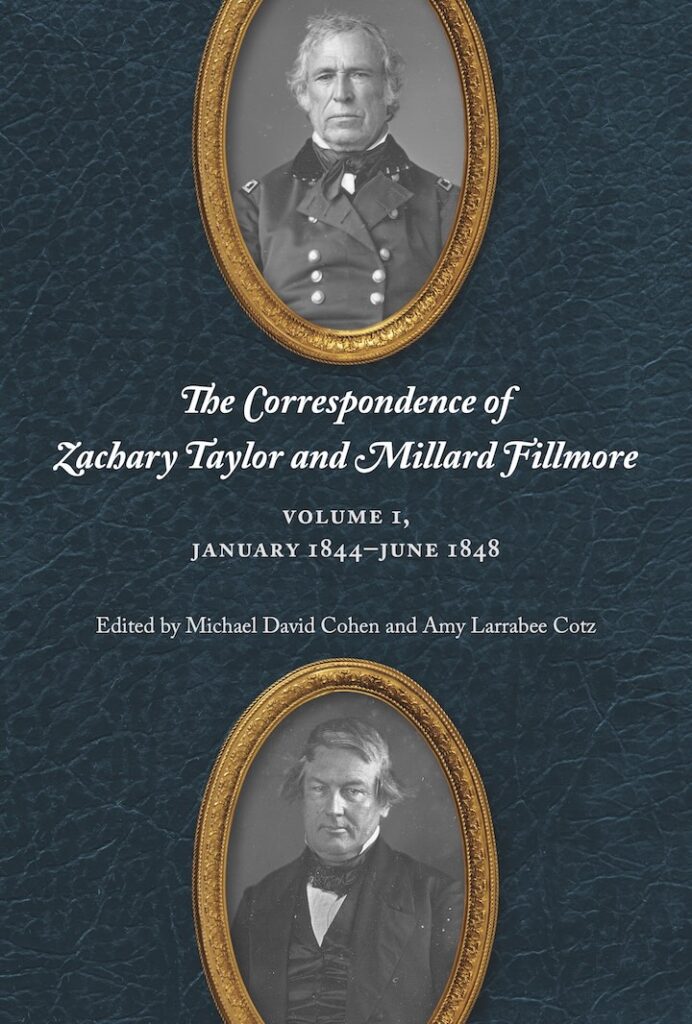
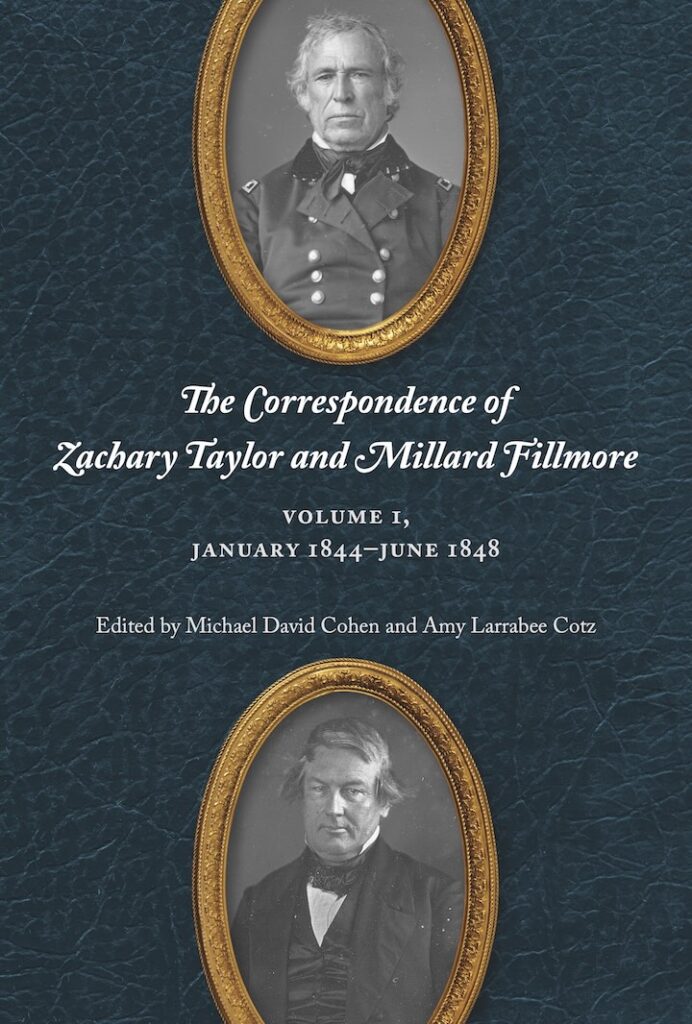
Next week, the University of Tennessee Press will publish volume 1 of The Correspondence of Zachary Taylor and Millard Fillmore. It will feature 369 letters (plus 4 enclosures) written by Taylor, Fillmore, and their diverse correspondents between January 1844 and June 1848. Readers of this blog know that they wrestled with questions eerily similar to those Americans face today. The letters reveal their thoughts on immigration, the ethics of war, the roles of Congress, election procedures, downsides to political office, and (of course) the weather. Letters reflect changes in the post office and presidents’ decisions not to seek reelection. Writers looked back on the US Revolution and the nation’s founding documents. From education to technology to voter fraud to territorial expansion, the letters illuminate the histories of topics that engage us still.
As I have noted before, though, Americans of the 1840s tackled those topics in a vastly different context. Four geopolitical transformations shaped US government and culture: the annexation of Texas, the Mexican-American War (which ended in the US acquisition of half of Mexico), the settling of the northwestern border with British Canada, and the ongoing expulsion of Indigenous peoples from the East. Slavery circumscribed the lives of millions of Black Americans, and Whites’ intensifying debate over it bled into other cultural and political questions. The letters in volume 1 help us to understand all these themes, including the forced labor of enslaved people, the policing of Black and Native Americans, and political violence with the possibility of disunion.
I conceived of this project in 2017, and American University’s Center for Congressional and Presidential Studies launched it in 2020. Back then, I had no idea how relevant its content would become. Having long studied antebellum history, I knew that Taylor’s and Fillmore’s letters, few of which were accessible to readers, would help us to understand America before the Civil War. Taylor was a lead general in the Mexican-American War, Fillmore was a prominent New York and national Whig, and both, of course, served in the White House. Their correspondents represented all walks of life and shared thoughts on numerous topics. But I didn’t know that those topics would connect so much with today’s headlines, highlighting at once the long narratives of North American history and the strong contrasts between the worlds of the 1840s and of today.
Having finished locating, transcribing, and annotating the letters, we now share them for your reading pleasure. They’ll be available in hardcover and ebook formats on August 18. This seems a good time to highlight a few of the many interesting or surprising stories in the volume that I haven’t yet mentioned in this blog. Each of them reflects enduring questions of American history while illuminating a distinctive era.
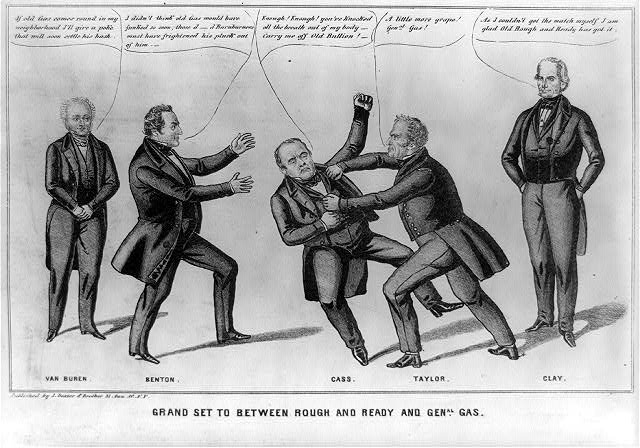
This political cartoon portrays the presidential election of 1848 as a physical fight. New York: J. Dexter & Brother, 1848. Library of Congress.
Parties and policies have always divided Americans. In the 1840s, free Americans were split both between Whigs and Democrats and, after the war with Mexico, between those who supported and opposed introducing slavery into the newly acquired Southwest (where Mexico had banned it). Powerful and obscure Americans alike lamented the rancor. Taylor often complained about harmful partisanship, and he grumbled to Jefferson Davis, on August 16, 1847, of pro- and antislavery advocates’ “intemperate zeal.” Detroit carpenter Amos Brown, on June 17, 1848, told Fillmore that “an exceeding darke political cloude [had been] hanging over this union for many years and the most dence parte I think has hung over Michigan but not only a dark cloud but an exceding tempestuous storm has come from the Cloud.” He concluded, sadly, “the national storm and state storm . . . has served to destroy the confydence betwen man and man.”
Left out of that public debate, but central to it, were the Black Americans whom slavery defined as property. We have yet to locate letters to Taylor and Fillmore by Black writers, though at least one man whom Taylor enslaved taught himself to read, and though some claimed that Fillmore aided freedom seekers on the Underground Railroad. The letters do, from Whites’ perspectives, teach us about Black people’s lives. Zachary’s son Richard Taylor, for example, visited his father’s Mississippi plantation in 1846. On March 23, he wrote with an update on conditions there. The White overseer, he argued, was “too lenient” toward the enslaved people. Concerned about their health, though, Richard advised shifting their housing to higher ground. He also observed the “practice of eating dirt,” which is now called geophagy and associated with medicine or culture.
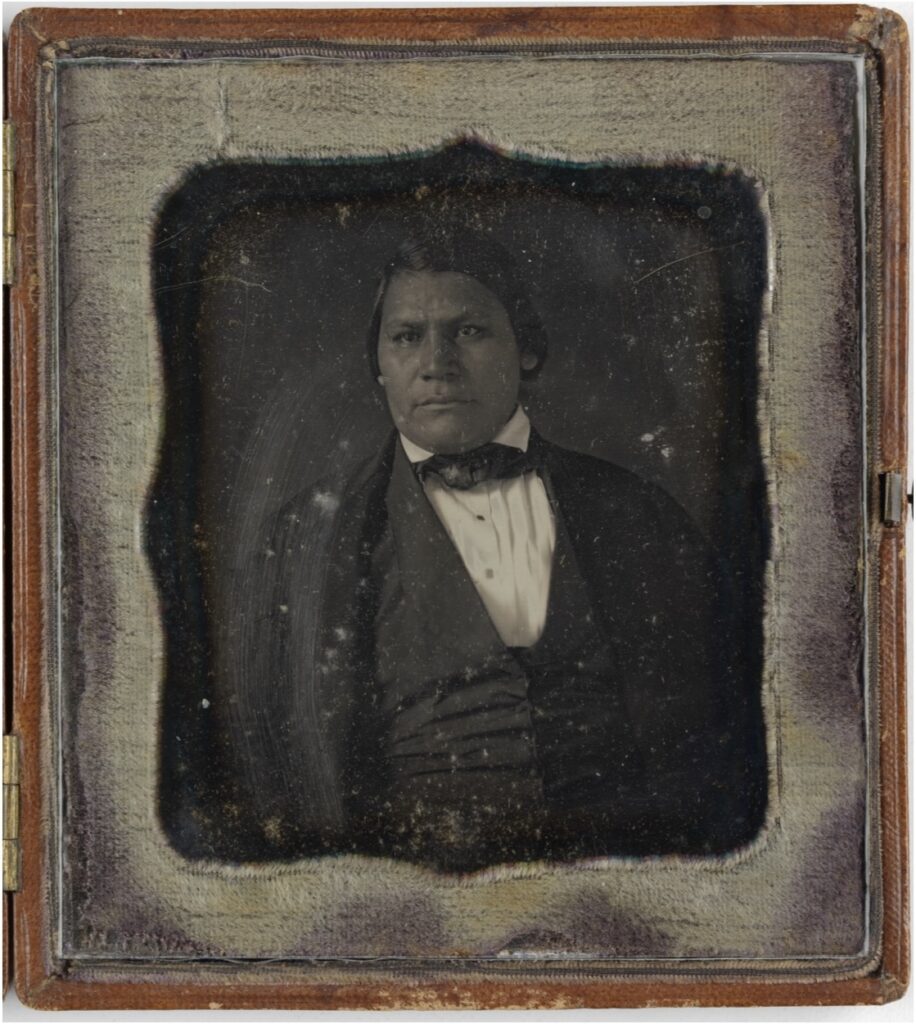
Daguerreotype of Peter Wilson, ca. 1852–55, P25296, NMAI.AC.405; National Museum of the American Indian Archives Center, Smithsonian Institution.
From the nation’s start, US-Indigenous relationships often involved violence and treaty violations. The 1840s were no exception. As US citizens and soldiers moved west and south, they encountered Native nations whose previous relationships with Whites had been with Spain, Mexico, and the Republic of Texas. Many of the letters document those encounters. Back in New York, the state government had negotiated treaties with the Native peoples within its borders. On May 24, 1848, Peter Wilson, a Cayuga chief and physician, wrote to the state comptroller—Millard Fillmore—to express his frustration with noncompliance. Annuities promised to his people, Wilson wrote, “have always been paid by the State, according to the understanding of the parties, Except that of 1846 when the payment was made contrary to, the then existing treaty.” Now that Fillmore was responsible for payments, he added, “I trust that the Cayugas will have no cause of complaint in this matter during your Administration.”
Although White women could not vote, that didn’t stop them from opining on politics and influencing powerful men. Elizabeth Milligan on January 22 and Miranda “Kate” Williams on May 26, 1844, wrote to Fillmore criticizing the government under President John Tyler. On June 20, 1846, Jane R. Dodge Gott related to Taylor her loss of a daughter and her yearslong effort to secure her son’s army discharge before her ill husband died. She succeeded: Taylor issued orders sending the son home. On October 1, 1847, Mexican woman María Polonia Gauna asked Taylor for help after the local government robbed her and imprisoned her father on the charge that he had worked as a courier for the US army. We cannot know, as one male writer claimed, that all women would have voted for the Taylor-Fillmore ticket if enfranchised. But they did participate in public life despite legal restrictions, and the letters document their roles.
These are only a few examples of the fascinating and informative letters in our first volume. I encourage you to read the introduction, which summarizes Taylor’s and Fillmore’s lives and provides a roadmap for the book’s contents. It will give you an idea of the letters’ major topics and diverse voices. The index, more thoroughly, will point you to the people, subjects, and concepts that interest you. Then please dig into the letters. As I wrote in my very first blog entry(albeit less concisely), we know of no better way to learn history than from the words of those who made it. That’s why we produced this volume. Whether you are a student studying antebellum America, a scholar researching one of myriad topics, or anyone who wants to know what people experienced and thought in a pivotal era, we made it for you. In clear type and with explanatory notes, you can read the words and study the lives of Zachary Taylor, Millard Fillmore, Amos Brown, Jane Gott, and numerous other men and women who shaped America.
You can find volume 1 at the University of Tennessee Press. This blog post also appears on the press’s website.