
Doors don’t stay closed where there are malls or airports, for instance. Persons continue to enter and exit and over time that begins to impact the indoor environment, more than anticipated.
Temperature heats up and cools down, dust creeps in, energy usage creeps up. This isn’t a first-time instinct, it starts to be apparent over a significant amount of time, such as a full day.
That’s where an air curtain comes into the picture. Not as something complex, but as a system that quietly controls what happens at the entrance.
It’s Not Just About Blocking Air
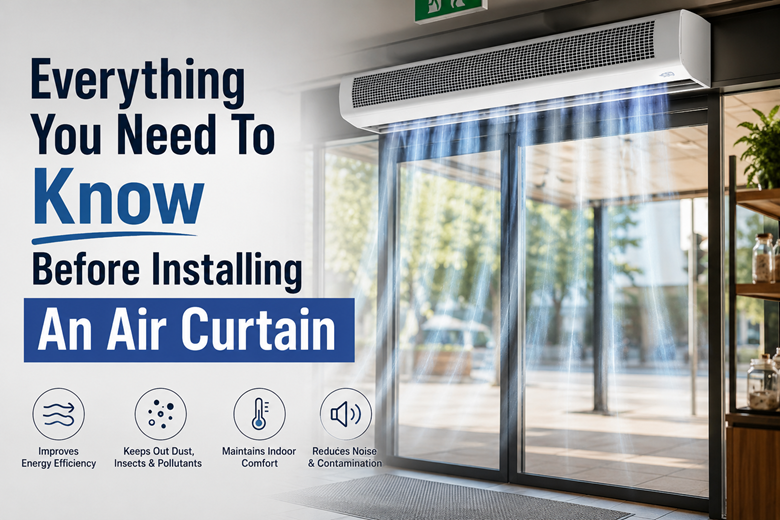
The simplest explanation for an air curtain is a billows of air blowing across an open doorway. It may not be visible from a distance, but certainly apparent when standing close to the entrance.
That airflow acts like a barrier. It separates indoor air from outside air without restricting movement.
In busy spaces, this becomes useful very quickly. Without a commercial air curtain, every door opening allows heat, dust, and external air to enter freely.
What Actually Makes an Air Curtain Work Properly
This is where most installations go wrong.
It’s not just about installing a unit above the door. It’s about how that airflow behaves once it’s running.
For an air curtain to work effectively, the airflow needs enough strength to reach the floor. If it weakens halfway, outside air still enters from below.
This is why door height matters. Taller entrances need stronger airflow. Otherwise, the barrier looks like it’s working, but it isn’t fully effective.
Coverage also matters. The airflow should span the entire width of the entrance. Even small gaps reduce performance.
Another factor is alignment. If the airflow is slightly tilted, it loses its ability to act as a proper barrier. It still runs, but not in a way that actually controls the environment.
Why Planning Matters More Than It Seems
A common assumption is that installing an air curtain is straightforward. Fix it above the door, connect power, and it works.
But small details change how effective it is.
If airflow strength doesn’t match the entrance height, performance drops.
If placement is off, gaps form.
If the wrong type is chosen, the system struggles under real usage.
Most of these issues don’t show up immediately. They appear during peak hours, when the system is actually tested.
Before You Install, These Things Make a Difference
A few checks can prevent most problems later.
Door size is one of the basics. The unit should match the full width of the entrance.
Type of space also matters. A retail store setup is very different from a large airport entry. Choosing between a commercial air curtain and an industrial air curtain depends on this.
Airflow strength needs to match the height of the door. Taller entrances require stronger output.
Installation space should also be considered. Limited space often leads to poor positioning.
Power setup usually isn’t an issue, but it’s still worth checking for stability.
Air Curtain vs No Air Curtain (What Actually Changes)
This is where the impact becomes clearer over time.
| Factor | Without Air Curtain | With Proper Air Curtain |
| Indoor temperature | Fluctuates frequently | Remains more stable |
| Dust and pollutants | Enter freely | Significantly reduced |
| Energy load on HVAC | Higher | More controlled |
| User comfort | Inconsistent | More predictable |
In smaller spaces, the difference may feel minor. In high-traffic environments, it becomes very noticeable.
Placement Is Where Most Systems Fail
Even a good air curtain won’t perform well if it’s not placed correctly.
Most installations are done above the entrance, which works in most cases. But only if the airflow fully covers the opening.
For wider entrances, vertical placement is sometimes used. An industrial air curtain installed on the sides can handle larger openings more effectively.
Alignment also matters more than expected. If the airflow is slightly off, the barrier weakens. It continues running, but doesn’t deliver the intended result.
Energy Efficiency: The Bigger Reason Behind Adoption
Many facilities install an air curtain for comfort, but the bigger impact shows up in energy usage.
Cooling systems must also operate more intensively when this occurs when doors are left open. This escalates to higher energy usage over time.
An air curtain can minimize this load by reducing the flow of fresh air from outside the building into the building and vice versa.
In today’s large commercial buildings even minor air conditioning efficiency improvements might result in significant reduction in costs in the long run. One of the reasons why they are now commonly employed in high pedestrian areas.
Where You’ll Notice Them the Most
Once you start paying attention, air curtain systems are quite common.
Airports use them to manage constant passenger movement.
Malls rely on them to maintain indoor comfort despite open entrances.
Hospitals use them to reduce the entry of external air and contaminants.
Office buildings use them mainly for efficiency and comfort.
Industrial setups use an industrial air curtain to maintain controlled internal conditions.
Common Issues That Show Up Later
Some problems don’t appear immediately.
Using the wrong size for the entrance is one of the most common issues.
Poor alignment during installation is another.
Sometimes the unit itself isn’t strong enough for the space.
And in many cases, maintenance is delayed until performance drops.
Keeping It Working Without Overcomplicating Things
There’s no complicated system required.
Periodic monitoring and testing of alignment and performance can insure consistency.
When usage is to be increased, upgrading or installing a second air curtain may be more effective than one than simply relying on the single air curtain.
Final Thoughts
An air curtain is not something people actively notice, but its impact is easy to feel. It helps maintain indoor conditions without restricting movement.
In high-traffic spaces, that consistency becomes important very quickly.
The basics are simple. Choose the right system, place it correctly, and maintain it regularly.
Whether it’s a commercial air curtain or an industrial air curtain, small details decide how well it performs.
And in most cases, those details only become visible once the space is fully in use.