
A Single Ox
by Barbara Corson of Dauphin, PA
When I was about 6 years old, our mother read the “Little House” book series to us, including the book Farmer Boy. I think that was the beginning of my interest in oxen. My parents were not farmers, but they both knew farming from their childhoods. We had a kind of hobby farm with horses and ponies, chickens, sheep and goats, but no cattle and I was fascinated by the cattle in the Laura Ingalls Wilder books.
What with one thing or another, it was about 25 years before I was in a position to act on my childhood interest in oxen. Although I had experience with milk cows and with riding, carriage driving and work horses, it was 1989 before I purchased my first bull calf to raise as a draft animal.
My first steps into the experience were truly blessed. For one thing, that first calf was a healthy and very gentle individual. Rex was a shorthorn/ Norwegian red cross and one of the kindest, smartest animals I have ever known. I have since learned that not all cattle are as easy to work with as he was!

And secondly, I was lucky enough to live near to a man who was an “ox whisperer.”

Worth McClure grew up in North Carolina during the depression on a farm that ran entirely on ox-power: no horses, no tractor, no truck, no car. Worth loved working oxen and he was so enthusiastic about helping me learn. Where I live (near Lancaster, Pennsylvania) there are a lot of draft horses and there used to be a lot of dairy cows, but not much ox culture at all. I would never have gotten far without Worth’s help.
Worth trained cattle to drive from behind, with long rope made into a halter, or else tied around the horns, because “I didn’t want to walk everywhere, I wanted to ride.” The cattle responded to voice commands reinforced with signals through the line: a steady pull meant turn left, and jerking the rope so that it slapped the animal’s shoulder meant turn right. I think this technique was / is used in horse teams, too, and called a “jerk line leader”?

In Lynn Miller’s book Horsedrawn Plows and plowing there is a picture of 2 teams of oxen plowing at Howell Living History Farm in New Jersey. One of the teams pictured belonged to Worth; in the picture, it is Worth’s son-in-law Dave Reath who is driving.
When Rex was 2 years old I purchased two more shorthorn calves, a bull calf that I named Rudy, and a heifer calf that I named Rose. For the first 2 years of their lives, I worked the calves together as a team. When Rose had her first calf, I put Rudy and Rex together in a yoke – with lots of help from Worth. They did fine as a team… but I didn’t! It was hard for me to yoke them by myself at my home (partly because I didn’t have a good place to tie them, and partly because the yoke was so heavy). So I found myself using them single more than as a team.

The advantages of a single ox, for me, were numerous. Because it was less of a struggle to yoke one animal, I was more likely to do it and less likely to put it off. And once yoked, it was easier to maneuver on the narrow, windy country roads and overgrown hilly countryside where I lived. And I enjoyed the one-on-one communication with the single animal, it made me feel more like a co-worker, and less of a supervisor.
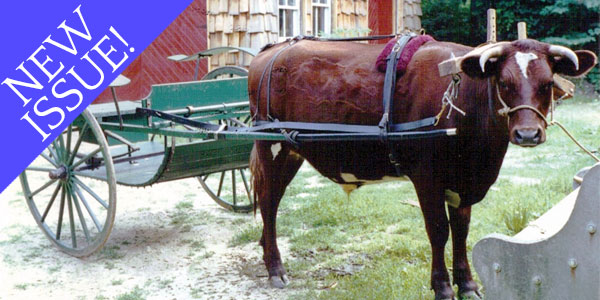
Over the years I raised and trained a number of cattle for draft work, and even when they eventually went on to work in a team, I wanted them to be able to work single too. Included are some pictures showing different ways I “harnessed” / yoked them.

Of course there are some things about using a single ox that could be seen as drawbacks. It’s challenging to get a single bow yoke to balance perfectly. I found that a girth and britchen helps with that. I started out using horse harness parts that I modified to suit. More recently I purchased britchen made specifically for cattle.
There are also other options for working a single ox besides a bow yoke, including: a single head yoke (used in Nova Scotia, I believe), a forehead yoke, or a three-pad-collar. Hopefully other SFJ readers (e.g. Claus Kropp, Barry Hiltz) will contribute information on those systems.

Cattle being social animals, there are questions as to whether it’s good husbandry to keep only one bovine. But if you have two, the bonding between the animals can make working one of them challenging. In my case, since I had three bovines, I could take one out to work without leaving anyone alone.
Another potential drawback for some would be that a single animal can’t pull as much as two. I can see that having a team would be a necessity for some people, but my goal in having cattle has always been simply for pleasure: to be around the animals, and learn as much as I could, and sometimes to share what I was learning with other people. For me, a single ox has always just worked.
My ox working days are pretty much over now – except as an observer – but I feel lucky to have so many good memories. Thanks for letting me share them.