Having a private elevator that opens directly into your New York City apartment sounds swanky—if you can afford it. But is it safe?
In this edition of Buy Curious, Brick turned to Sydney Blumstein, an agent at Corcoran, to learn how the elevators work, where you can find apartments with this amenity, and what security measures you should expect.
[Editor’s Note: A previous version of this post was published in August 2025. We are presenting it again with updated information for August 2026.]
The question:
I’ve been thinking of buying an apartment with a private keyed elevator, but I’m concerned about safety. Do I need to worry about strangers getting into the elevator with me? How do these elevators work?
The reality:
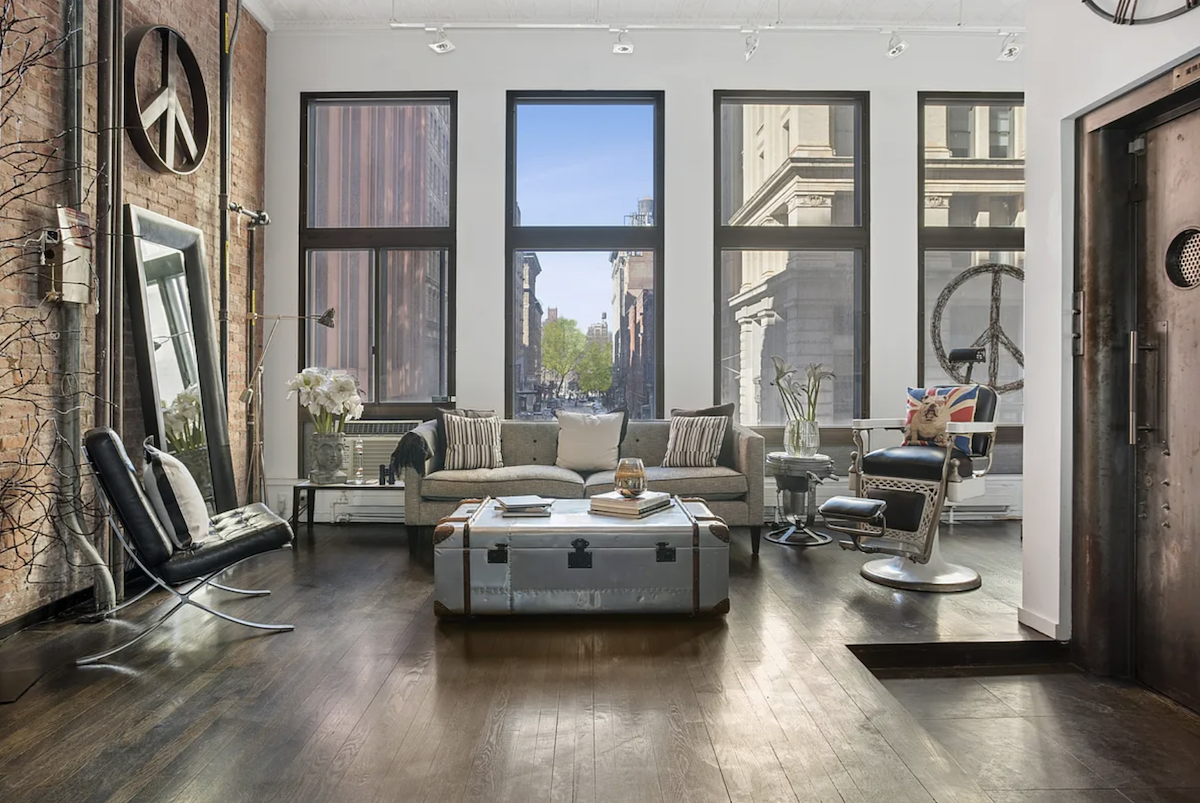
Blumstein grew up in a converted loft with a keyed elevator and still spends a lot of time visiting her parents there, so she has firsthand experience with this feature’s ups and downs.
“First-time visitors are always mystified when they try to figure out how to get the elevator to move,” she said. “And they are equally surprised to discover it opens directly into an apartment.”
How do private elevators work?
First, a terminology note: A truly private elevator typically serves a single residence, while a key-locked elevator may serve multiple apartments, with each resident’s key providing access to a particular floor or unit. Real estate listings often use the two terms interchangeably.
In older buildings, key-locked elevators commonly use a physical key. Residents can also buzz visitors into the building and, depending on the elevator’s setup, provide access from their apartment.
“The front door of the elevator is locked and can only be opened by key or if someone is providing access. The elevator will not move without inserting the key into the lock inside the elevator or by the resident ringing you up,” she said.
Her building uses non-duplicatable Medeco keys, which she said is fairly common in older buildings (and in all her listings). The trick to using one of these? You must remember to turn the key back to the locked position after pressing the button that moves the elevator.
She noted that some buildings have key-locked elevators that serve all the units on each floor and open onto a common hallway. “For example, in an older building in Hudson Yards, they’ve put in a key system that automatically bounces back to the locked position for added security, so you don’t have to rely on your neighbors to do this,” she explained.
In newer construction, access may be controlled by magnetic cards, keypads, codes, or biometric systems such as fingerprint readers.
Where can you find them?
Manhattan is your best bet. A recent StreetEasy search for “private elevator” returned 189 listings, spanning neighborhoods from the Upper East and West sides to Lower Manhattan; a handful were in Brooklyn. (The search turns up “semi-private” elevators too, so be sure to read the fine print.)
“Historically, you find them in converted warehouse conversions in Greenwich Village, Soho, and tiny parts of Tribeca, where sometimes the buildings have been combined, and the elevator will serve the east and west side,” Blumstein said, adding “whereas in the Village you find grander floor plans that are 2,500 square feet.”
But the amenity isn’t limited to older lofts. Today, keyed or direct-access elevators are found in both co-ops and condos, from prewar and mid-century conversions to new construction. Indeed, only 64 of the current 189 listings were co-ops.
Blumstein pointed to The Metropolitan, a newer condo development in North Williamsburg, where some residences have keyed elevators that open directly into the apartments. “These often have a huge freight elevator that serves two units with those giant doors that open on opposite sides into adjacent apartments,” she said.
And 104 Charlton St., a boutique rental condo in Hudson Square, offers another variation: its key-locked elevator opens directly into individual loft apartments.
In an older building such as 55 East 11th St. in Greenwich Village, a converted warehouse that became a co-op, the setup is different. The 12-story building has full-floor lofts, illustrating how the feature has evolved from its industrial-building roots into a sought-after residential amenity.
Are these apartments more secure?
“A key-locked apartment is as safe as, or even safer than, having a doorman, which you can often breeze right by,” Blumstein said.
But an apartment’s overall security depends on the building’s entire system, including its entrance, intercom, elevator controls, locks, cameras, and whether there is a doorman or other staff.
Sometimes apartments are in posh buildings with doormen; others, like Blumstein’s, use video intercoms that let residents see who is entering the building or elevator. Steel gates outside the elevator, cameras, and alarms can provide additional security. For added security, cameras with multiple views and alarms are also commonly used.
Loft-style apartments may also have a separate entrance door between the elevator and the apartment. “We had one but honestly never used it because of the built-in safety of the keyed elevators,” Blumstein said.
Can a stranger get into the elevator with you?
“Hypothetically, sure, but in 30-plus years, my parents have never had this happen,” she said, nor has she ever heard about anything from her neighbors—and it’s a tight-knit group.
The likelihood can also depend on the building type. Loft buildings are often small, with only one or two apartments per floor, so residents may know their neighbors and recognize the people coming and going.
In newer condo buildings, a doorman or other building staff may control access to the elevator and building.
And if you do find yourself in an elevator with someone unfamiliar, don’t panic. In a properly functioning key-access system, simply being inside the elevator doesn’t necessarily give that person access to your apartment floor.
Does a private elevator command a premium?
As with all real estate, pricing depends on many factors—and a private elevator is one of them. Apartments on StreetEasy ranged from $795,000 for a 1,000-square-foot, two-bedroom, one-bath co-op in Murray Hill to $70 million for a three-bedroom, four-plus-bath duplex totaling 10,875 square feet.
But according to Blumstain, “Anything that makes a place unique adds to the price these days.”
She reported seeing a significant uptick in buyer interest in unusual spaces “because there’s so much homogeneity being created in the marketplace and a lot of similar materials—how many times are you going to see a Bosch dishwasher? So it’s about having something that stands out.”
A keyed elevator is particularly appealing for people who value privacy and don’t necessarily want to interact with a doorman—or pay the associated building costs and holiday tips.
In some older loft buildings, the amenity comes with something less tangible: a sense of community. Blumstein said neighbors collaborate to buzz in deliveries so packages can be left in a hallway or elevator rather than a lobby or package room.
“And after a 20-year chapter of raze and rebuild,” Blumstein added, “the idea that we are still honoring spaces with keyed elevators makes me feel like we are leaning into the prewar beauty that makes New York so special.”
Check out these apartments with direct elevator access.
This three-bedroom, two-bath apartment is one of three units for sale in a boutique nine-unit, five-story condo built in 2025. It spans 1,264 square feet complemented by a 55-square-foot private balcony. The private elevator opens onto a spacious foyer that leads to a great room comprising an open chef’s kitchen, dining area, and living room. The asking price is $1.295 million; monthly common charges are $722, plus $576 in taxes.
Located on a cobblestone street in the historic South Street Seaport district, this full-floor, 1,818-square-foot co-op is on the market for $1.495 million, with $3,550 in monthly maintenance. The two-bath legal loft is accessed by private elevator and currently configured with one private and one open bedroom, a home office, and distinct living and dining spaces. Other features include original wood-beamed ceilings, exposed brick walls, and Brooklyn Bridge views. The seven-unit, eight-story building offers unlimited subletting and no flip tax.
Featuring a private elevator leading to a an entry gallery, this four-bedroom, three-bath condo spans over 3,300 square feet and offers prewar architectural details, 10-foot ceilings, four wood-burning fireplaces, and a windowed eat-in chef’s kitchen. It is one of 26 units at The Verona, a 10-story building where amenities a resident manager, full-time doorman, porters, a fitness room, and storage. The asking price is $3 million, with $7,478 in monthly maintenance (plus a monthly $1,033 assessment through January 2027).
This 1,228-square-foot two-bedroom, two-bath apartment is one of five floor-through units at the six-story boutique condo, built in 2021. It is listed for $4.5 million, with a monthly common charge of $1,810 and $2,424 in monthly taxes. A private elevator entry opens into a corner living and dining room wrapped in oversized windows, with a Juliet balcony reached by sliding glass doors. Another balcony is off the secondary bedroom. Building amenities include virtual doorman services, a package room, and available storage.
Listed for $2.795 million, this 1,556-square-foot duplex condo features three bedrooms, two and a half baths, an expansive covered terrace, and a state-of-the-art kitchen with custom walnut cabinetry, honed marble countertops, and Miele appliances. The private elevator opens directly into a generous foyer and entry space. The brand-new building has three units on five stories. The monthly common charge is $744, with $1,288 in taxes.
—Previous versions of this article contained reporting and writing by Leah Hochbaum Rosner.