Trump Administration’s War on DEI in Universities Closes Off Students’ Learning Opportunities

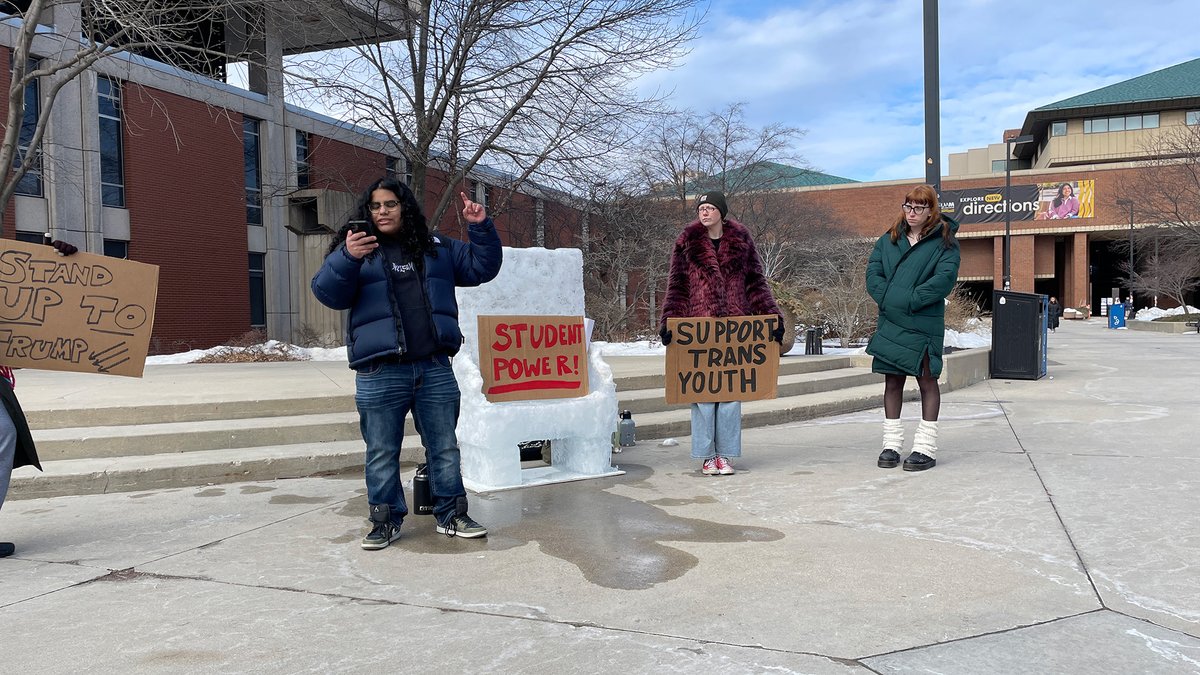

“Education is a right. Not just for the rich and white. We’re defending DEI,” chanted University of Wisconsin–Milwaukee (UWM) students on a bitterly cold afternoon in February 2026. They were protesting the proposed merging of eight of its student centers—intended for women, Black students, Latine students, Southeast Asian students, LGBTQ+ students, veterans and military-enrolled students, commuters, and first-generation college students, respectively—into a single resource hub.
Protesting students were concerned that the move would dilute the culturally-specific services each center provides and diminish these students’ sense of belonging on campus. During the protest, UW–Milwaukee student Juan Luis Flores put the proposed consolidation in the context of the school’s 5 percent tuition increase: “You cannot have more money this year taken directly from student pockets and then claim you do not have the money to fund these centers.”
Rachel Buff, professor of history at UW–Milwaukee Rachel Buff who has written previously for The Progressive, says students stood up for the centers at the listening sessions. They described how the Roberto Hernández Center helped their parents translate immigration paperwork and the Women’s Center gave them space to talk about sexual assault. But instead of seeing the unique importance of each center, the UW system prioritizes efficiency.. “In general, this is about alignment with corporate prerogatives which come from the [University of Wisconsin] System and the consultants they pay so much money to,” Buff says. “My students are worried about the grocery bill, so to take it out on them is really unethical.”
UW–Milwaukee’s cultural centers, including the Roberto Hernández Center which was founded in 1970 to serve the Latine community, were created by and for students. The reason the university takes issue with these centers, Buff says, is that “they’re essentially bottom-up because students have demanded them. They’re democratic in a way that the university is not comfortable with.”
Abigail Nye, the reference & instruction archivist at UW–Milwaukee, says the consolidation is “an erasure of the history of activism” that led to the formation of the cultural centers. “I have the benefit of having all of the photographs, newspaper articles, video footage, and all the other documentation that shows how the students, for the past fifty years, have really fought for these centers, fought for their services, fought for the legitimacy of the centers within the institution.” Nye says the consolidation “feels like an institutional betrayal.”
In May, after months of listening sessions and community input, the school announced the merger would be delayed until fall 2027. Elise Texidor, a UW-Milwaukee student who attended one of these sessions, says school administration cited “federal pressures” as one of the reasons for their decision to ultimately move forward with the consolidation.
Employees like Buff and Nye have watched the slow erosion of diversity, equity, and inclusion (DEI) efforts and the corporatization of the UW system for decades. But since President Donald Trump took office for a second term, the UW system has accelerated its disinvestment from DEI programs, scholarships, and initiatives. These changes across the UW system’s thirteen campuses, are shrinking students’ educational opportunities, eroding academic freedom, and, as several UW faculty and staff tell The Progressive, effectively “complying in advance” with the Trump Administration’s all-out attack on DEI and public education.
“Much like Act 10, where Wisconsin was a test case for getting rid of collective bargaining for public unions, what’s happening now is a test case again for how the right can engage in backdoor attacks in purple states to undermine academic freedom,” says a faculty member at UW–Eau Claire who requested to remain anonymous for fear of retaliation. Wisconsin’s Act 10 was a controversial 2011 law that greatly reduced the bargaining power of most public employee unions in the state by narrowing what they were allowed to negotiate down to only base wages, excluding health insurance, pension contributions, and other workplace policies.
Many college students and faculty are troubled by the ways that Wisconsin schools are starting to increasingly look like those in Florida and Texas. In Florida, DEI initiatives were banned from the state college system. The University of Texas at Austin restructured race, ethnic, and gender studies programs to a single department and the system’s Board of Regents approved limits on teaching topics deemed “unnecessary controversial subjects” by conservative politicians—a term left undefined in the policy, but speculated to encompass race, sexuality, and gender orientation.
In Wisconsin, a Republican-backed constitutional amendment on the ballot this November would remove DEI from all state agencies. The constitutional amendment adds urgency to what is already a contentious race for Wisconsin governor, and, if approved, would “send us back to the pre-Civil Rights eara, possibly further” State Senator Dora Drake, a Democrat from Milwaukee, told the Wisconsin Examiner. Republican legislators have increasingly turned to constitutional amendments to circumvent the veto power of Democratic Governor Tony Evers, and they’ve been successful in cutting DEI through other anti-democratic means.
To more fully understand the political climate around DEI in the UW system, “you need to take it back to 2023 and the deal that Jay Rothman cut with Robin Vos,” Jon Shelton, a professor at UW–Green Bay and president of the Wisconsin division of the American Federation of Teachers, tells The Progressive. In December 2023, Rothman, president of the UW Board of Regents, and Vos, the speaker of the Wisconsin State Assembly, orchestrated what’s known as “the DEI deal.” The agreement eliminated DEI positions across the system in exchange for staff pay raises that had already been signed into law several months prior.
Vos called the decision “just the first step in what will be our continuing efforts to eliminate these cancerous DEI practices on UW campuses.”
“That was really the first moment where you could see the state legislature drive that political wedge between people in the state of Wisconsin,” says Shelton. “Rothman capitulated, [even though] this was money that had already been allocated [in the budget].” The DEI deal came on the heels of the U.S. Supreme Court’s decision in Students for Fair Admissions v. Harvard to end race-based college admissions. “All of the attacks on DEI at the federal level have just made it easier for actors like Vos to try and push for this,” Shelton adds.
Since 2023, UW faculty and staff have reported growing hostility from administrators regarding any programs or initiatives that serve diversity, equity, and inclusion goals. One former employee of the Department of Equity, Inclusion, and Employee Wellbeing (EIEW) within UW–Madison’s Office of Human Resources describes being forced out of their job before the entire department was sunset in October 2025.
UW-Madison’s EIEW worked to improve retention of Black, Indigenous, and people of color (BIPOC) and LGBTQ+ employees through initiatives like monthly gatherings for BIPOC employees and compiled annual well-being reports from participants. The latest numbers from 2024 show that faculty and staff of color made up only 19.6 percent of the employee population at UW–Madison. In 2020, only 3.2 percent of faculty members were Black, a disparity that professor emerita Gloria Ladson Billings has attributed to the lack of a retention policy.
After the DEI deal, the former staff member with the EIEW told The Progressive they received messages from vulnerable employees concerned the DEI programs would be cut. In April 2025, the monthly meetings for BIPOC and women of color were indeed canceled and the EIEW web page devoted to defining terms like racism, sexism, and belonging was deleted. They watched as coworkers resigned because of a hostile environment created by leadership who would “question our competence, our dignity, our schooling, our experience on our resumes.” Last fall, UW-Madison shut down the entire EIEW department.
Administrators are now reorganizing departments “with surgical care,” says Brandon Thomas, an associate professor of psychology at UW–Whitewater. In October 2023, just two months before the DEI deal, the school dissolved its Office of Student Diversity, Engagement, and Success. Later, Thomas says a seemingly benign initiative called the Underrepresented Faculty Mentorship Program was rebranded to the Faculty Mentorship Program.
Thomas, who is mixed-race, says he has benefited from the university’s DEI-related programs. “It’s really difficult to see opportunities that I had, some even twenty years ago, that no longer exist for students,” he says. “It feels like there are all these doors closing behind me. There aren’t a lot of people from underrepresented groups here. The institution tends to spit out people from underrepresented groups pretty quickly, and it’s an often uphill battle to get people to care.”
Though some of these changes have made local news, many things go unreported, like the unannounced cancellation of diversity awards and training programs. In 2025, the UW system stopped granting the P.B. Poorman Award for outstanding achievement on behalf of LGBTQ+ people. The annual award was established in 2008 in honor of Poorman, who taught at UW–Whitewater and played a key role in supporting LGBTQ+ inclusion efforts within the university system. There was no money attached to this award—just institutional recognition for good work.
William Dirienzo, who teaches physics at UW–Green Bay and received the P.B. Poorman Award in 2024, says the elimination of the award “seemed like a pretty thinly veiled excuse” for not wanting to “draw negative attention” to the school by granting a DEI award. The award was a small way of “recognizing people’s work when so many people across all of our universities go way over and above job descriptions and aren’t appropriately compensated for that,” says Dirienzo.
The anonymous non-tenured instructor at UW–Eau Claire describes how there are shrinking opportunities for teaching and professional development related to DEI. UW–Eau Claire, they say, is one of the few schools in the country where every employee is evaluated based on their contributions to what the school calls Equity, Diversity, and Inclusion (EDI) goals. Jodi Thesing-Ritter ran the Center for EDI Training, Development, and Education, but after she retired, the role was never refilled. “I found those trainings very valuable for me as a tool to improve my teaching, and I mourn their loss,” the anonymous instructor reflects.
In the past year, campuses have canceled events like UW–Madison’s Diversity Forum, a conference on equity and inclusion that had been running for more than twenty years. There are fears the system-wide Women’s and Gender Studies Consortium will be gutted. Each loss carries with it the decades of labor and care that faculty, staff, and students have put into making their workplace and educational experiences more robust, welcoming, and forward-thinking.
The most sweeping change to DEI will go into effect this fall with the UW’s new general education requirements. Last summer, the Wisconsin legislature passed Act 15 to create a transferability policy across its campuses by recategorizing courses and limiting the maximum number of general education credits that schools can require. Though there is not a demonstrable problem with transfer credits, the procedural change became an opportunity to dramatically restructure credit requirements.
Notably missing from the new general education requirements are courses in categories like “American Cultural Diversity” or “Global Awareness” that were once mandatory at different campuses. “I think what this will lead to is less of an institutional investment in the kinds of courses that bring some of these ideas to students,” says Shelton.
At UW–Stevens Point, a campus known for its conservation work, the category of environmental responsibility was eliminated and will no longer apply to courses as of this fall. A faculty member at Stevens Point who requested to remain anonymous for fear of retaliation reports that students are concerned that they won’t be able to take classes that reflect the school’s “unique campus character.” Students also wonder if their minor in women’s and gender studies or certificates in Native American and Indigenous studies or social justice and equity will disappear.
Neil Kraus, a professor of political science at UW–River Falls and president of the university’s chapter of the American Federation of Teachers, says there were “nearly unanimous” votes against the change from the faculty senate—the legislative and governing body of the faculty that is responsible for shared governance, academic policies, and faculty welfare at the university. Although supporters claim there will be minimal disruption as current courses will get shuffled into other categories, Kraus says that “underneath the UW system rules, American Cultural Diversity courses, for example, will have to compete with other classes, which, by definition, means that fewer students will be enrolling in them.”
“You won’t see an immediate, massive reduction in offerings, but a gradual decline,” says Kraus. “Instructional academic staff—who make up about 50 percent of all faculty—have jobs completely dependent on enrollments. So if a class on a diversity-related subject has only eight or ten students enrolled, the Dean might say, ‘We’re just not going to run this class.’ ”
The fear of low enrollment and canceled classes extends beyond adjunct faculty to tenured folks as well, especially in the humanities and social sciences. “It’s a sneaky way to scale back what we can offer and a frontal assault on diversity-related classes,” says Kraus.
As the 2026 fall term approaches, faculty and staff are exhausted from fighting too many fires—from curricular changes to the threat of immigration raids on their campuses. In January, when UW–Green Bay sent out a campus email about the university’s response to potential U.S. Immigration and Customs Enforcement (ICE) actions on campus, a conservative TikTok account claimed the university was refusing to cooperate with ICE and actively “protect[ing] illegal student aliens.” When the school clarified the original message saying “Nowhere did [the email] say campus police wouldn’t cooperate,” some students and staff felt “the university does not have their back,” says Dirienzo.
Shelton of UW–Green Bay says instructors are now self-censoring out of fear of being doxxed—having their personal information posted online—or losing their jobs. Shelton, too, was targeted in 2022 by the ultra-conservative group Wisconsin Institute for Law and Liberty (WILL), which claimed that he was “indoctrinating teachers” in a course called “Mentoring for Equity and Inclusion.”
The anonymous UW–Stevens Point faculty member says colleagues are “preemptively going through and trying to clean up the language of their course descriptions. Some have been advised to do that by their administrators, while some of them are doing it out of self-protective measures.”
At a predominantly white organization like the UW System, the abandonment of diversity, equity, and inclusion—from the DEI deal to the re-branding of awards—contributes to a climate of unbelonging for marginalized employees and students. Buff at UW–Milwaukee says, “For underrepresented groups, it’s important to see people like them at the head of the class and in the content.” And for other students, courses in American Cultural Diversity can be illuminating. “We have the UW so you can go to college and you can change,” says Buff, “and that [opportunity] is being taken away from everyone who lives in the state.”