 Long before toys, monsters, fish, and superheroes broke box-office records and made history for Pixar Animation Studio, there was the modest story of a desk lamp.
Debuting on August 17, 1986, and celebrating its 40th anniversary this month, the short subject Luxo, Jr. was a watershed moment for the Studio, so much so that the main character has become the mascot for Pixar, now iconically forming the “I” in the Studio’s name at the beginning of all their films,
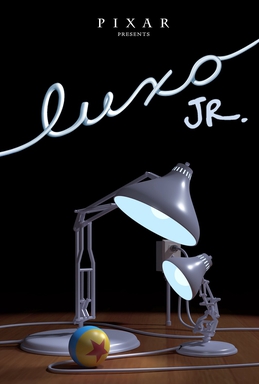
Directed by John Lasseter, Luxo, Jr. centers on a large desk lamp (Luxo Sr.), who sits beside a small yellow ball with a blue stripe and a red star (another future Pixar icon). A smaller lamp, Luxo Jr., bounces in and begins excitedly playing with the ball. Luxo Jr. enthusiastically bounces on top of the ball and causes it to deflate. Luxo Sr. seems relieved that the smaller lamp will now settle down. However, Jr. bounds back in with a second, larger ball, and the older Luxo seems exasperated as the short concludes.
The first film Pixar made as an independent company after it spun off from Lucasfilm’s Computer Division and became its own company, Lasseter was inspired to make Luxo, Jr. after observing a desk lamp and moving it around. He then experimented with computer models of a lamp (the “Luxo” brand in particular). Lasseter had experience in bringing inanimate objects to life, as his award-winning student film, Lady and the Lamp, made in 1979, centered on lamps coming to life in a shop when the owner isn’t around.
Thanks to Eben Ostby, a pioneering computer graphics software developer, Luxo Jr. also became the first film to use procedural animation, where the animation is generated in real time by code rather than being pre-drawn. Even with this technological leap, it still took great effort to bring Luxo Jr. to the screen, with Lasseter working long hours and sometimes sleeping under his desk to finish the short.
 Luxo, Jr. premiered at the annual conference of SIGGRAPH (Special Interest Group on Computer Graphics and Interactive Techniques) in August 1986. There, the short drew a standing ovation before it had even finished.
The short was a technical breakthrough, particularly in its use of shadow and light, as well as in giving the lamps a sense of real physical presence and weight. Told in pantomime, Luxo, Jr. is a wonderful example of an animator getting personality from inanimate objects, showing the power of character that would become a hallmark of all of Pixar’s films.
Reportedly, after the short’s debut screening, computer scientist Jim Blinn approached Lasseter and, instead of asking about a complex technical issue, asked whether the big lamp was the mother or the father.
Luxo, Jr. then became the first computer-generated film ever nominated for an Oscar, and opened the floodgates for more Pixar short subjects, including Red’s Dream (1987), Tin Toy (1988), the first computer-animated short to win an Oscar, and Knick Knack (1989).
And, of course, partnering with Disney, Pixar then branched out into full-length features in 1995 with Toy Story. This landmark film changed the industry, still inspires sequels, and was followed by a successive string of blockbusters, including A Bug’s Life (1998), Monsters, Inc. (2001), Finding Nemo (2003), The Incredibles (2004), and many more.
Now, as Luxo, Jr. and Pixar celebrate 40 years, many look back at the Studio’s impressive canon of films, and it’s easy to dub Toy Story as the “Snow White of computer animation.” If that’s the case, then Luxo, Jr. is “Pixar’s Steamboat Willie,” and for this now-major Studio, a little lamp lit the way.