It would be easy to judge the latest Qantas Business suites purely by their specifications. Sliding privacy doors, direct aisle access, large entertainment screens and fully flat beds are all important, but increasingly expected ingredients in a contemporary premium cabin.

What makes these new interiors more interesting is not necessarily the architecture of the seats themselves. It is the world Qantas is beginning to construct around them.
Across its future aircraft and lounges, the airline is developing a remarkably confident design language built around natural colour, tactile finishes and softened geometric forms. The references to Australia are clear, but never laboured. There are no literal images of coastlines, forests or deserts. Instead, the continent appears through earthen reds, warm neutral surfaces, mineral tones, gently curved structures and materials that invite touch.

It is a subtle form of national identity, and arguably one of the most successful uses of biophilic design currently emerging in aviation.
Familiar products, elevated through design
The headline product is the new Business Suite for a specially configured subfleet of Airbus A321XLRs, due to begin arriving in 2028. It will bring a fully flat bed to a Qantas single-aisle aircraft for the first time.

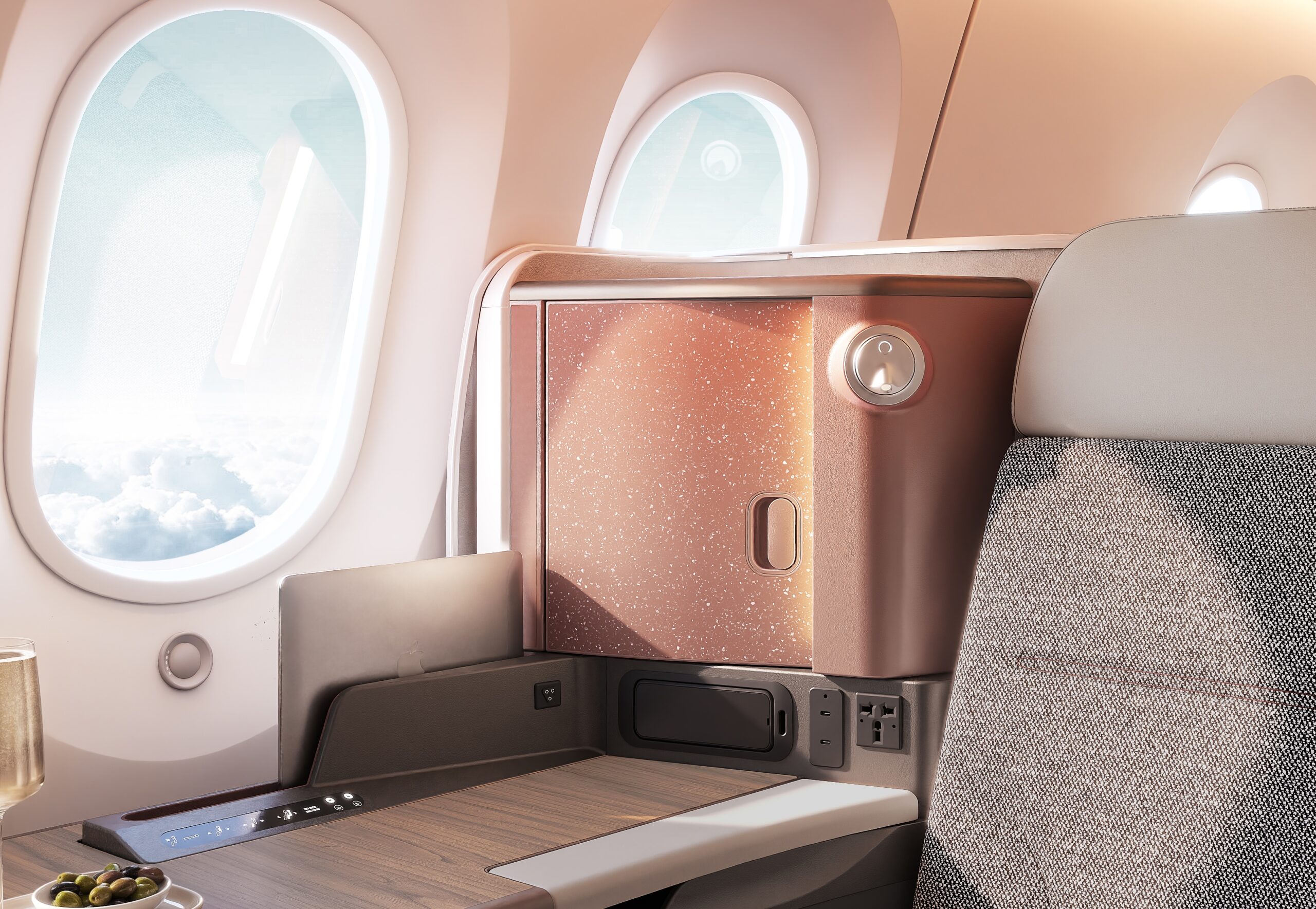
The suites are arranged in a 1-1 angled herringbone configuration, orientated towards the aisle and using the available width of the narrowbody cabin intelligently. Each passenger receives direct aisle access, a sliding privacy door, a 19-inch entertainment screen, wireless and USB-C charging, fast and free Wi-Fi, and storage designed to keep laptops and personal items close at hand.

These aircraft will be used on longer transcontinental services, including routes to and from Perth, as well as short and medium-haul international flying. Qantas says the A321XLR has a range of up to 8,700 kilometres, more than 3,000 kilometres beyond the Boeing 737 it is progressively replacing. Sixteen of the airline’s future A321XLRs will receive the new suites from 2028.
The layout itself will be familiar to anyone following the development of premium narrowbody cabins. Angled herringbone seating has become an effective answer to the difficult question of fitting direct aisle access and fully flat beds inside a single-aisle fuselage. The Qantas interpretation does not rewrite that formula, but it gives it a far more considered visual identity.

Its enclosing forms feel substantial without appearing defensive. Hard architectural lines are softened by rounded edges, warm surfaces and layers of upholstery. Privacy is created without turning each suite into an anonymous grey cubicle.
The airline has also unveiled an evolved Business Suite for the additional Boeing 787-9s it has on order. Each aircraft will feature 42 suites, retaining the forward-facing staggered layout of the current product but adding a sliding door, an 80-inch fully flat bed, a wider footwell developed through ergonomic trials, restyled storage and a larger 19-inch entertainment screen.

Once again, the underlying product is evolutionary rather than revolutionary. Yet the treatment around it makes the difference. A rich storage surface takes inspiration from the red earth of Western Australia’s Pilbara region, bringing the same warmth and material depth seen across the wider Qantas design portfolio. The first of these new Dreamliners is expected during FY28.
Bringing the landscape inside
Biophilic design is often misunderstood as little more than placing plants inside buildings. At its most effective, it is about creating an instinctive connection with nature through colour, light, texture, pattern and form.
Those principles are particularly valuable inside an aircraft, an environment defined by synthetic materials, regulation and hard engineering. Real timber, stone and natural fibres cannot always be used in the way they would be inside a home or hotel, but their visual and tactile qualities can still be referenced.

Qantas does this with considerable restraint. Rather than reproducing the Australian landscape literally, it abstracts it.
The palette suggests sun-warmed earth, rock, sand and native vegetation. Matte surfaces sit beside richer areas of colour. Woven textiles, grain, stitching and carefully layered materials provide relief from the technical precision of the seat structure. Even the geometry feels nature-led, with curved privacy panels and gently sculpted surfaces tempering the inherently mechanical architecture of the cabin.

Texture is especially important here. In many contemporary cabins, colour does most of the visual work while the surfaces themselves remain flat and repetitive. Qantas appears to understand that perceived quality also comes from how materials catch the light, how they feel beneath the hand and how different finishes meet one another. These layers make the interiors feel composed rather than decorated.
They also connect the aircraft to the airline’s evolving lounges. The recently redesigned Auckland International Lounge brings the outside in through living green walls, travertine, terrazzo, wool, leather and bespoke furniture, while retaining the curved forms and crafted detailing that now identify Qantas spaces globally. Its forthcoming Sydney International Business Lounge takes its inspiration from a journey between the Blue Mountains and Bondi.

Similar cues can be found within the Project Sunrise A350-1000ULR. Its sculpted Wellbeing Zone, Pilbara Red wool upholstery, tailored lighting and quietly residential premium suites all belong to the same family. Seating, lighting, dining and wellbeing have been considered as parts of one environment rather than as separate product features.
This is where Qantas moves beyond the familiar aviation trend of “residentialisation”. Airlines have spent much of the past decade attempting to make cabins and lounges feel like homes, often by adding table lamps, bookshelves, sofas and domestic-looking fabrics. The result can be pleasant, but also strangely generic.

Qantas is doing something more sophisticated. These spaces do not simply imitate a home. They present an aspirational interpretation of one, almost like a beautifully curated showroom that feels both desirable and strangely familiar. Crucially, that imagined home could only be Australian and this is where Qantas has a clear right to win.
Comfort beyond the A380
This consistency will become increasingly important as Qantas begins to retire its Airbus A380 fleet from 2028. The airline has now confirmed that the superjumbo will be gradually phased out as its next generation international fleet expands.

For all its operational complexity, the A380 remains an aircraft passengers associate instinctively with comfort. Its scale, quietness and double-deck architecture create a physical and psychological sense of occasion before the seat itself is even considered. For many airlines, it has also served as a halo product, lending prestige to the wider brand even when most passengers rarely travel on one.
Replacing that emotional value is harder than replacing its capacity. An A321XLR will never offer the same innate spaciousness as an A380. Nor can warmer colours and better textures compensate entirely for fuselage width, cabin acoustics or personal space. The physical realities of each aircraft will always matter.

Design can, however, influence how comfortable an environment feels. Enveloping forms create security. Natural tones reduce visual noise. Familiar textures soften the machinery around us. Consistency also builds reassurance: when the same colours, curves and material cues appear in a lounge, an A321XLR suite, a Dreamliner and an A350, passengers begin to recognise the environment before consciously processing it.
That recognition has value. It can make a diverse fleet feel less fragmented and allow the airline’s identity to carry more of the emotional weight previously concentrated in one iconic aircraft.
The challenge will be execution. Rendered surfaces can appear richer than production materials, while texture can quickly disappear beneath harsh cabin lighting, cleaning requirements and everyday wear. Qantas will need to ensure that the subtlety visible in these images survives certification and service. If the finishes become too flat, or the palette is reduced to a collection of safe browns and beiges, much of the intended character could be lost.
Yet the direction is compelling. Qantas has not attempted to reinvent Business Class through an unfamiliar seat mechanism or a headline-grabbing gimmick. Instead, it is creating distinction through atmosphere, materiality and continuity.
As the A380 slowly leaves the fleet, that may prove more valuable than producing another singular hero aircraft. Through the A350, 787, A321XLR and a new generation of lounges, Qantas has the opportunity to distribute its halo across the entire passenger experience. The result may not be one halo aircraft, but something much harder to achieve: a halo airline.
As I do every year, I ask on your kind support to keep things going. If you are able to donate – whatever amount – it all gets funnelled back in to the site, to keep the site full of content. And I thank you personally for your kind support.
Related
Discover more from TheDesignAir
Subscribe to get the latest posts sent to your email.