Moonshot’s Kimi K3 Lands With a 2.5-Trillion-Parameter Pitch to Rival Opus 4.8

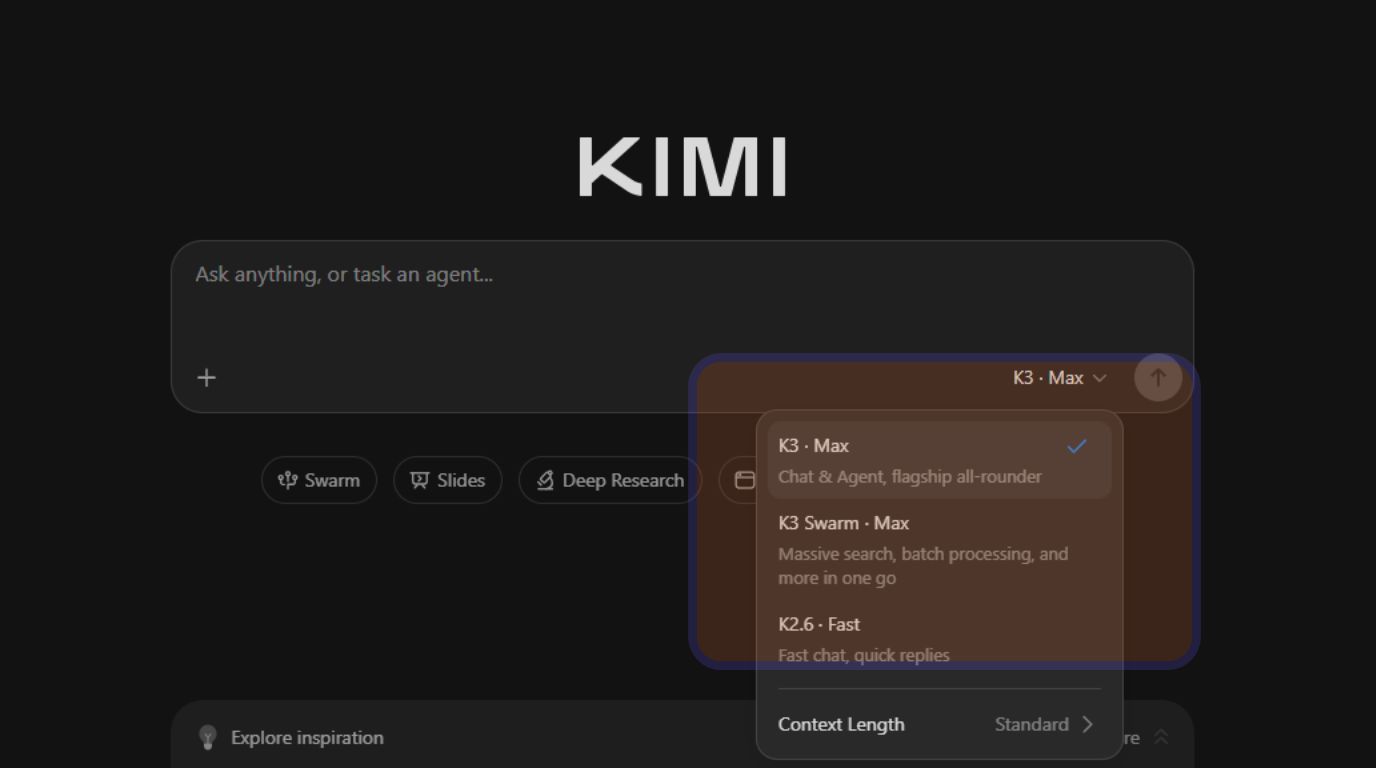
Moonshot AI released Kimi K3 on July 16, and the pitch is direct: a model built to close the distance with Anthropic’s Opus 4.8, and possibly cross it. TechCrunch reported that the Financial Times, citing anonymous sources, described K3 as the largest open-weight model to come out of China, with a parameter count somewhere between 2 trillion and 3 trillion.
That scale claim matters less on its own than what it represents: the ninth time in roughly a year that a Kimi release has reset the bar for open-source model size, starting from the original Kimi K2’s 1 trillion parameters through the K2.5, K2.6, and K2.7 Code updates that followed. Where those releases nibbled at the gap between open and closed models one point at a time, K3 looks like Moonshot deciding to jump instead of inch.
2–3T
Reported total parameters, per FT sourcing
1M
Token context window claimed at launch
$31.5B
Moonshot’s reported new funding valuation
What Moonshot is claiming
Beyond scale, Moonshot says K3 delivers frontier-level performance, and that among the models it tested internally, K3’s overall intelligence trails only Claude Fable 5 and GPT-5.6 Sol. Early testers cited across several outlets place its output somewhere between GPT-5.6 and Fable 5 in practice, and describe K3 beating Opus 4.8 and GPT-5.5 on select coding benchmarks. The model reportedly uses a Mixture-of-Experts architecture and Moonshot’s own long-context technique to support a 1-million-token window, more than triple the 256K context of the prior K2.6 release.
None of that is independently verified. As of publication, Moonshot has not published an official model card, a benchmark table, licensing terms, or per-token pricing for K3. The 2.5-trillion-parameter figure that recurs across most coverage traces back to an April 2026 report out of China and has been repeated in leak after leak since, without a primary Moonshot source confirming it directly.
For a Mixture-of-Experts model, total parameter count is a capacity and storage signal — not a quality certificate. The number that actually determines cost and latency is active parameters per token, and Moonshot hasn’t published that figure either.
Kimi K2’s track record set up this moment
K3 doesn’t arrive from nowhere. Moonshot’s Kimi K2 family has performed well in the open-source market since its mid-2025 debut, ranking high on public benchmarks and staying closer to frontier closed models than most open-weight competitors managed. That track record is precisely why K3’s claims are being taken seriously rather than dismissed as marketing: Moonshot has iterated fast, shipping K2, K2.5, K2.6, and K2.7 Code inside about a year, each one closing a bit more of the distance to paid, closed-source labs like OpenAI and Anthropic.
The money behind the model
Moonshot is also reportedly raising a fresh funding round that would value the company at $31.5 billion — a sharp jump from the $20 billion valuation it reached in May, when it raised $2 billion. A model release timed alongside a valuation jump is a familiar sequence in this market: proof points for investors tend to arrive right before the round closes, which is one more reason to treat unverified specs as marketing collateral until Moonshot publishes primary documentation.
Why this lands during an open-vs-closed reckoning
K3’s launch also lands squarely inside a live argument about whether it’s worth paying for closed models at all. Microsoft CEO Satya Nadella recently warned enterprises that using proprietary AI systems means paying twice: once in subscription fees, and again by handing model providers the corrections and workflows that encode a company’s institutional knowledge. Palantir CEO Alex Karp has raised similar concerns about how AI is sold, and Solo.io CEO Idit Levine has told reporters that enterprise clients increasingly ask whether an open-source model, run on their own infrastructure, can do roughly 90% of what a closed frontier model does for a fraction of the cost.
Every open-weight release that narrows the performance gap gives that argument more weight. Whether or not K3 actually matches Opus 4.8 once independent benchmarks arrive, the fact that a credible challenger exists — one enterprises can inspect, fine-tune, and run on-premises — is the more consequential story for buyers deciding where to spend their AI budget next quarter.
Still Unconfirmed
- Exact total and active parameter counts (Moonshot has not published an official model card)
- Independent, third-party benchmark results on standard evaluations
- Final license terms and whether open weights will be released, as with K2
- Official per-token API pricing
- Whether the full 1-million-token context ships across chat, API, and coding tools alike
The Timespek take
Treat Kimi K3 as a credible open-weight contender, not a confirmed win over Opus 4.8. Moonshot’s iteration speed and Kimi K2’s benchmark history make the claims plausible — this is not a lab making noise from nowhere. But “largest open model from China” and “beats Opus 4.8 on coding benchmarks” are two different claims resting on two different levels of evidence, and only one of them currently has a primary source behind it. Until Moonshot ships a model card and independent testers publish scores, the honest read is: watch closely, don’t take the parameter count as the headline.
Frequently Asked Questions
What is Kimi K3?
Kimi K3 is the newest large language model from Chinese AI lab Moonshot AI, launched July 16, 2026. It follows the Kimi K2 family and reportedly uses a Mixture-of-Experts architecture with a total parameter count between roughly 2 trillion and 3 trillion, plus a context window claimed to reach 1 million tokens.
Is Kimi K3 better than Claude Opus 4.8?
Moonshot claims frontier-level performance and says K3 beats Opus 4.8 on some coding benchmarks, and the Financial Times reported it could match or surpass Opus 4.8 overall. No independent, third-party benchmark testing has confirmed this as of publication, so it remains an unverified claim rather than a settled result.
How many parameters does Kimi K3 have?
Reported figures range from roughly 2 trillion to 2.8 trillion total parameters in a Mixture-of-Experts design, depending on the source. Moonshot has not published an official model card confirming the exact total or active parameter count, so treat the number as a leak-derived estimate.
Is Kimi K3 open source?
Moonshot has not confirmed a license for K3. Its predecessor, Kimi K2, shipped under a modified MIT license with open weights, and the industry expects K3 to follow the same pattern — but that is not yet officially announced.
Why does this matter for companies using Anthropic or OpenAI?
The release lands amid a live enterprise debate about closed AI models. Microsoft CEO Satya Nadella and others have warned that using proprietary models means handing providers data that could be used to compete with their own customers. Every open-weight model that closes the performance gap, like Kimi K3, strengthens the case for running AI on-premises instead of paying for closed access.